All posts by Wintery Knight

https://winteryknight.com/

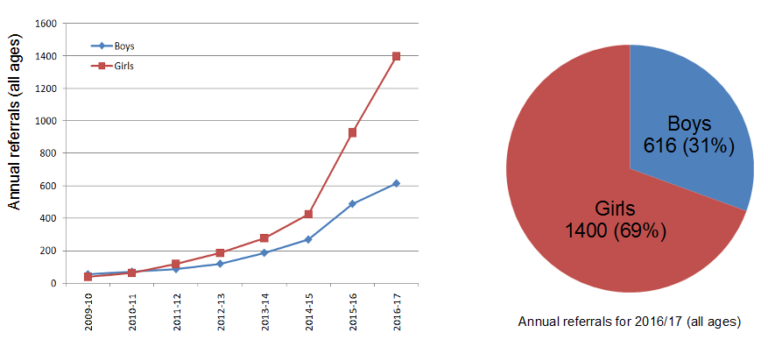
Controversial study on Rapid Onset Gender Dysphoria and transgenderism re-published

What's the best explanation of this data? Genetics or cultural pressure?
What’s the best explanation of this transgenderism data? Genetics or cultural pressure?

I blogged before about a study out of Brown University, which concluded that transgender behavior in children developed rapidly as a result of factors like peer pressures, social media, mental disorders, trauma, etc. I.e. – it’s not genetic. Brown University retracted it because some people complained. Well, it’s now been republished. Let’s see if there were any mistakes found.

Here’s how the study was first reported by Science Daily:

This month, a Brown University researcher published the first study to empirically describe teens and young adults who did not have symptoms of gender dysphoria during childhood but who were observed by their parents to rapidly develop gender dysphoria symptoms over days, weeks or months during or after puberty.

[…]The study was published on Aug. 16 in PLOS ONE.

Peer pressure / The Internet:

The pattern of clusters of teens in friend groups becoming transgender-identified, the group dynamics of these friend groups and the types of advice viewed online led her to the hypothesis that friends and online sources could spread certain beliefs.

[….]”Of the parents who provided information about their child’s friendship group, about a third responded that more than half of the kids in the friendship group became transgender-identified,” Littman said. “A group with 50 percent of its members becoming transgender-identified represents a rate that is more 70 times the expected prevalence for young adults.”

Mental disorders / traumatic events:

Additionally, 62 percent of parents reported their teen or young adult had one or more diagnoses of a psychiatric disorder or neurodevelopmental disability before the onset of gender dysphoria. Forty-eight percent reported that their child had experienced a traumatic or stressful event prior to the onset of their gender dysphoria, including being bullied, sexually assaulted or having their parents get divorced.

This article at The Federalist had a few examples to illustrate the conclusion of the study. I’ll pick two.

The study includes other eye-opening information, such as case studies of several children’s stories.

  • “A 14-year-old natal female and three of her natal female friends were taking group lessons together with a very popular coach. The coach came out as transgender, and, within one year, all four students announced they were also transgender.”

  • “A 14-year-old natal female and three of her natal female friends are part of a larger friend group that spends much of their time talking about gender and sexuality. The three natal female friends all announced they were trans boys and chose similar masculine names. After spending time with these three friends, the 14-year-old natal female announced that she was also a trans boy.”

I thought this quote from that article was interesting as well, given the culture’s obsession with “bullying”, which is a nebulous term that can mean actual bullying, or mere disagreement.

The study also may indicate that school “anti-bullying” programs typically created by LGBT activist organizations such as the Human Rights Campaign may help accelerate children identifying as transgender by pushing peers and authority figures to profusely express their support.

Coming out as transgender means instant fame and popularity, because you’re a victim, and everyone has to be nice to you… or else:

“Great increase in popularity among the student body at large. Being trans is a gold star in the eyes of other teens,” wrote one parent on the study response form. Another wrote, “not so much ‘popularity’ increasing as ‘status’ … also she became untouchable in terms of bullying in school as teachers who ignored homophobic bullying …are now all at pains to be hot on the heels of any trans bullying.”

Well, we’ve had a delay of 6 months for Littman to answer her critics and submit her work to even more extensive peer-review. And now the study has been re-published in PLOS One. So were there any mistakes in it? Does it still reach the same conclusions?

The College Fix reports:

Here’s what actually changed, according to PLOS One:

Other than the addition of a few missing values in Table 13, the Results section is unchanged in the updated version of the article.

So, the results didn’t change, and that means that the conclusions stand. So what was the problem originally? The problem originally was that the research didn’t confirm the biased politically correct views of the secular leftists.

She lost her consulting job anyway

However, that’s not the whole story. I looked up her interview from this week on Quillette, and she got to tell her side of the story.

Two parts stood out to me.

This part, where she contrasted the favoral response of research scientists and clinical scientists with the angry outbursts of a social worker:

The third presentation was the smallest and least research-oriented audience of the three. In contrast to the other presentations, the vast majority of the comments were made by one person who I later learned was a social worker. Again, I tried to answer politely with comments such as “Actually, the scientific literature says the following…”; “Actually, social media can be both a positive and a negative influence, not just positive…”; “Actually, this method of data collection has been used in many studies…” But because her interruptions were so frequent and argumentative in nature, it quickly created a tense and adversarial tone in the room.

This part, where she explains the mob that contacted her employers and got her fired:

The worst outcome for me personally was losing my consulting job over this issue. Shortly after my paper came out, some local clinicians who are opposed to my research wrote a letter of complaint about the work and demanded that I be fired immediately. It was an interesting demand, as my consulting work was unrelated to gender dysphoria. Nonetheless, I was called in to several meetings to answer questions about my research… After the meetings, the leadership explained to me that their decision not to renew my contract was not related to the quality of my work but rather that they, as an agency, needed to remain neutral and not take sides regarding the issues raised in the letter.

Do you know what this whole episode reminded me of? It reminded me of the stories of scientists who publish work critical of Darwinian evolution, and work critical of the man-made catastophic global warming hypothesis. It seems as if the viewpoints of secular leftists are decide by emotions, and then defended with rage, coercion and harassment. What does it say about secular leftism that they respond to scientific progress with rage and censorship?

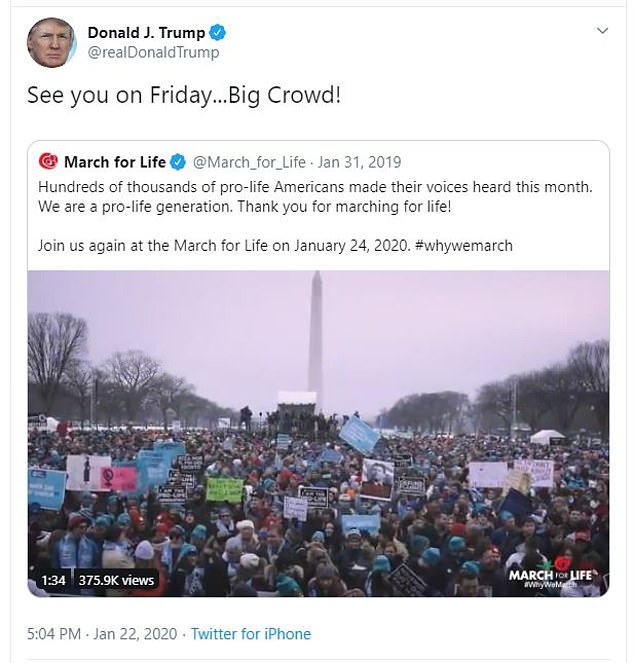
Donald Trump is the first sitting US President to address March for Life

Barack Obama speaking to Planned Parenthood

I am old enough to remember when Americans voted for a pro-abortion president for two terms. He voted for infanticide twice, as a state senator in Illinois. He subsidized abortion with taxpayer money. He forced Christian organizations to cover abortions. He forced Christian doctors and nurses to perform and assist in abortions. And he appointed pro-abortion judges.

Obama would never have address pro-lifers at March for Life. But Trump is planning to do just that today! He is the first sitting present to actually join pro-lifers and take part in the events in person.

Donald Trump to speak at March for Life 2020

There was a good interview between two pro-lifers discussing how Trump has done on the pro-life issue.

Here is what one of them said:

Stanek answered that she admired Bush for signing the Born-Alive Infants Protection Act and Partial-Birth Abortion Ban Act into law, but what set Trump apart was that “he is just so proactive.”

“I think saying that Trump is the most pro-life president we’ve ever had isn’t to slight other presidents like President Bush and President Reagan,” she explained. “It’s to say that he is fitting the mold that we’ve always hoped for of being verbal, vocal about it,” from calling out Hillary Clinton for believing “in the ninth month you can take the baby and rip the baby out of the womb,” to his use of blunt language like “execute the baby” to discuss infanticide.

“President Trump is going gangbusters, is hiring people in the administration who are like-minded on abortion,” Stanek said. “They set the policy…he has issued executive orders and administrative orders…just about everything we’ve ever asked him to do, he’s done.”

I found some statements of Trump’s pro-life achievements but the best one by far was from Susan B. Anthony List:

Appointed Pro-Life Judges

In April, 2017, Judge Neil Gorsuch was successfully confirmed to the U.S. Supreme Court. And in October, 2018, Judge Brett Kavanaugh was successfully confirmed to the U.S. Supreme Court. To date, 157 of President Trump’s judicial nominees have been confirmed, including two Supreme Court justices, forty-three U.S. Courts of Appeals judges, and one hundred thirteen District Court judges.

Permitted States to Defund Planned Parenthood of Title X Funds

In April 2017, Congress sent a bill to President Trump’s desk that permits states to defund Planned Parenthood of Title X family planning funds passed in Congress. President Trump signed the bill which reverses an Obama-era rule that disbarred states from doing so. Because this was passed using the Congressional Review Act, future Administrations cannot enact a similar rule to Obama’s.

Stopped Tax Dollars Funding Abortion Overseas

President Trump not only reinstated the Mexico City Policy, but expanded it to the new Protecting Life in Global Health Assistance program. This new policy ensures that our tax dollars are protected from funding the abortion industry overseas across ALL global health spending, not just family planning dollars. The Bush-era Mexico City Policy protected roughly $500 million in spending – the new Trump policy protects over $8.8 billion overseas aid from funding abortion.

Defunded the Pro-Abortion UNFPA

The UNFPA has long been complicit in China’s oppressive population control activities, including birth limitation policies and forced abortions. President Trump’s State Department cut U.S. Taxpayer funding to the UNFPA.

Required Health Insurance Companies to Disclose if Plans Cover Abortion

The Trump Administration Department of Health & Human Services (HHS) issued a rule requiring that insurers specify in each plan Summary of Benefits whether the plan covers abortion.

Settlements & New Rule Regarding HHS Mandate

The Departments of HHS, Treasury, and Labor issued two interim final rules, which means they took effect immediately, while allowing a comment period, that provide permanent, enforceable relief from the previous HHS mandate for both religious objectors, such as Little Sisters of the Poor, and moral objectors, such as Susan B. Anthony List. The new rule also exempts private employers and educational institutions that have sincerely held religious beliefs or moral objections against providing contraceptives or abortifacient drugs.

New Office for Conscience Protection at HHS

In May 2019, the Trump administration finalized new regulations to strengthen enforcement of federal laws protecting the conscience rights of health care workers who do not want to participate in abortion. The regulations clarify what recourse is available to victims of discrimination under the law and what penalties the HHS Office of Civil Rights may enforce for violations. Additionally, in January 2018, the Department of Health & Human Services announced the creation of the Conscience and Religious Freedom Division within the Office for Civil Rights. This new office works to protect health care professionals who do not want to participate in abortion. In May, 2019, HHS issued a proposed rule amending Obama-era regulations, clarifying that Section 1557 shall not force a recipient of federal funding to provide or pay for an abortion. It shall also be consistent with the First Amendment and with pro-life provisions, conscience provisions and religious liberty protections in current law.

Allowed States to Defund Planned Parenthood of Medicaid Funds

The Obama administration attempted to prevent states from defunding Planned Parenthood of Medicaid dollars, issuing guidance claiming this may be a violation of federal law. In January 2018, the Trump administration rescinded this guidance, allowing states to defund Planned Parenthood of Medicaid dollars as they see fit.

Cut Planned Parenthood’s Tax Funding by up to $60 Million

In February, 2019, the Trump administration finalized the Protect Life Rule to redirect Title X family planning program funds away from the abortion industry. The rule advances President Trump’s promise to stop taxpayer funding of abortion businesses like Planned Parenthood, who will no longer receive Title X funding if they choose not to comply.

Canceled Huge Contract for Taxpayer-Funded Experimentation with Body Parts of Aborted Babies

In June, 2019, the U.S. Department of Health and Human Services (HHS) and National Institutes of Health (NIH) announced they would not renew a major contract with the University of California, San Francisco (UCSF) to fund research using the body parts of aborted babies. (learn more)

My favorite was the conscience protections! I really hate the idea of being forced by secular leftists to violate my conscience.

I think it’s very important for pro-life voters of all parties to understand that Trump has taken action on pro-life concerns. He listened to pro-life leaders, and did far more than other Republican presidents who were pro-life in name only. Americans often have this annoying habit of forming their opinions based on what they feel and what they hear in the culture. But we need to be informed voters. Let’s look at the facts and decide based on actions.

Should Christian men expect a wife / mother candidate to know how to defend the Christian worldview?

Is the Christian worldview an accurate picture of the world?
Is the Christian worldview true? Can we know that it is true?

A while back, I was debating some Christian feminists about what men want from a wife and mother. At one point, I asserted that Christian women ought to have some knowledge of how to defend their faith using scientific and historical evidence. Some women asked me: “are you joking?” In this post,  I’ll explain why I’m serious, and then I’ll ask them some questions of my own.

Let’s start with Jesus. Jesus set an example by showing the importance of knowing how to answer questions and challenges from skeptics in the New Testament. His favorite way to answer a challenge was by using evidence to support his truth claims.

So, take this story that’s in Mark 2:1-12, Matthew 9:1-8 and Luke 5:17-26. This story is accepted even by skeptical historians because it’s in three different books, and one of them is early (Mark).

In each version of the story, there are 4 steps:

  1. Jesus forgives the sins of a paralyzed man
  2. The Pharisees say that he doesn’t have authority to forgive sins
  3. Jesus miraculously heals the paralyzed man
  4. Jesus explains the evidence of the healing supports his claim that he has authority to forgive sins

And this is an example that you will find repeated in many places in the life of Jesus. You can see it in the Old Testament as well, where God performs miracles so that people who don’t believe in his existence or respect the Scriptures can still be convinced.

Christian apologetics is the skill of being able to give a defense for the Christian worldview when presented with a challenge from a non-Christian.

So, who has to be ready with a defense?

Look at 1 Peter 3:15-16:

15 But in your hearts revere Christ as Lord. Always be prepared to give an answer to everyone who asks you to give the reason for the hope that you have. But do this with gentleness and respect,

16 keeping a clear conscience, so that those who speak maliciously against your good behavior in Christ may be ashamed of their slander.

This passage applies to every one who claims to be a disciple of Jesus, whether they like to prepare a defense or not. How much work must you put into it? It depends on the sophistication of the challenges you get. In the mountains of Pakistan, you don’t need to know much because there might not be a sophisticated challenge. In an American society filled with college graduates, the challenges are more difficult. So you will need to prepare a lot more, because the challenges will be a lot harder.

Those who take this passage seriously are doing something difficult, and time-consuming, in order to serve Christ. Buying books costs money. Reading books takes time. Debating with non-Christians can make you look bad to others. But the Bible commands us to be ready with answers for the people around us. Sometimes, doing what the Bible says makes us feel bad, or look bad to others. But we have do what the Bible says anyway. Part of being a real Christian is being obedient even if it feels bad or makes you look bad.

William Lane Craig on apologetics and the culture

What’s in an apologetics book?

So, with that said, let’s look at the table of contents of my favorite introduction to Christian apologetics, which is “Is God Just a Human Invention?” written by Sean McDowell and Jonathan Morrow.

In that book, you will find 18 topics.

  1. Is Faith Irrational? (Commentary by: Gregory Koukl)
  2. Are Science and Christianity at Odds? (Commentary by: John Warwick Montgomery)
  3. Are Miracles Possible? (Commentary by: Gary R. Habermas)
  4. Is Darwinian Evolution the Only Game in Town? (Commentary by: William A. Dembski)
  5. How Did the Universe Begin? (Commentary by: R. Douglas Geivett)
  6. How Did Life Begin? (Commentary by: Fazale R. Rana)
  7. Why Is the Universe Just Right for Life? (Commentary by: Jay W. Richards)
  8. Has Science Shown There Is No Soul? (Commentary by: Dale Fincher and Jonalyn Fincher)
  9. Is God Just a Human Invention? (Commentary by: Garry DeWeese)
  10. Is Religion Dangerous? (Commentary by: Douglas Groothuis)
  11. Does God Intend for Us to Keep Slaves? (Commentary by: Paul Copan)
  12. Is Hell a Divine Torture Chamber? (Commentary by: Frank Turek)
  13. Is God a Genocidal Bully? (Commentary by: Clay Jones)
  14. Is Christianity the Cause of Dangerous Sexual Repression? (Commentary by: Kerby Anderson)
  15. Can People Be Good Without God? (Commentary by: Mark D. Linville)
  16. Is Evil Only a Problem for Christians? (Commentary by: Randy Alcorn)
  17. What Good Is Christianity? (Commentary by: Glenn S. Sunshine)
  18. Why Jesus Instead of the Flying Spaghetti Monster? (Commentary by: Darrell L. Bock)

Prominent atheist scholars are quoted in each chapter to introduce the challenges, and then scholarly arguments and evidence are presented to defend the Christian worldview. The language is simple enough, but the material is solid enough to use in a real debate. I would say that introductory books like this one are more than enough to equip you for everyone who will challenge you.

Why are these 18 topics important? Because these are the questions that atheists ask. These are the questions that cause Christians to leave the faith. These are the questions that your children will face in high school and college, which might cause them to leave the faith.

Let’s start with chapter one. One of the most prominent arguments by atheists is that faith is irrational. This chapter allows you to define faith using the Bible’s definition of faith, which relies on logic and evidence.

Atheists also say that Christianity is at war with science. In chapter 2, they discuss the history of science and how Christianity provided the framework that allowed scientific method to take root and flourish.

Atheists like to claim that miracles are impossible. Chapter 3 defends the view that God, if he exists, is capable of interacting with his created world.

Atheists love to put forward Darwinism as means to deny that God is the designer of life. Chapter 4 explains the concept of intelligent design, and why intelligent design is a better explanation for the history of life.

Atheists love to talk about how the universe has always existed, and there’s no need for a Creator. Chapter 5 contains a philosophical argument that is supported by mainstream science to argue that the universe had a beginning, just like the Bible says.

Atheists love to argue that life can emerge from non-life, and the process is simple. Chapter 6 is written by a biochemist, and it takes a look at the real complexity of the simplest living cell.

Atheists like to argue that the universe itself is just an accident, and there is no need for a Designer. Chapter 7 introduces the scientific evidence for fine-tuning and habitability.

Atheists like to say that there is no soul and no afterlife. Chapter 8 gives some arguments for the existence of the soul.

Atheists like to argue that Christians invent God because God makes them feel good. But chapter 9 explains that having an all-powerful God who can hold humans accountable is the last thing any human would want to invent.

Atheists like to talk about how religion, with it’s habit of teaching to believe in things that can’t be tested, causes religious people to do a lot of harm. Chapter 10 takes a look at the real record of Christianity as a force for good in the world.

Atheists like to talk about slavery in the Bible. Chapter 11 talks about what the Bible really says, and provides some rational responses to the accusation.

Atheists like to talk about eternal punishment in Hell isn’t a just punishment for just getting a few questions wrong on a theology exam. Chapter 12 provides an explanation and defense of the concept of Hell.

Atheists love to talk about how God commanded the Israelites to attack their enemies in the Bible. Chapter 13 explains who their enemies really were, and what was really happening in those wars.

Atheists feel that unrestricted sexual activity is very healthy and normal, and that the Biblical prohibitions outside of male-female marriage are repressive and unhealthy.  Chapter 14 explains why God has these rules in place, and supports his rules with evidence.

Atheists love to assert that they don’t need God, because they can behave morally on their own. Chapter 15 explains how to answer this claim by talking about how well atheism grounds objective moral values, objective moral duties, free will and moral accountability: the minimum requirements for objective morality.

Atheists think that the mere existence of natural disasters and human immorality are incompatible with the God of the Bible. Chapter 16 explains why this argument doesn’t work, and why even the concept of evil requires God to exist.

I had an atheist co-worker who couldn’t really defeat the scientific arguments for God’s existence, but he would say that even if God exists, why would that matter to my life? Chapter 17 explains what difference Christianity makes in a person’s life.

Atheists think that the life of Jesus has no relevance to their life, and that he has nothing to offer them anyway. Chapter 18 explains the uniqueness of Jesus and explains why his resurrection is relevant to our lives today.

I guess that many people think that reading a Christian book means reading Christian fiction or Christian devotions – things that are entertaining or produce feelings. But fiction and devotions do not equip you to answer realistic questions from non-Christians.

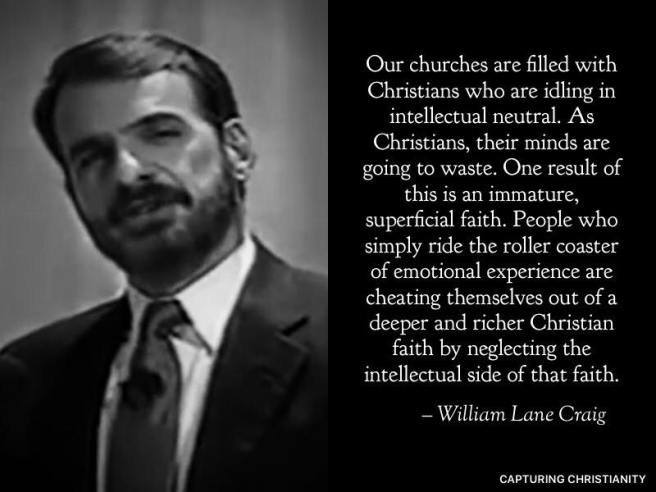
Dr. William Lane Craig says churches aren't preparing Christians to give an answer
Dr. W. L. Craig: churches don’t prepare Christians to answer skeptics

Wife candidates ought to know apologetics

So, back to my original point about how some Christian feminists responded when I said that during courtship, I ask women questions about how much preparation they have done to answer objections from atheists, like the ones answered in this book. Am I joking?

Well, I think the problem is that Christian feminists don’t understand how Christian men view marriage. Christian men are interested in marriage because they think that their marriage will be an enterprise that produces a return for God. They like the idea of having a clean, comfortable home to host debate viewings and discussions over dessert with skeptics. They like the idea of raising children who will be effective and influential. Men don’t see marriage a means of making us feel better, or having fun, or getting our peers to approve of us. We see it as a way to promote Jesus’ agenda in the world. Men are looking for a woman who think that Christianity is true, so that they will have a wife who will act like a Christian when it goes against her self-interest. Men want a wife who knows how to persuade others that Christianity is true – first the children, then others.