Tag Archives: Women

Why are so many educated, successful women struggling to find a husband?

Do young women understand how to get to a stable marriage?

The New York Times says that more and more women are having to freeze their eggs because they can’t find good men to marry. The NYT doesn’t think that women are doing anything wrong. They blame the men for refusing to commit. According to feminism, women who value careers, abortion rights, no-fault divorce, big government, high taxes, etc. are doing everything right. But does it work?

I thought it might be a good idea to help Western women to make better decisions with men and marriage. Although setting out boundaries seems harsh and restrictive, it’s actually protective and loving. If we want women to get to a stable marriage and children, (what they really need long term, after they lose their looks and youth), then we should be bold about leading them.

The first thing to point out is that the women celebrated by the New  York Times are intentionally delaying marriage for their education and careers.

Another New York Times article explains:

It could be that the new generation of millennial women is delaying having children even longer than the women who came before them, as prime childbearing years are also critical years for advancing in a career. A recent study shows that the marital pay gap that springs up after a first child is born typically does not close if the birth happens between age 25 and 35.

Shannon Hettinger, a 32-year-old from Washington, D.C., said she definitely wanted children. She grew up in a large family in a small town in Pennsylvania and almost all her high school friends are married with children. But she moved to Washington, and spent her 20s deciding on a career. Now that she has one she loves — she works in residential real estate sales — she is not going to stop until she gets established. That means not having children for a while.

“I just want to build my book of business and see where I can go from here,” she said. “My whole focus is career growth. That’s my No. 1 priority.”

“Once I achieve a certain level of success,” she added, “then I’ll start thinking about a family.”

Ivy Gray-Klein, 26, who lives in Philadelphia and works at the University of Pennsylvania School of Design, said she was open to having children but cannot imagine doing so until she is 30 or 35. She wants to feel settled in her own life first. Now she has three roommates, is paying down her student loans and is working to build a little bit of savings.

“I’m just really trying to get myself to a place that is solid,” she said by phone. “Having a child right now would be so destabilizing. Children just seem like such an enormous financial undertaking.”

The thing about women wanting to pursue their careers in their 20s is that this is the time when they have the most attractiveness to a man as a wife and mother. The woman’s 20s are the perfect time for her to be searching through the men in her life, looking for the ones who are serious about marriage, while rejecting the ones who just want sex before marriage, cohabitation, and other irresponsible “fun”. Most women who are focusing on their careers will still be in relationships during their 20s, but since they can’t afford to be “encumbered” by marriage, they’ll be spending time with guys who don’t want to commit. This is NOT a good way for a woman to prepare her character for marriage. Flings and break-ups with bad boys do not cause a woman to be trusting with a good man later on.

However, are women ever really attracted to good men? Suppose a woman chased bad boys in her 20s, while focusing on her career, then got serious at 30 and started looking for marriage-read men. Would she really be attracted to those marriage-ready men, after all that time spent choosing the bad boys who would not commit?I think many marriage-ready men know that most women who are 30 or over have kept busy in relationships with bad boys. And they don’t want to be married to a woman who finds them unattractive. So the real problem with men not marrying women who are over 30 is the that many women are not trained to be attracted to good men in their 20s.

Here’s an LA Times editorial about women and domestic terrorist Dzhokar Tsarnaev, one of the Boston marathon bombers.

Excerpt:

Mostly, though, they think Dzhokhar is cute. The Bambi eyes (looking right out of his Instagram-doctored photos at you!), the hipster facial stubble, the masses of wine-dark tousled hair — adorable! Impassioned believers have written “Dzhokhar is innocent” on their hands and plastered “Innocent until proven guilty!!!!” posters around their towns. An 18-year-old waitress interviewed by the New York Post vowed to have Dzhokhar’s last tweet before the bombing tattooed onto her arm: “If you have the knowledge and the inspiration all that’s left is to take action.”

[…]But the real cause of the Jahar craze more likely lies in something more primal and less pretty in the female psyche. I’m betting that women, young and old, are drawn to Dzhokhar not because he is a good-looking late adolescent but because he is a good-looking accused killer. He’s a classic “bad boy” of the sort to whom women are chronically attracted because they want to reform them, or minister to their wounds, or be the healing presence they’ve never had — but mostly because they find them sexy.

That article also noted:

It’s not surprising, then, that every homicide perp on death row who is reasonably attractive has groupies. Consider the handsome (and widely philandering) Scott Peterson, sentenced in 2005 for killing his wife and unborn son and throwing their remains into San Francisco Bay. The day he checked into San Quentin, he received three dozen phone calls from smitten women, including an 18-year-old who wanted to become the second Mrs. Peterson.

Some of the tweets and other fangirl comments about Tsarnaev were collected in this New York Post article.

Lots of Western women from the UK, France, Russia, etc. all picked up and moved to the Middle East to become ISIS jihadi brides.

Excerpt:

Western women joining Islamic State are increasingly from comfortable backgrounds and often well educated with romantic notions of adventure often quickly dispelled by the harshness of life as a “Jihadi bride”, according to a British research report.

Some 550 women from Western countries have left their homelands to join Islamic State, which has captured swathes of Syria and Iraq, said the report by the Institute for Strategic Dialogue and the International Centre for the Study of Radicalisation at King’s College, London.

[…]It said female recruits were increasingly younger, some from comfortable backgrounds and often well-educated, and were playing “crucial” propaganda and recruitment roles.

That article is three years old, the numbers have more than doubled since then. The most common reasons cited for leaving are romance and adventure.

Psychology Today has some comments about why some women do this:

In her post, “Women Who Love Serial Killers,” PT blogger, Katherine Ramsland, offers some suggestions about why some women can be so attracted to, or hopelessly beguiled by, the most terrifying of human predators. At first, she provides explanations from the women themselves, women who actually married these dangerously unhinged criminals. Their reasons (somewhat elaborated here) include the assumptions that:

  • their love can transform the convict: from cunning and cruel, to caring, concerned, and compassionate.

  • there’s a wounded child nested somewhere inside the killer that can be healed through a devoted nurturance that only they can provide.

  • they might share the killer’s media spotlight, and so triumphantly emerge from their anonymity, and maybe in the process even land a book or movie deal (an aspiration about as cynical as it is narcissisticand self-serving).

And this is even more interesting:

To simplify this work’s findings for my present purpose, however, let me begin by emphasizing that Ogas and Gaddam find substantial evidence from Web searches, posts, and many 1,000s of romance novels that women demonstrate a strong erotic preference for dominant men. Or toward what’s now commonly referred to as alpha males—in the authors’ words, men who are “strong, confident, [and] swaggering [as in “cocky,” and the pun is intended].” Unfortunately, what these descriptors often imply is behavior sufficiently bearish, self-centered, and insensitive as to often cross the line into a physical, mental, and emotional abuse that can be downright brutal.

[…]Moreover, in responding to the question as to whether some men, such as “serial killers, violent offenders, and rapists,” might be too dominant for women to accept, Ogas and Gaddam note: “It turns out that killing people is an effective way to elicit the attention of many women: virtually every serial killer, including Ted Bundy, Charles Manson, and David Berkowitz, have received love letters from large numbers of female fans” (p. 98).

Women choose good-looking bad boys, because they think that they can change them:

The fantasy that seems to be operating in such devotees, and that constitutes the plot of virtually all erotic/romantic novels written with women in mind, is that the “misogyny and jerkdom” they might have to battle with in such super-dominant males is only temporary. That it doesn’t really represent the man’s innermost reality. That his violence and lack of tender feelings is only the beginning of the story, and that their unsparing love, affection, and dedication can ultimately transform his character by helping him get in touch with his, well, “inner goo.”

I don’t think it’s wrong for women to do STEM degrees, and even go to graduate school, and work a couple of years in the private sector. The problems occur when they want to have relationships during those years, but not with men who want to commit. The experiences they have with the hot bad boys in that time cause them to be disatisfied with marriage-minded men (self-control, frugality, provider ability, chastity, loyalty, mentoring, etc.) later on when they do want to marry. And marriage-minded men KNOW THAT. We aren’t going to be tricked into marriage to someone who finds the shallow characteristics of irresponsible bad boys more attractive than men who have demonstrated ability at the husband and father roles.
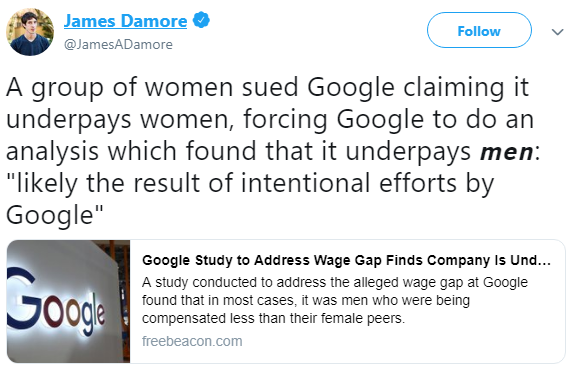

Wage gap: are women paid less than men because of discrimination?

Google pays men less than women
Far-left social media giant Google pays men less than women

Liberal feminist Hanna Rosin takes a look at this question in the far-left Slate, of all places.

Excerpt:

The official Bureau of Labor Department statistics show that the median earnings of full-time female workers is 77 percent of the median earnings of full-time male workers. But that is very different than “77 cents on the dollar for doing the same work as men.” The latter gives the impression that a man and a woman standing next to each other doing the same job for the same number of hours get paid different salaries. That’s not at all the case. “Full time” officially means 35 hours, but men work more hours than women. That’s the first problem: We could be comparing men working 40 hours to women working 35.

How to get a more accurate measure? First, instead of comparing annual wages, start by comparing average weekly wages. This is considered a slightly more accurate measure because it eliminates variables like time off during the year or annual bonuses (and yes, men get higher bonuses, but let’s shelve that for a moment in our quest for a pure wage gap number). By this measure, women earn 81 percent of what men earn, although it varies widely by race. African-American women, for example, earn 94 percent of what African-American men earn in a typical week. Then, when you restrict the comparison to men and women working 40 hours a week, the gap narrows to 87 percent.

But we’re still not close to measuring women “doing the same work as men.” For that, we’d have to adjust for many other factors that go into determining salary. Economists Francine Blau and Lawrence Kahn did that in a recent paper, “The Gender Pay Gap.”.”They first accounted for education and experience. That didn’t shift the gap very much, because women generally have at least as much and usually more education than men, and since the 1980s they have been gaining the experience. The fact that men are more likely to be in unions and have their salaries protected accounts for about 4 percent of the gap. The big differences are in occupation and industry. Women congregate in different professions than men do, and the largely male professions tend to be higher-paying. If you account for those differences, and then compare a woman and a man doing the same job, the pay gap narrows to 91 percent. So, you could accurately say in that Obama ad that, “women get paid 91 cents on the dollar for doing the same work as men.”

I believe that the remainder of the gap can be accounted for by looking at other voluntary factors that differentiate men and women.

The Heritage Foundation says that a recent study puts the number at 95 cents per dollar.

Excerpt:

Women are more likely than men to work in industries with more flexible schedules. Women are also more likely to spend time outside the labor force to care for children. These choices have benefits, but they also reduce pay—for both men and women. When economists control for such factors, they find the gender gap largely disappears.

A 2009 study commissioned by the Department of Labor found that after controlling for occupation, experience, and other choices, women earn 95 percent as much as men do. In 2005, June O’Neil, the former director of the Congressional Budget Office, found that “There is no gender gap in wages among men and women with similar family roles.” Different choices—not discrimination—account for different employment and wage outcomes.

A popular article by Carrie Lukas in the Wall Street Journal agrees.

Excerpt:

The Department of Labor’s Time Use survey shows that full-time working women spend an average of 8.01 hours per day on the job, compared to 8.75 hours for full-time working men. One would expect that someone who works 9% more would also earn more. This one fact alone accounts for more than a third of the wage gap.

[…]Recent studies have shown that the wage gap shrinks—or even reverses—when relevant factors are taken into account and comparisons are made between men and women in similar circumstances. In a 2010 study of single, childless urban workers between the ages of 22 and 30, the research firm Reach Advisors found that women earned an average of 8% more than their male counterparts. Given that women are outpacing men in educational attainment, and that our economy is increasingly geared toward knowledge-based jobs, it makes sense that women’s earnings are going up compared to men’s.

When women make different choices about education and labor that are more like what men choose, they earn just as much or more than men.

Are men allowed to have preferences about which women are best for marriage?

Telling a woman how to make wise decisions protects her

So, in my last post, I explained why men have to be careful about choosing a wife. Men have plans and they need a woman with the right skills to achieve it. Even if a woman genuinely repents her past, she may not have developed the skills for a godly man’s marriage plan. For example, her 50K of student loans makes it harder to afford a stay-at-home homeschooling mother.

But many Christian women feel that there is no such thing as a Christian woman who is a bad candidate for marriage. It doesn’t matter what a Christian woman did in the past. A man should never evaluate her skills for the roles of wife and mother. After all, if God forgives a Christian woman for running up student loan debt for a useless women’s studies degree, or for getting drunk and sleeping around with hawt bad boys in college, then no Christian man should hold her past decisions against her when choosing a wife. Men are obligated to disregard the past anti-marriage decisions made by women. To do anything else is to deny the Gospel of Jesus Christ. So many Christian women say.

What would happen if the shoe were on the other foot? What if it were the MAN who had been selfish, lazy and irresponsible? What if the MAN had made choices that seriously harmed his ability to perform male marriage roles like protecting and providing for his wife and children? Would marriage-ready women be obligated to marry this man as much as a man who had remained chaste, got a good education, built up a gapless resume, saved enough for a downpayment on a house, and taught apologetics in his home church? Is she allowed to prefer a man who has made good decisions to prepare for his marriage roles over a man who has made horrible decisions, but just hollers “grace” when anyone questions his ability to be a husband and father?

This MUST-READ article from The Federalist asks and answers that question. (H/T Lindsay)

Do you agree with the author?

I think it’s time for a conversation about another elephant in the room: this idea that women prefer physically fit men with good jobs and no criminal record. It’s incredibly sexist and matriarchal to insist that women have a natural preference for men who have invested time and energy into stewarding their bodies, have shown the capability of earning a living and supporting a family, and have not gone to jail for attempting to grow 452 marijuana plants in their mother’s basement.

I know more than a few men who spent their twenties languishing in their parents’ homes, subsisting on Cheetos and Mountain Dew, playing Xbox, watching pornography, and smoking controlled substances. If one of these men turns his life around, accepts Jesus, and starts fresh, young women have no right to overlook him as a potential mate just because he is 280 pounds, has almost no marketable skills at 30 years old, and cannot vote, serve on a jury, or own a firearm. He is created in the image of God, and accepted by Jesus! Any women who would overlook every other noble quality he possesses for basic financial security and a clean background check (not to mention browsing history) isn’t a woman he should want.

Men like this have often long since repented of their listless and slothful ways. If the lingering consequences of their pasts didn’t stop Christ from living and dying for them, then it shouldn’t stop a Christian woman from loving them, either. Period.

The Federalist article makes it clear that a man’s poor choices about his education, job, obedience to the law, and physical fitness CLEARLY compromise his ability to perform his male duties to protect and provide. What about moral and spiritual leading? Well if he didn’t spent his teens and 20s studying  apologetics, moral issues, etc. then he isn’t going to compare favorably to a man who teaches apologetics in his church, debates atheists, and writes blog posts for the Life Training Institute.

My friend Lee is a superb stay-at-home wife and mother. She says that we shouldn’t accept “Jesus forgives me” as an immediate reversal of past harmful choices:

I would note that there is a difference between just being forgiven of sin and actually repenting of it. Repenting is a turning away from and will manifest in changes; paying down debts, becoming chaste, becoming otherwise responsible and wise. Someone’s past doesn’t have to define their future. But that will manifest in observable and measurable changes.

She’s right.

I knew a Christian woman who had 25,000 worth of student loan debt when she was 29. She wasn’t using her degree, she was just working as a waitress. I found her a job as an IT project manager in an FT100 company, so she could pay off her loans. She declined, because “being a waitress is the easiest job I’ve ever had”. She hasn’t worked full-time as a professional since January 2013. She’ll say “Jesus forgives me!” and “I hate my student loans!”, but the loans are even larger now, and the wasteful spending on fun and thrills hasn’t stopped. Hollering “grace” and saying you hate debt doesn’t make you a good steward – and you’ll need to be a good steward if you are in a marriage. She’s not ready to manage the finances of a household. If she had taken the job, and paid off the loans, then she would have overcome the mistake, and become marriage-ready.

So what’s really behind the hysteria against men evaluating women for marriage?

Deti nails the real root problem:

Not one person – NOT ONE PERSON – said that nonvirgins with tattoos and debt are bad people; that they are irredeemable, that they’re bad Christians; that they cannot be Christians; that they’re unsalvageable; that they’re ugly; or that they couldn’t and shouldn’t marry. That is NOT what was said.

All that was said was that men prefer tattooless, debtfree virgins for marriage. That’s all.

[…]The bible… teaches repentance is the way to salvation. But repentance does not mean you no longer bear the scars of your past sins in body and mind. You do. Oh yes you do. The effects can be minimized, even overcome. But they’re still there.

And more to the point, what’s really being complained about here is a Christian woman acknowledging that men have preferences and that men are entitled to have preferences. If women want men, then they have to satisfy those preferences or lower their standards until they find men whose preferences they can satisfy.

This can’t be overemphasized – it’s the idea that men have preferences. Its’ the idea that there’s a man that’s one-half of that relationship, and there are things HE wants, and HE needs, and HE desires. Why does it matter what HE wants? Why do we care about him?

Men don’t want to marry high N women. Men don’t want to take on debt and they don’t prefer markedup tatted up women who look and act like men.

What this gets down to is women objecting to men having standards. Because that leads to men judging women. And that leads to men evaluating women. And that leads to men rejecting some women and accepting others. And women hate judgment and rejection, especially when it’s “less than” men who are doing the judging and rejecting.

One of my editors for this post (Mary) didn’t think that some readers would know what N refers to, so I’ll tell you. N refers to the number of sexual partners a person has had.

The reason we discuss best practices for marriage-minded women is so that young women, especially young women who lack a father in the home, can get some kind of guidance about how to resist the culture’s lies about men, sex and marriage. Such a woman has NOWHERE TO GO in this culture in order to learn how to relate to men, and how to marry to a man who will love her faithfully and forever. That’s not fair! We have to help her!

What Christian men are doing by promoting chastity, sobriety, good stewardship and self-control to these young women is protecting them from a culture that lies to them. The well-meaning Christian women who think that talking about moral boundaries and wisdom will hurt the feelings of women who have made mistakes are actually making it harder for young women who have no guidance at all. The most vulnerable ones are the ones who need to hear that chastity is wise. Doing a STEM degree is wise. Getting out of debt by spending less is wise. Not seeking attention with graffiti on your body is wise. That’s what unmarried women need to hear.

It’s amazing to me that so many Christians do not understand the protective value of recommending Biblical morality and Biblical wisdom to young women. They would rather sacrifice these young women to the secular culture than allow older women to feel bad about their past decisions. So many Christians seem to be more concerned about their own feelings than about promoting and defending what the Bible teaches to young people who really need help.