
Tag Archives: Unilateral Divorce

New study shows that children of divorce twice as likely to have a stroke

Science Daily reports on a recent peer-reviewed Canadian study that links an increased risk of stroke to divorce. (H/T Ruth Blog)

Excerpt:

“We were very surprised that the association between parental divorce and stroke remained so strong even after we had adjusted for smoking, obesity, exercise and alcohol consumption,” said [study leader Esme] Fuller-Thomson.

[…]Of the 13,134 total study respondents, 10.4 percent had experienced parental divorce during their childhood, and 1.9 percent reported that they had been diagnosed with a stroke at some point in their lives. When adjusting for age, race and gender, the odds of stroke were approximately 2.2 times higher for those who had experienced parental divorce.

When other risk factors — including socioeconomic status, health behaviors, mental health, and other adverse childhood experiences — were controlled in a logistic regression analysis, the odds ratio of stroke for those who had experienced parental divorce remained significantly elevated.

I also noticed that Stephen Baskerville has a new article on no-fault divorce up in the (ugh! blech!) American Conservative.

Excerpt:

First: Marriage exists primarily to cement the father to the family. This fact is politically incorrect but undeniable. The breakdown of marriage produces widespread fatherlessness, not motherlessness. As Margaret Mead pointed out long ago—yes, leftist Margaret Mead was correct about this—motherhood is a biological certainty whereas fatherhood is socially constructed. The father is the weakest link in the family bond, and without the institution of marriage he is easily discarded.

[…]The notion that marriage exists for love or “to express and safeguard an emotional union of adults,” as one proponent puts it, is cant. Many loving and emotional human relationships do not involve marriage. Even the conservative argument that marriage exists to rear children is too imprecise: marriage creates fatherhood. No marriage, no fathers.

[…]Here is the second unpleasant truth: homosexuals did not destroy marriage, heterosexuals did. The demand for same-sex marriage is a symptom, not a cause, of the deterioration of marriage. By far the most direct threat to the family is heterosexual divorce. “Commentators miss the point when they oppose homosexual marriage on the grounds that it would undermine traditional understandings of marriage,” writes family scholar Bryce Christensen. “It is only because traditional understandings of marriage have already been severely undermined that homosexuals are now laying claim to it.”

[..]Thus the third inconvenient fact: divorce is a political problem. It is not a private matter, and it does not come from impersonal forces of moral and cultural decay. It is driven by complex and lucrative government machinery operating in our names and funded by our taxes. It is imposed upon unwilling people, whose children, homes, and property may be confiscated. It generates the social ills that rationalize almost all domestic government spending. And it is promoted ideologically by the same sexual radicals who now champion same-sex marriage. Homosexuals may be correct that heterosexuals destroyed marriage, but the heterosexuals were their fellow sexual ideologues.

Conservatives have completely misunderstood the significance of the divorce revolution. While they lament mass divorce, they refuse to confront its politics. Maggie Gallagher attributes this silence to “political cowardice”: “Opposing gay marriage or gays in the military is for Republicans an easy, juicy, risk-free issue,” she wrote in 1996. “The message [is] that at all costs we should keep divorce off the political agenda.”

No American politician of national stature has seriously challenged unilateral divorce. “Democrats did not want to anger their large constituency among women who saw easy divorce as a hard-won freedom and prerogative,” writes Barbara Dafoe Whitehead. “Republicans did not want to alienate their upscale constituents or their libertarian wing, both of whom tended to favor easy divorce, nor did they want to call attention to the divorces among their own leadership.”

If we social conservatives care about children, then we need to be opposed to no-fault divorce. We need to be more careful about who we choose to marry, and not choose mates because of “chemistry” or “hotness” or because our friends approve of them based on arbitrary cultural standards gleaned from Lady Gaga and Dancing With The Stars. There are defined roles for the participants to a marriage, and there is a design for marriage, and there are specific tasks that need to get done. Marriage is a job, and it requires skills to execute difficult tasks that are morally obligatory. It’s not about immature selfish adults pursuing happiness at the expense of their children. It’s not about feelings. It’s not about sentimentality. It’s not about fun.

Divorce causes damage to the health and well-being of children, resulting in behaviors that will give us less liberty (greater intervention of government) and higher taxes (for social welfare programs) later on. There are consequences to selfishness and irresponsibility in relationships. Other people do not exist to entertain you. Relationships are not a form of recreational activity. At least they should not be for Christians. For Christians, the goal of relationships is to get the other person to have a closer relationship with God and to be equipped to serve God better. If children are the result, then the same obligation applies to them. That is the purpose of relationships in Christianity.
Does being a virgin before marriage affect marital stability?

Please click this link and read this post by an Australian medical doctor. (H/T Mysterious C)

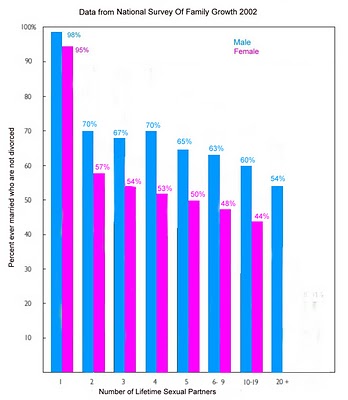
Here’s the graph which is based on data from the National Survey of Family Growth, 2002:

Marriage stability vs. number of lifetime sexual partners

(Click for larger image)

This shows why it is important for men to marry virgins, and also to be virgins themselves.

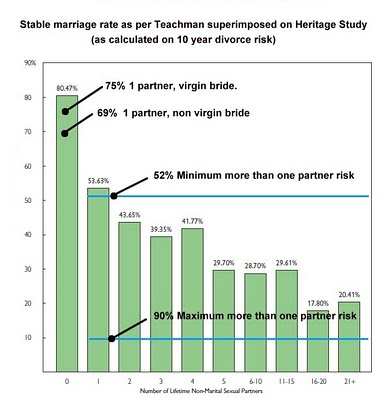
And in another post he analyzes another independent study that reached the same conclusion:

The results presented in this article replicate findings from previous research: Women who cohabit prior to marriage or who have premarital sex have an increased likelihood of marital disruption. Considering the joint effects of premarital cohabitation and premarital sex, as well as histories of premarital relationships, extends previous research. The most salient finding from this analysis is that women whose intimate premarital relationships are limited to their husbands—either premarital sex alone or premarital cohabitation—do not experience an increased risk of divorce. It is only women who have more than one intimate premarital relationship who have an elevated risk of marital disruption. This effect is strongest for women who have multiple premarital coresidental unions. These findings are consistent with the notion that premarital sex and cohabitation have become part of the normal courtship pattern in the United States. They do not indicate selectivity on characteristics linked to the risk of divorce and do not provide couples with experiences that lessen the stability of marriage.

[…]This limitation notwithstanding, the results presented here should shift attention away from research that focuses on the selection of individuals into cohabitation and premarital sex to a focus on the selection of individuals who do not marry the individuals with whom they first cohabit or initiate first sex. It may well be the case that, irrespective of the legal status of the relationship, the relevant distinction to make is between people who form multiple relationships and people who form a single, longer lasting relationship.

The graph:

Published in the Journal of Marriage and Family

(Click for larger image)

The Teachman study was not done by a conservative.

What is the point of a man being a virgin?

OK, I just wrote this part out in one fell swoop, and I am not sure if it is all relevant, but…

I wanted to consider the question of whether women should value the property of virginity in men from a Biblical perspective. Men have specific things they are supposed to do based on the Bible’s specifications. First, they have to be able to provide for the family financially. Second, they have to be able to protect the family from threats, including threats from false worldviews that lead to damage and destruction. Third, they have to be moral and spiritual leaders, nurturing their wives and children in moral values, moral duties, and their relationships with God.

Biblical men make good decisions all along their lives in order to satisfy these Biblical goals. In order to be a good provider, they study math and become engineers, which is hard and requires self-sacrifice. In order to be a good protector, they study science apologetics, philosophy of religion and the historical Jesus, which is hard and requires self-sacrifice. In order to be a good moral and spiritual leader, they guard their chastity and learn how to behave chivalrously, which is hard and requires self-sacrifice.

What women need to do is to do the research on everything including marriage/divorce/parenting, just like the research I talked about above, and generate a seriously Biblical set of criteria for choosing men that seriously satisfies the requirements for Biblical manhood. Women cannot expect good behavior from bad men. And they should actually affirm, approve, and encourage good behaviors in men – and not be resentful about having the obligation to build good men up with words and gifts.

What women need to do is to understand the behaviors that lead to stability and fidelity in a marriage – and that means studying research. Saying “I already know about the damage caused by divorce” is useless – it’s the knowledge of the evidence that changes how a woman makes decisions about men. Personal preferences can be changed at any time, but knowledge doesn’t vary depending on how you feel at any given moment.

For example, to test men for apologetics knowledge, it’s really easy – just ask them what the significance of cosmic microwave background radiation is, what chirality is, what the significance of 1 Corinthians 15:3-7 is, and what is the difference between the deductive and inductive problem of evil. If they can’t answer all four of those then you can’t marry them. Biblical manhood concerns are not check-boxes on the marriage application form – they’re long-form essay questions. Judging the man’s ability to do silly stuff, like get a tattoo or clown around in a bar, is just not relevant to making the marriage serve God. A woman’s personal preferences don’t decide here – evidence decides. (So long as the goal of marriage is to serve God, instead of to make women happy)

Men have a very specific role in marriages. They have to be able to teach the children about theology, apologetics and morality. When it comes to morality, women should not just believe what a man says. Instead, women need to look at what a man does. Specifically, she should look at what a man does representing his worldview, faith and morality to people who disagree with him. Go to his non-Christian co-workers and ask them what the man has told them about theology, apologetics and morality. Ask them for the reasons and evidences that were used in debates with them. That’s how you know what a man really thinks – it’s about what he is willing to say to people who he would rather not upset. Where standing up for the truth is really going to hurt his career and make him less popular. That is the true measure of his faithfulness. Not how well he speaks, sings and prays in church. What matters is whether he puts God above his own selfish needs for advancement and popularity. Is he willing to choose Christ over his own selfish desires? What is number one in his heart?

And finally, if a women chooses a bad man because she knows nothing about how to choose a good one, and hasn’t done any research about what a man has to be able to do to make a marriage stable, then she needs to stop blaming men and taking responsibility for her own poor decision-making. Choosing a man just because he makes you feel happy is not the best way to have achieve a stable marriage. You need to have better criteria than that, because you are going to answer for it later, especially if things go awry.

Evidence creates knowledge and knowledge binds the will

OK now back to the real topic of the post: the use of evidence to support Biblical moral values.

I like having evidence. I hate having to take stands for Biblical morality without evidence. If I can use the evidence for the Big Bang, the fine-tuning, the origin of biological information, the Cambrian explosion, the habitability fine-tuning and irreducible complexity to argue for theism, and then argue for the resurrection based on early sources and minimal facts, then I should have the exact same quality of data when defending moral values. If the Bible says something, I should be able to look at the best research and find that the Bible is correct.

You have to persuade a person during courtship by making them read and write about things, and dump them if they won’t do it. People can say anything during a courtship – make all kinds of promises and then suddenly just turn selfish and break them all. If they haven’t studied and tested these things out, because they think they know everything already, then you really can’t expect good behavior. It’s a crapshoot unless they’ve seen the evidence.

UPDATE: Another peer-reviewed paper on the effects of abstinence on stability and communication.

Related posts

MUST-HEAR: Jennifer Roback Morse debates on marriage at Columbia University

Cloning her would solve the marriage problem
Dr. J makes marriage interesting and fun!

Dr. Jennifer Roback Morse defends marriage at Columbia University in this short hour-long exchange. This is your chance to hear how anti-child advocates of same-sex marriage really are. And Dr. J links SSM to unilateral divorce at the end of the Q&A, too. Awesome! This debate really needed to go for twice the time, and I look forward to hearing MORE debates from Dr. J.

Details:

Columbia University’s Federalist Society hosts a debate between Dr J and Professor Katherine Franke based on the question “Is Marriage Equality Possible?”  About an hour of audio includes opening position (Dr J), arguments (Prof. Franke), and rebuttal (Dr J), as well as a brief question-and-answer period.

The MP3 file is here.

Dr. J’s opening speech (15 min.)

Two basic contentions:

  • 1) same-sex marriage is not the equivalent of traditional marriage
  • 2) if we legislate that they are equal, then we are really redefining marriage by changing the essential purpose of marriage

A case study from Ireland:

  • a known sperm donor for a lesbian couple was excluded from having a relationship with the child he conceived
  • after the child was born, the sperm donor wanted regular contact with the child, but the women opposed giving him access
  • same-sex marriage requires that courts are able to assign parental rights instead of having rights assigned biologically, as with traditional marriage
  • That is why SSM is different from TM

What is the purpose of marriage?

  • Marriage is about attaching mothers and fathers to children, and mothers and fathers to one another
  • Children are born helpless from two opposite-sex parents and they need parental guidance and care during development
  • In TM, there is no third party needed in order to have a child
  • In TM, the biological parents have rights and responsibilities for the child
  • TM is about providing the child with justice
  • Every child is entitled a relationship to both biological parents, and is entitled to care, protection and nourishment from both parents, and every child is entitled to a stable family environment
  • the problem is that children don’t have standing to sue for these rights in court
  • so the purpose of marriage is that we have a social construct to provide these rights to children naturally, without the state having to intervene

The purpose of marriage according to SSM?

  • In SSM, the essential child-centered  purpose marriage is replaced with new purposes like pooling resources and having same-sex couples recognized by society

SSM redefines marriage in four ways:

  • it diminishes the entitlement of children to a relationship with both biological parents
  • it diminishes the identification of parental roles with biology
  • it requires the state to determine parental relationships, instead of recognizing biological parents
  • it enshrines the idea that mothers and fathers are interchangeable, that children don’t really need mothers AND fathers

Dr. Franke’s opening speech (20 min.)

Hard cases make bad law 1: the presumption of paternity

  • consider the case where a mother is married and has an affair resulting in a child
  • the Supreme Court has ruled that the father of the child has no right of contact
  • this is a case where marriage gets in the way of biological parents having a relationship with the child
  • so it can be the case where marriage is in conflict with the relationships to biological parents

Hard cases make bad law 2: the purpose of marriage can be changed

  • marriages was used to keep peace between families and communities
  • marriage used to be about trading and trafficking of women
  • so the concern for offspring was not always the greatest concern

TM and SSM are both equally able to create stability for children:

  • same-sex unions are just as stable for children as TM marriages

Same-sex unions do provide justice for the child:

  • giving the adults in same-sex couples the social recognition that opposite sex married couples have is good for children

Children can sue in court

  • children can use guardians to sue their parents in court to get their rights

Opposing SSM is racism

  • opposing same-sex marriage is equivalent to racism
  • we could abolish marriage completely and let individuals form private contracts, then the state would really be neutral on marriage

Dr. J’s rebuttal speech (5 min.)

The state cannot be neutral on marriage

  • what the deinstutionalization of marriage means is that the private contracts are made by adults and children will have no consideration in those contracts

Regarding the adultery case

  • the presumption of paternity is there to protect the marriage
  • such borderline cases almost never happen with TM, whereas in SSM these third party problems occur in 100% of the cases

Children are not happy being separated from their biological parents

  • adults do not have a right to exclude a child’s biological parents from having a relationship with them, and children are often not happy being excluded from their biological parents

Related posts