
Tag Archives: Socialism

Jay Richards: eight common myths about wealth, poverty and the free market

I have a key that will unlock a puzzling mystery

Have you read Jay Richards’ book “Money, Greed and God?” Because if you haven’t, he’s written a series of articles that summarize the main points of the book.

The index post is here.

Here are the posts in the series:

  • Part 1: The Eight Most Common Myths about Wealth, Poverty, and Free Enterprise
  • Part 2: Can’t We Build A Just Society?
  • Part 3: The Piety Myth
  • Part 4: The Myth of the Zero Sum Game
  • Part 5: Is Wealth Created or Transferred?
  • Part 6: Is Free Enterprise Based on Greed?
  • Part 7: Hasn’t Christianity Always Opposed Free Enterprise?
  • Part 8: Does Free Enterprise Lead to An Ugly Consumerist Culture?
  • Part 9: Will We Use Up All Our Resources?
  • Part 10: Are Markets An Example of Providence?

Parts 4 and 5 are my favorites. It’s so hard to choose one to excerpt, but I must. I will choose… Part 4.

Here’s the problem:

Myth #3: The Zero Sum Game Myth – believing that trade requires a winner and a loser. 

One reason people believe this myth is because they misunderstand how economic value is determined. Economic thinkers with views as diverse as Adam Smith and Karl Marx believed economic value was determined by the labor theory of value. This theory stipulates that the cost to produce an object determines its economic value.

According to this theory, if you build a house that costs you $500,000 to build, that house is worth $500,000. But what if no one can or wants to buy the house? Then what is it worth?

Medieval church scholars put forth a very different theory, one derived from human nature: economic value is in the eye of the beholder. The economic value of an object is determined by how much someone is willing to give up to get that object. This is the subjective theory of value.

And here’s an example of how to avoid the problem:

How you determine economic value affects whether you view free enterprise as a zero-sum game, or a win-win game in which both participants benefit.

Let’s return to the example of the $500,000 house. As the developer of the house, you hire workers to build the house. You then sell it for more than $500,000. According to the labor theory of value, you have taken more than the good is actually worth. You’ve exploited the buyer and your workers by taking this surplus value. You win, they lose.

Yet this situation looks different according to the subjective theory of value. Here, everybody wins. You market and sell the house for more than it cost to produce, but not more than customers will freely pay. The buyer is not forced to pay a cost he doesn’t agree to. You are rewarded for your entrepreneurial effort. Your workers benefit, because you paid them the wages they agreed to when you hired them.

This illustration brings up a couple important points about free enterprise that are often overlooked:

1. Free exchange is a win-win game.

In win-win games, some players may end up better off than others, but everyone ends up better off than they were at the beginning. As the developer, you might make more than your workers. Yet the workers determined they would be better off by freely exchanging their labor for wages, than if they didn’t have the job at all.

A free market doesn’t guarantee that everyone wins in every competition. Rather, it allows many more win-win encounters than any other alternative.

2. The game is win-win because of rules set-up beforehand. 

A free market is not a free-for-all in which everybody can do what they want. Any exchange must be free on both sides. Rule of law, contracts, and property rights are needed to ensure exchanges are conducted rightly. As the developer of the house, you’d be held accountable if you broke your contract and failed to pay workers what you promised.

An exchange that is free on both sides, in which no one is forced or tricked into participating, is a win-win game.

On this view, what you really need to fear as a consumer is government intervention that restricts your choices in the marketplace, or makes some choices more expensive than they need to be (tariffs).

If you care about poverty, it’s often tempting to think that it can only be solved one way – by transferring wealth from the rich to the poor. But that is a very mistaken view, as any economist will tell you. The right way to create prosperity is by creating laws and policies that unleash individual creativity. Letting individuals create innovative products and services, letting them keep what they earn, making sure that the law doesn’t punish entrepreneurs – that incentivizes wealth creation. Fixing poverty does not mean transferring wealth, it means giving people more freedom to create wealth on their own. Free trade between nations is an important way that we encourage people to create better products and services that what they have available in their own countries.

Economists agree on the benefits of free trade

Who could possibly disagree with free trade? Well, many people on the left do. But economists across the spectrum of ideology (university and private sector and public sector) agree on the benefits of free trade.

Harvard economist Greg Mankiw explains what most professional economists agree on.

Excerpt:

Here is the list, together with the percentage of economists who agree:

  1. A ceiling on rents reduces the quantity and quality of housing available. (93%)
  2. Tariffs and import quotas usually reduce general economic welfare. (93%)
  3. Flexible and floating exchange rates offer an effective international monetary arrangement. (90%)
  4. Fiscal policy (e.g., tax cut and/or government expenditure increase) has a significant stimulative impact on a less than fully employed economy. (90%)
  5. The United States should not restrict employers from outsourcing work to foreign countries. (90%)
  6. The United States should eliminate agricultural subsidies. (85%)
  7. Local and state governments should eliminate subsidies to professional sports franchises. (85%)
  8. If the federal budget is to be balanced, it should be done over the business cycle rather than yearly. (85%)
  9. The gap between Social Security funds and expenditures will become unsustainably large within the next fifty years if current policies remain unchanged. (85%)
  10. Cash payments increase the welfare of recipients to a greater degree than do transfers-in-kind of equal cash value. (84%)
  11. A large federal budget deficit has an adverse effect on the economy. (83%)
  12. A minimum wage increases unemployment among young and unskilled workers. (79%)
  13. The government should restructure the welfare system along the lines of a “negative income tax.” (79%)
  14. Effluent taxes and marketable pollution permits represent a better approach to pollution control than imposition of pollution ceilings. (78%)

Socialist economic policies don’t work because they are making policies that are based on economic myths. We know that these myths are myths because of economics is a mathematical science, and because we have tried good and bad policies in different times and places. We have calculations and we have experience to know what works and what doesn’t work. If you want to help the poor, you have to respect what economists know about how wealth is created. The solution is not to “spread the wealth around”, it’s to encourage people to create more wealth by inventing things that people freely choose to buy.
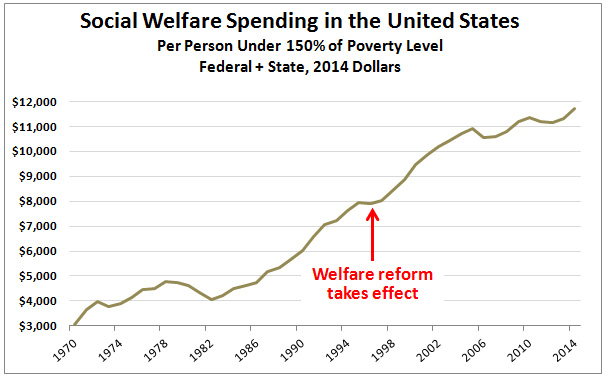
Why is it so hard for a working man to provide for a family these days?

Welfare spending
Welfare spending

Here’s my argument which answers the question:

  1. Feminism was behind no-fault divorce.
  2. Making it easier to divorce means that more divorces will occur.
  3. Marital instability causes women to vote for bigger government.
  4. Unmarried women vote mostly for Democrats.

*Please note that I am talking about unmarried (never married, divorced) women throughout this post.

Here’s the evidence for each point.

1. Feminism was behind no-fault divorce, according to this feminist, pro-no-fault-divorce writer.

Excerpt:

Households of 2010 don’t look quite like they did in 1969, when no-fault divorce actually was a controversial topic and these counter-arguments held some weight. The working dad/stay-at-home mom model of the middle class has been replaced by two-parent earner households and a growing number of working mom/stay-at-home dad arrangements. In working poor and impoverished families, the one-parent provider model was never the norm. No-fault divorce seemed scary when it had never before existed, but the truth is that its introduction was long overdue. Feminist groups at the time supported no-fault divorce, as it provided women an escape hatch from desperately unhappy marriages in a society where they were already disadvantaged on almost every level, regardless of their marital status. Imagine an abusive marriage in 1968, when the court-savvy abuser could actually force the victim to stay in the relationship forever. Imagine that now, and you know why domestic violence attorneys are in full support of introducing no-fault divorce to New York. And the judges aren’t the only problem.

Note that the author of this piece thinks that it is not women’s fault that they choose men who they then want to divorce. It’s not the woman’s fault that she is unhappy with the man she courted with and then chose and then made vows to – women need a no-fault escape hatch, and children do fine without fathers.

2. Easier divorces means more divorces.

Abstract:

This paper analyzes a panel of 18 European countries spanning from 1950 to 2003 to examine the extent to which the legal reforms leading to “easier divorce” that took place during the second half of the 20th century have contributed to the increase in divorce rates across Europe. We use a quasi-experimental set-up and exploit the different timing of the reforms in divorce laws across countries. We account for unobserved country-specific factors by introducing country fixed effects, and we include country-specific trends to control for timevarying factors at the country level that may be correlated with divorce rates and divorce laws, such as changing social norms or slow moving demographic trends. We find that the different reforms that “made divorce easier” were followed by significant increases in divorce rates. The effect of no-fault legislation was strong and permanent, while unilateral reforms only had a temporary effect on divorce rates. Overall, we estimate that the legal reforms account for about 20 percent of the increase in divorce rates in Europe between 1960 and 2002.

It seems obvious, but more evidence never hurts. About 70% of divorces are initiated by women, either because they chose to marry the wrong man, or because they are unhappy with the right man.

3. Marital instability causes women to vote for bigger government for security.

Excerpt:

Giving women the right to vote significantly changed American politics from the very beginning. Despite claims to the contrary, the gender gap is not something that has arisen since the 1970s. Suffrage coincided with immediate increases in state government expenditures and revenue, and these effects continued growing as more women took advantage of the franchise. Similar changes occurred at the federal level as female suffrage led to more liberal voting records for the state’s U.S. House and Senate delegations. In the Senate, suffrage changed voting behavior by an amount equal to almost 20 percent of the difference between Republican and Democratic senators. Suffrage also coincided with changes in the probability that prohibition would be enacted and changes in divorce laws.

[…]More work remains to be done on why women vote so differently, but our initial work provides scant evidence that it is due to self-interest arising from their employment by government. The only evidence that we found indicated that the gender gap in part arises from women’s fear that they are being left to raise children on their own (Lott and Kenny 1997). If this result is true, the continued breakdown of the family and higher divorce rates imply growing political conflicts between the sexes. 19

Bigger government must be paid for by higher taxes, of course, which makes it harder for one working man’s income to provide for a family. In fact, feminists wanted men to be displaced as sole-providers. They would prefer that women are “equal” to men, and that means making women get out and work like men. Feminists had every reason to want bigger government and higher taxes to make traditional single-earner families unfeasible financially. They did it for equality.

4. Women are in fact observed to vote for bigger government.

Excerpt:

On Tuesday, the nation made history. It made history in electing the first African American president; it made history in building a bigger margin for the first female Speaker of the House; it made history in delivering the biggest Democratic margin since 1964; it made history in sending a record number of people to the polls and the highest percentage turnout since the 1960 election. Analysts will spend the next few months sifting through the data, trying to figure out what happened and why. Historians will likely spend the next several years and decades studying this election, as well. But one thing is immediately clear. Unmarried women played a pivotal role in making this history and in changing this nation. They delivered a stunning 70 to 29 percent margin to Barack Obama and delivered similarly strong margins in races for Congress and the U.S. Senate. Although unmarried women have voted Democratic consistently since marital status has been was tracked, this election represents the highest margin recorded and a 16-point net gain at the Presidential level from 2004.

In fact, there was a recent (2011) study showing that unmarried women do in fact vote for higher taxes and more government as a substitute for a husband’s provider role.

Abstract:

The last three decades have witnessed the rise of a political gender gap in the United States wherein more women than men favor the Democratic party. We trace this development to the decline in marriage, which we posit has made men richer and women poorer. Data for the United States support this argument. First, there is a strong positive correlation between state divorce prevalence and the political gender gap – higher divorce prevalence reduces support for the Democrats among men but not women. Second, longitudinal data show that following marriage (divorce), women are less (more) likely to support the Democratic party.

What follows from voting Democrat?

Since the Democrats took the House and Senate in 2006, and then the Presidency in 2008, the national debt has more than doubled from about 8 trillion to 20 trillion. A lot of that money was spent in welfare for single mothers, which only makes the women and their fatherless children more dependent on government. Children raised in unmarried home are far less likely to marry themselves, and to be independent of government. Which means that they will vote for bigger government when they start to vote, since they can’t make it through life on their own strength.

If more people vote for Democrats then we will get higher taxes to pay for all the government spending. Higher taxes means that a married man can no longer retain enough of his earnings to support a family. And that means his wife has to work, and that means that his children will learn what the government schools decide they should learn – so that all the children will be equal and think the same (pro-government) thoughts. This should not be controversial, because it is what it is. But if we want to talk about the decline of marriage honestly, then we need to be talking to single women about how they choose men, when they have sex with men, and how they vote at election time. You really can’t have it all.

Every immigrant without a high school degree will cost taxpayers $640,000

Major welfare programs as of 2012

I am very much in favor of expanding and streamlining immigration processes for skilled immigrants, especially for areas where there is more demand than supply. But I am not in favor of letting in refugees or other unskilled immigrants, especially if they will be eligible to collect benefits paid for by other working taxpayers.

The Daily Signal explains what the cost is:

On Thursday, the National Academies of Sciences, Engineering, and Medicine will release its report on “The Economic and Fiscal Consequences of Immigration.” According to the report, first generation immigrants as a group increase the nation’s fiscal deficit. In other words, the government benefits they receive exceed the taxes paid.

The National Academies’ report provides 75-year fiscal projections for new immigrants and their descendants. The fiscal impact varies greatly according to the education level of the immigrant. Low-skill immigrants are shown to impose substantial fiscal costs that extend far into the future. The future government benefits they will receive greatly exceed the taxes they will pay.

On average, a nonelderly adult immigrant without a high school diploma entering the U.S. will create a net fiscal cost (benefits received will exceed taxes paid) in both the current generation and second generation. The average net present value of the fiscal cost of such an immigrant is estimated at $231,000, a cost that must be paid by U.S. taxpayers.

The concept of “net present value” is complex: it places a much lower value on future expenditures than on current expenditures.

One way to grasp net present value is that it represents the total amount of money that government would have to raise today and put in a bank account earning interest at 3 percent above the inflation rate in order to cover future costs.

Thus, as each adult immigrant without a high school diploma enters the country, the government would need to immediately put aside and invest $231,000 to cover the future net fiscal cost (total benefits minus total taxes) of that immigrant.

Converting a net present value figure into future outlays requires information on the exact distribution of costs over time. That data is not provided by the National Academies.

However, a rough estimate of the future net outlays to be paid by taxpayers (in constant 2012 dollars) for immigrants without a high school diploma appears to be around $640,000 per immigrant over 75 years. The average fiscal loss is around $7,551 per year (in constant 2012 dollars).

Slightly more than 4 million adult immigrants without a high school diploma have entered the U.S. since 2000 and continue to reside here. According to the estimates in the National Academies report, the net present value of the future fiscal costs of those immigrants is $920 billion.

If you want to take in refugees or unskilled immigrants or sponsor elderly family members, then they should not be allowed to collect benefits paid by other taxpayers. The family that is here already must provide for them, and be held accountable should anything go wrong. Unfortunately, that’s not how the system works now, and it’s not what the Democrats want. They want to import more people who will depend on big government, and then give them the right to vote.

Now, you might think that young American students who expect to find jobs will also expect to keep most of what they earn. It’s very surprising then that they keep voting for a party (the Democrats) that seeks to enslave them with the obligation to pay for other people. I know that the next generation will be paying more in taxes than I ever did during my lifetime.