
Tag Archives: Social Programs

Government handouts make up 35% of all wages

From CNBC.

Excerpt:

Government payouts—including Social Security, Medicare and unemployment insurance—make up more than a third of total wages and salaries of the U.S. population, a record figure that will only increase if action isn’t taken before the majority of Baby Boomers enter retirement.

Even as the economy has recovered, social welfare benefits make up 35 percent of wages and salaries this year, up from 21 percent in 2000 and 10 percent in 1960, according to TrimTabs Investment Research using Bureau of Economic Analysis data.

“The U.S. economy has become alarmingly dependent on government stimulus,” said Madeline Schnapp, director of Macroeconomic Research at TrimTabs, in a note to clients. “Consumption supported by wages and salaries is a much stronger foundation for economic growth than consumption based on social welfare benefits.”

The economist gives the country two stark choices. In order to get welfare back to its pre-recession ratio of 26 percent of pay, “either wages and salaries would have to increase $2.3 trillion, or 35 percent, to $8.8 trillion, or social welfare benefits would have to decline $500 billion, or 23 percent, to $1.7 trillion,” she said.

[…]Social welfare benefits have increased by $514 billion over the last two years, according to TrimTabs figures, in part because of measures implemented to fight the financial crisis. Government spending normally takes on a larger part of the spending pie during economic calamities but how can the country change this make-up with the root of the crisis (housing) still on shaky ground, benchmark interest rates already cut to zero, and a demographic shift that calls for an increase in subsidies?

At the very least, we can take solace in the fact that we’re not quite at the state welfare levels of Europe. In the U.K., social welfare benefits make up 44 percent of wages and salaries, according to TrimTabs’ Schnapp.

You can see a nice graph of welfare spending and another graph of single motherhood in this post at Director Blue. He makes the same point I made about increased welfare spending destroys marriage by reducing the need for men in their traditional roles.
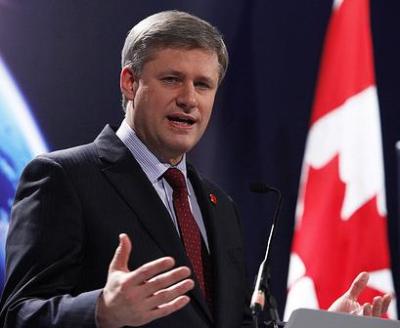
Stephen Harper’s Conservative Party cuts federal spending by 6.2%

Prime Minister Stephen Harper

More news from up north. (H/T Ben)

Excerpt:

Federal government expenditures are set to fall next fiscal year by $16.5-billion, or 6.2%, with big cuts to regional development and environment programs, according to documents tabled Tuesday.

That would leave total expenditures for the 2011-12 year at $250-billion, with the bulk taken up by transfer payments to individuals and governments, and operating costs. Just over $30-billion of that expense is attributed to refinancing Canada’s debt.

The figures, contained in spending estimates provided by the Treasury Board, sees budget increases for departments entrusted with security and law enforcement – such as a 21% boost to jails — but cuts of roughly 20% to Environment Canada, Natural Resources Canada and Agriculture and Agri-Food Canada.

Government is supposed to be concerned with security and law enforcement, not with environmentalist wastefulness.

Here’s Paul Ryan. He would like to cut our budget by 6.2% – and maybe even more.

If Canada is cutting their government waste, then why can’t we?

There are a lot of programs that we could be cutting.

Excerpt:

The federal government could save billions in taxpayer dollars annually by consolidating duplicative government programs, according to a new report.

The newly-released report from the Government Accountability Office “makes us all look like jackasses,” Sen. Tom Coburn (R-Okla.) told reporters Monday night.

The conservative senator said the report — which identifies redundancies in more than 546 individual programs — reveals why the United States is $14 trillion in debt.

“Anybody who says we don’t look like fools up here hasn’t read the report,” he said.

[…]The GAO reviewed 34 areas (among them agriculture, defense and social services) where agencies, offices or initiatives have similar or overlapping objectives. The report also looked at 47 additional cost-saving opportunities related to more general government efficiency. For instance, the report said, “Improved corrosion prevention and control practices could help [the Defense Department] avoid billions in unnecessary costs over time.”

Addressing duplicative efforts on even a single issue could save billions, the report found. For instance, the GAO says the government could save up to $5.7 billion annually by addressing potentially duplicative policies designed to boost domestic ethanol production. Additionally, the Defense Department could save $460 million annually by making broader changes to the governance of its military health care system.

The report finds that there are 15 agencies involved in food safety, 80 programs involved in economic development and more than 100 involved in surface transportation. There are 10 agencies and 82 programs involved in teacher quality, and more than 20 agencies and about 56 programs involved in financial literacy efforts. There are about 2,300 investments across the Defense Department to modernize its business operations.

House Majority Leader Eric Cantor (R-Va.) said today that in order to foster long term economic growth, “we’re going to deal with the pressing issues of regulatory waste in our agencies, as well as long term issues facing our country with entitlement programs.”

This is why we have to stop giving private sector money to government. They don’t earn any money by making things or helping people – they don’t sell anything useful. They just steal money from the productive workers and businesses and then they waste it and run up trillion dollar deficits. This kind of corruption, fraud and waste would not survive in small businesses, and probably not even in big businesses. Business have to be efficient or they go bankrupt. They have to perform or their competitors will have them for lunch. The consumer is king in the private sector.

Related posts

New study finds that eating dinner as a family makes children happier

From the left-wing UK Guardian. (H/T Mercator via RuthBlog)

Excerpt:

Researchers at the National Foundation for Educational Research asked the English pupils, aged between 10 and 15, whether they agreed, disagreed or were unsure about the statement: “I feel happy about life at the moment.”

[…]The research, Reasons to be Cheerful: Being a 12-year-old Boy who Eats Dinner with his Family, which was commissioned by the Department for Education, also found that boys were 1.4 times more likely to say they felt happy than girls.

[…]Children who often eat a meal with family or friends at home and regularly eat fruit and vegetables are also more likely to say they are happy. The study found young people who often sit down for a meal with their family are 1.6 times more likely to state that they are happy as those who sometimes or never sit down to a meal with their family. The most likely reason for children to say they are unhappy is being worried about their parents or family, the researchers found. A high proportion of those who worried about their looks also said they were unhappy.

The happiest group were 12-year-old boys who eat with their families.

[…]Benton said: “Our analysis confirms that If we are interested in the happiness and wellbeing of young people we need to look beyond how much money they have.

“In particular, growing up in a supportive and safe environment, both within the home and elsewhere appear to be far more important. Parents making the effort to spend time with their children are a major positive influence on their chances of being happy.”

This sort of contradicts the left’s way of addressing children’s issues – which is to weaken the parental bond through taxation and government-run social programs. Maybe we should lower taxes and let parents have more of their own earned income to pump into their own families directly on things like family dinners and family activities?