Tag Archives: Salary

Indiana voucher program offers hope to low-income students

From the Courier Press, news of the latest success for Republicans in their long war against public sector teacher unions.

Excerpt:

Kristy Wentworth of Evansville said she was never dissatisfied with public education, and her three children, who attended schools in the Evansville Vanderburgh School Corp., were making good grades.

But when friends told her about Indiana’s new private school voucher program, she was intrigued.

After some discussion, Wentworth enrolled her children this year at Evansville Lutheran School, which is near her home. It didn’t take the single mother long to decide her choice was correct. Her children — who are in grades 7, 6 and 4 — are thriving at Evansville Lutheran. Wentworth noted the school’s small class sizes, and she marveled at the frequent communication she receives from her teachers.

“They come home from school excited, they leave for school excited. They can’t wait to get there,” Wentworth said. “(The school) encouraged them to sign up for Boy Scouts and volleyball, and on the first night they made the kids feel so welcome.”

Wentworth recently lost her job, and she said she couldn’t have afforded a private school without the voucher program, which proponents say helps overall educational achievement and closes achievement gaps along socioeconomic lines.

And these private schools help children to perform better in testing.

Can greater competition among schools help? That’s what state education officials are banking on. While scars from the lengthy spring debate over vouchers heal, they are encouraging local school districts to embrace the new environment.

Local nonpublic schools have courted voucher students. As of Friday, 114 were awarded to students in the EVSC district — the fourth highest number in the state.

Officials with the EVSC, meanwhile, point to recent academic progress, its network of community partnerships aimed at meeting students’ most fundamental needs and classroom innovations.

Delaware Elementary School, which is in the same neighborhood as Evansville Lutheran, has made strides in several areas in a short period of time, said Heather Ottilie, parent of a Delaware third-grader.

Delaware is in its second year as an EVSC “equity school.” Along with two other schools of similar socioeconomic demographics — McGary Middle School and Evans School — Delaware is free to have longer school days and longer school years and has more leeway in curriculum and rules. The three equity schools all showed gains on the spring ISTEP.

Ottilie said Delaware has placed heavy emphasis on independent reading. Other innovations include the use of netbook computers and iPod Touches in classrooms, world language instruction and new learning programs such as LEGO robotics, which emphasize problem-solving skills.

“I love it,” Ottilie said. “Everything is hands-on … the kids aren’t just doing worksheets.”

What is the conservative plan to help the poor? Is it wealth redistribution? Does that even work? Or is there a way to produce better results for the poor through free market capitalism? Those who advocate big government never bother to ask these questions. For those who take the time to study economics, the answer is clear – what works to reduce costs and raise quality is choice and competition.

Related posts

Must-see videos on education policy

Related posts

Should teachers be paid more money?

From the American Enterprise Institute.

Excerpt:

Mark Perry posts regarding the new AEI Education Outlook by University of Missouri economist Cory Koedel which shows Education to be by far the easiest course of study in most colleges. Mark finds additional evidence from Cornell University to back up Koedel’s claim. Education majors enter college with lower SAT scores than students majoring in other fields but leave college with higher GPAs.

[…]But, as a forthcoming paper that I have co-authored with Jason Richwine will show, the low standards applied in education degrees also complicate the task of determining whether public school teachers are fairly paid. Teachers claim to be underpaid because they receive lower average salaries than private sector workers with similar levels of education. (Our paper shows that, even if this is true, they more than make up the gap through generous benefits, but we’ll ignore that for now.) But note that the control variable here is the level of education — meaning, Bachelor’s degree, Master’s degree, and so on — and not the quality of education nor, more importantly, the ability or productivity of the worker.

[…]Put bluntly, public school teachers enter college with below-average SAT scores, major in the easiest undergraduate course of study, take Master’s degrees in education that have no appreciable impact on teaching quality, and then wonder why they’re not as well paid as someone who got a Master’s in chemical engineering. They shouldn’t.

Education is what you study when you can’t get into anything else, and you don’t learn anything in it. What we really need is to hire teachers with real degrees in math, science and business. There should not even be an education MAJOR.

Here’s a fun story about the Chicago Teacher Union (CTU).

Excerpt:

Like many Illinois citizens, the CTU has seen reports that three out of four state high school graduates are not ready for college.  And the union’s response has been, well … the CTU hasn’t really said anything about it.

You see, the fact that students are leaving Illinois’ K-12 public education system totally unprepared for college, the workplace or life in general – that’s not really the CTU’s thing.

Instead, the union is “upset” and feeling very “disrespected” because the Chicago Board of Education doesn’t have the money to pay CTU members the four percent pay raise they were promised in their contract.

The union is also steaming over the fact that more than 1,500 teachers have been laid off, some of which have been placed on a “secret” do-not-hire list, CTU President Karen Lewis told the Chicago Sun-Times.

Pay, benefits, working conditions – these are the things that the teachers unions are willing to strike over. If only 23 percent of Illinois high school grads pass a college-readiness test, well, what do you expect them to do about it? Lewis is quick to point out that union teachers are just simple “workers,” doing the best they can with the kids they are given. (It’s mostly the parents’ fault, anyway.)

Sure, some trouble making education reformers may suggest that kids are doing badly on the tests because their school days have been frittered away on silly social justice lessons, but the fact that the CTU is being stiffed on its four percent pay raise only underscores the need for such a curriculum.

Teachers don’t like it when you expect them to earn their salaries. They just go on strike.

Do right-to-work or forced union states create more high-paying jobs?

Neil Simpson writes about a CNBC report entitled “America’s Top States for Business 2011“. At the top of the list: right-to-work states where workers are not forced to join unions that collect union dues to support Democrat policies like amnesty for illegal immigrants, taxpayer-funded abortion and legalizing same-sex marriage.

Here are the criteria used to rank states in the CNBC survey:

  • Cost of Doing Business
  • Workforce
  • Quality of Life
  • Economy
  • Transportation & Infrastructure
  • Technology & Innovation
  • Education
  • Business Friendliness
  • Access to Capital
  • Cost of Living

Red State writes:

When it comes to America’s Top States for Business 2011, when it comes to a quality workforce, 18 out of the top 20 states are Right-to-Work states. Moreover, all 22 Right-to-Work states are in the top 25 states for having the best workforces.

CNBC defines its criteria as this:

Many states point with great pride to the quality and availability of their workers, as well as government-sponsored programs to train them. We rated states based on the education level of their workforce, as well as the numbers of available workers. We also considered union membership. While organized labor contends that a union workforce is a quality workforce, that argument, more often than not, doesn’t resonate with business. We also looked at the relative success of each state’s worker training programs in placing their participants in jobs.

Since nine out of 10 of the states cited for having the best education are not right to work states, it appears that those who receive their educations in forced-union states get smart, pack up and leave, leaving the not-so-smart union extremists to invent myths about their own superiority while they pay their forced union dues.

And here’s a map of right to work states:

Right to Work State Map

Notice that they are mostly Republican states, because are the states that are run by economists and people with business experience – people who know how to create jobs, as opposed to giving speeches that demonize and threaten the people who create jobs.

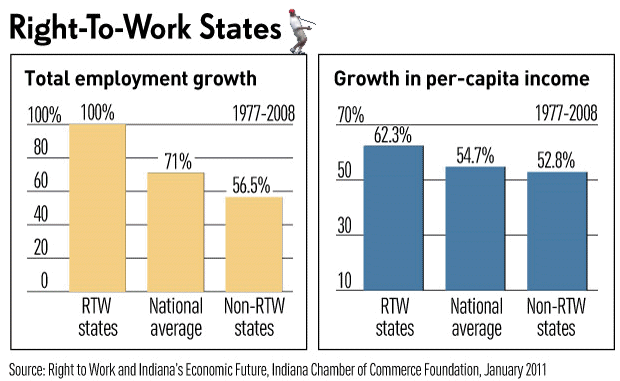
Doug Ross posted these charts a while back that show that employees also do better in right to work states. There are more jobs being created, and the income growth is higher than the forced union states.

Employment growth:

Right To Work States: Employment Growth

Income growth:

Right To Work States: Income Growth

The only losers are the unions. In right to work states, businesses and workers WIN.