
Tag Archives: Rate

Why do people oppose same-sex marriage?

UPDATE: The research paper seems to have expired from the FRC web site, but you can see the whole thing here.

I found this research paper at the Family Research Council web site. The paper compares same-sex couples and heterosexual married couples, in the following ways:

  • relationship duration
  • monogamy vs. promiscuity
  • relationship commitment
  • number of children being raised
  • health risks
  • rates of intimate partner violence

Are there really significant differences between the two arrangements? Let’s take a look at the some of the data.

Relationship duration
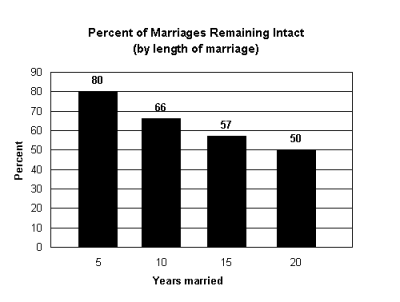
% of Marriages Remaining Intact

Source: National Center for Health Statistics, Centers for Disease Control and Prevention (2001)
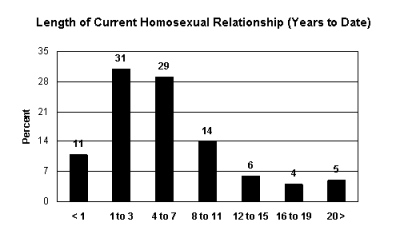
Length of Current Homosexual Relationship

Source: 2003-2004 Gay/Lesbian Consumer Online Census

Monogamy vs Promiscuity
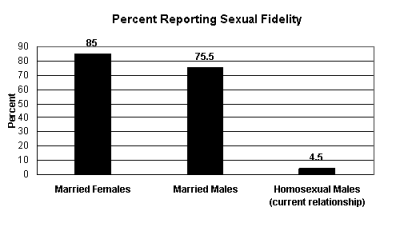
% Reporting Sexual Fidelity

Sources:Laumann, The Social Organization of Sexuality, 216; McWhirter and Mattison, The Male Couple: How Relationships Develop (1984): 252-253; Wiederman, “Extramarital Sex,” 170.

Rates of intimate partner violence
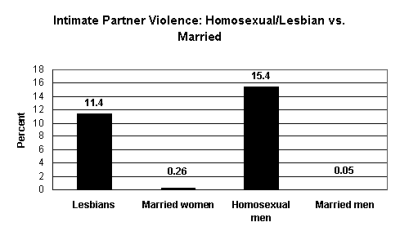
Intimate Partner Violence

Sources: “Extent, Nature, and Consequences of Intimate Partner Violence,” U.S. Department of Justice: Office of Justice Programs: 30; “Intimate Partner Violence,” Bureau of Justice Statistics Special Report:11.

Conclusion

Marriage is a relationship that has a specific purpose. That purpose is to bind together two opposite natures and to produce children that are biologically linked to the parents. The children gain the benefits of being parented by the two different natures, so they get two perspectives. The fact that the children are genetically linked to two parents helps to ensure the stability of the commitment, as we see in the animal kingdom where animals protect their young.

The goal of marriage is not to increase the happiness of the adults, or to “recognize” the love of adults. The goal of marriage is have two people enter into a relationship where they understand that it is not about adults being fulfilled. Marriage is about people having a goal of raising children, which are tremendously stressful to raise. Marriage requires self-denial and sacrifice in order to raise those children – that is the main point of it. It also requires fidelity and chastity, so that the environment is kept stable for the children over a long period of time.

Children benefit from the stability that is more common in traditional marriages than it is in other arrangements, including heterosexual co-habitation which is similarly unstable (50% greater chance of divorce, more domestic violence, etc.). Therefore, it is important to keep the concept of marriage separate from other kinds of relationships so that the focus on commitment for the sake of the children is clear to those who contemplate marriage. Society needs to give special recognition to married couples, in view of their child-focused commitment.

I apologize in advance if this post causes anyone any harm or distress, I am just trying to explain why people have that opinion. They could be wrong, but that is the case they make. Obviously, married couples fall short of the goal, but that is their goal.

Further study

Two much bigger challenges to marriage are big-government socialism and especially no-fault divorce. I also wrote about same-sex marriage and co-habitation before, in the context of European states like Sweden and Norway.

You may also be interested in a recent post about whether homosexuality is caused by a “gay gene”.

Barack Obama’s claim to save or create 150000 jobs falsified by FactCheck.org

Obama claim that his socialist policies that attack “greedy corporations” and “the rich” are actually increasing employment rates. Now, that seems to be impossible for rational people to believe, and FactCheck.org confirms that intuition. It is not possible for socialist policies such as card check, higher taxes, increased spending, more regulation, etc. to create more jobs than are lost from the changes.

Obama’s claim was:

At President Obama’s April 29 news conference, he claimed that the American Recovery and Reinvestment Act has “already saved or created over 150,000 jobs.”

That’s what he learned to believe at Harvard in his marxist rap sessions with the radical students and professors.

But how does the world really work?

According to the Bureau of Labor Statistics, the economy lost more than 1.3 million jobs in the two months after he took office, and it has probably lost at least another half-million in April. The day after Obama spoke, the Department of Labor announced that another 631,000 workers (seasonally adjusted) had filed new claims for unemployment insurance the previous week.

So what 150,000 jobs was Obama talking about?

It turns out the president’s claim is really an estimate of what his economic advisers think the stimulus bill is doing, and not based on any evidence of its actual effects.

But how does the White House respond to the falsification of their propaganda by reality?

We asked the White House for substantiation of Obama’s claim, and a spokesman responded that the figure comes from a recent estimate by the Council of Economic Advisers. “Because the baseline for employment is obviously still strongly downward,” the spokesman told us, “the estimate does not mean that employment has risen by 150,000. Rather, it means that employment is 150,000 higher than it otherwise would have been.” He said the figure is an estimate of people hired to work directly on ARRA-funded projects, plus “jobs created by the tax cuts, aid to the states, and other parts of the ARRA.”

So when the president said his stimulus bill “already saved or created” those jobs, he was just giving an estimate produced by his own economic advisers at the White House. Furthermore, the jobs figure is based on projections done at the time ARRA was passed. Recipients of ARRA spending aren’t required to report until later what they’re doing with the money and how well it’s working, so there’s very little hard data on where the money is being spent, let alone how many jobs may have resulted from the legislation. The CEA incorporated some actual spending reports into its estimate, but that information is not complete.

This is the result of voting by people who know more about the lives of celebrities than they know about economics. Imagine how surprised these Democrat voters are to find out that the 1 hour spent voting was not enough time to have thought anything through. Some of them thought that Obama was better on pro-life issues and government spending than McCain for example.

Remember, Democrats caused this recession and Republicans tried to stop it.

Why do people favor legal private ownership and concealed carry of handguns?

The entire practical case for concealed carry is based on a comparison between the number of crimes that can be prevented by brandishing a weapon versus the number of incidents where firearms are misused. Basically, supporters of the 2nd amendment (the right to bear arms) argue that the number of successful defensive handgun uses is high, and the number of accidents is low.

Take a look at this defensive handgun usage story from WSB TV: (H/T John Lott, Michelle Malkin)

COLLEGE PARK, Ga. — A group of college students said they are lucky to be alive and they’re thanking the quick-thinking of one of their own.

Police said a fellow student shot and killed one of two masked me who burst into an apartment.

Channel 2 Action News reporter Tom Jones met with one of the students to talk about the incident.

“Apparently, his intent was to rape and murder us all,” said student Charles Bailey.

Bailey said he thought it was the end of his life and the lives of the 10 people inside his apartment for a birthday party after two masked men with guns burst in through a patio door.

“They just came in and separated the men from the women and said, ‘Give me your wallets and cell phones,’” said George Williams of the College Park Police Department.

Bailey said the gunmen started counting bullets. “The other guy asked how many (bullets) he had. He said he had enough,” said Bailey.

That’s when one student grabbed a gun out of a backpack and shot at the invader who was watching the men. The gunman ran out of the apartment.

The student then ran to the room where the second gunman, identified by police as 23-year-old Calvin Lavant, was holding the women.

“Apparently the guy was getting ready to rape his girlfriend. So he told the girls to get down and he started shooting. The guy jumped out of the window,” said Bailey. . . . . .

If you are a supporter of gun control, how does a story like this fit into your worldview? What if the number of defensive handgun uses was 1 million per year, but the number of accidental incidents was less than a 100? Is that worth looking into, or is this an issue where facts must yield to emotions and intuitions?

RELATED: I found a story recently in Reason magazine in which the writer explains how the  banning of handguns in the UK in 1997 DOUBLED the violent crime rate in the next 4 years. The whole point of the case for permitting the concealed carry of legally owned handguns is that it dramatically reduces violent crime.

Excerpt:

The illusion that the English government had protected its citizens by disarming them seemed credible because few realized the country had an astonishingly low level of armed crime even before guns were restricted. A government study for the years 1890-92, for example, found only three handgun homicides, an average of one a year, in a population of 30 million. In 1904 there were only four armed robberies in London, then the largest city in the world. A hundred years and many gun laws later, the BBC reported that England’s firearms restrictions “seem to have had little impact in the criminal underworld.” Guns are virtually outlawed, and, as the old slogan predicted, only outlaws have guns. Worse, they are increasingly ready to use them.

Nearly five centuries of growing civility ended in 1954. Violent crime has been climbing ever since. Last December, London’s Evening Standard reported that armed crime, with banned handguns the weapon of choice, was “rocketing.” In the two years following the 1997 handgun ban, the use of handguns in crime rose by 40 percent, and the upward trend has continued. From April to November 2001, the number of people robbed at gunpoint in London rose 53 percent.

Gun crime is just part of an increasingly lawless environment. From 1991 to 1995, crimes against the person in England’s inner cities increased 91 percent. And in the four years from 1997 to 2001, the rate of violent crime more than doubled. Your chances of being mugged in London are now six times greater than in New York. England’s rates of assault, robbery, and burglary are far higher than America’s, and 53 percent of English burglaries occur while occupants are at home, compared with 13 percent in the U.S., where burglars admit to fearing armed homeowners more than the police. In a United Nations study of crime in 18 developed nations published in July, England and Wales led the Western world’s crime league, with nearly 55 crimes per 100 people.

This sea change in English crime followed a sea change in government policies. Gun regulations have been part of a more general disarmament based on the proposition that people don’t need to protect themselves because society will protect them. It also will protect their neighbors: Police advise those who witness a crime to “walk on by” and let the professionals handle it.

So, given this data regarding legal gun ownership and violent crime rates, what should our policy be?