Indiana is poised to become the first right-to-work state in more than a decade after the Republican-controlled House passed legislation on Wednesday banning unions from collecting mandatory fees from workers.
It is yet another blow to organized labor in the heavily unionized Midwest, which is home to many of the country’s manufacturing jobs. Wisconsin last year stripped unions of collective bargaining rights.
The vote came after weeks of protest by minority Democrats who tried various tactics to stop the bill. They refused to show up to debate despite the threat of fines that totaled $1,000 per day and introduced dozens of amendments aimed at delaying a vote. But conceding their tactics could not last forever because they were outnumbered, they finally agreed to allow the vote to take place.
The House voted 54-44 Wednesday to make Indiana the nation’s 23rd right-to-work state. The measure is expected to face little opposition in Indiana’s Republican-controlled Senate and could reach Republican Gov. Mitch Daniels’ desk shortly before the Feb. 5 Super Bowl in Indianapolis.
“This announces especially in the Rust Belt, that we are open for business here,” Republican House Speaker Brian Bosma said of the right-to-work proposal that would ban unions from collecting mandatory representation fees from workers.
Republicans recently attempted similar anti-union measures in other Rust-Belt states like Wisconsin and Ohio where they have faced massive backlash. Ohio voters overturned Gov. John Kasich’s labor measures last November and union activists delivered roughly 1 million petitions last week in an effort to recall Wisconsin Gov. Scott Walker.
Indiana would mark the first win in 10 years for national right-to-work advocates who have pushed unsuccessfully for the measure in other states following a Republican sweep of statehouses in 2010. But few right-work states boast Indiana’s union clout, borne of a long manufacturing legacy.
Every time one state enacts a right-to-work law, it puts competitive pressure on other states. The reason why is because businesses are attracted to right-to-work states, and they will prefer to expand there, rather than in union-friendly states. In fact, some companies will just up and move to right-to-work states, leaving the union-friendly states with no employers at all.
In the 2010 mid-term elections, Republican John Kasich won the governorship and promised to balance the state’s budget by reining in the state’s spending on salaries and benefits for public sector union employees. To accomplish this, the Ohio legislature pass Senate Bill 5. However, an effort is on the ballot to repeal the law, and Ohio voters will get a chance to keep or scrap the law on Tuesday, November 8th, 2011.
Issue 2 makes some very fair and common sense requests of our government employees to give local communities the flexibility they need to get taxes and spending under control, while providing the essential services that we rely on.
It allows an employee’s job performance to be considered when determining compensation, rather than just awarding automatic pay increases based only on an employee’s length of service.
It asks that government employees pay at least 15 percent of the cost of their health insurance premium. That’s less than half of what private sector workers are currently paying.
It requires that government health care benefits apply equally to all government employees, whether they work in management or non-management positions. No special favors.
It asks our government employees to pay their own share of a generous pension contribution, rather than forcing taxpayers to pay both the employee and employer shares.
It keeps union bosses from protecting bad teachers and stops the outdated practice of laying off good teachers first just because they haven’t served long enough.
Finally, it preserves collective bargaining for government employees, but it also returns some basic control of our schools and services to the taxpayers who fund them, not the union bosses who thrive on their mismanagement.
Even under the reforms of State Issue 2, Ohio’s government employees will still receive better pay, better health care and better retirement benefits, on average, than the vast majority of Ohioans who work in the private sector.
There are a number of myths going around about Issue 2, and it’s important to set the record straight, so I’ll do that below.
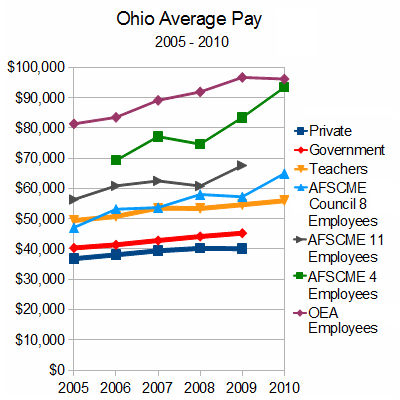
Ohio Average Pay: Public Unions vs. Private
Myths and truths about Ohio State Issue 2
Here’s a common myth:
State Issue 2 would “cut salaries and benefits.”
The truth:
Issue 2 would not cut salaries or benefits for any government employee. Employees would simply be asked to pay a modest share of their benefits, just like employees in the private sector do. For health care coverage, they would pay at least 15% of their overall plan. (Many local government employees currently pay less than 9% of their health care premium, while the average private sector worker pays upwards of 30%.) In addition, employees would be required to pay their personal share of a retirement plan (only 10%), rather than asking taxpayers to pay that share. That’s not too much to ask at a time when many private sector workers get no retirement benefit at all. Finally, Issue 2 requires that benefits apply equally to all public employees, so no one gets special treatment.
And another common myth:
State Issue 2 will eliminate government employee pensions.
The truth:
Government employees will still get a very generous pension benefit – an annual payment that averages their three highest annual salaries. That’s a pretty nice deal, when many private sector workers get no retirement benefit at all. State Issue 2 only ends a practice where some government union contracts require taxpayers to pick up the tab for BOTH the employer AND employee shares of a required pension contribution. In this economy, it’s simply not right to ask struggling taxpayers to foot the bill so government employees can get a free retirement. Issue 2 simply says government employees should pay their required share (10 percent) and taxpayers will contribute the employer share (14 percent).
Another myth:
State Issue 2 will cut teacher salaries.
The truth:
That’s one of the scare tactics government unions are using to turn people against these reforms. Nothing in Issue 2 determines salary levels. It only ends the practice of handing out automatic pay raises, or “step” increases, and longevity pay – or bonuses just for holding the job for a certain period of time. Issue 2 also asks that performance be added as a factor in teacher compensation, a goal President Barack Obama set out in his national education policy in 2009.
And another myth:
State Issue 2 will cost jobs
The truth:
Just the opposite is true. Ohio’s state and local tax burden ranks among the top third in the nation. As a result, companies large and small have left our state in pursuit of better tax incentives elsewhere, taking hundreds of thousands of jobs with them. If Ohio hopes to compete for new job growth, we have to make our state a more affordable place to live, work and do business. That starts with getting the cost of government under control so we can direct more of our limited resources into economic development, community revitalization and better schools.
The fiscal picture of local governments and school districts, especially, will improve as they are able to right-size their work forces and their expenditures on services. That will happen over time, not overnight, as new contracts are established.
Repeal SB 5, though, and it’s going to be awfully hard for local governments to manage their payrolls without resorting to larger-scale layoffs than would otherwise be necessary. And local governments will continue to be hamstrung by anti-merit seniority rules that lead to worker complacency and protect dead weight and time-servers.
Voting YES on Issue 2 will prevent layoffs by keeping public sector wages and benefits in line with what the private sector can afford to pay.
Despite the insistence of opponents, the effort to reform Ohio’s out-of-balance collective-bargaining law is not an expression of disrespect for or dissatisfaction with Ohio teachers, police officers, firefighters and other government employees. It is a much-needed attempt to restore control over public spending to the public officials elected to exercise that control.
It does not assert that public employees are worth less than the compensation they’re receiving, only that the compensation has grown faster than the public’s ability to pay for it.
[…]With more ability to control the escalation of salary and benefit costs, governments won’t be forced as often to impose layoffs, and might be able to afford to keep even more police and firefighters on the streets.
Again, no one is saying that public sector workers don’t matter – the question is whether we can afford to give them better wages and benefits than the private sector workers who are their customers and their employers. Public sector workers work for the public, and the public can only afford to pay so much.
Conclusion
Government employees are paid 43% more than private sector employees, in salary and benefits:
I think that people who care about the long-term prosperity of Ohio should vote “YES” on Issue 2 to make public and private salaries and benefits MORE EQUAL. Ohio is facing enormous economic pressure from the global recession, and everyone has to make sacrifices. Now is not the time for public sector workers to insist on higher wages and benefits, especially when the private sector workers who pay their salaries don’t make as much money, nor do they get the pensions, nor do they get the better job security. Ohio voters can certainly go back and renegotiate union salaries and benefits when Ohio is out of the recession.
Whenever advocates of greater spending on education try to argue that teachers are not paid enough, they always compare teachers to other workers to other workers in terms of years spent in college. On that view, a software engineer with 6 years of college (B.S. and M.S. in computer science) is the same as an English teacher with 6 years of “Education college” (B.Ed and M.Ed in education). But is the ability to write code to perform real-time commercial transactions in a distributed database environment really deserving of the same total compensation as teaching 6-year olds how to read Dr. Seuss books? Is the supply of each skill set the same? Is the demand for each skill set the same? What should the price of each kind of labor be?
The teaching profession is crucial to America’s society and economy, but public-school teachers should receive compensation that is neither higher nor lower than market rates. Do teachers currently receive the proper level of compensation? Standard analytical approaches to this question compare teacher salaries to the salaries of similarly educated and experienced private-sector workers, and then add the value of employer contributions toward fringe benefits. These simple comparisons would indicate that public-school teachers are undercompensated. However, comparing teachers to non-teachers presents special challenges not accounted for in the existing literature.
First, formal educational attainment, such as a degree acquired or years of education completed, is not a good proxy for the earnings potential of school teachers. Public-school teachers earn less in wages on average than non-teachers with the same level of education, but teacher skills generally lag behind those of other workers with similar “paper” qualifications.
Here’s what the study shows:
The wage gap between teachers and non-teachers disappears when both groups are matched on an objective measure of cognitive ability rather than on years of education.
Public-school teachers earn higher wages than private- school teachers, even when the comparison is limited to secular schools with standard curriculums.
Workers who switch from non-teaching jobs to teaching jobs receive a wage increase of roughly 9 percent. Teachers who change to non-teaching jobs, on the other hand, see their wages decrease by roughly 3 percent. This is the opposite of what one would expect if teachers were underpaid.
Pension programs for public-school teachers are significantly more generous than the typical private sector retirement plan, but this generosity is hidden by public-sector accounting practices that allow lower employer contributions than a private-sector plan promising the same retirement benefits.
Most teachers accrue generous retiree health benefits as they work, but retiree health care is excluded from Bureau of Labor Statistics benefits data and thus frequently overlooked. While rarely offered in the private sector, retiree health coverage for teachers is worth roughly an additional 10 percent of wages.
Job security for teachers is considerably greater than in comparable professions. Using a model to calculate the welfare value of job security, we find that job security for typical teachers is worth about an extra 1 percent of wages, rising to 8.6 percent when considering that extra job security protects a premium paid in terms of salaries and benefits.
And they conclude:
We conclude that public-school teacher salaries are comparable to those paid to similarly skilled private sector workers, but that more generous fringe benefits for public-school teachers, including greater job security, make total compensation 52 percent greater than fair market levels, equivalent to more than $120 billion overcharged to taxpayers each year.
Well, maybe teachers are overpaid – but that would be OK if they were somehow super intelligent and productive.
Are teachers intelligent?
CBS Moneywatch explains what the research shows about teachers.
Excerpt:
Research over the years has indicated that education majors, who enter college with the lowest average SAT scores, leave with the highest grades. Some of academic evidence documenting easy A’s for future teachers goes back more than 50 years!
The latest damning report on the ease of majoring in education comes from research at the University of Missouri, my alma mater. The study, conducted by economist Cory Koedel shows that education majorsreceive “substantially higher” grades than students in every other department.
Koedel examined the grades earned by undergraduates during the 2007-2008 school year at three large state universities that include sizable education programs — University of Missouri, Miami (OH) University and Indiana University. The researcher compared the grades earned by education majors with the grades earned by students in 12 other majors including biology, economics, English, history, philosophy, mathematics, chemistry, psychology and sociology.
Education majors enjoyed grade point averages that were .5 to .8 grade points higher than students in the other college majors. At the University of Missouri, for instance, the average education major has a 3.80 GPA versus 2.99 GPA (science, math, econ majors), 3.12 GPA (social science majors) and 3.16 GPA (humanities majors).
So it is easy for teachers with lower SAT scores to get much higher grades than other applicants to non-teaching programs with much higher SAT scores. It doesn’t sound like the smartest people go to teachers college. Nor does it sound as if they learn anything very challenging when they are there.
Are teachers doing a good job of teaching useful skills?
Last week, the College Board dealt parents, teachers and the education world a serious blow. According to its latest test results, “SAT reading scores for the high school class of 2011 were the lowest on record, and combined reading and math scores fell to their lowest point since 1995.”
The reading scores, which stand at 497, are noticeably lower than just six years ago, when they stood at 508. And it’s just the second time in the last 20 years that reading scores have dropped so precipitously in a single year.
[…]The 2011 budget for the Department of Education is estimated to top $70 billion, while overall spending on public elementary and secondary education is about $600 billion a year. By comparison, in 1972, before the Department of Education even existed, SAT critical reading scores for college-bound seniors were above 525, more than 20 points higher than they are today, while today’s math scores are only slightly better than in 1972.
So, not only are these highly-paid teachers less intelligent (on average) than other college applicants, but they also fail to educate our children properly. And we are forced to pay them, through taxes, regardless of how they perform. Our children who are suffering from this failed monopoly.
Do teacher unions improve teacher quality?
And do you know who protects bad teachers from being fired, and prevents good teachers from being paid more?
This is why we need to abolish the federal Department of Education and teacher unions. Why are we paying these people ridiculous salaries and benefits to fail our children?


 WINTERY KNIGHT