
Tag Archives: Mother

Ryan T. Anderson defends marriage at Indiana House Judiciary Committee hearing

(the video is 11 minutes long)

The Heritage Foundation reports.

Excerpt:

Ryan T. Anderson, the William E. Simon Fellow at The Heritage Foundation, testified before the Indiana House Judiciary Committee yesterday on their proposed constitutional amendment to define marriage as the union of a man and woman.

The controversial bill, which would place the amendment on the state ballot and give citizens the right to vote about such an important matter, spurred a three-hour heated debate full of testimonies from both supporters and opponents.

Anderson,  co-author with Princeton’s Robert P. George and Sherif Girgis of the acclaimed book “What Is Marriage? Man and Woman: A Defense” which Justice Samuel Alito cited twice in his dissenting opinion in the Supreme Court case involving the Defense of Marriage Act, began his testimony by explaining what marriage is and why marriage matters. According to Anderson, the collapse of marriage over the past 50 years is directly tied to the over-expanded welfare state of the country, and lack of male figureheads in families.

“If the biggest social problem we face right now in the United States is absentee dads,” Anderson said, “How will we insist that dads are essential when the law redefines marriage to make fathers optional?”

The full testimony is here at the Public Discourse, and here is one part of it:

Part of this is based on the reality that there’s no such thing as parenting in the abstract: there’s mothering, and there’s fathering. Men and women bring different gifts to the parenting enterprise. Rutgers sociologist Professor David Popenoe writes, “the burden of social science evidence supports the idea that gender-differentiated parenting is important for human development and the contribution of fathers to childrearing is unique and irreplaceable.” He then concludes:

We should disavow the notion that mommies can make good daddies, just as we should the popular notion that daddies can make good mommies. The two sexes are different to the core and each is necessary—culturally and biologically—for the optimal development of a human being.

This is why so many states continue to define marriage as the union of a man and a woman, many doing so by amending their constitutions.

So why does marriage matter for public policy? Perhaps there is no better way to analyze this than by looking to our own president, President Barack Obama. Allow me to quote him:

We know the statistics: that children who grow up without a father are five times more likely to live in poverty and commit crime, nine times more likely to drop out of school, and twenty times more likely to end up in prison. They are more likely to have behavioral problems or run away from home, or become teenage parents themselves. And the foundations of our community are weaker because of it.

There is a host of social science evidence. We go through the litany and cite the studies in our book, but President Obama sums it up pretty well. We’ve seen in the past fifty years, since the war on poverty began, that the family has collapsed. At one point in America, virtually every child was given the gift of a married mother and father. Today, 40 percent of all Americans, 50 percent of Hispanics, and 70 percent of African Americans are born to single moms—and the consequences for those children are quite serious.

The state’s interest in marriage is not that it cares about my love life, or your love life, or anyone’s love life just for the sake of romance. The state’s interest in marriage is ensuring that those kids have fathers who are involved in their lives.

People who are honest in recognizing that fathers matter cannot press for a redefinition of marriage that makes fathers optional. Any policy that normalizes and celebrates gender-interchangeability is bad for children, and we should be favoring the rights of children over the selfishness of adults in our laws and policies. Period.

The rest of the article is a nice short summary of the case for traditional marriage. It addresses social issues like religious liberty, but it also addresses fiscal issues like the costs of social programs.
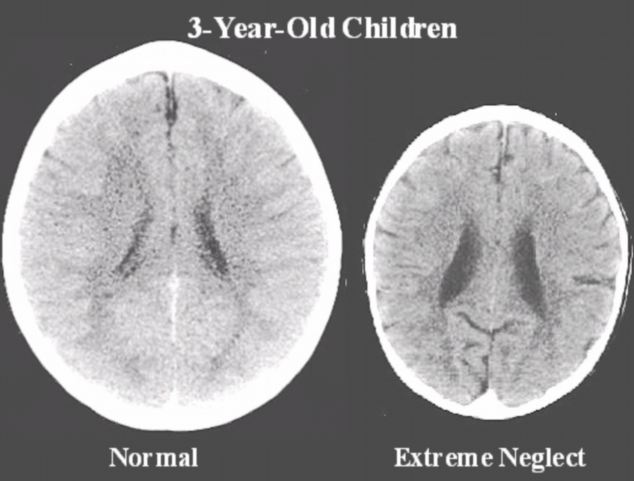

Study: brain of child neglected by mother is smaller and underdeveloped

Dina sent me this article from the UK Daily Mail.

Here is the scan:

Brain scans of 3-year old children: normal vs neglected

Excerpt:

Both of these images are brain scans of a two three-year-old children, but the brain on the left is considerably larger, has fewer spots and less dark areas, compared to the one on the right.

According to neurologists this sizeable difference has one primary cause – the way each child was treated by their mothers.

The child with the larger and more fully developed brain was looked after by its mother – she was constantly responsive to her baby, reported The Sunday Telegraph.

But the child with the shrunken brain was the victim of severe neglect and abuse.

According to research reported by the newspaper, the brain on the right worryingly lacks some of the most fundamental areas present in the image on the left.

The consequences of these deficits are pronounced – the child on the left with the larger brain will be more intelligent and more likely to develop the social ability to empathise with others.

But in contrast, the child with the shrunken brain will be more likely to become addicted to drugs and involved in violent crimes, much more likely to be unemployed and to be dependent on state benefits.

The child is also more likely to develop mental and other serious health problems.

Professor Allan Schore, of UCLA, told The Sunday Telegraph that if a baby is not treated properly in the first two years of life, it can have a fundamental impact on development.

He pointed out that the genes for several aspects of brain function, including intelligence, cannot function.

[…]The study correlates with research released earlier this year that found that children who are given love and affection from their mothers early in life are smarter with a better ability to learn.

The study by child psychiatrists and neuroscientists at Washington University School of Medicine in St. Louis, found school-aged children whose mothers nurtured them early in life have brains with a larger hippocampus, a key structure important to learning, memory and response to stress.

The research was the first to show that changes in this critical region of children’s brain anatomy are linked to a mother’s nurturing, Neurosciencenews.com reports.

The research is published online in the Proceedings of the National Academy of Sciences Early Edition.

Lead author Joan L. Luby, MD, professor of child psychiatry, said the study reinforces how important nurturing parents are to a child’s development.

I have a very good feminist non-Christian friend who sometimes comments here. I once asked her about marriage and she said that her skills would be wasting on raising children. I explained to her my view that a mother needs to stay at home with the children, and that is more important work. I expect my future wife to read all kinds of books on child care and to give the child attention, nutrition, exercise and play so that the child will grow up to be an effective Christian. Maybe I need to be clear. I am not going to spend hundreds of thousands per child with just any woman. I need a woman who can produce influential and effective Christians who will engage in the public square. And we do not entrust that job to just anyone – we want a Michele Bachmann or a Jennifer Roback Morse. Professional women who are willing to be stay-at-home moms when it’s necessary to do that.

I expect the woman I marry (if I marry) to have a college degree, and preferably a graduate degree, and a couple of years of employment. Then she has to stay home and invest in those children through the first five years at least. After that she can stay home or work as much as she thinks is beneficial to the family goals of impacting the university, the church and the public square – as well as continuing to raise those children. It’s not a waste of her talent to make the next William Lane Craig, the next Marsha Blackburn, the next Doug Axe, or the next Edith Jones.

Jennifer Roback Morse lectures on sex and sexuality at Harvard University

Dr. Jennifer Roback Morse

Dr. Morse delivers a talk based on her book “Smart Sex” at Harvard University.

The MP3 file is here. (30 Mb)

Topics:

  • the hook-up culture and its effects on men and women
  • cohabitation and its effect on marriage stability
  • balancing marriage, family and career
  • single motherhood by choice and IVF
  • donor-conceived children
  • modern sex: a sterile, recreation activity
  • the real purposes of sex: procreation and spousal unity
  • the hormone oxytocin: when it is secreted and what it does
  • the hormone vassopressin: when it is secreted and what it does
  • the sexual revolution and the commoditization of sex
  • the consumer view of sex vs the organic view of sex
  • fatherlessness and multi-partner fertility
  • how the “sex-without-relationship” view harms children

52 minutes of lecture, 33 minutes of Q&A from the Harvard students. The Q&A is worth listening to – the first question is from a gay student, and Dr. Morse pulls a William Lane Craig to defeat her objection. It was awesome! I never get tired of listening to her talk, and especially on the topics of marriage and family. She is a debater, as well (see below).

And just so everyone knows, the Wintery Knight is pro-chastity and pro-marriage. I believe in chastity and I am chaste. I recommend chastity to men who are contemplating a stable, effective marriage. The research shows that you will have a better marriage by being chaste before marriage.

Related posts