Tag Archives: Marriage

New study: cohabitation produces far inferior outcomes to marriage

Does government provide incentives for people to get married?
Is cohabitation the same thing as a lifelong marriage commitment?

This study is from the American College of Pediatricians.

The Stream writes about the study:

The American College of Pediatricians recently published a paper, Cohabitation, which cautions adolescents and young adults about the negative consequences of cohabitation for both themselves and their children, and urges parents to teach their children about the advantages of waiting until marriage.

More young people are now first cohabiting than are marrying without prior cohabitation, yet research shows that, rather than being a stepping-stone to a healthy marriage, living together before marriage (cohabitation) makes couples more likely to break-up and more likely to divorce if they do marry. It results in lower marital satisfaction and increased negative communication.  Cohabiting couples spend less time together; men are more likely to spend their time on personal pleasure than do married men.

Commitment failure:

Cohabiting couples are now less likely to later marry than 40 years ago. Controlling for other factors that increase risk of divorce, marriages preceded by cohabitation are still 50 percent more likely to end in divorce.  (Some recent studies challenge this, but are scientifically flawed and omit the raw data.)  Also 27 percent of cohabitations dissolve without marriage in the first three years.

Domestic violence:

Cohabiters commit increased violence against their partner. Women are nine times more likely to be killed by a cohabiting partner than by their husband. Severe violence is four times as common among cohabiting couples; any violence is nearly 50 percent more common among couples cohabiting before marrying and doubled among couples continuing to cohabit after five years.

Alcohol abuse:

Men who cohabit without marrying in 5 to 10 years have more than double the rate of alcohol abuse as married men; women who cohabit without marrying have 4 to 7 times the rate of alcohol abuse as married women.

Infidelity:

Cohabiters, both men and women, have rates of infidelity in the preceding year more than triple that of married spouses. Among the married, those cohabiting prior to marriage were 50 percent more likely to be unfaithful as those marrying without cohabiting.

Poverty:

Poverty is more common among cohabitating women and their children. Their male partners have both a higher unemployment rate (15 percent vs 8 percent), and work less hours if employed.

Abortion:

Cohabitating women are ten times more likely to have an abortion than married women, and suffer from its associated mortality and morbidity. In fact, 89 percent of women who have had abortions have at one time cohabited; 40 percent have lived with three or more men. Abortion also puts future children at risk, especially from extremely premature birth.

Harm to children:

Children who survive also suffer due to parental cohabitation.  They have increased risk of losing a parent to divorce or separation, possibly multiple times.  Children born of cohabiting parents are over four times more likely to suffer separation of their parents by their third birthdays (49 percent) than those born to married parents (11 percent).

[…]Nearly one-third of couples enter into cohabitation with a child from a previous relationship, as do half of those cohabitating for six years or longer. Children living with a parent and unmarried partner (live-in boyfriend) have 20 times the risk of sexual abuse and eight times the risk of all maltreatment compared to children living with married biological parents.  Even if the couple marries, stepchildren have over eight times the risk of sexual abuse and triple the overall risk of abuse of neglect. Girls living with a stepparent had 60 percent higher risk of being raped than girls living with their biological parents.

Depression:

Women in cohabiting relationships have more depression than married women, and poorer responsiveness to their children’s emotional needs.  Children whose mothers are depressed have increased cortisol responses to stress (which may explain their increased hypertension in adulthood). Children with unmarried mothers are half as likely to be breastfed, leading to higher rates of asthma, pneumonia, ear and intestinal infections, diabetes, obesity, and lower intelligence.

Please believe me when I say that you should click through to the Stream and read the entire article.

So what do I want to say about this in my 500 words? Well, I want to say that the cohabitation issue is a good opportunity for us to reason about whether there should be any rules around sexuality and relationships.

Our culture is absolutely poisoned right now with a kind of feelings-oriented non-judgmentalism that prevents debate. Everything has been reduced to people feeling “offended” and using the power of government to stifle debate. Nowhere is this more evident than on the university campus, which is the source of the problem. This hyper-tolerance and emotional non-judgmentalism leaves people open to making poor decisions that cause self-destruction and harm to others. As a result, young people are blindly accepting a script for sexuality and relationships from the culture, e.g. – Hollywood, celebrities, and ideologically-driven academics. A script made by professional story-tellers insulated from the consequences of their ideas.

As Christians, we seem to have so much trouble talking to young people about rules around sexuality and relationships. So many young people think that premarital sex is benign. That cohabitation is no big deal. And that redefining marriage cannot be opposed. Christian parents and pastors are not preparing themselves to discuss these things with young people. If there is a battle of ideas, and one side shows up with a bunch of feelings and lies, that side still wins – if the other side doesn’t show up at all. Don’t be so focused on your career and your own self that you fail your children by failing to discuss and debate with them about the issues. Don’t assume that just because your children look OK on the surface that there are not serious questions underneath.

There is so much I could say about this problem of talking to young people. As I argued in a previous post, I truly believe that apologists should not neglect these social / cultural / fiscal issues. We have to study them and know how to argue for our values using secular arguments and evidence, such as you see in the study above. Once young people have decided that Christian teachings on sexuality (e.g. – chastity, courting) are primitive and irrational, or worse, then getting them to accept Christianity becomes that much harder. And that goes double for marriage. If they think that cohabitation, no-fault divorce, same-sex marriage and gay adoption are opposed for no other reason than blind prejudice or even hatred, then we’ve lost before we even begin to make our first philosophical argument.

Sociologist Rodney Stark discusses whether religion is good for society

Let's take a look at the data
Let’s take a look at the data

Mysterious Chris S. posted this interview with Baylor University sociologist / historian Rodney Stark.

About Rodney Stark:

Rodney Stark grew up in Jamestown, North Dakota, and began his career as a newspaper reporter. Following a tour of duty in the U.S. Army, he received his Ph.D. from the University of California, Berkeley, where he held appointments as a research sociologist at the Survey Research Center and at the Center for the Study of Law and Society. He left Berkeley to become Professor of Sociology and of Comparative Religion at the University of Washington. In 2004 he joined the faculty of Baylor University. He has published 30 books and more than 140 scholarly articles on subjects as diverse as prejudice, crime, suicide, and city life in ancient Rome. However, the greater part of his work has been on religion. He is past president of the Society for the Scientific Study of Religion and of the Association for the Sociology of Religion. He also has won a number of national and international awards for distinguished scholarship. Many of his books and articles have been translated and published in foreign languages, including Chinese, Dutch, French, German, Greek, Indonesian, Italian, Japanese, Polish, Portuguese, Romanian, Spanish, and Turkish.

Education:

  • B.A. University of Denver, 1959, Journalism.
  • M.A. University of California, Berkeley, 1965, Sociology.
  • Ph.D. University of California, Berkeley, 1971, Sociology.

I don’t count sociologists as non-STEM, since they have to know statistics, which is math. Anyway, onto the interview.

Excerpt:

Q: After examining hundreds of relevant studies, what’s the biggest misconception you’ve found about the typical religious believer?

Rodney Stark: Even some leading evangelical scholars take it for granted that religious Americans are lacking in appreciation for “high culture,” for music, art, literature, and the like. Nothing could be further from the truth. The more often Americans attend religious services, the more likely they are to read newspapers, poetry, novels, and to admire writers. The same applies to liking classical music, to attending symphony concerts, operas, and stage plays, and to dislike rock ‘n roll.

Q: Some recent books, like Christopher Hitchens’ God Is Not Great, suggest that “religion poisons everything.” But your book indicates that religious belief offers society many tangible benefits. What are some of these benefits?

Rodney Stark: Religious Americans are more law abiding, have superior mental and physical health, are far more generous vis-à-vis charities, have much better family life, are more successful, and religious couples even have more satisfactory sex lives!

Q: In the book’s Conclusion you look at religion’s effect on many areas of society—crime, schooling, health, employment, welfare—and you determine that, by a conservative estimate, religion saves America over $2.6 trillion each year. What are some of the biggest contributors to this savings?

Rodney Stark: The biggest by far has to do with the criminal justice system. If all Americans committed crimes at the same level as those who do not attend religious services, the costs of the criminal justice system would about double to, perhaps, $2 trillion annually. Second is health costs. The more often people attend religious services, the healthier they are. However, the net savings involved is reduced somewhat by the fact that religious Americans live, on average, seven years longer than those who never attend religious services.

Previously, I noted how people who attend church or synagogue have much better marriage stability than atheists.

Let’s just review that with some research done by W. Bradford Wilcox:

Married couples who attend church together tend to be happier than couples who rarely or never attend services, according to sociologist W. Bradford Wilcox of the University of Virginia.

Using three nationally representative surveys – the General Social Survey (GSS), the National Survey of Families and Households (NSFH), and the National Survey of Family Growth (NSFG) – Wilcox found that married church-going Americans across denominational and racial classifications were more likely to describe themselves as “very happy” than their non-religious counterparts.

Couples who attended church regularly were also less likely to divorce than couples who seldom attended church services, Wilcox found.

“Attending church only seems to help couples when they attend together,” Wilcox told Cybercast News Service. “But when they do, they are significantly happier in their marriages, and they are much less likely to divorce, compared to couples who do not attend church. I would say that church attendance is a beneficial component of marriage when it is done together.”

Wilcox explained that regular church attendance offers certain positive benefits to a married couple: “Churches supply moral norms like sexual fidelity and forgiveness, family-friendly social networks that lend support to couples facing the ordinary joys and challenges of married life, and a faith that helps couples make sense of the difficulties in their lives-from unemployment to illness-that can harm their marriages.”

“So, in a word, the couple that prays together stays together,” said Wilcox.

[…]”Men and women who hold a religious faith and put that faith into practice by attending church on a regular basis do look different in the marital realm,” Wilcox said.

“At least in the marriage arena, faith alone doesn’t work. You’ve got to combine faith and works to enjoy a happy and stable marriage. You need the consistent message, the accountability, and the support a church community can provide to really benefit from religious faith,” he added.

This Wall Street Journal article from a while back, entitled “Look Who’s Irrational Now” argues that atheists are less skeptical than believers.

Excerpt:

The reality is that the New Atheist campaign, by discouraging religion, won’t create a new group of intelligent, skeptical, enlightened beings. Far from it: It might actually encourage new levels of mass superstition. And that’s not a conclusion to take on faith — it’s what the empirical data tell us.

“What Americans Really Believe,” a comprehensive new study released by Baylor University yesterday, shows that traditional Christian religion greatly decreases belief in everything from the efficacy of palm readers to the usefulness of astrology. It also shows that the irreligious and the members of more liberal Protestant denominations, far from being resistant to superstition, tend to be much more likely to believe in the paranormal and in pseudoscience than evangelical Christians.

The Gallup Organization, under contract to Baylor’s Institute for Studies of Religion, asked American adults a series of questions to gauge credulity. Do dreams foretell the future? Did ancient advanced civilizations such as Atlantis exist? Can places be haunted? Is it possible to communicate with the dead? Will creatures like Bigfoot and the Loch Ness Monster someday be discovered by science?

The answers were added up to create an index of belief in occult and the paranormal. While 31% of people who never worship expressed strong belief in these things, only 8% of people who attend a house of worship more than once a week did.

Even among Christians, there were disparities. While 36% of those belonging to the United Church of Christ, Sen. Barack Obama’s former denomination, expressed strong beliefs in the paranormal, only 14% of those belonging to the Assemblies of God, Sarah Palin’s former denomination, did. In fact, the more traditional and evangelical the respondent, the less likely he was to believe in, for instance, the possibility of communicating with people who are dead.

[…]Surprisingly, while increased church attendance and membership in a conservative denomination has a powerful negative effect on paranormal beliefs, higher education doesn’t. Two years ago two professors published another study in Skeptical Inquirer showing that, while less than one-quarter of college freshmen surveyed expressed a general belief in such superstitions as ghosts, psychic healing, haunted houses, demonic possession, clairvoyance and witches, the figure jumped to 31% of college seniors and 34% of graduate students.

And naturally, studies show that religious people are both more generous than their secular counterparts.

Can blacks and Hispanics blame their troubles on racism by whites?

Does government provide incentives for people to get married?
The success of children is due to their parents’ choices, not from outside racism

If the underperformance of blacks and Hispanics in America were caused by racism by whites, then it follows that Asian-Americans would be underperforming as well. But Asian-Americans are outperforming whites. Let’s look at three reasons why, and see if blacks and Hispanics can learn how to succeed by looking at the Asian example.

Here is the summary of this post:

  1. Asian Americans marry before they have children
  2. Asian Americans save more of what they earn
  3. Asian Americans monitor their children’s educational progress

Now let’s take a look at each of these in order.

Asians marry before they have children, so the kids have two parents

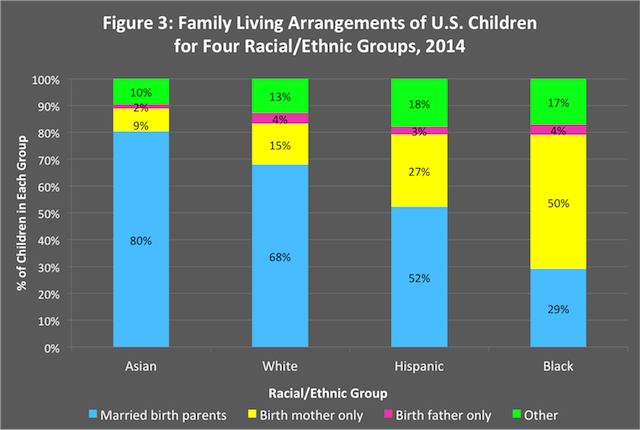
1. Asian Americans marry before they have children

This article is from Family Studies.

It says:

Eight in ten Asian-American kids live with married birth parents, compared with about seven in ten European-American kids, five in ten Hispanic-American kids, and only about three in ten African-American kids. Half of black children live with their mothers only, compared to three in ten Hispanic children, less than two in ten white children and less than one in ten Asian children.

Naturally, children who have two parents to look after them do better, because one parent alone cannot work and do household chores and monitor the children as easily as two parents can. The decision about whether to have sex before marriage is entirely under the control of the grown-ups. It cannot be blamed on racism, poverty and other non-moral pre-occupations of the secular left. Marriage is a moral issue, and Asian-Americans do the moral thing, and marry before they have children.

Asian household wealth set to surpass whites

2. Asian Americans save more of what they earn

This article from CNN Money explains:

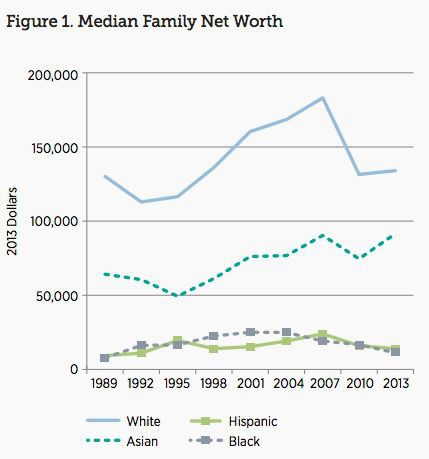
Asians have had higher median incomes than their white counterparts, according to a new study by the Federal Reserve Bank of St. Louis. The typical Asian family has brought home more money for most of the past two decades.

[…][Asians] will surpass whites in net worth in the next decade or two, Fed researchers said.

[…]In 1989, the median Asian family had about half the net worth of its white peer. By 2013, they had more than two-thirds.

The gap between whites and blacks and Hispanics, meanwhile, remained little changed over that time period.

Asians have similar financial habits to whites, in terms of investing and borrowing. Both groups are more likely than blacks and Hispanics to invest in stocks and privately-owned businesses and to have more liquid assets, which serves as a buffer against financial shocks. And, on average, the former have about half as much debt as the later.

As a result, Asians and whites have more financial stability than blacks and Hispanics, which also allows the former to build more wealth.

Everyone has to earn and save money, but in some cultures, it becomes normal to not save part of what you earn. That needs to stop. But it has nothing to do with discrimination due to skin color. In Asian culture, there is no glorification of consumer spending on sparkles, bling and other ostentatious wealth. Asians don’t want to appear to be wealthy, they want to actually be wealthy – by saving money.

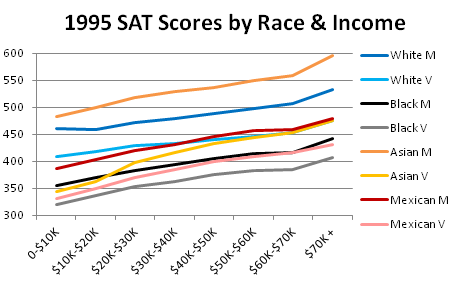
Composite SAT scores by race and income levels
Composite SAT scores by race and income levels: Asians outperform at every income level

3. Asian Americans monitor their children’s educational progress

This article from Investors Business Daily explains how Asian parents don’t just make demands on their kids to learn, they actively monitor their progress and talk to their kids’ teachers:

Asian-American parents tend to oversee their children’s homework, hold them accountable for grades and demand hard work as the ticket to a better life. And it pays off: Their children are soaring academically.

[…]As a group, Americans need to take a page from the Asian parents’ playbook. American teens rank a dismal 28th in math and science knowledge, compared with teens in other countries, even poor countries.

Singapore, Hong Kong, South Korea, Japan and Taiwan are at the top. We’ve slumped. For the first time in 25 years, U.S. scores on the main test for elementary and middle school education (NAEP) fell. And SAT scores for college-bound students dropped significantly.

[…]Many [Asian students]from poor or immigrant families, but they outscore all other students by large margins on both tests, and their lead keeps widening.

In New York City, where Asian-Americans make up 13% of overall students, they win more than 50% of the coveted places each year at the city’s eight selective public high schools, such as Bronx Science and Stuyvesant.

What’s at work here? It’s not a difference in IQ. It’s parenting. That’s confirmed by sociologists from City University of New York and the University of Michigan. Their study showed that parental oversight enabled Asian-American students to far outperform the others.

No wonder many successful charter schools require parents to sign a contract that they will supervise their children’s homework and inculcate a work ethic.

You can see an updated image with the latest scores here.

It’s not enough to just outsource the education of your children to a bunch of non-STEM education-degree-holding teachers. Teachers can be good, and some work very hard. But the Democrat teacher unions prevent the firing of teachers who underperform. This is especially true in non-right-to-work states (Democrat states). So, you cannot depend on teachers to educate your children, and Asian parents don’t. That’s why their kids learn. Performance of children in school is not affected by discrimination against skin color, it’s affected by the level of involvement of parents.

Conclusion

We have learned that the success of Asian-Americans in America is all earned. And this proves that there is no such thing as “racism” that holds back non-whites. If blacks and Hispanics imitated the behaviors of Asians (not whites, but Asians), then they would achieve just as well as Asians do. It’s not a race problem, it’s a behavior problem. It’s not a “racism” problem, it’s a behavior problem. It’s an us problem, it’s not a them problem.