
Tag Archives: Manufacturing

Men are the biggest losers in the recession

From the American Spectator.

Excerpt:

Over the past decade, the total number of jobs for women went up by close to a million. Meanwhile, men lost more than 3 million jobs. From 1960 to 2008, the average unemployment rate for men 25 years and older was 4.2 percent. In the last two years, it has more than doubled, shooting up to 8.9 percent. By contrast, unemployment for women of the same age and for the same period of time went from 4.7 percent to 7.2 percent, an increase of 52 percent. The disparity is more striking if one considers that women’s rate of participation in the workforce has risen sharply since 1960 while the percentage of men in the job market has been shrinking.

One reason that men’s employment rate lags behind is that there has been negative growth in the types of jobs men historically have occupied. In the last 10 years, 5.5 million manufacturing jobs were lost. That’s one-third of our manufacturing base in an industry where men make up 70 percent of the workforce. In construction, where 87 percent of positions are filled by men, more than 1.4 million jobs went away during that time frame. Approximately 4.4 million jobs have been added in the education and health care sectors, but women dominate this growing field as they make up 77 percent of the work force.

It’s working-class men, not those who occupy elite positions in finance and government, who are suffering. The hemorrhaging of manufacturing and other well-paying jobs in America means that a rising number of young American men face dwindling prospects for earning a middle-class wage in the future. Young male unemployment is at 19 percent. More than 15 percent of Iraq and Afghanistan war veterans (most of whom are male) were unemployed in January 2011. African-American males also have been hit hard. Ten years ago, both African-American men and women had the same unemployment rate of 8.2 percent. Since then, the men’s rate has more than doubled and now is almost four points higher than the unemployment rate for women. Similarly, Hispanic men now have a 1.7 percent higher unemployment rate than Hispanic women, whom they historically have outperformed.

With growing numbers of out-of-work young men comes a volatile mix of negative social outcomes: they are less likely to marry, less likely to be a stable parental force for the children they father, and more likely to engage in violent behavior.

One would think that Washington policymakers would see these developments as a cause for concern. Nonetheless, for more than a decade, they have looked the other way as good American jobs have been shipped overseas, outsourced or have simply gone away. Ironically, our business tax system incentivizes our companies to export jobs and prosperity overseas. Also, our government welfare system all but discourages an intact family of a father and mother by the way it distributes money.

Men are not going to be able to fulfill their roles of protector, provider and moral/spiritual leader if they do not have the authority that comes from being the principle/sole breadwinner in the family. Right now, we have a situation where the schools are discriminating against men by having a tiny minority of male teachers, as well as co-ed classrooms. Men cannot learn as well when they are taught primarily by women and are distracted by female peers and do not have a separate male-focused curriculum. And that is why men now earn 40% of bachelor degrees on many campuses. Government’s massive spending and job-killing policies leave the few men who can graduate in an unstable employment situation where marriage becomes too risky. De-valuing a man’s savings with inflation doesn’t help, either.
New poll finds one third of young New Yorkers plan to leave state

Eastern United States Map

From CBS News.

Excerpt:

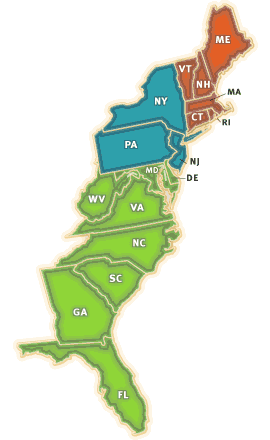
A New York poll provides grim evidence of a continuing exodus from the state, once the national leader in manufacturing and other high-paying jobs.

The NY1-YNN-Marist College poll released Thursday night finds 1 in 3 New Yorkers under age 30 plans to move to another state at some time, while 1 in 4 adults overall plans an exodus from the Empire State within five years.

“Right now, many young people do not see their future in New York state,” said Marist pollster Lee Miringoff. “Unchecked, this threatens to drain the state of the next generation.”

According to the survey, most of those who plan to move will do so because of economic reasons including jobs, the cost of living, and taxes. Although the recession has been officially over for months, many New Yorkers still feel the worst is yet to come.

Thirty-seven percent of New Yorkers polled feel the economy is getting worse, up from 31 percent in February’s poll. The number who feels the economy is improving dropped to 16 percent, from 19 percent in February.

[…]The American Legislative Exchange Council reported that New York lost 1.9 million residents from 1998 to 2007, most of them young and educated.

Why is this happening?

Mary sent me this article from the Manhattan Institute, which gives some clues.

Excerpt:

For one thing, according to a recent survey in Chief Executive, New York State has the second-worst business climate in the country. (Only California ranks lower.) People go where the jobs are, so when a state repels businesses, it repels residents, too. It’s also telling that in the Marist poll, 62 percent of New Yorkers planning to leave cited economic factors—including cost of living (30 percent), taxes (19 percent), and the job environment (10 percent)—as the primary reason.

In upstate New York, a big part of the problem is extraordinarily high property taxes. New York has the 15 highest-taxed counties in the country, including Nassau and Westchester, which rank first and second nationwide. Most of the property tax goes toward paying the state’s Medicaid bill—which is unlikely to diminish, since the state’s most powerful lobby, the political cartel created by the alliance of the hospital workers’ union and hospital management, has gone unchallenged by new governor Andrew Cuomo.

[…]Parts of the country are seeing a revival of manufacturing—traditionally a source of upward mobility for immigrants—but not New York City, whose manufacturing continues to decline. The culprits here include the city’s zoning policies, business taxes, and declining physical infrastructure.

Then there’s the cost of living in New York City. A 2009 report by the Center for an Urban Future found that “a New Yorker would have to make $123,322 a year to have the same standard of living as someone making $50,000 in Houston. In Manhattan, a $60,000 salary is equivalent to someone making $26,092 in Atlanta.” Even Queens, the report found, was the fifth most expensive urban area in the country.

In completely unrelated news, the Democrats just won another seat in New York state due to the incompetence of the state Republican party.

We’ve become a nation of takers, not makers

From moderate conservative Stephen Moore, writing in the Wall Street Journal. (H/T ECM)

Excerpt:

If you want to understand better why so many states—from New York to Wisconsin to California—are teetering on the brink of bankruptcy, consider this depressing statistic: Today in America there are nearly twice as many people working for the government (22.5 million) than in all of manufacturing (11.5 million). This is an almost exact reversal of the situation in 1960, when there were 15 million workers in manufacturing and 8.7 million collecting a paycheck from the government.

It gets worse. More Americans work for the government than work in construction, farming, fishing, forestry, manufacturing, mining and utilities combined. We have moved decisively from a nation of makers to a nation of takers. Nearly half of the $2.2 trillion cost of state and local governments is the $1 trillion-a-year tab for pay and benefits of state and local employees. Is it any wonder that so many states and cities cannot pay their bills?

Every state in America today except for two—Indiana and Wisconsin—has more government workers on the payroll than people manufacturing industrial goods. Consider California, which has the highest budget deficit in the history of the states. The not-so Golden State now has an incredible 2.4 million government employees—twice as many as people at work in manufacturing. New Jersey has just under two-and-a-half as many government employees as manufacturers. Florida’s ratio is more than 3 to 1. So is New York’s.

Even Michigan, at one time the auto capital of the world, and Pennsylvania, once the steel capital, have more government bureaucrats than people making things. The leaders in government hiring are Wyoming and New Mexico, which have hired more than six government workers for every manufacturing worker.

Now it is certainly true that many states have not typically been home to traditional manufacturing operations. Iowa and Nebraska are farm states, for example. But in those states, there are at least five times more government workers than farmers. West Virginia is the mining capital of the world, yet it has at least three times more government workers than miners. New York is the financial capital of the world—at least for now. That sector employs roughly 670,000 New Yorkers. That’s less than half of the state’s 1.48 million government employees.

The problem with having a high number of government workers is that government workers don’t actually produce anything to sell. They pay the salaries of their workers by taking a percentage of the money that productive business make when they sell customers useful things like cell phones and laptops and automobiles.

This article is the second most popular on the Wall Street Journal. Recommended.