Judging from the coverage of Rick Santorum’s presidential campaign over the last few weeks, you might think that the former Pennsylvania Senator’s numbers would be cratering among women.
But you would be wrong. Way wrong.
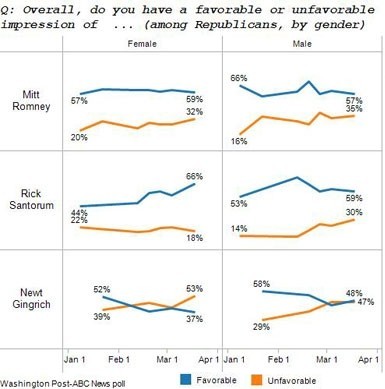
In a new Washington Post-ABC poll, Santorum’s numbers among Republican and Republican-leaning women have soared over the past month. He now has the highest favorability rating among that group of any of the top-tier Republican presidential candidates.
[…]The poll numbers reinforce findings from recent exit polls that suggest Santorum is holding steady — if not strengthening — among Republican women. In Alabama, Santorum beat former Massachusetts governor Mitt Romney by eight points among women; in Mississippi, Santorum took 35 percent among women to 32 percent for Romney.
[…]The third potential reason for Santorum’s improved position among Republican women is that he has successfully framed the issue as one of government imposing on people’s personal beliefs — an argument that hits home with the GOP base. Karen Santorum, the candidate’s wife, made that case during an appearance on CNN Monday night. “I think the issue is the government forcing people to go against their conscience,” she said. “That’s really the issue here.”
Regardless of the reason, it’s clear that Santorum’s comments have not hurt him one bit with his target audience at the moment: Republicans — and, in particular, Republican women.
Now, why do you suppose that you have been hearing so much from the mainstream media about women voters not supporting Santorum? Well, it’s because of liberal media bias, and this is not my opinion, it’s a fact.
This section only protects the teaching of scientific information, and shall not be construed to promote any religious or non-religious doctrine, promote discrimination for or against a particular set of religious beliefs or non-beliefs, or promote discrimination for or against religion or non-religion.
And here’s how it was reported by the secular leftist mainstream media: (links removed)
The Guardian writes that the bill “comes at a time when science associations are increasingly concerned by moves to inject religious or ideological beliefs into science teaching…”
The Huffington Post has two pieces, one with the outlandish title “Tennessee Science Bill Allowing Discussion of Creationism in Schools Passes State Senate,” and another that states the bill would bring “religious doctrine within the public school system.”
OpposingViews.com carries a piece titled “Tennessee Bill to Push Creationism in Schools,” which states: “Tennessee lawmakers have revived a scary bill that would open the door to promotion of creationism in public schools.”
The Times Daily, a Tennessee paper, has an op-ed claiming the bill is “a ploy to subvert science in favor of theology” where “Critics of the bills say the door is being opened in Tennessee schools for teaching religious views.”
And the far-left ThinkProgress.org has a sky-is-falling piece stating: “Critics call it a ‘monkey bill’ that promotes creationism in classrooms.”
Let’s review the research on media bias, so we understand how unreliable the mainstream media can be.
Of the 20 major media outlets studied, 18 scored left of center, with CBS’ “Evening News,” The New York Times and the Los Angeles Times ranking second, third and fourth most liberal behind the news pages of The Wall Street Journal.
Only Fox News’ “Special Report With Brit Hume” and The Washington Times scored right of the average U.S. voter.
The most centrist outlet proved to be the “NewsHour With Jim Lehrer.” CNN’s “NewsNight With Aaron Brown” and ABC’s “Good Morning America” were a close second and third.
“Our estimates for these outlets, we feel, give particular credibility to our efforts, as three of the four moderators for the 2004 presidential and vice-presidential debates came from these three news outlets — Jim Lehrer, Charlie Gibson and Gwen Ifill,” Groseclose said. “If these newscasters weren’t centrist, staffers for one of the campaign teams would have objected and insisted on other moderators.”
The fourth most centrist outlet was “Special Report With Brit Hume” on Fox News, which often is cited by liberals as an egregious example of a right-wing outlet. While this news program proved to be right of center, the study found ABC’s “World News Tonight” and NBC’s “Nightly News” to be left of center. All three outlets were approximately equidistant from the center, the report found.
“If viewers spent an equal amount of time watching Fox’s ‘Special Report’ as ABC’s ‘World News’ and NBC’s ‘Nightly News,’ then they would receive a nearly perfectly balanced version of the news,” said Milyo, an associate professor of economics and public affairs at the University of Missouri at Columbia.”
The programming studied on Fox News offered a somewhat more positive picture… of Republicans and more negative one of Democrats compared with other media outlets. Fox News stories about a Republican candidate were most likely to be neutral (47%), with the remainder more positive than negative (32% vs. 21% negative). The bulk of that positive coverage went to Giuliani (44% positive), while McCain still suffered from unflattering coverage (20% positive vs. 35% negative).
When it came to Democratic candidates, the picture was more negative. Again, neutral stories had a slight edge (39%), followed by 37% negative and 24% positive. And, in marked contrast from the rest of the media, coverage of Obama was twice as negative as positive: 32% negative vs. 16% positive and 52% neutral.
But any sense here that the news channel was uniformly positive about Republicans or negative about Democrats is not manifest in the data.”
From the Daily Caller, a study of the political contributions made by the mainstream media.
Excerpt:
Senior executives, on-air personalities, producers, reporters, editors, writers and other self-identifying employees of ABC, CBS and NBC contributed more than $1 million to Democratic candidates and campaign committees in 2008, according to an analysis by The Examiner of data compiled by the Center for Responsive Politics.
The Democratic total of $1,020,816 was given by 1,160 employees of the three major broadcast television networks, with an average contribution of $880.
By contrast, only 193 of the employees contributed to Republican candidates and campaign committees, for a total of $142,863. The average Republican contribution was $744.
Disclosure of the heavily Democratic contributions by influential employees of the three major broadcast networks follows on the heels of controversy last week when it was learned that media baron Rupert Murdoch’s News Corp. contributed $1 million to the Republican Governors Association.
The News Corp. donation prompted Nathan Daschle, executive director of the Democratic Governors Association and son of former Senate Majority Leader Tom Daschle, to demand in a letter to Fox News chairman Roger Ailes that the cable news outlet include a disclaimer in its coverage of gubernatorial campaigns. Fox News is owned by News Corp., which also owns The Wall Street Journal.
MSNBC.com identified 143 journalists who made political contributions from 2004 through the start of the 2008 campaign, according to the public records of the Federal Election Commission. Most of the newsroom checkbooks leaned to the left: 125 journalists gave to Democrats and liberal causes. Only 16 gave to Republicans. Two gave to both parties.
The donors include CNN’s Guy Raz, now covering the Pentagon for NPR, who gave to Kerry the same month he was embedded with U.S. troops in Iraq; New Yorker war correspondent George Packer; a producer for Bill O’Reilly at Fox; MSNBC TV host Joe Scarborough; political writers at Vanity Fair; the editor of The Wall Street Journal’s weekend edition; local TV anchors in Washington, Minneapolis, Memphis and Wichita; the ethics columnist at The New York Times; and even MTV’s former presidential campaign correspondent.
And here’s a bit from that same article about The New Yorker:
The last bulwark against bias’s slipping into The New Yorker is the copy department, whose chief editor, Ann Goldstein, gave $500 in October to MoveOn.org, which campaigns for Democrats and against President Bush. “That’s just me as a private citizen,” she said. As for whether donations are allowed, Goldstein said she hadn’t considered it. “I’ve never thought of myself as working for a news organization.”
I’m seeing a lot of ignorance in the mainstream media, including in the conservative media, and even from some Republican politicians. So it’s time to set the record straight on what Mormons and Christians really believe.
Do Mormons and Christians have the same beliefs?
First, let’s take a look at what the founder of Mormonism, Joseph Smith, believes about the origin of the universe:
“The elements are eternal. That which had a beggining will surely have an end; take a ring, it is without beggining or end – cut it for a beggining place and at the same time you have an ending place.” (“Scriptural Teachings of the Prophet Joseph Smith”, p. 205)
“Now, the word create came from the word baurau which does not mean to create out of nothing; it means to organize; the same as a man would organize materials and build a ship. Hence, we infer that God had materials to organize the world out of chaos – chaotic matter, which is element, and in which dwells all the glory. Element had an existance from the time he had. The pure principles of element are principles which can never be destroyed; they may be organized and re-organized, but not destroyed. They had no beggining, and can have no end.”
(“Scriptural Teachings of the Prophet Joseph Smith”, p. 395)
A Mormon scholar named Blake Ostler summarizes the Mormon view in a Mormon theological journal:
“In contrast to the self-sufficient and solitary absolute who creates ex nihilo (out of nothing), the Mormon God did not bring into being the ultimate constituents of the cosmos — neither its fundamental matter nor the space/time matrix which defines it. Hence, unlike the Necessary Being of classical theology who alone could not not exist and on which all else is contingent for existence, the personal God of Mormonism confronts uncreated realities which exist of metaphysical necessity. Such realities include inherently self-directing selves (intelligences), primordial elements (mass/energy), the natural laws which structure reality, and moral principles grounded in the intrinsic value of selves and the requirements for growth and happiness.” (Blake Ostler, “The Mormon Concept of God,” Dialogue: A Journal of Mormon Thought 17 (Summer 1984):65-93)
So, Mormons believe in an eternally existing universe, such that matter was never created out of nothing, and will never be destroyed.
What do the best Christian theologians believe about the origin of the universe?
“By what means did you make heaven and earth? What tool did you use for this vast work? You did not work as a human craftsman does, making one thing out of something else as his mind directs… Nor did you have in your hand any matter from which you could make heaven and earth, for where could you have obtained matter which you had not yet created, in order to use it as material for making something else? It must therefore be that you spoke and they were made. In your Word you created them.” (Augustine, Confessions 11.5.7.)
“As said above (Question 44, Article 2), we must consider not only the emanation of a particular being from a particular agent, but also the emanation of all being from the universal cause, which is God; and this emanation we designate by the name of creation. Now what proceeds by particular emanation, is not presupposed to that emanation; as when a man is generated, he was not before, but man is made from “not-man,” and white from “not-white.” Hence if the emanation of the whole universal being from the first principle be considered, it is impossible that any being should be presupposed before this emanation. For nothing is the same as no being. Therefore as the generation of a man is from the “not-being” which is “not-man,” so creation, which is the emanation of all being, is from the “not-being” which is “nothing”.” (Summa Theologica, part 1, question 45)
“Let this, then, be maintained in the first place, that the world is not eternal, but was created by God.” (John Calvin, Genesis)
“We firmly believe and simply confess that there is only one true God … the Creator of all things visible and invisible, spiritual and corporeal; who from the very beginning of time by His omnipotent power created out of nothing both the spiritual beings and the corporeal.” (The Fourth Lateran Council of 1215)
So who is right? Has the universe always existed or did it come into being out of nothing?
Breaking the tie
To break the tie, we must use the ordinary tools of investigation – logic, science, historical methods, and so on. Let’s use science this time.
The standard Big Bang model thus describes a universe which is not eternal in the past, but which came into being a finite time ago. Moreover,–and this deserves underscoring–the origin it posits is an absolute origin ex nihilo. For not only all matter and energy, but space and time themselves come into being at the initial cosmological singularity. As Barrow and Tipler emphasize, “At this singularity, space and time came into existence; literally nothing existed before the singularity, so, if the Universe originated at such a singularity, we would truly have a creation ex nihilo.“
[…]On such a model the universe originates ex nihilo in the sense that at the initial singularity it is true that There is no earlier space-time point or it is false that Something existed prior to the singularity.
Christian cosmology requires such a creation out of nothing, but this is clearly incompatible with what Mormons believe about the universe. The claims about the universe made by the two religions are in disagreement, and we can test empirically to see who is right, using science.
Taking religion seriously
You can find other disagreements between Christianity and Mormonism, if you are not so busy putting on make-up like politicians and journalists are. For example, Christianity is monotheistic (one God) and Mormonism is polytheistic (many gods). That means Mormonism is more like Hinduism than it is like Christianity – Mormonism and Hinduism even agree on the eternally oscillating universe. You can read all about it, with citations from Mormon scholars, in this article, authored by Baylor University professor Francis J. Beckwith. Or you could take a look at the history of Mormonism, and see if the claims made in the religious texts of Mormonism are historical. Or you could take a look at the prophetic claims of the founder of Mormonism and see if they were accurate.
Here’s an examination of the historical basis for the Mormon Scriptures, for example:
This is how responsible people evaluate religions to see whether they are all the same as the others, and, more importantly, if one is true. The point of religion is not to make people feel good, or to make them have a sense of community. The point of religion is to know how we got here, where we are going, and what we are supposed to be doing – as matters of fact.
As long as you don’t assume, before doing any research, that all religions are the same, and that all of their claims are equally untestable, then you can actually investigate things and come to some conclusions. Investigating is good, but watching debates with different views that feature public, testable evidence is also a good idea. The important thing is that you are serious about evaluating the testable claims of different religions, and that you don’t assume that choosing a religion is just like taste in clothes or taste in food, which varies by time and place and is really not making objective propositional claims about reality, instead of subjective claims about individual tastes and preferences. Just because you were born into a country that believed that the Earth was flat (or round) that wouldn’t take away the obligation on you to test those views and go looking at other views using the tools of logic, science and historical analysis.

 WINTERY KNIGHT