Tag Archives: Life

Astronomer Guillermo Gonzalez lectures on intelligent design and habitability

Christianity and the progress of science

Here is a lecture that talks about intelligent design and eclipses. There are 5 video clips that make up the full lecture.

The playlist for all 5 clips is here.

About the speaker

Guillermo Gonzalez is an Associate Professor of Physics at Grove City College. He received his Ph.D. in Astronomy in 1993 from the University of Washington. He has done post-doctoral work at the University of Texas, Austin and at the University of Washington and has received fellowships, grants and awards from such institutions as NASA, the University of Washington, the Templeton Foundation, Sigma Xi (scientific research society) and the National Science Foundation.

Learn more about the speaker here.

The lecture

Here’s part 1 of 5:

And the rest are here:

Total time: 43 minutes.

Topics:

  • What is the Copernican Principle?
  • Is the Earth’s suitability for hosting life rare in the universe?
  • Does the Earth have to be the center of the universe to be special?
  • How similar to the Earth does a planet have to be to support life?
  • What is the definition of life?
  • What are the three minimal requirements for life of any kind?
  • Requirement 1: A molecule that can store information (carbon)
  • Requirement 2: A medium in which chemicals can interact (liquid water)
  • Requirement 3: A diverse set of chemical elements
  • What is the best environment for life to exist?
  • Our place in the solar system: the circumstellar habitable zone
  • Our place in the galaxy: the galactic habitable zones
  • Our time in the universe’s history: the cosmic habitable age
  • Other habitability requirements (e.g. – metal-rich star, massive moon, etc.)
  • The orchestration needed to create a habitable planet
  • How different factors depend on one another through time
  • How tweaking one factor can adversely affect other factors
  • How many possible places are there in the universe where life could emerge?
  • Given these probabilistic resources, should we expect that there is life elsewhere?
  • How to calculate probabilities using the “Product Rule”
  • Can we infer that there is a Designer just because life is rare? Or do we need more?

The corelation between habitability and measurability.

  • Are the habitable places in the universe also the best places to do science?
  • Do the factors that make Earth habitable also make it good for doing science?
  • Some places and times in the history of the universe are more habitable than others
  • Those exact places and times also allow us to make scientific discoveries
  • Observing solar eclipses and structure of our star, the Sun
  • Observing stars and galaxies
  • Observing the cosmic microwave background radiation
  • Observing the acceleration of the universe caused by dark matter and energy
  • Observing the abundances of light elements like helium of hydrogen
  • These observations support the big bang and fine-tuning arguments for God’s existence
  • It is exactly like placing observatories on the tops of mountains
  • There are observers existing in the best places to observe things
  • This is EXACTLY how the universe has been designed for making scientific discoveries

This lecture was delivered by Guillermo Gonzalez in 2007 at the University of California at Davis. If you like this lecture, but maybe want something a bit more user friendly, check out “The Privileged Planet” DVD, or watch it online here (first 60 minutes of that video).
What did early church fathers think about abortion and infanticide?

Unborn Baby - 10 weeks old
Unborn Baby – 10 weeks old

I noticed that the Southern Baptists over at ERLC had a post up which seemed to say that preaching against abortion was morally wrong, because it hurts women’s feelings. This didn’t seem like a very traditional Christian view to me.

The author Phoebe Cates writes:

So, you don’t have to post internet memes and videos, display bumper stickers, or make rude comments to tell me how terrible abortion is. Nor do you need to shout it from street corners or pulpits—I know. My mother knows. Over 66% of women know.

I quoted her from Pulpit and Pen, and it looks like the post has been edited to remove this shaming of pro-life apologists.

The author thinks that women do think abortion is wrong, despite the fact that young, unmarried women vote overwhelmingly for abortion rights in elections. Her goal doesn’t seem to be to convince women not to have abortions by making a case for the right to life of the unborn. Her goal seems to be to stop Christians from making women feel judged when they kill their children. Her focus is on women’s feelings, not the right to life of unwanted children.

The church has been changing a lot lately to accept the teachings of radical feminism. Radical feminism urges women to abandon chastity, delay marriage, get on birth control, and have reckless recreational sex with attractive, no-commitment men, while pursuing their careers. And abortion is fine with these Christians, because they think it’s just a method of birth control to be used to help women to avoid being “punished with a baby” as Obama said. The concern of these Christians about abortion isn’t that it kills babies, it’s that women feel judged when they kill babies.

So, what did Christians used to believe about protecting children before they tossed out the Bible for radical feminism?

This is from Birds of the Air.

Summary:

Recently I came across a reading of the Didache. “The what?” you may ask. The Didache is a book written somewhere in the first or second century. For a long time it was up for consideration as Scripture. It was believed to be the Teaching of the Twelve Apostles. Eventually it was agreed that the book was an excellent book, but not inspired Scripture. So I was pleased to be able to download this admirable book containing good teachings from the early Church fathers.

The book seemed to be largely a lot of quotes from Scripture. You’ll learn the basic rules of Christianity — “First, you shall love God who made you; second, love your neighbor as yourself.” You’ll learn that “grave sins” are forbidden, like adultery, murder, fornication, and so on. (They specifically include pederasty in the list.) There are instructions regarding teachers, prophets, Christian assembly, and so on. Lots of the normal, good stuff. But, since this was written sometime prior to 200 AD, I was somewhat surprised at this instruction: “You shall not murder a child by abortion” (Didache, Ch 2).

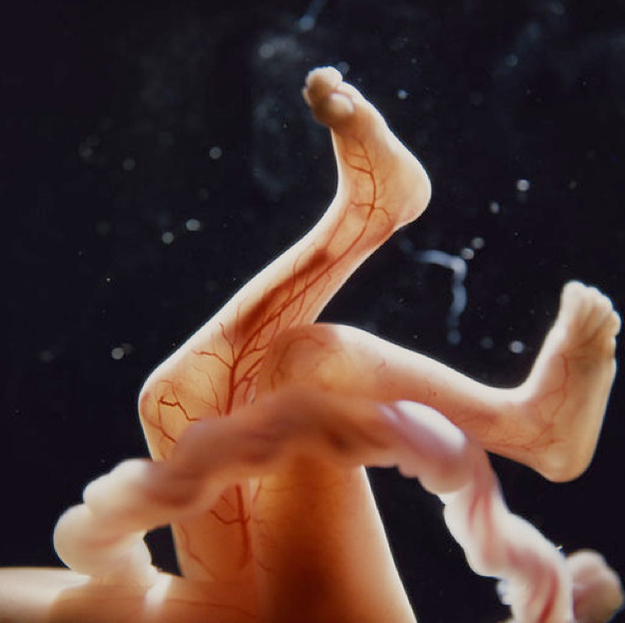
I got curious about what babies look like when they are just a few weeks old, so I went looking for pictures of them.

This post from Life News has ten excellent pictures of life inside the womb.

Here’s my favorite from 10 weeks:

Unborn Baby - 10 weeks old

Unborn Baby – 10 weeks old

This is a first trimester baby!

I decided to go hunting to see what is developed at this time, and found this list:

  • From this week until birth, the developing organism is called a fetus.
  • The fetus is now the size of a small strawberry.
  • The feet are 2mm long (one tenth of an inch).
  • The neck is beginning to take shape.
  • The body muscles are almost developed. Baby has begun movement.
  • While still too small for you to feel, your little one is wriggling and shifting.
  • The jaws are in place. The mouth cavity and the nose are joined.
  • The ears and nose can now be seen clearly.
  • Fingerprints are already evident in the skin.
  • Nipples and hair follicles begin to form.

The unborn baby is now called a fetus. Though the fetus is constantly moving, you will not be able to actually feel fetal movement for several more weeks. All of the organs, muscles, and nerves are in place and beginning to function. As the hands and feet develop fingers and toes, they have lost their paddle like look. The touch pads on the fingers form and already have fingerprints.

During this week of pregnancy the crown to rump length of the fetus is 0.9 inch to 1.2 inches (22 to 30mm), weight 0.07 ounce (2gm). They are now on the way to forming their testicles or ovaries, getting ready for the next generation. Until the ninth week of fetus development, the fetal reproductive apparatus is the same one for the both sexes. The head is still large and curves into chest.

Each week your uterus grows larger with the baby growing inside it. You may begin to see your waistline growing thicker by this time. A pelvic exam will detect that your uterus has grown from it’s normal, size of your fist, to a little bigger than a grapefruit.

Fascinating!

Stephen C. Meyer lectures on intelligent design and the origin of life

Christianity and the progress of science

A MUST-SEE lecture based on Dr. Stephen C. Meyer’s book “Signature in the Cell“.

I highly recommend watching the lecture, and looking at the slides. The quality of the video and the content is first class. There is some Q&A (9 minutes) at the end of the lecture.

Topics:

  • intelligent design is concerned with measuring the information-creating capabilities of natural forces like mutation and selection
  • Darwinists think that random mutations and natural selection can explain the origin and diversification of living systems
  • Darwinian mechanisms are capable of explaining small-scale adaptive changes within types of organisms
  • but there is skepticism, even among naturalists, that Darwinian mechanisms can explain the origin of animal designs
  • even if you concede that Darwinism can account for all of the basic animal body plans, there is still the problem of life’s origin
  • can Darwinian mechanisms explain the origin of the first life? Is there a good naturalistic hypothesis to explain it?
  • there are at least two places in the history of life where new information is needed: origin of life, and Cambrian explosion
  • overview of the structure of DNA and protein synthesis (he has helpful pictures and he uses the snap lock blocks, too)
  • the DNA molecule is composed of a sequence of bases that code for proteins, and the sequence is carefully selected to have biological function
  • meaningful sequences of things like computer code, English sentences, etc. require an adequate cause
  • it is very hard to arrive at a meaningful sequence of a non-trivial length by randomly picking symbols/letters
  • although any random sequence of letters is improbable, the vast majority of sequences are gibberish/non-compiling code
  • similarly, most random sequences of amino acids are lab-proven (Doug Axe’s work) to be non-functional gibberish
  • the research showing this was conducted at Cambridge University and published in the Journal of Molecular Biology
  • so, random mutation cannot explain the origin of the first living cell
  • however, even natural selection coupled with random mutation cannot explain the first living cell
  • there must already be replication in order for mutation and selection to work, so they can’t explain the first replicator
  • but the origin of life is the origin of the first replicator – there is no replication prior to the first replicator
  • the information in the first replicator cannot be explained by law, such as by chemical bonding affinities
  • the amino acids are attached like magnetic letters on a refrigerator
  • the magnetic force sticks the letters ON the fridge, but they don’t determine the specific sequence of the letters
  • if laws did determine the sequence of letters, then the sequences would be repetitive
  • the three materialist explanations – chance alone, chance and law, law alone – are not adequate to explain the effect
  • the best explanation is that an intelligent cause is responsible for the biological explanation in the first replicator
  • we know that intelligent causes can produce functional sequences of information, e.g. – English, Java code
  • the structure and design of DNA matches up nicely with the design patterns used by software engineers (like WK!)

There are some very good tips in this lecture so that you will be able to explain intelligent design to others in simple ways, using everyday household items and children’s toys to symbolize the amino acids, proteins, sugar phosphate backbones, etc.

Proteins are constructed from a sequence of amino acids:

A sequence of amino acids forming a protein

Proteins sticking onto the double helix structure of DNA:

Some proteins sticking onto the sugar phosphate backbone

I highly, highly recommend this lecture. You will be delighted and you will learn something.

Here is an article that gives a general overview of how intelligent design challenges. If you want to read something more detailed about the material that he is covering in the lecture above related to the origin of life, there is a pretty good article here.

There is a good breakdown of some of the slides with helpful flow charts here on Uncommon Descent.

Positive arguments for Christian theism