
Tag Archives: Jobs

Wage gap: are women paid less than men because of discrimination?

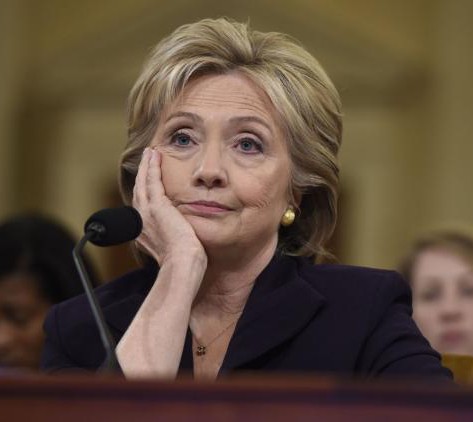
Hillary Clinton look bored about the deaths of 4 Americans who asked for her help
Hillary Clinton thinks that women are not paid fairly compared to men: is it true?

Liberal feminist Hanna Rosin takes a look at this question in the far-left Slate, of all places.

Excerpt:

The official Bureau of Labor Department statistics show that the median earnings of full-time female workers is 77 percent of the median earnings of full-time male workers. But that is very different than “77 cents on the dollar for doing the same work as men.” The latter gives the impression that a man and a woman standing next to each other doing the same job for the same number of hours get paid different salaries. That’s not at all the case. “Full time” officially means 35 hours, but men work more hours than women. That’s the first problem: We could be comparing men working 40 hours to women working 35.

How to get a more accurate measure? First, instead of comparing annual wages, start by comparing average weekly wages. This is considered a slightly more accurate measure because it eliminates variables like time off during the year or annual bonuses (and yes, men get higher bonuses, but let’s shelve that for a moment in our quest for a pure wage gap number). By this measure, women earn 81 percent of what men earn, although it varies widely by race. African-American women, for example, earn 94 percent of what African-American men earn in a typical week. Then, when you restrict the comparison to men and women working 40 hours a week, the gap narrows to 87 percent.

But we’re still not close to measuring women “doing the same work as men.” For that, we’d have to adjust for many other factors that go into determining salary. Economists Francine Blau and Lawrence Kahn did that in a recent paper, “The Gender Pay Gap.”.”They first accounted for education and experience. That didn’t shift the gap very much, because women generally have at least as much and usually more education than men, and since the 1980s they have been gaining the experience. The fact that men are more likely to be in unions and have their salaries protected accounts for about 4 percent of the gap. The big differences are in occupation and industry. Women congregate in different professions than men do, and the largely male professions tend to be higher-paying. If you account for those differences, and then compare a woman and a man doing the same job, the pay gap narrows to 91 percent. So, you could accurately say in that Obama ad that, “women get paid 91 cents on the dollar for doing the same work as men.”

I believe that the remainder of the gap can be accounted for by looking at other voluntary factors that differentiate men and women.

The Heritage Foundation says that a recent study puts the number at 95 cents per dollar.

Excerpt:

Women are more likely than men to work in industries with more flexible schedules. Women are also more likely to spend time outside the labor force to care for children. These choices have benefits, but they also reduce pay—for both men and women. When economists control for such factors, they find the gender gap largely disappears.

A 2009 study commissioned by the Department of Labor found that after controlling for occupation, experience, and other choices, women earn 95 percent as much as men do. In 2005, June O’Neil, the former director of the Congressional Budget Office, found that “There is no gender gap in wages among men and women with similar family roles.” Different choices—not discrimination—account for different employment and wage outcomes.

A popular article by Carrie Lukas in the Wall Street Journal agrees.

Excerpt:

The Department of Labor’s Time Use survey shows that full-time working women spend an average of 8.01 hours per day on the job, compared to 8.75 hours for full-time working men. One would expect that someone who works 9% more would also earn more. This one fact alone accounts for more than a third of the wage gap.

[…]Recent studies have shown that the wage gap shrinks—or even reverses—when relevant factors are taken into account and comparisons are made between men and women in similar circumstances. In a 2010 study of single, childless urban workers between the ages of 22 and 30, the research firm Reach Advisors found that women earned an average of 8% more than their male counterparts. Given that women are outpacing men in educational attainment, and that our economy is increasingly geared toward knowledge-based jobs, it makes sense that women’s earnings are going up compared to men’s.

When women make different choices about education and labor that are more like what men choose, they earn just as much or more than men.

Now back to Hillary Clinton. How much does she pay the women on her staff?

The Washington Times reports:

During her time as senator of New York, Hillary Rodham Clinton paid her female staffers 72 cents for every dollar she paid men, according to a new Washington Free Beacon report.

From 2002 to 2008, the median annual salary for Mrs. Clinton’s female staffers was $15,708.38 less than what was paid to men, the report said. Women earned a slightly higher median salary than men in 2005, coming in at $1.04. But in 2006, they earned 65 cents for each dollar men earned, and in 2008, they earned only 63 cents on the dollar, The Free Beacon reported.

[…]Mrs. Clinton has spoken against wage inequality in the past. In April, she ironically tweeted that “20 years ago, women made 72 cents on the dollar to men. Today it’s still just 77 cents. More work to do. #EqualPay #NoCeilings.”

Think of this next time Hillary Clinton talks about “the wage gap”. She is talking about the women on her staff, and no one else.
Obama borrowed $10 trillion and all we got was this horrible jobs report

They told me if I voted Republican, we'd lose jobs, and they were right!
What kind of economic growth can you get from a community organizer?

Wow, you would think that there would be some organic economic growth after Obama added $10 trillion to the national debt, but the September jobs report looks more like a forecast for recession than anything else.

The Daily Signal reports:

The Bureau of Labor Statistics’ September jobs report showed unexpected weakness in the labor market.

The payroll survey showed that employers created only 142,000 jobs in September. The economy created only 167,000 net new jobs a month in the 3rd quarter—a substantial drop from the 231,000 jobs a month pace in the 2nd quarter.

The numbers are even worse for private-sector job growth. Large expansions in government hiring boosted the August and September figures. Private-sector job growth dropped from 220,000 net new jobs a month in the 2nd quarter to 138,000 in the 3rd quarter.

[…]The Household survey reported that the unemployment rate remained constant at 5.1 percent in September. Unfortunately, this happened only because almost 600,000 Americans left the labor force. People not looking for work do not count as unemployed, so the unemployment rate remained unchanged.

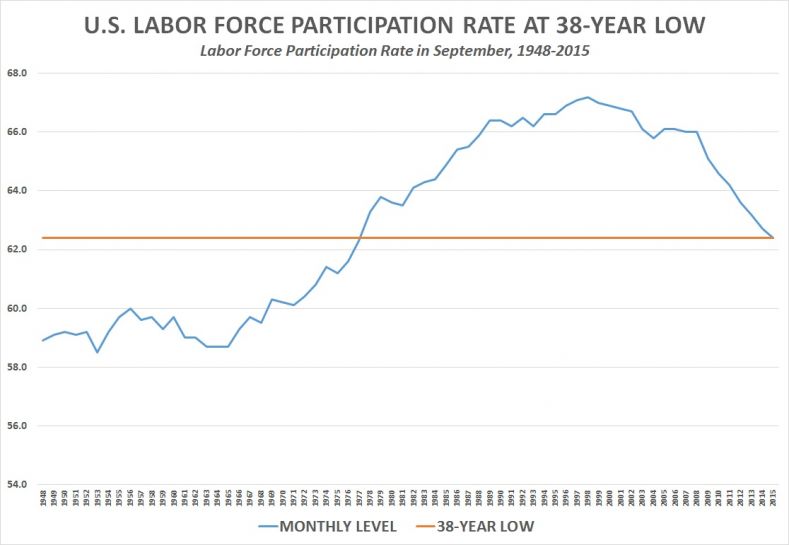
However, the labor force participation rate dropped another 0.2 percentage points to 62.4 percent—its lowest level since 1977.

[…][T]he September report follows a disappointing August report. Revisions also showed that employers created 60,000 fewer jobs in July and August than previously estimated.

CNS News says that the number of Americans not in the workforce is at 94,610,000. The Weekly Standard says we are going in reverse: ” For the last three months, average job growth comes in at 167,000. Nearly 100,000 below the average for 2014. We are going in reverse.” and “Of the 142,000 new jobs, 24,000 are in government. ”

The manufacturing sector is hardest hit, as Investors Business Daily explains:

The anemic September jobs report was bad news for anyone hoping that the economy had turned a corner. But it was even worse news for manufacturing, which is on a two-month losing streak.

Manufacturing shed 9,000 jobs last month on top of the 18,000 lost in August, completely erasing the gains made so far this year. Since January 2013, the industry has gained only 338,000.

All this flies in the face of President Obama’s repeated promise in 2012 that if reelected, he would create 1 million new manufacturing jobs by the end of his second term. Obama said that these new jobs would “put middle-class people back to work.” To make it happen, he promised to aggressively pursue corporate tax reform and unfair trade practices by China, set up new community-college/employer partnerships and create up to 20 “manufacturing innovation institutes.”

Since then, he’s done little if any of it.

The problem is big government regulations:

A study by the National Association of Manufacturers found that regulations cost the industry nearly $20,000 per worker in 2012. At smaller firms, the cost is almost $35,000 per worker.

It’s only getting worse, as new or impending regulations on CO2 emissions, smog, etc. threaten hundreds of thousands of manufacturing jobs.

Investors Business Daily says:

The biggest decline in the workforce has not been among the elderly, but the young, who just aren’t jumping into starter jobs at the normal rate.

[…]The workweek shrank again — to 34.5 hours — largely due to the rise of part-time hiring. Thank you, ObamaCare.

Obamacare forces employers to make workers part-time, or else pay more to employ them if they stay full-time. It’s a real genius-level policy.

More:

Can we finally repeal the law requiring employers to provide health benefits to workers once they log 30 hours of work in a week? Workers can’t pay their bills and feed their families with 28-hour paychecks.

Wages, which made decent gains over the previous several months, actually ticked down in September. So we are working less, for less.

This is no accident; it’s policy-induced slow growth.

It’s fitting that we get a disappointing jobs report in the very week that the administration says it will move forward with a new ozone containment rule that the National Association of Manufacturers says will be one of the biggest job-killing regulations in American history.

Obama still won’t allow the Keystone Pipeline, or the exporting of oil, which would be a major job producer. He won’t cut the corporate tax, or roll back ObamaCare rules hindering employment. His grandiose plans to save the planet come before putting Americans to work.

This is serious. I know that a lot of people in the media, in academia, in Hollywood, etc. think that you can tax and regulate your way to prosperity with laws like Obamacare, but it’s not true. Massive expansions of government and massive borrowing depress economic growth and job creation. Jobs come from entrepreneurs, and entrepreneurs do not like what they have seen from the government in the last 7 years under these Democrats.

Eight years of socialism: more debt, more regulation, fewer Americans working:

Has the economy been doing well lately? When I ask Democrats that question, they often point me to the stock market. I know that the stock market has done very well in the last 8 years. But I really question which Democrat policies have been responsible for this winfall.

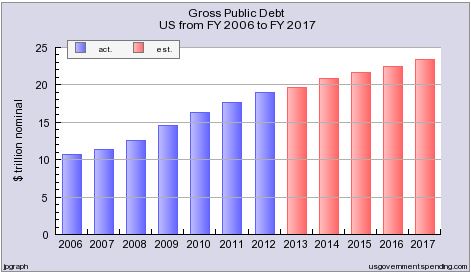
Certainly, policies like Obamacare, Dodd-Frank, green energy subsidies, blocking Keystone XL, creating a student loan bubble, and even loosening mortgage lending again to create another housing bubble, cannot cause any economics growth. My personal opinion is that all the growth came from adding over $10 trillion dollars to the debt – a process that started with the election of Nancy Pelosi and Harry Reid to the House and Senate majorities, respectively, in 2007.

Look at the national debt:

Gross public debt, Democrats control spending in 2007
Gross public debt, Democrats control spending starting in 2007

If you add $10 trillion to the national debt in 8 years then OF COURSE the stock prices will go up. You would look richer too if you took your credit card balance from $8,500 to $18,500. But what is behind all this consumer spending and government spending? Just trillions of dollars of new debt.

I think a better measure of how the economy is doing is to ask job creators how it is doing. For example, we can ask small businesses, since they are responsible for so much of the job creation in this economy.

Here’s an article from the Daily Signal about that.

It says:

More than five years after the end of the “Great Recession,” only 21 percent of small businesses* say they have fully recovered. During the recession, lack of sales ranked as the top problem small business faced. Taxes placed second, and “government regulations and red tape” placed third. And since 2012, at least one in five small business owners identify government regulations as their most important problem.

The reason for this is simple—small business owners directly feel the impact of federal regulation in the daily life of their businesses. The small business owner is often the main person in a business who bears the burden of complying with regulations and paperwork requirements. According to a 2010 study, small businesses spend $10,585 per employee on regulation, which amounts to 36 percent more per employee than larger companies spend.

With that as a backdrop, it is easy to see how small business owners continue to wonder why Washington just does not get it when it comes to regulation. For decades, Congress has sought to solve societal problems through mandates on business. Too many Americans without health insurance? Congress tries to solve that by requiring businesses to provide health insurance to their employees (regardless of whether or not they can afford it) or pay hefty penalties. Too many Americans unable to care for a sick relative? Congress seeks to address that by mandating that a business keep a position open three months out of every year for qualified employees, using a cumbersome reporting system.

Always entrepreneurial, with a keen focus on the bottom line, the American small business owner looks for ways to minimize the time and money spent on things other than running his or her business. Since many of these regulations wisely exempt the smallest of small businesses, some employers purposefully do not increase hiring because they do not want to have to comply with the regulatory regimes that await businesses that expand to 10, 15, and 50 or more employees.

This might be why the labor force participation rate is at a 38-year low.

CNS News explains:

A record 94,031,000 Americans were not in the American labor force last month — 261,000 more than July — and the labor force participation rate stayed stuck at 62.6 percent, a 38-year low, for a third straight month in August, the Labor Department reported on Friday, as the nation heads into the Labor Day weekend.

[…]In August, according to BLS, the nation’s civilian noninstitutional population, consisting of all people 16 or older who were not in the military or an institution, reached 251,096,000. Of those, 157,065,000 participated in the labor force by either holding a job or actively seeking one.

The 157,065,000 who participated in the labor force equaled only 62.6 percent of the 251,096,000 civilian noninstitutional population — the same as it was in July and June. Not since October 1977, when the participation rate dropped to 62.4, has the percentage been this low.

So… do you still think that the economy is in good shape? Any economy is going to look better if you take an $8.5 trillion debt and run it up to $18.5 trillion. But if you look a little closer, you see that small businesses are hard-pressed, and it’s affected the real unemployment rate.