Tag Archives: Intelligent Design

Intelligent Design conference in Oklahoma, March 25-26

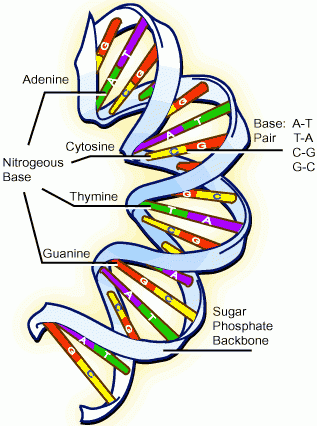
Structure of DNA
Structure of DNA

Information here at Evolution News. (H/T Apologetics 315)

Excerpt:

During the past decade, an increasing number of so-called “new atheists” have argued that human beings and the rest of nature are the products of chance and necessity rather than intelligent design. These “new atheists” typically base their ideas on Darwinian evolution, arguing that Darwin proved that nature is the product of a blind and unguided evolutionary process.

The message of the new atheists has spread far and wide. Just two years ago, thousands of students flocked to a lecture by leading new atheist Richard Dawkins at the University of Oklahoma. Dawkins famously contends that “Darwin made it possible to be an intellectually fulfilled atheist.” He received cheers and applause from the audience at OU.

The Darwinian view of nature has had a powerful impact on nearly every area of our culture. In public policy, it has encouraged the devaluation of human life. Among Christians, it has led some leading theologians and scientists to argue that God Himself doesn’t know how the history of life will turn out. And in science, Darwinian theory has encouraged the censorship of new scientific data as well as discrimination against scientists and students who think nature supplies evidence of intelligent design.

The good news is that the new atheists are wrong. Far from establishing a blind and purposeless universe, the findings of science increasingly provide powerful evidence that we live in a purpose-driven universe of incredible beauty and design.

On March 25-26 Oklahomans will have the chance to explore this evidence for themselves as four national experts come to Oklahoma to address the growing intersection between science and faith. Dr. Michael Behe, renowned biochemist and author of the books Darwin’s Black Box and The Edge of Evolution, will speak about the incredible design in the nanotechnology of the cell. Dr. Jay Richards, co-author of The Privileged Planet, will talk about how earth itself was intelligently designed for life and for scientific discovery. Dr. John West, author of Darwin Day in America and co-editor of The C.S. Lewis Readers’ Encyclopedia, will document the widespread impact of Darwin’s theory on society and faith. And lawyer Casey Luskin, co-author of Traipsing into Evolution: Intelligent Design and the Kitzmiller v. Dover Decision will outline positive steps you can take to stand for truth for you and your family.

Visit the event page here for more details.

If you don’t usually read Apologetics 315, you really need to check out the Friday round-up of all the week’s news.

Other conferences

Can intelligent design be front-loaded at the creation of the universe?

Structure of DNA
Structure of DNA

This video introduction to intelligent design packs a lot of information into a very small video. (H/T Brian Auten from Apologetics 315)

When it comes to the science of DNA, theistic evolutionists and atheists agree: matter, law and chance are sufficient to evolve DNA. No intelligence is needed to sequence the base pairs or the amino acids. That agreement that intelligent causes are not needed to explain DNA is why I call theistic evolution “functional atheism”.

Theistic evolutionists express subjective opinions about God that no one can investigate using science. These untestable opinions about God are similar to the opinions of little children about Santa Claus. And yet they insist that they be taken seriously alongside the people who actually think Christianity is objective knowledge, not subjective opinion.

To defuse a theistic evolutionist, simply ask them for  fully materialistic and naturalistic explanation for the first living organism – the origin of life. And then watch how they avoid answering the question. For even Richard Dawkins has no idea how life could begin, if only purely naturalistic, materialistic causes are allowed in the explanation.

Theistic evolutionists hate talking about evidence. They want to talk their private feelings and beliefs and experiences in order to reassure you that they are just like you. Don’t let them talk about religion – stick to what science can show. Demand evidence that the material processes can do the creating that the theistic evolutionists think that material processes can do.

Here’s an easy article that you can read that explains a bit more about what the video discussed. Here is one is a bit more difficult. These are mentoring articles for Christians.

If you want to read some serious research, then read this post and listen to this interview which are both about the work of Doug Axe.

Brian Auten interviews Jay Richards about Christian apologetics

Dr. Jay Richards
Dr. Jay Richards

Christian scholar Jay Richards was interviewed by Brian Auten of Apologetics 315.

The MP3 file is here.

Topics:

  • What is intelligent design (ID)?
  • Is ID specifically Christian?
  • How does ID helpful to Christian apologetics?
  • What does ID prove?
  • Is it OK to use an argument that doesn’t prove Christianity specifically?
  • What is the difference between deism and theism?
  • Do ID arguments get you to deism or theism?
  • What is materialism, and how can you challenge it?
  • How do opponents of ID define ID?
  • What factors do you need to make a habitable planet?
  • Are habitable planets common or rare in the universe?
  • What is “The Privileged Planet” hypothesis?
  • Is there an overlap between habitability and suitability for making scientific discoveries?
  • What is the “Copernican Principle”?
  • Has the progress of science made Earth seem common and ordinary?
  • What is the most Earth-like planet that we’ve ever discovered?
  • How should ID proponents respond to the objection that creatures aren’t perfect?
  • Does having a big moon make a planet more or less habitable?
  • Does a planet’s distance to the Sun make that planet more or less habitable?
  • How do these two habitability factors affect the observability of solar eclipses?
  • What does co-relation between habitability and “discoverability” tell us about God?
  • How important is training in philosophy to Christian apologetics?
  • What one thing should a Christian apologist work on to be more effective?

I’m hoping that Brian will do a follow-up interview with Jay on Jay’s new book on theistic evolution.

Here’s the description from Amazon.com:

What does it mean to say that God “used evolution” to create the world? Is Darwin’s theory of evolution compatible with belief in God? And even if Darwin’s theory could be reconciled with religious belief, do we need to do so? Is the theory well established scientifically? Is it true?

In the century and a half since Charles Darwin first proposed his theory of evolution, Christians, Jews, and other religious believers have grappled with how to make sense of it. Most have understood that Darwin’s theory has profound theological implications, but their responses have varied dramatically.

Some religious believers have rejected it outright; others, often called “theistic evolutionists,” have sought to reconcile Darwin’s theory with their religious beliefs, but often at the cost of clarity, orthodoxy, or both. Too few have carefully teased out the various scientific, philosophical, and theological claims at stake, and separated the chaff from the wheat. As a result, the whole subject of God and evolution has been an enigma wrapped in a shroud of fuzz and surrounded by blanket of fog.

The purpose of this anthology of essays is to clear away the fog, the fuzz, and the enigma. Contributing authors to the volume include Jay Richards, co-author of The Privileged Planet: How Our Place in the Cosmos Is Designed for Discovery; Stephen Meyer, author of Signature in the Cell: DNA and the Evidence for Intelligent Design; William Dembski, author of The Design Revolution; Jonathan Witt, co-author of A Meaningful World: How the Arts and Sciences Reveal the Genius of Nature; Denyse O’Leary, author of By Design, or by Chance?; and David Klinghoffer, author of Shattered Tablets.

Those authors are some of my favorite people to read in the whole world. I think this group will be mostly fed up with theistic evolutionists, like I am, although they may not go as far as I do when I label theistic evolutionists “functional atheists” or “theistic atheists”.

Jay Richards is probably my favorite all-round Christian scholar, because he also writes a lot on policy and economics, and was interviewed on those topics by Frank Turek. He has a complete, well-rounded worldview.

Posts featuring Jay Richards

Interviews by Jay Richards

Related posts