Tag Archives: Income

Should young people vote for Barack Obama and Obamacare?

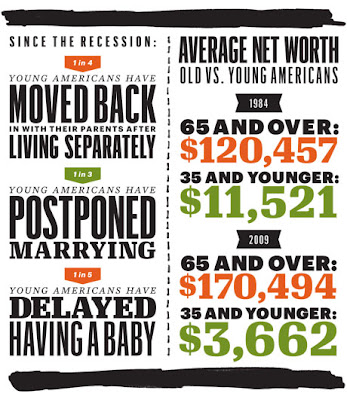
The real inequality: young America and old America

From Donald Sensing at Sense of Events blog.

Excerpt:

Shikha Dalmia, responds to Slate’s Dahlia Lithwick, who was so, “Shell shocked by the shellacking that the Solicitor General Donald Verrilli received at the hearing Tuesday, [that] she went into a deep sulk and threw the intellectual equivalent of a hissy fit.” Shikha observes:

In our current health care system, a mix of taxpayers; (rich) hospitals/providers and (even richer) private insurers are stuck with the tab for uncompensated care. There are many problems with this. But isn’t it at least more compassionate than ObamaCare that would force asset-poor young people – trying to pay off their college debt and hang on to some beer money – to subsidize the coverage of relatively wealthier prospective geezers? If maximizing compassion is the issue, shouldn’t we stick with what we’ve got?

In other words, under Obamacare the young overpay for health insurance in order to subsidize the old, whose medical costs are magnitudes higher than those of the young. That is a key feature of the “individual mandate” that makes it mandatory to buy health insurance under Obamacare. I remember reading during the SCOTUS hearings that men and women younger than 30 (or so) average using about $1,800 of health insurance per year, but will have to pay $5,400.

It’s very important to understand that when government gets involved with spending money on handing out goodies, that it is tempting for them to buy the votes of those who are politically informed with the money taken from those who don’t know a thing about real life.

Now consider these numbers from socialist Europe – where Obama’s plan is a little further along.

Excerpt:

Youth unemployment now exceeds 50pc in both Spain and Greece as the number of people out of work in the eurozone as a whole hit a 15-year high of 17.2m.

The unemployment rate among Spain’s under-25s rose to 50.5pc in January, and to 50.4pc in Greece in December, according to the latest available data from Eurostat, the European Union’s statistics office. It compared with an average eurozone youth unemployment rate of 21.6pc. One of the lowest rates of youth unemployment is in Germany, where it remained at 8.2pc in February.

The rise in Spain and Greece reflects the deep financial woes of both countries, which are in the midst of far-reaching and highly unpopular austerity programmes, considered necessary by the broader EU to reduce huge deficits.

Spain’s unemployment rate now stands at 23.6pc, compared with a eurozone average of 10.8pc. The extent of Spain’s problems are further underlined by a housing market in crisis, with prices expected to fall the most on record this year. One-in-four homeowners in the country owes more than their property is worth.

I find it so sad that kids are brainwashed by unionized public school teachers to support nonsense like global warming, while despising free market capitalism. And then they go out and vote for more and more government, so that their “teachers” can be paid more and more. They will never fix their worldviews until they get out into the real world, and by then it they will have voted in many elections.

New study: low family income not a major cause of low student achievement

From PhysOrg.com.  Please click the “Like” button below and tweet this one on Twitter. This is one to share.

Excerpt:

Family income is associated with student achievement, but careful studies show little causal connection. School factors – teacher quality, school accountability, school choice – have bigger causal impacts than family income per se, according to a new analysis by Harvard’s Program on Education Policy and Governance (PEPG).

The analysis, prepared by PEPG director Paul E. Peterson, calls into question the Broader, Bolder Approach (BBA) to educational reform that has been advanced by a group of education scholars, teacher union leaders, and non-profit groups. The BBA recommends that proposals to enhance teacher quality, school accountability and student choice be dropped in favor of policies that would redistribute income and provide support services to families outside the regular school day.

Peterson focuses on a paper presented by Duke University Professor Helen F. Ladd, a BBA co-chair, which was given as the presidential address before the Association of Public Policy and Management in Washington, D.C. in November of 2011, and is widely regarded as the key scholarly work underpinning BBA. Peterson’s article, “Neither Broad Nor Bold: A narrow-minded approach to school reform,” is available at http://www.educationnext.org and will appear in the Summer, 2012 issue of Education Next.

BBA’s mission statement holds: “Weakening that link [between income and achievement] is the fundamental challenge facing America’s education policy makers.” Peterson agrees that the connection between income and student performance “is no less true in the Age of Obama than it was in the Age of Pericles.” But, he points out, most of the connection is not causal, but due to other factors. He cites a study by Julia Isaacs and Katherine Magnuson (Brookings Institution, 2011), that examines an array of family characteristics – such as race, mother’s and father’s education, single parent or two-parent family, smoking during pregnancy – on school readiness and achievement. The Brookings study finds that the distinctive impact of family income is just 6.4 percent of a standard deviation, generally regarded as a small effect. In addition, Peterson calls attention to earlier research by Susan Mayer, former dean of the Harris School at the University of Chicago, which also found that the direct relationship between  and education success for children varied between negligible and small.

[…]“A better case can be made that any increase in the achievement gap between high- and low-income groups is more the result of changing family structure than of inadequate medical services or preschool education,” Peterson says. In 1969, 85 percent of children under the age of 18 were living with two married parents; by 2010, that percentage had declined to 65 percent. The median income level of a single-parent family is just over $27,000 (using 1992 dollars), compared to more than $61,000 for a two-parent family; and the risk of dropping out of high school increases from 11 percent to 28 percent if a white student comes from a single-parent family instead of a two-parent family. For blacks, the increment is from 17 percent to 30 percent, and for Hispanics, the risk rises from 25 percent to 49 percent.

Peterson notes that most of the proposals to lift  that Ladd and her BBA colleagues offer, such as expanded social services, preschool, and summer programs, ignore the many hours children spend at school and amount to a “potpourri of non-educational services (that) have never been shown to have more than modest effects on student achievement.” He points out that many school reforms – merit pay, school vouchers, and student and school accountability – have been shown to have had equivalent or larger impacts. For example,  accountability initiatives have raised student performance by 8 percent of a standard deviation. Initiatives to improve teacher quality have the potential of raising  performance by 10 to 20 percent of a standard deviation.

Read the rest here, this is important. So long as we keep looking to big government to solve all of our problems. We should instead be looking to our own good decision making, our own families and the free enterprises system.

New paper on income inequality: Does taxing the rich hurt the middle class?

Aparna Mathur (right)

Here’s an article by Indian economist Aparna Mathur.

She writes (in part):

In a recent paper that I co-authored with Kevin Hassett, we explored the effect of high corporate taxes on worker wages. The motivation for the paper came from the international tax literature (summarized by Roger Gordon and Jim Hines in a 2002 paper1) that suggested that mobile capital flows from high tax to low tax jurisdictions. In other words, in any set of competing countries, investment flows are determined by relative rates of taxation. The current U.S. headline rate of corporate tax is 35 percent. The combined federal and state statutory rate of 39 percent is second only to Japan in the OECD. With Japan set to lower its statutory rate later this year, the U.S. rate will soon be the highest in the OECD and one of the highest in the world. What effect do these high rates have on worker wages?

When capital flows out of a high tax country, such as the United States, it leads to lower domestic investment, as firms decide against adding a new machine or building a factory. The lower levels of investment affect the productivity of the American worker, because they may not have the best machines or enough machines to work with. This leads to lower wages, as there is a tight link between workers’ productivity and their pay. It could also lead to less demand for workers, since the firms have decided to carry out investment activities elsewhere.

Our paper was one of the first to explore the adverse effect of corporate taxes on worker wages. Using data on more than 100 countries, we found that higher corporate taxes lead to lower wages. In fact, workers shoulder a much larger share of the corporate tax burden (more than 100 percent) than had previously been assumed. The reason the incidence can be higher than 100 percent is neatly explained in a 2006 paper by the famous economist Arnold Harberger.2 Simply put, when taxes are imposed on a corporation, wages are lowered not only for the workers in that firm, but for all workers in the economy since otherwise competition would drive workers away from the low-wage firms. As a result, a $1 corporate income tax on a firm could lead to a $1 loss in wages for workers in that firm, but could also lead to more than a $1 loss overall when we look at the lower wages across all workers.

Following our paper, several academic economists substantiated our results, using different data sets and applying varied econometric modeling and techniques. Some examples of these studies include a 2007 paper by Mihir A. Desai and C. Fritz Foley of Harvard Business School and James Hines Jr. of Michigan University Law School, a 2007 paper by R. Alison Felix of the Federal Reserve Bank of Kansas City, a 2009 paper by Robert Carroll of The Tax Foundation, and a 2010 paper by Wiji Arulampalam of the University of Warwick and Michael Devereux and Giorgia Maffini of Oxford.3 A recent Tax Notes article that I co-authored summarizes these various studies and also the lessons from the theoretical literature on the topic. The general consensus from theory and empirical work is that while we may argue academically about the size of the effect, there is no disagreement among economists that a sizeable burden of the corporate income tax is disproportionately felt by working Americans. On average, a $1 increase in corporate tax revenues could lead to a dollar or more decline in the wage bill.

Conservatives and liberals have the same goal. We both want to help the poor. Liberals think that taking money from the rich and giving it to the poor helps, but all it does it cause the rich to move their capital and jobs elsewhere, leaving the poor poorer. Conservatives let the rich keep their money and encourage them to risk it trying to make more money by engaging in enterprises that create wealth – creating products and services from less valuable raw materials. In a socialist system, the rich get poorer, but so do the poor. In a capitalist system, the rich get very rich, but the poor also gain more wealth. That’s what happens when corporations like Apple make IPads out of junky raw materials. That’s how wealth is created – by letting people who want to make things keep more of what they earn. We all benefit from encouraging people to make new things and provide value for their neighbors.

Related articles