Tag Archives: Health-care

Jon Huntsman’s anti-Romney ads are awesome

Check out these ads by Jon Huntsman.

Backflip:

Weather Vane:

Scared Mittless:

Mitt Romney is the most liberal candidate running in the primary – there are even more videos showing that the man is liberal on abortion, gay rights, global warming, gun control, government-controlled health care, and so on. He is a moderate Democrat – he has no record as a conservative. If elected, he would govern about 80% as liberal Barack Obama governs now. He is to the left of John McCain, in my view.

What is issue 2? Should you vote no on Ohio issue 2?

In the 2010 mid-term elections, Republican John Kasich won the governorship and promised to balance the state’s budget by reining in the state’s spending on salaries and benefits for public sector union employees. To accomplish this, the Ohio legislature pass Senate Bill 5. However, an effort is on the ballot to repeal the law, and Ohio voters will get a chance to keep or scrap the law on Tuesday, November 8th, 2011.

Here’s what Ohio’s State Issue 2 is all about:

Issue 2 makes some very fair and common sense requests of our government employees to give local communities the flexibility they need to get taxes and spending under control, while providing the essential services that we rely on.

  • It allows an employee’s job performance to be considered when determining compensation, rather than just awarding automatic pay increases based only on an employee’s length of service.
  • It asks that government employees pay at least 15 percent of the cost of their health insurance premium. That’s less than half of what private sector workers are currently paying.
  • It requires that government health care benefits apply equally to all government employees, whether they work in management or non-management positions. No special favors.
  • It asks our government employees to pay their own share of a generous pension contribution, rather than forcing taxpayers to pay both the employee and employer shares.
  • It keeps union bosses from protecting bad teachers and stops the outdated practice of laying off good teachers first just because they haven’t served long enough.
  • Finally, it preserves collective bargaining for government employees, but it also returns some basic control of our schools and services to the taxpayers who fund them, not the union bosses who thrive on their mismanagement.

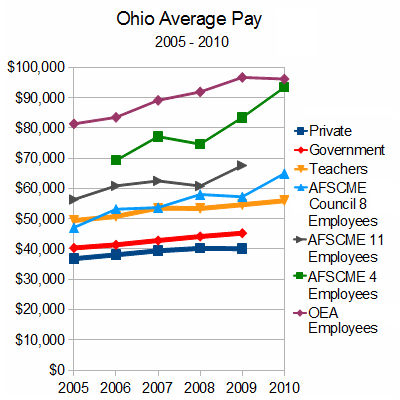
Even under the reforms of State Issue 2, Ohio’s government employees will still receive better pay, better health care and better retirement benefits, on average, than the vast majority of Ohioans who work in the private sector.

There are a number of myths going around about Issue 2, and it’s important to set the record straight, so I’ll do that below.

Ohio Average Pay: Public vs. Private
Ohio Average Pay: Public Unions vs. Private

Myths and truths about Ohio State Issue 2

Here’s a common myth:

State Issue 2 would “cut salaries and benefits.”

The truth:

Issue 2 would not cut salaries or benefits for any government employee. Employees would simply be asked to pay a modest share of their benefits, just like employees in the private sector do. For health care coverage, they would pay at least 15% of their overall plan. (Many local government employees currently pay less than 9% of their health care premium, while the average private sector worker pays upwards of 30%.) In addition, employees would be required to pay their personal share of a retirement plan (only 10%), rather than asking taxpayers to pay that share. That’s not too much to ask at a time when many private sector workers get no retirement benefit at all. Finally, Issue 2 requires that benefits apply equally to all public employees, so no one gets special treatment.

And another common myth:

State Issue 2 will eliminate government employee pensions.

The truth:

Government employees will still get a very generous pension benefit – an annual payment that averages their three highest annual salaries. That’s a pretty nice deal, when many private sector workers get no retirement benefit at all. State Issue 2 only ends a practice where some government union contracts require taxpayers to pick up the tab for BOTH the employer AND employee shares of a required pension contribution. In this economy, it’s simply not right to ask struggling taxpayers to foot the bill so government employees can get a free retirement. Issue 2 simply says government employees should pay their required share (10 percent) and taxpayers will contribute the employer share (14 percent).

Another myth:

State Issue 2 will cut teacher salaries.

The truth:

That’s one of the scare tactics government unions are using to turn people against these reforms. Nothing in Issue 2 determines salary levels. It only ends the practice of handing out automatic pay raises, or “step” increases, and longevity pay – or bonuses just for holding the job for a certain period of time. Issue 2 also asks that performance be added as a factor in teacher compensation, a goal President Barack Obama set out in his national education policy in 2009.

And another myth:

State Issue 2 will cost jobs

The truth:

Just the opposite is true. Ohio’s state and local tax burden ranks among the top third in the nation. As a result, companies large and small have left our state in pursuit of better tax incentives elsewhere, taking hundreds of thousands of jobs with them. If Ohio hopes to compete for new job growth, we have to make our state a more affordable place to live, work and do business. That starts with getting the cost of government under control so we can direct more of our limited resources into economic development, community revitalization and better schools.

More myths about Ohio State Issue 2 are corrected on this page.

Newspaper endorsements

So far, Issue 2 has been endorsed by several Ohio newspapers, including the biggest ones.

The Cleveland Plain Dealer:

The fiscal picture of local governments and school districts, especially, will improve as they are able to right-size their work forces and their expenditures on services. That will happen over time, not overnight, as new contracts are established.

Repeal SB 5, though, and it’s going to be awfully hard for local governments to manage their payrolls without resorting to larger-scale layoffs than would otherwise be necessary. And local governments will continue to be hamstrung by anti-merit seniority rules that lead to worker complacency and protect dead weight and time-servers.

Voting YES on Issue 2 will prevent layoffs by keeping public sector wages and benefits in line with what the private sector can afford to pay.

The Columbus Dispatch:

Despite the insistence of opponents, the effort to reform Ohio’s out-of-balance collective-bargaining law is not an expression of disrespect for or dissatisfaction with Ohio teachers, police officers, firefighters and other government employees. It is a much-needed attempt to restore control over public spending to the public officials elected to exercise that control.

It does not assert that public employees are worth less than the compensation they’re receiving, only that the compensation has grown faster than the public’s ability to pay for it.

[…]With more ability to control the escalation of salary and benefit costs, governments won’t be forced as often to impose layoffs, and might be able to afford to keep even more police and firefighters on the streets.

Again, no one is saying that public sector workers don’t matter – the question is whether we can afford to give them better wages and benefits than the private sector workers who are their customers and their employers. Public sector workers work for the public, and the public can only afford to pay so much.

Conclusion

Government employees are paid 43% more than private sector employees, in salary and benefits:

I think that people who care about the long-term prosperity of Ohio should vote “YES” on Issue 2 to make public and private salaries and benefits MORE EQUAL. Ohio is facing enormous economic pressure from the global recession, and everyone has to make sacrifices. Now is not the time for public sector workers to insist on higher wages and benefits, especially when the private sector workers who pay their salaries don’t make as much money, nor do they get the pensions, nor do they get the better job security. Ohio voters can certainly go back and renegotiate union salaries and benefits when Ohio is out of the recession.

Click here to learn more about Ohio State Issue 2.

Induced abortions, drinking and use of contraceptives all increase breast cancer risk

Here’s the latest study from the Journal of the American Medical Association (JAMA), showing that excessive consumption of alcohol is a rish factor for breast cancer.

Excerpt:

Consumption of 3 to 6 alcoholic drinks per week is associated with a small increase in the risk of breast cancer, and consumption in both earlier and later adult life is also associated with an increased risk, according to a study in the November 2 issue of JAMA.

“In many studies, higher consumption of alcohol has been associated with an increased risk of breast cancer. However, the effect of low levels of drinking as is common in the United States has not been well quantified,” according to background information in the article. “In addition, the role of drinking patterns (i.e., frequency of drinking and ‘binge’ drinking) and consumption at different times of adult life are not well understood.”

Wendy Y. Chen, M.D., M.P.H., of Brigham and Women’s Hospital and Harvard Medical School, Boston, and colleagues examined the association of breast cancer with alcohol consumption during adult life, including quantity, frequency, and age at consumption. The study included 105,986 women enrolled in the Nurses’ Health Study who were followed up from 1980 until 2008 with an early adult alcohol assessment and 8 updated alcohol assessments. The primary outcome the researchers measured was the risk of developing invasive breast cancer.

During the follow-up period, there were 7,690 cases of invasive breast cancer diagnosed among the study participants. Analyses of data indicated that a low level of alcohol consumption (5.0 to 9.9 grams per day, equivalent to 3-6 glasses of wine per week) was modestly but statistically significantly associated with a 15 percent increased risk of breast cancer. In addition, women who consumed at least 30 grams of alcohol daily on average (at least 2 drinks per day) had a 51 percent increased risk of breast cancer compared with women who never consumed alcohol.

The researchers also found that when examined separately, alcohol consumption levels at ages 18 to 40 years and after age 40 years were both strongly associated with breast cancer risk. The association with drinking in early adult life still persisted even after controlling for alcohol intake after age 40 years.

Binge drinking, but not frequency of drinking, was also associated with breast cancer risk after controlling for cumulative alcohol intake.

Now let’s take a look at some other factors that raise the risk of breast cancer.

Abortion and breast cancer

Many studies show a link between abortion and breast cancer.

Study 1: (September 2010)

Based on the expression of estrogen receptor (ER), progesterone receptor (PR) and HER2/neu (HER2), breast cancer is classified into several subtypes: luminal A (ER+ and/or PR+, HER2-), luminal B (ER+ and/or PR+, HER2+), HER2-overexpressing (ER-, PR-, and HER2+) and triple-negative (ER-, PR-, and HER2-). The aim of this case-control study is to determine reproductive factors associated with breast cancer subtypes in Chinese women. A total of 1,417 patients diagnosed with breast cancer in the First Affiliated Hospital, China Medical University, Shenyang, China between 2001 and 2009 and 1,587 matched controls without a prior breast cancer were enrolled.

[…]Postmenopause and spontaneous abortion were inversely associated with the risk of luminal tumors. By contrast, multiparity, family history of breast cancer and induced abortion increased the risk of breast cancer.

Study 2: (March 2010)

OBJECTIVE: To explore the risk factors of breast cancer for better control and prevention of the malignancy.

METHODS: The clinical data of 232 patients with pathologically established breast cancer were investigated in this 1:1 case-control study to identify the risk factors of breast cancer.

RESULTS: The history of benign breast diseases, family history of carcinoma and multiple abortions were the statistically significant risk factors of breast cancer, while breast feeding was the protective factor.

CONCLUSION: A history of benign breast diseases, family history of carcinoma and multiple abortions are all risk factors of breast cancer.

But wait, there’s more.

Birth control pills

Many studies showed that taking birth control pills caused an increased risk of breast cancer.

Study 1: (March 2003)

RESULTS: Among the youngest age group (<35 years, n = 545), significant predictors of risk included African-American race (RR = 2.66: 95% CI 1.4-4.9) and recent use of oral contraceptives (RR = 2.26; 95% CI 1.4-3.6). Although these relationships were strongest for estrogen receptor-negative (ER-) tumors (RRs of 3.30 for race and 3.56 for recent oral contraceptive use), these associations were also apparent for young women with ER+ tumors. Delayed childbearing was a risk factor for ER+ tumors among the older premenopausal women (Ptrend < 0.01), but not for women <35 years in whom early childbearing was associated with an increased risk, reflecting a short-term increase in risk immediately following a birth.

Study 2: (October 2008)

Oral contraceptive use ≥1 year was associated with a 2.5-fold increased risk for triple-negative breast cancer (95% confidence interval, 1.4-4.3) and no significantly increased risk for non-triple-negative breast cancer (Pheterogeneity = 0.008). Furthermore, the risk among oral contraceptive users conferred by longer oral contraceptive duration and by more recent use was significantly greater for triple-negative breast cancer than non-triple-negative breast cancer (Pheterogeneity = 0.02 and 0.01, respectively).

Why are these risk factors so prevalent today?

Now let’s put it all together by looking at this New York Times article by Nancy Bauer.

Excerpt:

If there’s anything that feminism has bequeathed to young women of means, it’s that power is their birthright.  Visit an American college campus on a Monday morning and you’ll find any number of amazingly ambitious and talented young women wielding their brain power, determined not to let anything — including a relationship with some needy, dependent man — get in their way.  Come back on a party night, and you’ll find many of these same girls (they stopped calling themselves “women” years ago) wielding their sexual power, dressed as provocatively as they dare, matching the guys drink for drink — and then hook-up for hook-up.

The article was written by:

Nancy Bauer is associate professor and chair of philosophy at Tufts University. She is the author of “Simone de Beauvoir, Philosophy, and Feminism,” and is currently completing a new book, “How to Do Things With Pornography.”

Her comments cause me to ask some questions. Where did women ever get the idea that they had to drink as much as men drink? Where did women ever get the idea that using contraceptives to enable hook-up sex was healthy and normal? Where did women ever get the idea that aborting their own unborn children was healthy and normal? Is there one unifying worldview that stipulates all of these beliefs? Why has this worldview become so popular that so many young women who now believe in it, rather than believing in traditional Judeo-Christian values?

Who is paying for all of this increased health care spending?

The total cost for breast cancer treatment, which raises medical insurance premiums (private health care) or taxes (single-payer health care), has been estimated to be between $1.8 billion and $3.8 billion dollars. In addition, the government spends billions of dollars each year on breast cancer research. All of this spending is costing taxpayers a lot of money, as people demand more and more government funding of breast cancer research and breast cancer treatment (with either private or single-payer health care).