Tag Archives: Greek

Greek men deprived of provider role commit suicide in record numbers

From the Wall Street Journal, a reminder that recessions hit men the hardest. (H/T Tom)

Excerpt:

]Gross domestic product in the second quarter was down more than 7% from a year before, amid government spending cuts and tax increases that, combined, will add up to about 20% of GDP. Unemployment is over 16%. Crime, homelessness, emigration and personal bankruptcies are on the rise.The most dramatic sign of Greece’s pain, however, is a surge in suicides.

Recorded suicides have roughly doubled since before the crisis to about six per 100,000 residents annually, according to the Greek health ministry and a charitable organization called Klimaka.

[…]Suicide has also risen in much of the rest of Europe since the financial crisis began, according to a recent study published in the British medical journal The Lancet, which said Greece is among the hardest hit.Suicide has also risen in much of the rest of Europe since the financial crisis began, according to a recent study published in the British medical journal The Lancet, which said Greece is among the hardest hit.

[…]A suicide help line at Klimaka, the charitable group, used to get four to 10 calls a day, but “now there are days when we have up to 100,” says a psychologist there, Aris Violatzis.

The caller often fits a certain profile: male, age 35 to 60 and financially ruined. “He has also lost his core identity as a husband and provider, and he cannot be a man any more according to our cultural standards,” Mr. Violatzis says.

Heraklion, commercial center of the island of Crete, has had a spate of such deaths.

[…]Victims once were typically adolescent males or old people facing severe illness, and in normal times suicide cases often involve a mixture of factors including mental illness, says local psychiatrist Eva Maria Tsapaki.

But the economic crash has created a “new phenomenon of entrepreneurs with no prior history of mental illness who are found dead every other week,” she says. “It’s very unusual.”

Hans Bader had a recent post about Obama’s stimulus bill that is relevant.

Excerpt: (links removed)

A logical place to have financed road and bridge repairs would have been Obama’s $800 billion stimulus package. But the stimulus package was purged of most investments in roads and bridges, and filled instead with welfare and social spending, out of political correctness, after feminist leaders complained that building and repairing roads and bridges would put unemployed blue-collar men to work, rather than women.

Christina Hoff Sommers points out that “of the 5.7 million jobs Americans lost between December 2007 and May 2009, nearly 80 percent had been held by men,” because men “predominate in manufacturing and construction, the hardest-hit sectors, which have lost more than 3 million jobs since December 2007.” But when some administration officials floated the concept of “an ambitious . . . stimulus program to modernize roads, bridges, schools, electrical grids, public transportation, and dams” as a way of “reinvigorating the hardest-hit sectors of the economy,” “Women’s groups were appalled,” asking “Where are the New Jobs for Women?” and denouncing what they called “The Macho Stimulus Plan.”

As Sommers notes, the Obama administration quickly knuckled under to this pressure, replacing its recovery package with an $800 billion stimulus package that instead “skews job creation somewhat towards women” by spending money instead on social services like welfare that are administered mostly by female employees.

As a 2009 Associated Press story reported, “Stimulus Funds Go to Social Programs Over ‘Shovel-ready’ Projects.” A team of six AP reporters who have been tracking the funds find that the $300 billion sent to the states is being used mainly for health care, education, unemployment benefits, food stamps, and other social services.” Or, as another AP report put it, “Stimulus Aid Favors Welfare, Not Work, Programs.”

The stimulus package also repealed welfare reform, as Slate’s Mickey Kaus and the Heritage Foundation have noted. (In 2008, Obama ran campaign ads claiming to support welfare reform, even though he had sought to undermine welfare reform as an Illinois legislator. The stimulus package largely repealed the 1996 welfare-reform law.)

Men: don’t vote for this man in 2012.

Related posts

Peter Williams debates Bart Ehrman on his book “Misquoting Jesus”

The audio for this Unbelievable radio show debate is available from Apologetics 315.

Details:

Bart Ehrman is the US author of the bestselling book “Misquoting Jesus” (In the UK “Whose word is it?”).  He calls into question the authority of the New Testament as scribal changes over time have changed the documents.

So can we trust the scripture? Bible scholar Peter Williams believes in the reliability of the New Testament and that Bart’s prognosis is far too pessimistic.

I think Justin Brierley breaks his record for saying “if you like” in this particular debate. So, if you like it when he says “if you like”, this debate is for you!

Summary of the Williams-Ehrman debate:

Note: this summary is snarky. When I get annoyed with whiners, I make things up.

Ehrman:

  • I had a mystical experience in childhood and became an evangelical Christian
  • I went to Moody Bible Institute, and they told me that the Bible was inerrant
  • For a while, I was committed to the view that there are no mistakes in the Bible
  • At Princeton, I was taught and graded by professors who did not accept inerrancy
  • I began to see that the Bible did have errors after all!
  • We don’t have the originals written by the authors, we only have thousands of copies
  • if the words of the Bible are not completely inerrant, then none of it is historical
  • if all of the words in the copies of the Bible are not identical, then none of it is historical

Williams:

  • I would say the New and Old testaments are the Word of God
  • We don’t need to have the original Greek writings in order to believe in the authority of the Bible
  • I believe in inerrancy, but doesn’t mean there are no problems
  • the doctrine of inerrancy has always referred to the original copies, not the translations

Moderator:

  • what are the main points of Misquoting Jesus?

Ehrman:

  • we don’t have the originals of any of the books of the New Testament
  • we have copies that are much later, sometimes even centuries later
  • the copies we have all differ from one another – they were changed by scribes
  • we have 5000 manuscripts in the original Greek language
  • there are hundreds of thousands of differences
  • most of the differences don’t matter
  • some differences are significant for meaning or doctrine
  • errors are propagated because the next scribe inherits the mistake of their source copy
  • a large gap between the time of writing and the first extant copy means more errors have crept in

Williams:

  • the reason we have so many variants is because the number of manuscripts is large

Angry Jesus or compassionate Jesus in Mark

Ehrman:

  • most manuscripts say that Jesus was compassionate when healing a leper, but one says he was angry
  • it makes a huge huge huge really really big difference if Jesus is compassionate or angry
  • the whole Bible needs to be thrown out because of this one word between different in one manuscript

Williams:

  • this variant is important for understanding the passage, but it has no great meaning
  • the change is probably just an accident – the two words are very similar visually in Greek
  • it’s just an accident – it emerged in one manuscript, and it impacted a few more
  • the tiny number of manuscripts that have the error are geographically isolated
  • I’m pretty sure that WK prefers the angry Jesus anyway – so who cares?

Ehrman:

  • no! someone changed it deliberately! it’s a conspiracy! you should buy my book! it’s a *big deal*!!!!!1!!1!one!!eleventy-one!

The woman caught in adultery in John

Ehrman:

  • it is isn’t in any of the earliest manuscripts
  • this is an apocryphical story that some scribe deliberately inserted into the text
  • most people don’t even know about this! it’s a cover-up! you need to buy my scandalous book!

Williams:

  • that’s right, it’s a late addition by some overzealous scribe
  • and it’s clearly marked as such in every modern Bible translation
  • the only people who don’t know about this are people who don’t read footnotes in their Bible
  • and in any case, this isn’t a loss of the original words of the New Testament – it’s an addition

Grace of God or apart from God in Hebrews

Ehrman:

  • well this is just a one word difference, but it makes a huge huge really really big difference!
  • the words are very similar, so it’s could be an accident I guess
  • but it wasn’t! this was a deliberate change! it’s a conspiracy! it’s a cover-up! scandal!
  • buy my book! It’s almost as good as Dan Brown!

Moderator:

  • hmmmn…. I kind of like “apart from God”, and I’m sure WK does too – why is this such a big scandal again?

Ehrman:

  • you don’t care? how can you not care? it has to be inerrant! or the whole thing is false!
  • Moody Bible Institute says!

Williams:

  • yeah Bart is always saying that every change is deliberate but it’s just an accident
  • the words are very similar, just a few letters are different, this is clearly an accident
  • I have no problem with apart from God, or by the Grace of God
  • please move on and stop screaming and running around and knocking things over

Moderator:

  • but what if pastors try to use this passage in a sermon?

Williams:

  • well, one word doesn’t make a big different, the meaning that appears is fine for preaching
  • it’s only a problem for people who treat the Bible as a magic book with magical incantations
  • they get mad because if one word is out of place then the whole thing doesn’t work for their spell
  • then they try to cast happiness spells but the spells don’t work and they experience suffering
  • the suffering surprises them since they think that fundamentalism should guarantee them happiness
  • then they become apostates and get on TV where they look wide-eyed and talk crazy

Ehrman:

  • hey! are you talking about me? a lot of people buy my books! i am a big success!
  • it is very important that people don’t feel bad about their sinning you know!

Is Misquoting Jesus an attack?

Williams:

  • it’s rhetorically imbalanced and misleading
  • it tries to highlight change and instability and ignore the majority of the text that is stable
  • he makes a big deal out of 5 or so verses that are different from the mainstream text
  • he says that scribes deliberately changed the scriptures, but he doesn’t prove that
  • it’s just as likely that the differences are just scribal errors made by accident

Ehrman:

  • well, maybe the variants aren’t a big deal, but what about one angel vs. two angels?
  • that’s a significant issue! significant enough for me to become an apostate – a rich apostate
  • if one word is different because of an accident, then the whole Bible cannot be trusted
  • it has to be completely inerrant, so a one word difference means the whole thing is unreliable
  • we don’t even know if Jesus was even named Jesus, because of one angel vs two angels
  • buy my book! you don’t have to read it, just put it on your shelf, then you’ll feel better about not having a relationships with God – because who’s to say what God really wants from you? Not the Bible!

Other debates:

Other critiques:

If government is paying the piper, then government is calling the tune

Veronique de Rugy

Check out this post from GMU economist Veronica de Rugy on Big Government. (H/T ECM)

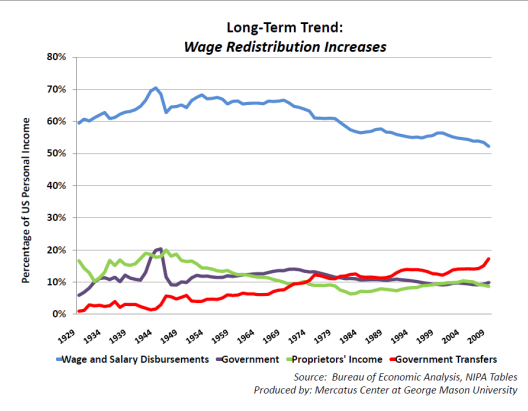
First, she puts up this chart.

Veronique writes:

On this chart we can see the changes over time in the composition of personal income in the United States since 1929. The most notable trend is the increase in the portion of personal income coming from government transfers (mainly social Security payments, unemployment benefits, food stamps, and personal and business tax credits.)  And the increase isn’t minor: the proportion of total personal income constituted by government money has grown from 0.9% to 17.2%.

Complementary decreases of wage earnings as percentages of total personal income (from 59.5% to 52.3%) are also going on.

The problem with government giving people money is that it creates a culture of dependency, as with Greece. Politicians take money from job-creating business-owners, or from productive individual workers, and they redistribute it to whiny unproductive, immature victim groups like unions, in order to buy their votes. Eventually, the government goes too far making promises and the productive people just stop or slow their working or they move away, since they keep less and less of their own money for the same amount of work and risk-taking.

And that’s when welfare checks of the losers dry up, and they have no choice but to riot and kill people. Why do they riot? Well, if they were earning their own money by working, then they would know that they are responsible for themselves, not government. They would understand that something might go wrong, and they would know that they had to cut their spending and save for a rainy day. So when things do go bad, they would have known how to live cheaply off of their savings while they find another job.

But people who take welfare don’t save – they think the money will always be there. What do they do when the taxpayers slow or stop production? They have no skills, and they have no savings. They can’t just find a new government because a new government isn’t going to find any more money from somewhere – there isn’t any left. So the only way to get their welfare back is to revolt – which is exactly what the socialists in Greece are doing right now. They’ve been spoiled rotten and they want their welfare back, like little babies crying for their mommies.

It’s sick. And this is what Obama and the Democrats idolize, because that’s how they grew up – begging their rich parents for money and bailouts for their own irresponsible behaviors. Their policies aren’t thought through – it’s just reliving their silver spoon childhoods of never having to work for anything.

Would you like to know what Republicans are like? Consider Michele Bachmann.

At 13, Bachmann was forced to become almost financially independent after her parents divorced. She used her babysitting money to buy her own clothes and lunches at school and saved up enough to purchase her first pair of contact lenses. Between college semesters at Winona State University, she took her hardworking streak to Alaska where on one memorable day she cleaned 280 salmon.

She also quit her job as a tax litigation attorney to homeschool her five kids, because she didn’t like the job the public schools were doing. Her business runs a small business, and she helped him to start it. That’s what Republicans do. We work. And we give.

We need to stop increasing the size of government so they can “take care” of all our needs. We need to take care of all our needs, and to take care of our neighbor’s needs, too. That’s capitalism. Having something to share from what you can make from your own industry and labor.