
Tag Archives: Gay Rights

Pro-gay web site tells real story of the Matthew Shepard murder

I have a key that will unlock a puzzling mystery

A fascinating article from the pro-gay The Advocate.

Excerpt:

What if nearly everything you thought you knew about Matthew Shepard’s murder was wrong? What if our most fiercely held convictions about the circumstances of that fatal night of October 6, 1998, have obscured other, more critical, aspects of the case? How do people sold on one version of history react to being told that facts are slippery — that thinking of Shepard’s murder as a hate crime does not mean it was a hate crime? And how does it color our understanding of such a crime if the perpetrator and victim not only knew each other but also had sex together, bought drugs from one another, and partied together?

None of this is idle speculation; it’s the fruit of years of dogged investigation by journalist Stephen Jimenez, himself gay. In the course of his reporting, Jimenez interviewed over 100 subjects, including friends of Shepard and of his convicted killers, Aaron McKinney and Russell Henderson, as well as the killers themselves (though by the book’s end you may have more questions than answers about the extent of Henderson’s complicity).  In the process, he amassed enough anecdotal evidence to build a persuasive case that Shepard’s sexuality was, if not incidental, certainly less central than popular consensus has lead us to believe.

And here are the details:

But in what circumstances does someone slam a seven-inch gun barrel into their victim’s head so violently as to crush his brain stem? That’s not just flipping out, that’s psychotic — literally psychotic, to anyone familiar with the long-term effects of methamphetamine. In court, both the prosecutor and the plaintiffs had compelling reasons to ignore this thread, but for Jimenez it is the central context for understanding not only the brutality of the crime but the milieu in which both Shepard and McKinney lived and operated.

By several accounts, McKinney had been on a meth bender for five days prior to the murder, and spent much of October 6 trying to find more drugs. By the evening he was so wound up that he attacked three other men in addition to Shepard. Even Cal Rerucha, the prosecutor who had pushed for the death sentence for McKinney and Henderson, would later concede on ABC’s 20/20 that “it was a murder that was driven by drugs.”
No one was talking much about meth abuse in 1998, though it was rapidly establishing itself in small-town America, as well as in metropolitan gay clubs, where it would leave a catastrophic legacy. In Wyoming in the late 1990s, eighth graders were using meth at a higher rate than 12th graders nationwide. It’s hardly surprising to learn from Jimenez that Shepard was also a routine drug user, and — according to some of his friends — an experienced dealer. (Although there is no real evidence for supposing that Shepard was using drugs himself on the night of his murder).

Despite the many interviews, Jimenez does not entirely resolve the true nature of McKinney’s relationship to Shepard, partly because of his unreliable chief witness. McKinney presents himself as a “straight hustler” turning tricks for money or drugs, but others characterize him as bisexual. A former lover of Shepard’s confirms that Shepard and McKinney had sex while doing drugs in the back of a limo owned by a shady Laramie figure, Doc O’Connor. Another subject, Elaine Baker, tells Jimenez that Shepard and McKinney were friends who had been in sexual threesome with O’Connor. A manager of a gay bar in Denver recalls seeing photos of McKinney and Henderson in the papers and recognizing them as patrons of his bar. He recounts his shock at realizing “these guys who killed that kid came from inside our own community.”

Not everyone is interested in hearing these alternative theories. When 20/20 engaged Jimenez to work on a segment revisiting the case in 2004, GLAAD bridled at what the organization saw as an attempt to undermine the notion that anti-gay bias was a factor; Moises Kaufman, the director and co-writer of The Laramie Project, denounced it as “terrible journalism,” though the segment went on to win an award from the Writers Guild of America for best news analysis of the year.

There are valuable reasons for telling certain stories in a certain way at pivotal times, but that doesn’t mean we have to hold on to them once they’ve outlived their usefulness. In his book, Flagrant Conduct, Dale Carpenter, a professor at the University of Minnesota Law School, similarly unpicks the notorious case of Lawrence v. Texas, in which the arrest of two men for having sex in their own bedroom became a vehicle for affirming the right of gay couples to have consensual sex in private. Except that the two men were not having sex, and were not even a couple. Yet this non-story, carefully edited and taken all the way to the Supreme Court, changed America.

In different ways, the Shepard story we’ve come to embrace was just as necessary for shaping the history of gay rights as Lawrence v. Texas; it galvanized a generation of LGBT youth and stung lawmakers into action. President Obama, who signed the Hate Crimes Prevention Act, named for Shepard and James Byrd Jr., into law on October 28, 2009, credited Judy Shepard for making him “passionate” about LGBT equality.

I think that it’s good that The Advocate posted this correction to the story. I admire them for being willing to tell the truth about the story. However, note that the author is not sorry that a fake version of the case was used to push the gay agenda forward. Now what if the same willingness to twist the truth was shared by the gay activists who are redefining the issues in the culture as a whole? What if the people who are pushing the gay agenda in schools, in the media, in the workplace, and elsewhere, had the same willingness to twist the truth in order to advance their cause?

It’s also helpful to understand the media bias angle of this story. Are they really interested in telling the truth? Or is there something else going on there? How much of a story was the attack on the Family Research Council building by a gun-wielding gay activist compared to the Matthew Shepard story? How much of a story is the persecution of Christians in the Middle East compared to the Matthew Shepard story? How much of a story is the loss of basic human rights like free speech and religious liberty here at home when compared to the Matthew Shepard story?

Breitbart has more about what really happened to Matthew Shepard.
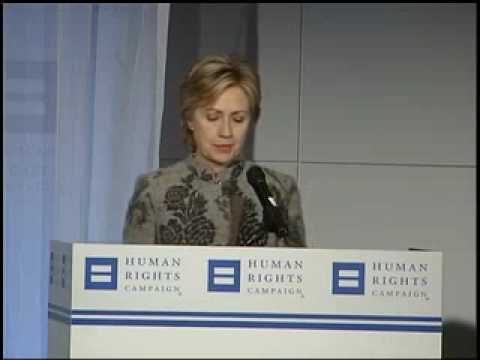
Gay activist group tells Obama administration to bully religious schools

Hillary Clinton and the Human Rights Campaign

This is from the Daily Signal.

Excerpt:

The largest lesbian, gay, bisexual, and transgender activist group in the country is calling on the Department of Education to address what it calls a “disturbing trend” on college campuses.

Specifically, the Human Rights Campaign is calling for more transparency towards what it sees as a trend of schools citing religious reasons for not adhering to Title IX.

The Human Rights Campaign believes that in granting such exemptions, schools are given  a “license to discriminate.”

Title IX prohibits discrimination on the basis of sex in educational programs that receive federal funding. If schools are found in violation of the statute, their federal dollars could be at risk.

To address these concerns, the Human Rights Campaign wants the Department of Education to issue public reports stating which institutions request or receive religious exemptions, and to detail the scope of those exemptions.

Conservatives reacted to this news so:

Hunter Baker, a fellow for religious liberty at Union, told The Daily Signal that the erosion of religious liberty exemptions, would make it “illegal” for schools to operate in accordance to their religious beliefs.

“If we were unable to choose faculty members who both live out and have a traditional view of Christian sexual morality, then that really damages our ability to pursue our mission as an institution,” Baker said. “You’re making it illegal for us to insist on a Christian life and worldview.”

Baker said it would be a “major intrusion” on the school’s standards of conduct for its student body. Union University, a Baptist college in Jackson, Tenn., follows a traditional Christian view of marriage and sexuality, for example.

“Any kind of activity that would occur between two same-sex individuals would be unacceptable by our standards of conduct,” he said.

Roger Severino, director of the DeVos Center for Religion and Civil Society at The Heritage Foundation, calls the Human Right Campaign’s requests an attempt to “blacklist religiously-affiliated schools.”

You might remember that the Human Rights Campaign previously denounced the socially conservative Family Research Council as a “hate group” after they were attacked by a gay activist who was later convicted of domestic terrorism. The Human Rights Campaign was never charged with hate speech by the Obama administration.

The Human Rights Campaign was also connected to the leaking of the names of pro-marriage donors by a gay activist inside the IRS. The IRS was able to settle that case, receiving only a slap on the wrist.

Unfortunately, the Human Rights Campaign enjoys broad support from many American companies, as well as prominent Democrats like Barack Obama and Hillary Clinton. It’s difficult for me to see how religious liberty can survive if we keep electing Democrats who want to give gay activists what they want: an end to religious liberty and freedom of conscience.

Tenured professor faces persecution for writing about being raised by two lesbians

Gay activist vandalizes pro-marriage sign

Here’s the latest story of secular leftist coercion from Breitbart News.

Excerpt:

The charges against Lopez shifted almost constantly and to this day he has never been shown the formal complaint from the still-unidentified former student. His understanding of the charges against him have been from meetings with university administrators and taking notes.

Her first complaint centered around a conference called The Bonds that Matter that Lopez organized at the Reagan Library, a forty-minute drive from the UC-Northridge campus. The conference featured noted speakers on divorce, third party reproduction, and adoption.

She says she was coerced into attending, that she was never informed of what the subject matter of the conference would be, and that she was offended by some of what she heard that day. She said the conference should have come with a trigger warning that it might cause trauma to gays and lesbians. She also said she broke down “in tears, crying.”

She says speakers explained that “all women who use sperm banks are evil” and that “gay people cannot be good parents.” She also complained about a brochure produced by the Ruth Institute she picked up at the conference aimed at the “victims of the sexual revolution” including those who tried the gay life and now want out.

Once the complaint was made, Lopez stepped beyond the Looking Glass and into the world of university investigations. For the next 378 days Lopez and his paid lawyers spent countless hours trying to keep up with the charges and investigations by multiple university administrates and their lawyers.

[…]He was formally charged with “discrimination,” one of the few charges that can result in revocation of tenure and dismissal.

[…]It should be noted that the speakers at the conference, while controversial, are not considered wild-eyed radicals. Jennifer Lahl speaks on the dangers to women of selling their eggs or renting their wombs. She’s from Berkley and is a frequent guest on liberal campuses. In fact, Lahl specializes in speaking to the left. Alana Newman spoke, a folk singer, who was born from surrogacy and is now an advocate against it. Perhaps the most controversial speaker was Jennifer Roback Morse who runs the Ruth Institute and who focuses broadly on what she calls the “victims of the sexual revolution.”

None of the speakers talked about gay issues and Lopez provided the tapes to prove it. There was one exchange between Newman and one student who asked about gays and surrogacy, but the student turned out to be the complainant. So, the only person who brought up the gay issue at the conference was the student who complained the conference slammed gays.

Lopez provided documents that also showed the students were not coerced. In fact, they didn’t even have to attend the conference. It was one of two options in the course. Most of the class chose the conference option.

The article alleges that the student was a plant by powerful LGBT groups who want to silence Lopez.

Marquette University

This reminds me of the other professor McAdams from Marquette who got into trouble for writing about how a student argued with his professor that he should be allowed to disagree with her about gay marriage. The left-leaning The Atlantic has the story, and surprisingly sides with professor McAdams.

Here are the details:

The incident that McAdams blogged about happened on October 28, 2014. Cheryl Abbate, a graduate student in philosophy who was leading a class called Theory of Ethics, was teaching undergraduates about John Rawls. She asked for examples of current events to which Rawlsian philosophy could be applied.

“One student offered the example of gay marriage as something that Rawls’ Equal Liberty Principle would allow because it would not restrict the liberty of others and therefore should not be illegal,” according to Holtz’s version of events. “Ms. Abbate noted that this was a correct way to apply Rawls’ Principle and is said to have asked ‘does anyone not agree with this?’ Ms. Abbate later added that if anyone did not agree that gay marriage was an example of something that fits the Rawls’ Equal Liberty Principle, they should see her after class.”

Sure enough, a student approached her after class, and in what was arguably an ethical breach, surreptitiously recorded their exchange.

[…]At this point, both the undergraduate and the grad student instructor spoke to various “superiors” about the incident. And the undergrad talked to McAdams, who decided to blog about it. He has been stripped of tenure for that blog post.

Marquette is a “Catholic” university, except it obviously is not.

Vanderbilt University

Meanwhile, here is yet another recent example of a professor getting into trouble for going against the secular left. National Review has that story, written by the famous civil rights expert Peter Kirsanow.

He writes:

The illiberal idiocy currently on display at the University of Missouri and Yale has now manifested itself at Vanderbilt, where an online student petition demanding the suspension of Professor of Law and Political Science Carol Swain for being “hateful” toward minorities has gotten more than 1,000 signatures. The fact that Professor Swain is black is no insulation from these charges.

Swain’s apostasy is that she has made politically incorrect statements about radical Islam and her traditional Christian beliefs, statements that the petitioners deem intolerant and which the University, therefore, must  not tolerate — tolerance, of course, being a one-way street.

That’s right. She’s a female, black professor. No one is safe from the secular left inquisition. They own the university, and if you want to go there, you have to get in, do your STEM degree, get out, and get to work. And vote to defund them completely when it’s election time.

The United States ought not have an official state church. But as Dennis Prager often says, universities and colleges are left-wing seminaries. They teach their secular left religious dogma, and God help you if you say one word to disagree with them. These are not people who handle disagreement and dissent well. These are not people who value free inquiry. These are not people who value truth.