Tag Archives: Fidelity

William Lane Craig explains how Christianity explains evil and suffering

A long journey through the night

A lot of people in the West complain too much about any little suffering they have to experience. But sometimes, when a very harsh suffering is felt by someone who has tried to follow Jesus, an explanation is necessary. I found something very good on the Reasonable Faith web site, written by Dr. William Lane Craig.

He makes the following points:

  1. We are not in a good position to assess the probability of whether God has morally sufficient reasons for the evils that occur.
  2. The Christian faith entails doctrines that increase the probability of the co-existence of God and evil.
  3. Relative to the full scope of the evidence, God’s existence is probable.

I’ve written before about point #1, in which Dr. Craig’s describes the limitations of human knowledge that make it hard for us to know for certain that a specific evil or suffering does not have a good reason for God to allow it. And I’ve written about #3, in which Dr. Craig makes some arguments for God’s existence. But #2 might be new to some of you, so let’s look at that.

He makes four sub points in section 2 about Christian doctrines that make the existence of evil and suffering more reasonable.

  • 2. a)The chief purpose of life is not happiness, but the knowledge of God.
  • 2. b) Mankind is in a state of rebellion against God and His purpose.
  • 2. c) The knowledge of God spills over into eternal life. 
  • 2. d) The knowledge of God is an incommensurable good.

My favorite one is 2. a), so let’s look at that one. He says:

2. a. The chief purpose of life is not happiness, but the knowledge of God. One reason that the problem of evil seems so puzzling is that we tend to think that if God exists, then His goal for human life is happiness in this world. God’s role is to provide comfortable environment for His human pets. But on the Christian view this is false. We are not God’s pets, and man’s end is not happiness in this world, but the knowledge of God, which will ultimately bring true and everlasting human fulfillment. Many evils occur in life which maybe utterly pointless with respect to the goal of producing human happiness in this world, but they may not be unjustified with respect to producing the knowledge of God. Innocent human suffering provides an occasion for deeper dependency and trust in God, either on the part of the sufferer or those around him. Of course, whether God’s purpose is achieved through our suffering will depend on our response. Do we respond with anger and bitterness toward God, or do we turn to Him in faith for strength to endure?

You know, I always get confused when I see Christians trying to follow the script of the world and trying to make themselves feel good with consumer purchases, travel, fun experiences, showing off to others, etc. When I read the story of Jesus, it’s pretty clear that the normal Christian life, if the person is following Jesus at all, is about suffering the disapproval and opposition of non-Christians while you remain faithful and obedient to God. Today, there’s probably no better example of this than defending unborn children from adult selfishness. Although, defending born children from selfish adults who seek to deprive children of their biological mother and father is pretty bad, too. Nobody is going to like you for restricting their fun (i.e. – abortion, divorce, adultery, homosexuality, etc.), but being willing to take the heat from non-Christians for the sake of promoting what God thinks is right is true Christianity. It’s what Jesus would do.

Anyway, the one I’ve been thinking about more lately is 2. d), where Dr. Craig writes this:

2. d) The knowledge of God is an incommensurable good. To know God, the source of infinite goodness and love, is an incomparable good, the fulfillment of human existence. The sufferings of this life cannot even be compared to it. Thus, the person who knows God, no matter what he suffers, no matter how awful his pain, can still say, “God is good to me,” simply by virtue of the fact that he knows God, an incomparable good.

I sometimes feel pretty stressed out about Americans who were born in conservative states, raised by two married Christian parents, attended Christian schools and youth groups, and then abandoned their faith for atheism as soon as they hit college. It really bothers me how people who had all these advantages turned their backs on God, and they’re ungrateful for all their blessings. They show no curiosity about God – they don’t want to know him. But when you read the gospels to see what Jesus has to say about these sorts of people, it’s very comforting. He really sees the problem, and he is on the side of the little guy who has to struggle to be faithful and obedient to God. The Bible has nothing to say to people who are able to feel happy and successful apart from God. It speaks to people who are struggling to follow God. Even when things are difficult, Jesus speaks to the problem of being an alien and a stranger in a world that turns its back on him.

Study: women who have fewer premarital sex partners have lower risk of divorce

Man helping a woman with proper handgun marksmanship

Consider this article from Family Studies that talks about how the number of pre-marital sex partners that a woman has increases her risk of divorce.

It says:

American sexual behavior is much different than it used to be. Today, most Americans think premarital sex is okay, and will have three or more sexual partners before marrying. What, if anything, does premarital sex have to do with marital stability?

This research brief shows that the relationship between divorce and the number of sexual partners women have prior to marriage is complex. I explore this relationship using data from the three most recent waves of the National Survey of Family Growth (NSFG) collected in 2002, 2006-2010, and 2011-2013. For women marrying since the start of the new millennium:

  • Women with 10 or more partners were the most likely to divorce, but this only became true in recent years;
  • Women with 3-9 partners were less likely to divorce than women with 2 partners; and,
  • Women with 0-1 partners were the least likely to divorce.

Earlier research found that having multiple sex partners prior to marriage could lead to less happy marriages, and often increased the odds of divorce.

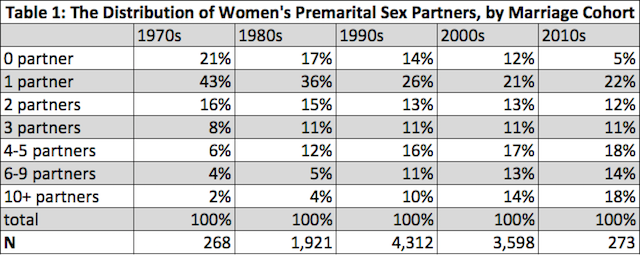
[…]Even more noteworthy has been the decline in the proportion of women who get married having had only one sex partner (in most cases, their future husbands). Forty-three percent of women had just one premarital sex partner in the 1970s.

[…]By the 2010s, only 5 percent of new brides were virgins. At the other end of the distribution, the number of future wives who had ten or more sex partners increased from 2 percent in the 1970s to 14 percent in the 2000s, and then to 18 percent in the 2010s. Overall, American women are far more likely to have had multiple premarital sex partners in recent years (unfortunately, the NSFG doesn’t have full data on men’s premarital sexual behavior, and in any event they recall their own marital histories less reliably than do women).

Here’s the change:

Women have freely chosen to dismiss the Bible and the moral law

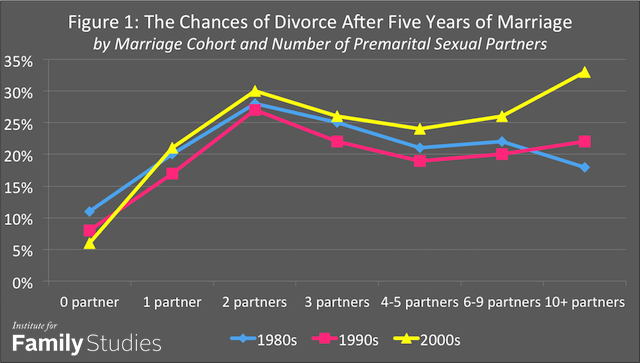
And the problem with this, of course, is that more premarital sex partners means a higher risk of divorce:

Even one non-husband premarital sex partner raises risk of divorce

Why is the 2-partner number so high?

In most cases, a woman’s two premarital sex partners include her future husband and one other man. That second sex partner is first-hand proof of a sexual alternative to one’s husband. These sexual experiences convince women that sex outside of wedlock is indeed a possibility. The man involved was likely to have become a partner in the course of a serious relationship—women inclined to hook up will have had more than two premarital partners—thereby emphasizing the seriousness of the alternative.

The Christian Post had an article about some recent numbers from the Centers for Disease Control about virgins.

Excerpt:

A new Centers for Disease Control study examines teenage health behaviors in connection to their self-reported sexual activity and shows those who remain abstinent are much healthier on many fronts than their sexually active peers.

The report, titled “Sexual Identity, Sexual Contacts, and Health-Related Behaviors Among Students in Grades 9-12, United States and Selected Sites,” showcased the results from a 2015 survey that monitored several categories of health-related behaviors like tobacco usage, drug and alcohol use, sexual habits, unhealthy dietary behaviors, and behaviors that contribute to unintentional injuries and violence.

The report concludes “that students who had no sexual contact have a much lower prevalance of most health-risk behaviors compared with students” who had sexual contact.

The article quotes Dr. Jennifer Roback Morse, who I have featured on this blog many times:

In a Monday interview with The Christian Post, Jennifer Roback Morse, founder and president of the Ruth Institute, said, “this study is remarkable because it asks questions and reports the answers, rather than avoiding questions or assuming answers.”

As Glenn Stanton noted last week in The Federalist, the results from those questions and answers are remarkable.

With regard to smoking, teenage virgins are 3,300 percent less likely to smoke daily than their peers who are sexually involved with someone of the opposite sex, Stanton computed from the report’s data. Teen virgins are 9,500 percent less likely to smoke daily than their peers who are sexually involved with someone of the same sex or in a bisexual relationship, he added. Chaste young people are also extremely less likely to use indoor tanning beds, binge drink, smoke marijuana, ride in cars as passengers with a drunk driver, and get into physical fights than their sexually active peers. Abstinent youth are also more likely to get a solid eight hours of sleep every night and eat breakfast daily.

[…]The CDC report also included findings from 25 state surveys, and 19 large, urban school district surveys conducted among students in grades 9–12 which took place between December of 2014 and September of 2015.

Now, many pro traditional marriage people will tell young men “feminism and the sexual revolution change nothing about a woman’s suitability for marriage, so go out there and get married to these women anyway”. In my experience, no one is telling women NOT to follow their hearts, and explaining to them the harm that they do by allowing their feelings to determine who they will engage in relationships.

I would like to see women make better decisions with men before they marry, rather than be influenced by their peers and culture to give themselves to men who are not marriage-minded. Maybe a little skepticism should be shown to “follow your heart”? Women need to understand what they are losing when they choose to have premarital sex.

In my group of friends, the men are aware of the Biblical prohibition on premarital sex. My friends know about the research on marriage, and what it takes to make a marriage work. We don’t follow our hearts, because we do what we know will work to achieve the results we want. We don’t listen to the culture, and we don’t listen to radical feminists. Men generally take an engineering approach to marriage – we want to know what the best practices and tradeoffs are, and then we plan and act to succeed.

Can recreational sex turn a selfish, irresponsible man into a marriage-minded provider?

Man helping a woman with proper handgun marksmanship

An article from the American Thinker answers the question that vexes many men. As you read this excerpt below, ask yourself if it is a man or a woman writing this.

First of all, liberal women seem to be having an awful lot of sex these days. They are losing their virginity early, and working their way through as many “alpha males” as possible, but all the while they insist that a stream of recreational-sex relationships is somehow a path to lifelong married love. Can you turn a man who wants nothing more than recreational sex into the perfect husband, simply by invoking the magical power of vagina?

Liberal women think that you can:

On the one hand, liberal women believe wholeheartedly in the idiotic social construct they call, “sexual liberation.”  They pride themselves on losing their virginity, as though that “accomplishment” had ever been above the challenge-scale of an alley cat in heat.

These liberal women I’ve known, having given away their female V-card over and over and over again, all the while scour their host of intimate “trial runs” searching for that mythical, Hollywood-construct, Mr. Right.  This Mr. Right guy, for whom they are searching, is known to them up front as even more sexually-liberated than they, but this little factoid seems not to register in their liberated little heads as they frantically search for the equally mythical family home with the white picket fence, which somehow never gets hit by any of life’s roving tornadoes.  One can almost hear them say in unison, “And they all lived happily ever after.”

I think it’s one of the deepest mysteries of the world why women think that a man who has lots and lots of recreational sex is somehow marriage material. When I think of men who are qualified for marriage, I think of men who have studied hard subjects, gotten marketable skills, worked and worked, saved and saved, and shown that they can be faithful in marriage by exhibiting self-control in the courtship. But liberal women think that all of this reasoning is junk, and you must just jump right into sex to see if the relationship will “work out” or to find out what you “like”. Recreational sex, they insist, is a superior way of finding a husband. Discussing who will do what in an actual marriage and what the actual marriage is for is apparently ineffective.

More:

Evidently, the liberal woman is capable of the most severe form of psychological denial known to humankind.  Certain that one of the men with whom she has copulated without strings will suddenly morph into a faithfully monogamous creature the minute she can convince one of them to say “I do” in front of a few witnesses, the liberal woman marches blindly down the aisle towards near-certain, adulterous doom.  Yet, no amount of honest reason can dissuade liberal women from this self-destructive, moral myopia.

What other term but “morally schizoid” could possibly describe this blatantly contradictory tendency among liberal women?

Having spent their youth casually throwing their own sexual morality to the winds of fairytale “liberation,” these liberal women still steadfastly cling to the faithfully monogamous ideal for that sometime-later moment when they actually do desire all the traditional things — the husband, the kids, the white picket fence — those pesky female-nature embedded longings, which coincidentally ensure the continuation of the human race.

But these liberal women somehow — in perfect schizoid manner — convince themselves that once married, they will be the gratuitous beneficiaries of the monogamous respect they still desire, but have never once demanded or deserved.  Intuitively, women know that strict monogamy provides the only real security for themselves and their own offspring.  Yet, they continue themselves to spurn the demands of monogamy until the very last minute, believing that fidelity springs forth naturally in miraculous profusion among all “married” humans.  Such pure poppycock can only be explained as a mental disorder.

I think women need to ask themselves questions honestly and rationally:

  • can recreational sex make an unemployed man get a job?
  • can recreational sex make a violent man be courteous and respectful?
  • can recreational sex make an atheist turn into a Christian?
  • can recreational sex make a male slut stay faithful?
  • can recreational sex make wastefulness turn into frugality?
  • can recreational sex make laziness turn into diligence?
  • can recreational sex make irresponsibility turn into commitment?

Marriages last because both partners have prepared themselves for self-sacrifice, rational discussions, problem solving and cooperation.

Previously, I provided the male perspective on liberal women’s poor decision-making about men and marriage. Read the article from the American Thinker (written by a woman), then read mine.