

Tag Archives: Feminism

New study: what lifestyle choices lead to happiness for women?

Marriage and family
Marriage and family

In preparation for this blog post, I read an article from a far-left source about the decline of women’s happiness.

Excerpt:

As women gain political, economic and social freedoms, one would expect that they should feel even more contented relative to men. But this isn’t so.

The “paradox of declining female happiness” was pointed out by economists Betsey Stevenson and Justin Wolfers, who also happen to share a house and kids. They analyzed the happiness trends of US citizens between 1970 and 2005 and found a surprising result.

Stevenson and Wolfers discovered that American women rated their overall life satisfaction higher than men in the 1970s. Thereafter, women’s happiness scores decreased while men’s scores stayed roughly stable. By the 1990s, women were less happy than men. This relative unhappiness softened after the turn of the century, but men continue to enjoy a higher sense of subjective wellbeing that is at least as high — if not higher — than women’s.

Those 35 years saw advances in American women’s rights and financial power.

Let’s take a look at a recent study that the Daily Wire reported on, to see what really makes women happy:

Despite the onslaught of propaganda telling young girls otherwise, a recent research paper distilling data from over 30 European countries concluded that mothers find homemaking preferable to working full-time.

Doc. PhDr. Dana Hamplová, Ph.D., a senior scientist at the Institute of Sociology, ASCR, and a current representative of the Czech Republic in the International Social Science Program, authored the paper. Addressing Betty Friedan’s narrative in the book The Feminine Mystique, which claims that women are happiest and most fulfilled at work, Hamplová “explores the link between employment and subjective well-being among mothers with children under 3 years of age,” reads the paper’s abstract.

“Analyzing multiple measures of subjective well-being, the paper shows that homemakers are generally happier than full-time workers,” the scientist found.

“Contrary to our expectations, homemaking was positively associated with happiness particularly among mothers who left higher quality employment for childcare. Though some variation across countries exists, it is not linked to the provision of formal childcare, duration of parental leave, or tax system,” Hamplová explains.

[…]”Thus, similarly to several other studies, the ESS [European Social Survey] data do not corroborate Betty Friedan’s idea that domesticity and housekeeping leaves women unhappy and unsatisfied,” she writes. “As all 12 measures of happiness/satisfaction point to the same direction, the conclusion that mothers with younger children tend to be better off if they are not engaged in paid employment seems to be robust.”

We’ve had lots of advancements in women’s power, often coming at the expense of men (i.e. – husband candidates). For example, anti-male schools staffed by feminist administrators and feminist teachers might be great for women, but they don’t produce high-earning men for women to marry. And when women vote to expand government, taxes must increase to pay for all the spending. This reduces even further the pool of men who can take on a wife and family shrinks even more because of the increased tax burden.

This article from the leftist The Atlantic explains:

In the view that has prevailed in American education over the past decade, boys are resented, both as the unfairly privileged sex and as obstacles on the path to gender justice for girls. This perspective is promoted in schools of education, and many a teacher now feels that girls need and deserve special indemnifying consideration.

[…]A review of the facts shows boys, not girls, on the weak side of an education gender gap. The typical boy is a year and a half behind the typical girl in reading and writing; he is less committed to school and less likely to go to college. In 1997 college full-time enrollments were 45 percent male and 55 percent female. The Department of Education predicts that the proportion of boys in college classes will continue to shrink.

Data from the U.S. Department of Education and from several recent university studies show that far from being shy and demoralized, today’s girls outshine boys. They get better grades. They have higher educational aspirations. They follow more-rigorous academic programs and participate in advanced-placement classes at higher rates. According to the National Center for Education Statistics, slightly more girls than boys enroll in high-level math and science courses. Girls, allegedly timorous and lacking in confidence, now outnumber boys in student government, in honor societies, on school newspapers, and in debating clubs. Only in sports are boys ahead, and women’s groups are targeting the sports gap with a vengeance. Girls read more books. They outperform boys on tests for artistic and musical ability. More girls than boys study abroad. More join the Peace Corps. At the same time, more boys than girls are suspended from school. More are held back and more drop out. Boys are three times as likely to receive a diagnosis of attention-deficit hyperactivity disorder. More boys than girls are involved in crime, alcohol, and drugs. Girls attempt suicide more often than boys, but it is boys who more often succeed. In 1997, a typical year, 4,483 young people aged five to twenty-four committed suicide: 701 females and 3,782 males.

It’s important to note that women are not victims here, they are actually the ones who created the shortage of men who could earn enough money to support a family, and allow them to stay home with their children. Their “advancements in power” came at a cost: they undermined the system that produced men who were capable of handling the financial demands of a family where the wife can raise her own children.

Look at this study of how women have voted to expand government and therefore raise taxes on working men for social programs that replace husbands:

This paper examines the growth of government during this century as a result of giving women the right to vote. Using cross‐sectional time‐series data for 1870–1940, we examine state government expenditures and revenue as well as voting by U.S. House and Senate state delegations and the passage of a wide range of different state laws. Suffrage coincided with immediate increases in state government expenditures and revenue and more liberal voting patterns for federal representatives, and these effects continued growing over time as more women took advantage of the franchise. Contrary to many recent suggestions, the gender gap is not something that has arisen since the 1970s, and it helps explain why American government started growing when it did.

Bigger government means higher taxes means men earn less money, after taxes. How are you supposed to keep your wife home to watch over the little ones when taxes are higher? You can’t.

Why are so many women with good careers being forced to freeze their eggs?

Do young women understand how to get to a stable marriage?

The New York Times says that more and more women are having to freeze their eggs because they can’t find good men to marry. The NYT doesn’t think that women are doing anything wrong. They blame the men for refusing to commit. According to feminism, women who value careers, abortion rights, no-fault divorce, big government, high taxes, etc. are doing everything right. But does it work?

I thought it might be a good idea to help Western women to make better decisions with men and marriage. Although setting out boundaries seems harsh and restrictive, it’s actually protective and loving. If we want women to get to a stable marriage and children, (what they really need long term, after they lose their looks and youth), then we should be bold about leading them.

The first thing to point out is that the women celebrated by the New  York Times are intentionally delaying marriage for their education and careers.

Another New York Times article explains:

It could be that the new generation of millennial women is delaying having children even longer than the women who came before them, as prime childbearing years are also critical years for advancing in a career. A recent study shows that the marital pay gap that springs up after a first child is born typically does not close if the birth happens between age 25 and 35.

Shannon Hettinger, a 32-year-old from Washington, D.C., said she definitely wanted children. She grew up in a large family in a small town in Pennsylvania and almost all her high school friends are married with children. But she moved to Washington, and spent her 20s deciding on a career. Now that she has one she loves — she works in residential real estate sales — she is not going to stop until she gets established. That means not having children for a while.

“I just want to build my book of business and see where I can go from here,” she said. “My whole focus is career growth. That’s my No. 1 priority.”

“Once I achieve a certain level of success,” she added, “then I’ll start thinking about a family.”

Ivy Gray-Klein, 26, who lives in Philadelphia and works at the University of Pennsylvania School of Design, said she was open to having children but cannot imagine doing so until she is 30 or 35. She wants to feel settled in her own life first. Now she has three roommates, is paying down her student loans and is working to build a little bit of savings.

“I’m just really trying to get myself to a place that is solid,” she said by phone. “Having a child right now would be so destabilizing. Children just seem like such an enormous financial undertaking.”

As far as I’m concerned, once a woman reaches 30 , she’s actually chosen not to marry, and not to have children. Marriage is something that men are willing to do with women in their early 20s. They want a woman to commit and invest herself in his life early. They don’t commit to a woman who has spent her 20s running up debts, traveling, being promiscuous, etc. The pattern of selfish behavior that  women get into damages their ability to be good wives and mothers later. And men know that.

But in this post, I’m discuss something that I think is responsible for women not finding good men: and that’s the fact that many women are not looking for good men. In fact, some women are very attracted to very bad men.

Here’s the first editorial about women and domestic terrorist Dzhokar Tsarnaev, one of the Boston marathon bombers.

Excerpt:

Mostly, though, they think Dzhokhar is cute. The Bambi eyes (looking right out of his Instagram-doctored photos at you!), the hipster facial stubble, the masses of wine-dark tousled hair — adorable! Impassioned believers have written “Dzhokhar is innocent” on their hands and plastered “Innocent until proven guilty!!!!” posters around their towns. An 18-year-old waitress interviewed by the New York Post vowed to have Dzhokhar’s last tweet before the bombing tattooed onto her arm: “If you have the knowledge and the inspiration all that’s left is to take action.”

[…]But the real cause of the Jahar craze more likely lies in something more primal and less pretty in the female psyche. I’m betting that women, young and old, are drawn to Dzhokhar not because he is a good-looking late adolescent but because he is a good-looking accused killer. He’s a classic “bad boy” of the sort to whom women are chronically attracted because they want to reform them, or minister to their wounds, or be the healing presence they’ve never had — but mostly because they find them sexy.

That article also noted:

It’s not surprising, then, that every homicide perp on death row who is reasonably attractive has groupies. Consider the handsome (and widely philandering) Scott Peterson, sentenced in 2005 for killing his wife and unborn son and throwing their remains into San Francisco Bay. The day he checked into San Quentin, he received three dozen phone calls from smitten women, including an 18-year-old who wanted to become the second Mrs. Peterson.

Some of the tweets and other fangirl comments about Tsarnaev were collected in this New York Post article.

Lots of Western women from the UK, France, Russia, etc. all picked up and moved to the Middle East to become ISIS jihadi brides.

Excerpt:

Western women joining Islamic State are increasingly from comfortable backgrounds and often well educated with romantic notions of adventure often quickly dispelled by the harshness of life as a “Jihadi bride”, according to a British research report.

Some 550 women from Western countries have left their homelands to join Islamic State, which has captured swathes of Syria and Iraq, said the report by the Institute for Strategic Dialogue and the International Centre for the Study of Radicalisation at King’s College, London.

[…]It said female recruits were increasingly younger, some from comfortable backgrounds and often well-educated, and were playing “crucial” propaganda and recruitment roles.

That article is three years old, the numbers have more than doubled since then. The most common reasons cited for leaving are romance and adventure.

Psychology Today has some comments about why some women do this:

In her post, “Women Who Love Serial Killers,” PT blogger, Katherine Ramsland, offers some suggestions about why some women can be so attracted to, or hopelessly beguiled by, the most terrifying of human predators. At first, she provides explanations from the women themselves, women who actually married these dangerously unhinged criminals. Their reasons (somewhat elaborated here) include the assumptions that:

  • their love can transform the convict: from cunning and cruel, to caring, concerned, and compassionate.

  • there’s a wounded child nested somewhere inside the killer that can be healed through a devoted nurturance that only they can provide.

  • they might share the killer’s media spotlight, and so triumphantly emerge from their anonymity, and maybe in the process even land a book or movie deal (an aspiration about as cynical as it is narcissisticand self-serving).

And this is even more interesting:

To simplify this work’s findings for my present purpose, however, let me begin by emphasizing that Ogas and Gaddam find substantial evidence from Web searches, posts, and many 1,000s of romance novels that women demonstrate a strong erotic preference for dominant men. Or toward what’s now commonly referred to as alpha males—in the authors’ words, men who are “strong, confident, [and] swaggering [as in “cocky,” and the pun is intended].” Unfortunately, what these descriptors often imply is behavior sufficiently bearish, self-centered, and insensitive as to often cross the line into a physical, mental, and emotional abuse that can be downright brutal.

[…]Moreover, in responding to the question as to whether some men, such as “serial killers, violent offenders, and rapists,” might be too dominant for women to accept, Ogas and Gaddam note: “It turns out that killing people is an effective way to elicit the attention of many women: virtually every serial killer, including Ted Bundy, Charles Manson, and David Berkowitz, have received love letters from large numbers of female fans” (p. 98).

Women choose good-looking bad boys, because they think that they can change them:

The fantasy that seems to be operating in such devotees, and that constitutes the plot of virtually all erotic/romantic novels written with women in mind, is that the “misogyny and jerkdom” they might have to battle with in such super-dominant males is only temporary. That it doesn’t really represent the man’s innermost reality. That his violence and lack of tender feelings is only the beginning of the story, and that their unsparing love, affection, and dedication can ultimately transform his character by helping him get in touch with his, well, “inner goo.”

I blogged before about feminists going after pro-choice bad boys like William Clinton, Peter Strzok, Eliot Spitzer, Anthony Weiner, John Edwards, Harvey Weinstein, etc. These men support selfish policies like abortion and no-fault divorce. Women seem to not understand that men who support selfishness as policy might actually BE selfish in their own lives. Men who are able to commit and raise children are not pro-abortion and pro-divorce. Those are the men who women should be pursuing, and during their early-to-mid 20s.

A lesson about men for marriage-minded women from the movie “High Noon”

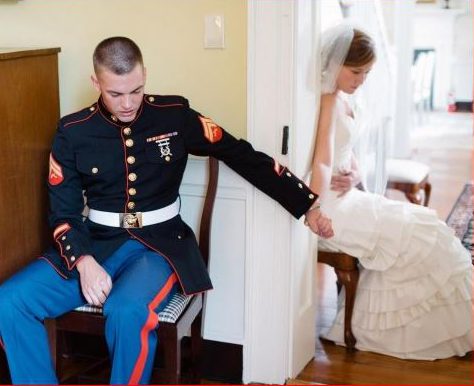
Marine prays with his wife on their wedding day

One of my favorite movies for explaining the differences between men and women is “High Noon” (1952).

Here’s the summary from IMDB:

Former marshal Will Kane (Gary Cooper) is preparing to leave the small town of Hadleyville, New Mexico, with his new bride, Amy (Grace Kelly), when he learns that local criminal Frank Miller has been set free and is coming to seek revenge on the marshal who turned him in. When he starts recruiting deputies to fight Miller, Kane is discouraged to find that the people of Hadleyville turn cowardly when the time comes for a showdown, and he must face Miller and his cronies alone.

The main theme of the film concerns Amy’s decision to break her wedding vows the very day that she makes them. She tells her new husband that he must bow to her will, and give up his male role as protector. When he explains his reasons for standing his ground to her practically (Miller will hunt them down) and morally (he has a duty protect the town), she dismisses both. She tells him that if he doesn’t run away from Miller and his gang with her, that she will get on the train and leave town by herself.

The intro of film shows the member’s of Miller’s gang assembling, and the words of the song explain the central conflict between husband and wife:

Here’s the part of the lyrics we care about:

The noonday train will bring Frank Miller.
If I’m a man I must be brave
And I must face that deadly killer
Or lie a coward, a craven coward,
Or lie a coward in my grave.

O to be torn ‘twixt love and duty!
S’posin’ I lose my fair-haired beauty!
Look at that big hand move along
Nearin’ high noon.

He made a vow while in State’s Prison,
Vow’d it would be my life or his’n
I’m not afraid of death, but O,
What will I do if you leave me?

Do not forsake me O my darlin’
You made that promise when we wed.
Do not forsake me O my darlin’
Although you’re grievin’, I can’t be leavin’
Until I shoot Frank Miller dead.

What’s interesting is that his new wife Amy apparently does not understand the meaning of wedding vows or the natural roles of good men as protectors of the weak, and fighters against evil. Although she vowed to stick by him and help him, the minute anything threatening appears that makes her feel unhappy, she abandons her vows and abandons her man. Let’s break down her mistakes now, using actual conversations from the movie.

First, she doesn’t understand or respect the man she married as a man:

Kane: [while riding out of town] It’s no good. I’ve got to go back, Amy.

Amy: Why?

Kane: This is crazy. I haven’t even got any guns.

Amy: Then let’s go on. Hurry.

Kane: No, that’s what I’ve been thinkin’. They’re making me run. I’ve never run from anybody before.

Amy: I don’t understand any of this.

Kane: [after looking at his vest watch] Well, I haven’t got time to tell ya.

Amy: Then don’t go back, Will.

Kane: I’ve got to. That’s the whole thing. [He turns the buggy around and rides back into town]

Her feelings and her desires for the world to be a happy place for her are so strong that they cloud her judgment.

Second, she doesn’t understand the threat posed by evil men:

More:

Kane: I sent a man up five years ago for murder. He was supposed to hang. But up North, they commuted it to life and now he’s free. I don’t know how. Anyway, it looks like he’s coming back.

Amy: I still don’t understand.

Kane: He was always wild and kind of crazy. He’ll probably make trouble.

Amy: But that’s no concern of yours, not anymore.

Kane: I’m the one who sent him up.

Amy: Well, that was part of your job. That’s finished now. They’ve got a new marshal.

Kane: He won’t be here until tomorrow. Seems to me I’ve got to stay. Anyway, I’m the same man with or without this. [He pins his badge on his vest]

Amy: Oh, that isn’t so.

Kane: I expect he’ll come lookin’ for me. Three of his old bunch are waiting at the depot.

Amy: That’s exactly why we ought to go.

Kane: They’ll just come after us, four of ’em, and we’d be all alone on the prairie.

Amy: We’ve got an hour.

Kane: What’s an hour?…What’s a hundred miles? We’d never be able to keep that store, Amy. They’d come after us and we’d have to run again, as long as we live.

Amy: No we wouldn’t, not if they didn’t know where to find us. Oh Will! Will, I’m begging you, please let’s go.

Kane: I can’t.

Amy: Don’t try to be a hero. You don’t have to be a hero, not for me.

Kane: I’m not trying to be a hero. If you think I like this, you’re crazy.

Instead of recognizing how her feelings are deceiving her about the threat and trusting her husband, she tries to force him to accept her mistaken view of reality by threatening to abandon him.

One of Kane’s ex-girlfriends has a talk with Amy, which helps her to understand who Kane is, and what is expected of her:

Amy: That man downstairs, the clerk, he said things about you and Will. I’ve been trying to understand why he wouldn’t go with me, and now all I can think of is that it’s got to be because of you…Let him go, he still has a chance. Let him go.

Helen: He isn’t staying for me. I haven’t spoken to him for a year – until today. I am leaving on the same train you are…What kind of woman are you? How can you leave him like this? Does the sound of guns frighten you that much?

Amy: I’ve heard guns. My father and my brother were killed by guns. They were on the right side but that didn’t help them any when the shooting started. My brother was nineteen. I watched him die. That’s when I became a Quaker. I don’t care who’s right or who’s wrong. There’s got to be some better way for people to live. Will knows how I feel about it.

Helen: I hate this town. I always hated it – to be a Mexican woman in a town like this.

Amy: I understand.

Helen: You do? That’s good. I don’t understand you. No matter what you say. If Kane was my man, I’d never leave him like this. I’d get a gun. I’d fight.

Amy: Why don’t you?

Helen: He is not my man. He’s yours.

Helen understands the need for a wife to stand by her man. But Amy’s response to evil is to shut her eyes and focus on feeling good and being happy. Notice that her “better way” is unspecified – it’s just a feeling she has that pacificism and no-violence will somehow “work” to stop evil. But in reality, pacifism is not a “better way” of dealing with evil – it does not work. Her pacifist response not only does not make evil go away, it actually encourages more evil. Weakness emboldens evildoers, and laying down your arms provokes them to do more evil. Will Kane knows this, but she won’t listen to him.

You can watch the final gunfight here, as well as Amy’s final decision:

So, this is why I really recommend this movie as a discussion-starter when you like a girl and are thinking of marrying her. It clarifies the essential problem with many young women today not being ready for marriage. To be fair, most women come around to respect their husbands and his different roles after they get married. However, the risk of divorce is so dangerous that it makes sense to bring it up for discussion before the marriage happens. Marriage is supposed to be an engine to serve God, and the success of that enterprise cannot be left to chance. You can’t just rely on the fact that she says the words of the vow, you have to check to see if she has a habit of keeping her promises when it goes against her own self-interest.

Ask yourself: Who are you, as a man? And does your woman accept that you have obligations to stand up to evil and do good ? Will she support you in your battle against evil, or will the marriage just be about her feelings and desires? I would especially beware of women who think that God is speaking to them through their feelings and desires. Look at her friends: are they practical and successful? Or are they irresponsible, unaccountable and reckless? Look at her father: does he have a plan for her, and does he lead her to be practical, frugal and hard-working? If you are not going to get an ally and a supporter in a wife, then you will not be able to serve God well, as a married man. Think about it.