
Tag Archives: Feminism

Unmarried 34-year-old woman vows to change shark into loving, faithful husband by hand-feeding him raw meat

Melissa Brunning dispenses advice and posts exotic selfies on her page “Wild and Free”

Melissa Brunning is a 34-year-old unmarried woman who operates a Facebook page called “Wild and Free“. On that page, she posts inspirational quotes about travel, fun, following your heart, as well as pictures from all her exotic vacations. The “about” section of the (public) page says “My mission is to inspire others to break free from 9-5 & live LIFE on their terms, to be WILD and FREE to follow their dreams, to explore & go on adventure”.

Here is her philosophy in one photo:

Life is too short to waste time listening to wise people
Life is too short to waste time listening to people with demonstrated ability and success

Anyway, you can look at all the selfies of her with her cat, her bikinis, etc. on her personal Facebook page. The reason for this post is because Melissa met a new guy on Match.com. He has everything that she wants. He’s tall. He’s strong. He’s smooth. He has really great teeth. And most importantly, he gives the impression that he could really lose his temper at any minute and attack other men violently. Melissa is sure that she can get around that problem somehow, though. Although the man lived 1500 miles away from her, this was no problem, because Melissa loves to travel, and  this trip was a once-in-a-lifetime exotic adventure!

The West Australian reported on her date:

Melissa Brunning was on a “once-in-a-lifetime” trip cruising the majestic Kimberley on a friend’s superyacht, so when an opportunity arose to feed a placid shark she was scared, but her adventurous spirit willed her to give it a go.

But it all ended in a freak shark bite incident that left the Perth woman grateful she didn’t lose a finger.

The last of her friends to try feeding the three to four Tawny nurse sharks hanging around the back of the boat, what Ms Brunning didn’t realise until it was too late was that she shouldn’t hand feed the 2m shark, rather place the piece of fish in front of her and watch it go by and suck it up.

With a suction “like a Hoover”, the shark sucked Ms Brunning’s right index finger into its mouth full of rows of razor sharp teeth.

Mobile phone footage filmed by a friend of the incident at the end of May shows Ms Brunning screaming as she’s pulled from the back of the boat into the croc-infested water as the shark swims off.

Oh no! The hot alpha male bad boy ate her food, bit her, and swam away without even leaving his phone number. Typical whale! Er, I mean shark. It wasn’t her fault! There was no way to predict from his appearance that he would become violent and unfaithful. It was the shark’s fault – he lied to her. He presented himself as kind and sweet. The shark’s toxic masculinity was clearly to blame. #Patriarchy #MeToo

Melissa is quoted in the article about the break-up with the sharp-looking thug: “We’re not meant to be in the water, if we were we’d have gills.” It was a love not meant to be. But while in the hospital getting taxpayer-funded health care for the “unexpected” result of her irrational choices, a nurse gave her the phone number of a hot looking crocodile who was just being released from prison. Maybe things will work out with him? At least her friends will be envious if she posts a selfie with him.

You can have a lot of fun reading the inspirational quotes on her Wild and Free page, and even more fun if you insert something about trying to hand feed a shark into each one.

Here are some:

  • When it feels scary to jump, that is exactly when you jump, otherwise you end up staying in the same place your whole life
  • Take every chance you get in life because some things only happen once
  • Life is an adventure, dare it
  • Live in the moment
  • When was the last time you did something for the first time?
  • If it scares you, it might be a good thing to try
  • Anything that gets your blood racing is probably worth doing
  • Be crazy, be stupid, be silly, be weird, be whatever – because life is too short to be anything but happy

I think the common denominator here is this glorification of thrill seeking and fun, at the expense of having a slow, deliberate plan that achieves a real result. When your sole purpose in life is to have good feelings, it becomes impossible to exercise self-control for the sake of something higher, like serving God. The pattern of always choosing self, self, self becomes impossible to break.

This sort of thrill-seeking lifestyle works when you’re young and pretty, but it doesn’t really set you up for success in the last 50 years of your life. A woman needs to use her pre-marriage time wisely. She needs to train up her wife and mother skills, and develop patience and maturity by doing hard things. She has to train herself to keep commitments if her marriage is to last. A stable marriage requires her to get comfortable with self-sacrifice. She has to train her character to be content with stability. She needs to stop seeking thrills and learn how to delay gratification.

I am seeing this attitude of hers a lot in young Christian women. There doesn’t seem to be much of a vision for marriage and family being taught to women today. Women don’t see Christianity as something that overrides their pleasure-seeking and self-centeredness. Instead, they just sing praise hymns, read devotionals, listen to Joyce Meyer’s prosperity gospel sermons, and focus on themselves. Nutrition, fitness and travel are all good, but they cannot be the main things in life for an authentic Christian.

Christians should be concerned with God’s reputation and God’s goals. Christians are meant to serve God, not themselves. Christians have to do what works for God, like apologetics. There is no such thing as a Christian whose Facebook and Instagram page celebrates “self-love”, thrill-seeking, exotic vacations, etc. A real Christian always does what works to serve God. Jesus was good at self-denial and self-control. He was obedient to God even when it cost him his life. He didn’t go on exotic vacations and do pointless, risky things to get fun and thrills.

If you missed my previous post on radical feminists turning to mermen to get around the problem of “toxic masculinity” in normal men, then be sure to read that.

New study: college students drink more before casual sex than relationship sex

Sex events measured against intimacy level (for women only)

It turns out that college students use MORE alcohol and drugs when they have sex with strangers, and LESS alcohol and drugs when they have sex with people they are in a relationship with.

This study was reported by the far-left Psychology Today.

Excerpt:

A recent study published in the Journal of Sex Research sheds some light on these questions. A research team headed by Jennifer Walsh analyzed alcohol use in almost 500 casual and 1400 romantic sexual intercourse events that happened to 300 college women on a monthly basis over a period of 12 months. Alcohol use was not very common during romantic sex: 20% of romantic encounters involved some drinking and only 5% involved heavy drinking (defined as four or more drinks). Hookups, on the other hand, were a different story: Women drank during 53% of their hookups, and drank heavily during 38% of all hookups.

But not all hookups are created equal. There was an almost perfect linear relationship between drinking and partner closeness: The less known the partner, the more likely women drank before sex, and the more likely they drank a lot. Look at the graph I created based on their data. When the casual partner was an ex-boyfriend, for example, only 30% of hookups involved drinking and 17% heavy drinking. When the partner was a random stranger, however, 89% of hookups involved drinking and 63% involved four or more drinks!

The writer explains why this happens:

Alcohol also provides an excuse to those who need one. In a world that encourages hooking up but also judges those (especially women) who engage in it too much, many seem to need it. You’re a slut if you hook up with people just because you want to: Good girls don’t actively want to hook up, and being sober means taking full responsibility for your actions. But if you can blame it on the alcohol, you’re absolved of guilt. You can still be a good girl who just happened to make a mistake.

This study agrees with a study I blogged about before from the University of Virginia, which explained that college students drink before hook-ups in order to be able to explain to their friends why it wasn’t their fault:

A Rutgers University student commented, “If you’re drinking a lot it’s easier to hook up with someone… [and] drugs, it’s kind of like a bonding thing… and then if you hook up with them and you don’t want to speak to them again, you can always blame it on the drinking or the drugs.”

Other women observed that being drunk gives a woman license to act sexually interested in public in ways that would not be tolerated if she were sober. For instance, a University of Michigan student said, “Girls are actually allowed to be a lot more sexual when they are drunk…”

A University of Chicago junior observed, “One of my best friends… sometimes that’s her goal when we go out. Like she wants to get drunk so I guess she doesn’t have to feel guilty about [hooking up].”

Now, the first thing I thought of when I saw this article in Psychology Today was: “I wonder what criteria these college students are using in order to decide which strangers they have sex with”. And then I realized. For perfect strangers, it would have to be something obvious, like physical appearance. A study found that it takes a woman 3 minutes to decide if she likes a man or not. Whatever assessment is being made in that 3 minutes surely isn’t adequate for long-term plans for marriage, children and church attendance.

Don’t judge me, it wasn’t my fault

It reminds me of something I read a while back in a Theodore Dalrymple book. Theodore Dalrymple is the famous psychiatrist who writes books about culture in the UK. One of his books about the complete lack of personal responsibility among criminals is actually posted online.

In the chapter “Tough Love“, he talks about the nurses he works with:

All the more surprising is it to me, therefore, that the nurses perceive things differently. They do not see a man’s violence in his face, his gestures, his deportment, and his bodily adornments, even though they have the same experience of the patients as I. They hear the same stories, they see the same signs, but they do not make the same judgments. What’s more, they seem never to learn; for experience—like chance, in the famous dictum of Louis Pasteur—favors only the mind prepared. And when I guess at a glance that a man is an inveterate wife beater (I use the term “wife” loosely), they are appalled at the harshness of my judgment, even when it proves right once more.

This is not a matter of merely theoretical interest to the nurses, for many of them in their private lives have themselves been the compliant victims of violent men. For example, the lover of one of the senior nurses, an attractive and lively young woman, recently held her at gunpoint and threatened her with death, after having repeatedly blacked her eye during the previous months. I met him once when he came looking for her in the hospital: he was just the kind of ferocious young egotist to whom I would give a wide berth in the broadest daylight.

Why are the nurses so reluctant to come to the most inescapable of conclusions? Their training tells them, quite rightly, that it is their duty to care for everyone without regard for personal merit or deserts; but for them, there is no difference between suspending judgment for certain restricted purposes and making no judgment at all in any circumstances whatsoever. It is as if they were more afraid of passing an adverse verdict on someone than of getting a punch in the face—a likely enough consequence, incidentally, of their failure of discernment. Since it is scarcely possible to recognize a wife beater without inwardly condemning him, it is safer not to recognize him as one in the first place.

This failure of recognition is almost universal among my violently abused women patients, but its function for them is somewhat different from what it is for the nurses. The nurses need to retain a certain positive regard for their patients in order to do their job. But for the abused women, the failure to perceive in advance the violence of their chosen men serves to absolve them of all responsibility for whatever happens thereafter, allowing them to think of themselves as victims alone rather than the victims and accomplices they are. Moreover, it licenses them to obey their impulses and whims, allowing them to suppose that sexual attractiveness is the measure of all things and that prudence in the selection of a male companion is neither possible nor desirable.

Often, their imprudence would be laughable, were it not tragic: many times in my ward I’ve watched liaisons form between an abused female patient and an abusing male patient within half an hour of their striking up an acquaintance. By now, I can often predict the formation of such a liaison—and predict that it will as certainly end in violence as that the sun will rise tomorrow.

At first, of course, my female patients deny that the violence of their men was foreseeable. But when I ask them whether they think I would have recognized it in advance, the great majority—nine out of ten—reply, yes, of course. And when asked how they think I would have done so, they enumerate precisely the factors that would have led me to that conclusion. So their blindness is willful.

If Dalrymple’s observations about female patients and nurses can be applied more broadly, then it explains why women initiate 70% of divorces. Women who don’t want to be “forced” to be self-controlled and responsible with their choices will want an easy way to get out of it. According to Dalrymple’s experience, it’s not that women don’t know that bad boys are lousy at marriage and fatherhood. They know it, but they choose to blind themselves to it, because it’s just too much self-denial to have to be serious about making responsible choices with men and sex and marriage.

Right now, we are $20 trillion in debt, half of that thanks to Barack Obama’s administration. I believe that the majority of this debt was accrued because people wanted to do what felt good to them in the moment, and then pass off the costs of their “unpredictable” mistakes onto their neighbors. The truth is that these costs will be paid by generations of young people not yet born. People shouldn’t talk about how much they care about children, if their voting will force all the children of tomorrow into slavery.

One last piece of advice to men. My best friend Dina told me to always evaluate women based on their past choices, not based on the picture of themselves that they paint with words. Wise advice.

If we seriously want men to marry and become fathers, let’s repeal no-fault divorce

I saw a very good article at the Heritage Foundation web site about the importance of fathers for children. The author Virginia Allen listed out some of the benefits that fathers provide to children:

Studies have found that children raised without a father are:

  • At a higher risk of having behavioral problems.
  • Four times more likely to live in poverty.
  • More likely to be incarcerated in their lifetime.
  • Twice as likely to never graduate high school.
  • At a seven times higher risk of teen pregnancy.
  • More vulnerable to abuse and neglect.
  • More likely to abuse drugs and alcohol.
  • Twice as likely to be obese.

From education to personal health to career success, children who lack a father find themselves at a disadvantage to their peers raised in a two-parent household.

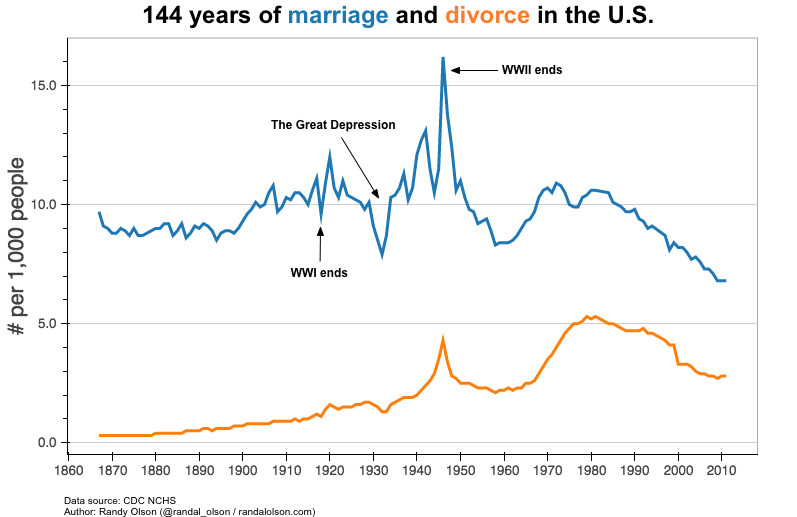
I was looking for a good analysis of why there’s been a decline of marriage and fatherhood, and I found an article by Joe Carter on The Gospel Coalition, of all places. By looking at marriage rates and historical events that changed the marriage rate, he was able to identify the cause of the decline of marriage – and fatherhood.

Marriage and divorce rates per capita

I’ll spare you the statistical analysis, which is excellent, and give you the conclusion – although you can guess it from the graph above:

Now that we’ve explored the data, what year should we use as the marker for the beginning of the decline of marriage in the United States? I would argue for 1985, the last year that the marriage rate topped 10 percent.

[…]What changed in 1985 that could have led to the decline in marriage? There are likely numerous factors—which we’ll examine in future articles—but one stands out in particular: By 1985, all states (except for New York) had enacted no-fault divorce legislation.

The most helpful book I know of about no-fault divorce is “Taken Into Custody”, by Dr. Stephen Baskerville. He wrote a column  for Crisis magazine that summarizes some of his ideas.

Excerpt:

Feminists were drafting no-fault divorce laws in the 1940s, which the National Association of Women Lawyers now describes as “the greatest project NAWL has ever undertaken.”

The result effectively abolished marriage as a legal contract. Today it is not possible to form a binding agreement to create a family.

The new laws did not stop at removing the requirement of citing grounds for a divorce, to allow divorce by mutual consent, as deceptively advertised at the time. Instead they created unilateral and involuntary divorce, so that one spouse may dissolve a marriage without any agreement or fault by the other.

Here’s what divorce does to the spouse who is the victim of the unilateral “no-fault” divorce:

Though marriage is a civil matter, the logic quickly extended into the criminal, including a presumption of guilt against the involuntarily divorced spouse (“defendant”). Yet formal due process protections of criminal proceedings did not apply, so forcibly divorced spouses became quasi-criminals not for recognized criminal acts but for failing or refusing to cooperate with the divorce by continuing to claim the protections and prerogatives of family life: living in the common home, possessing the common property, or—most vexing of all—parenting the common children.

Following from this are the horrendous civil liberties violations and flagrant invasions of family and individual privacy that are now routine in family courts. A personalized criminal code is legislated by the judge around the forcibly divorced spouse, controlling their association with their children, movements, and finances. Unauthorized contact with their children can be punished with arrest. Involuntarily divorced parents are arrested for running into their children in public, making unauthorized telephone calls, and sending unauthorized birthday cards.

In my conversations with men, no-fault divorce laws, and anti-male divorce courts are the main reasons given for why they do not pursue marriage and fatherhood. Men do not want to be coerced in a marriage with the threat of divorce by an unhappy wife. Men do not want to be subject to the government in so many areas of their lives if the wife does carry out the threat. They especially don’t want to be separated from their children. One my secular male friends told me that he would not marry unless the woman had evidence in her past of hating radical feminism and no-fault divorce. This was the main criteria. He actually was able to find a woman who was a men’s rights activist who hated divorce. But that was the only way he would marry.

Statistically speaking, the wife is more likely to initiate divorce than the husband. Women initiate 70% of divorces, the majority of those just because she is “unhappy”. I think this is because women get into marriage based on their feelings, and they think that it is the husband’s job to make them feel good. They see their happiness as the primary goal of the marriage, and see a marriage that does not make them happy as a marriage that needs to be ended. Their view of commitment really means “I’ll commit so long as it makes me feel good”. None of this is particularly appealing to men, who take marriage vows to mean what they say, and think that the commitment isn’t conditional on being happy. (Note: if you’re husband doesn’t have this view of marriage, then why did you choose him out of all the other men in the world?)

Are we going to repeal no-fault divorce, then?

My experiences speaking with divorced Christian women is that they married primarily based on first impressions and emotional responses. No-fault divorce was seen as a boon to women who had married the wrong men by following their hearts. It’s an interesting question to ask whether women really would want no-fault repealed. It would mean that they would have to get serious about who they marry. They would have to think about what a man does in a marriage. They would have to think about what men want out of a marriage. And they would have to say no to their feelings, both in choosing a man, and in keeping the man after the wedding.

I’ve been told by women that the rapid giving of sex is a way to get attention from a man without having to be respectful of him. Are women willing to stop using sex as a tool to attract the wrong men, and start developing their skills as wives and mothers in order to attract the right men? Are women willing to stop seeing relationships as “fun and thrills”, and get serious about pursuing men who have marriage and children as the goal? Are wives willing to give a man what he needs in the marriage: sex, respect and obedience? Are they willing to give up the threat of divorce in the home and learn to argue rationally and compromise?

If women aren’t willing to demand the repeal of no-fault divorce laws and get serious about men and marriage, then what’s the point of complaining that men don’t want to marry and become fathers? If you’re not willing to fix the root cause of the problem, then don’t complain about the problem.