Tag Archives: Feminism

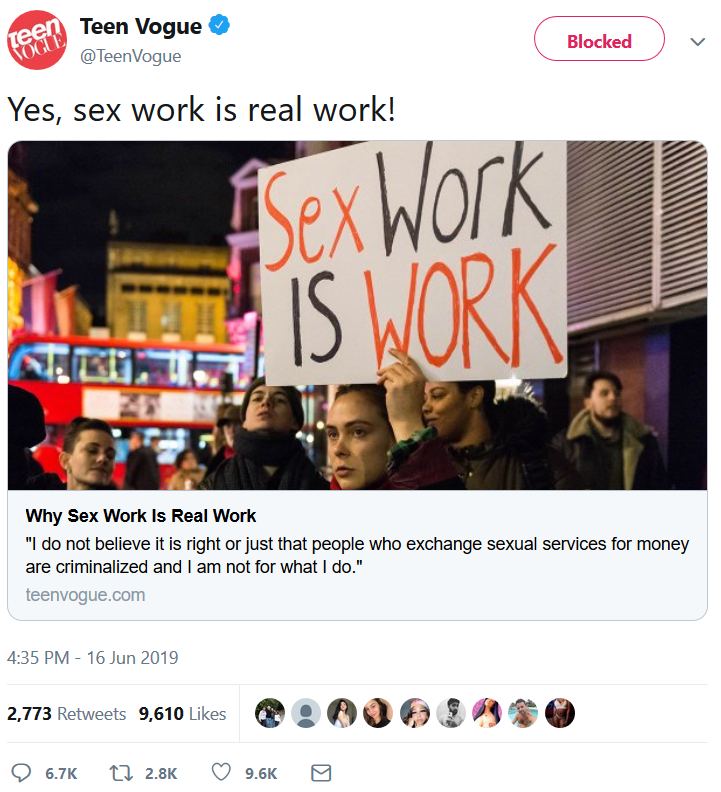
Radical feminist magazine Teen Vogue promotes legalization of prostitution

Ten Vogue urges young women to legalize sex trafficking
Ten Vogue urges young women to legalize sex trafficking of women

Third wave feminism promotes the conditions that allow women to bypass the traditional path to marriage (chastity, courtship, marriage, children, stay at home wife and mother) and “have sex like a man” without any shame or repercussions. They want sex outside of marriage is seen as normal. sex outside of marriage is seen as normal.

Here’s the latest article “Why Sex Work is Real Work” from Teen Vogue, a feminist magazine that is read by millions of teenage girls.

They write:

[C]ontinued criminalization of sex work and sex workers is a form of violence by governments and contributes to the high level of stigma and discrimination.

[…]But governments often fail to accept the evidence for the economic and social bases for sex work; the ILO estimates that “sex workers support between five and eight other people with their earnings. Sex workers also contribute to the economy.” Governments ignore the nuanced histories and contexts in different countries and thus continue to wrongfully offer blanket solutions and “rescue” models that advocate for partial decriminalization or continued criminalization. They also ignore the wishes of sex workers, who want full decriminalization, as supported by the Global Commission on HIV and the Law, and the Lancet, as well as human rights organizations like Amnesty International.

Now, since the author is a radical feminist, you can imagine what she would say to my suggestions that instead of incentivizing women to avoid sex work, we should instead provide incentives for women to be chaste, stay debt-free, choose marriage-minded men, marry before having sex. She would say that this life plan would stigmatize women who have sex before marriage with men who won’t commit. She would say that this life plan would stigmatize women who choose to raise girls without a father (who are far more likely to engage in sex work). She would say that the most important thing government can do is to promote a “good” lifestyle for women that would make the women who want sex with hot bad boys outside of marriage feel “bad” about their own choices. What we need, she thinks, is laws and social spending that allow women who make poor choices and raise fatherless daughters to escape shame, stigma and discrimination.

But what comes next, after countries have decriminalized “sex work” as Teen Vogue urges?

The far-left UK Guardian explains:

Until his dramatic fall from grace, Jürgen Rudloff was the self-proclaimed “brothel king” of Germany. Owner of a chain of clubs he boasted was the “the largest marketplace for sex in Europe”, he was every inch the well-dressed entrepreneur, a regular face on reality TV and chat shows.

Rudloff is now serving a five-year sentence for aiding and abetting trafficking. His trial laid bare the misery and abuse of women working as prostitutes at his club who, according to court documents, were treated like animals and beaten if they didn’t make enough money. His imprisonment has dismantled the idea of Germany’s “clean prostitution” industry and raised troubling questions about what lies behind the legalised, booming sex trade.

Prostitution – legalised in Germany in 2002 – is worth an annual €15bn (£13.4bn), and more than a million men visit prostitutes every day. The change in the law led to a rise in “super brothels”, attracting tourists from countries where such establishments are illegal.

[…]Rudloff’s high-volume, low-cost model only works if the supply of women is enough to satisfy demand and bring enough customers through the doors.

According to court documents, this became a problem for Paradise almost immediately. There weren’t enough women to fill the clubs. So Rudloff’s friends in the industry offered to help him out.

[…]In a trial lasting almost a year, testimony from the jailed pimps revealed that trafficking was crucial to the success of Rudloff’s business.

Legalizing prostitution inevitably leads to sex-trafficking, and the radical feminists who promote legalized prostitution to young women know that. They know that if they remove moral and legal barriers to legalized prostitution, then they will cause more young women to find it attractive, leading to easier targets for sex-trafficking. Sex-trafficking is the end goal of the radical feminists.

Don’t believe me? I’ll prove it.

Women's March
Women’s March says that banning sex-trafficking of women is wrong

I remember when the Women’s March came out in favor of sex-trafficking, because they didn’t want women to feel shame, stigma and discrimination for having sex outside of marriage.

Well, here’s an article from The Federalist to explain.

Excerpt:

Last Friday, the FBI seized Backpage.com, a website well known for facilitating the sale of trafficked minors, mostly girls, for sex all over the United States. On Monday, seven top Backpage officials were arrested after being indicted on 93 counts, including money laundering and facilitating prostitution, 17 cases of which involve trafficking victims as young as 14. The Washington Post says Backpage earned an estimated $500 million in prostitution-related revenue since its launch in 2004.

The National Center on Missing and Exploited Children reports that 73 percent of all child sex trafficking cases it has handled involved Backpage.com. According to the National Center on Sexual Exploitation, Backpage reached 97 countries and was the world’s largest single facilitator of sex trafficking. NCOSE also reports that from January 2013 to March 2015, 99 percent of Backpage’s global revenue was attributable to prostitution advertising. During that time, it made nearly $51 million from prostitution ads in California alone.

The rest of the The Federalist article makes clear that nothing in that web site’s operations made sex-trafficking “safer” for women. In fact, the whole “sex work” business is dangerous for women:

We do know, thanks to the research of Melissa Farley at Prostitution Research and Education, that 70 percent of those in the sex industry link their entry to prior sexual abuse.

Most say they entered as minors, which in the United States qualifies as trafficking. Many enter feeling they have no other options, reducing the sense of free choice in the matter. Once they’re in, 89 percent of “sex workers” say they want to get out of the industry but feel they have limited options. You don’t call an industry safe when women are coerced into it and have difficulty getting out.

According to Farley’s comprehensive studies, as many as 99 percent of those in the sex industry have said they experienced violence within it.

And of course, in the feminized UK, radical feminists voted in regime after regime of secular leftists, who imported thousands of unskilled workers from Muslim countries, who proceeded to immediately set up sex-trafficking rings where young girls were taken from their single mothers and passed around at parties like a cigarette. Taking women out of married homes where they will be influenced by their biological fathers and taught Judeo-Christian values like chastity, sobriety, and self-control is the primary aim of the radical feminists. And if a few teenage girls need to be sex-trafficked, then too bad for them. The important thing is that young women grow up without fathers, have sex outside of marriage, and depend on the government to help them with “health care”: contraceptives, abortions and treatment for STDs. Women must never choose men to be husbands and fathers in a married home: that’s sexist.

Keep in mind that the VAST MAJORITY of the young women who enter sex work do so because their mothers freely chose to have sex outside of marriage to men who they were attracted to on a superficial level: tall, piercings, tattoos, bad boy, criminal record, etc. As a society, we’re more concerned with preventing these women from being shamed (and supporting their recklessness with taxpayer dollars) then we are with encouraging them towards the marriage life plan: chastity, sobriety, courting, marriage, being a stay-at-home wife and mother. We attacked the “shaming” of reckless single mothers that created sex-trafficking instead, thinking that eliminating the moral boundaries that protected daughters from their mother’s hypergamy was the real target.

Whenever you see a girl in difficult circumstances, always remember that this is the result of a chain of reckless decisions by her mother, and her mother’s mother, and so on, to flout the moral law by choosing irresponsible, immoral men that she found more attractive than “boring” men who were chaste, sober, Christians looking for marriage before sex. And always remember that these women were encouraged in their choices about who to have sex with and when to have sex by radical feminists, who were MORE ANXIOUS to have these women avoid moral judgment (“shame, stigma and discrimination”), probably because they felt that their own moral failures would look better if they could trick more younger women into repeating (and surpassing) their own moral failures. Third-wave feminism is ultimately a movement by adult sluts to escape the shame of their slutting by manipulating younger women away from chastity, sobriety, marriage and wed motherhood with lies.

The war on Christianity and moral judgment by radical feminists in the end results in subsequent generations of women living in conditions that Christian stay at home wives and mothers of generations could not possibly have imagined. But this is what happened when we decided that out public policy and laws should be based on feelings and compassion, rather than on moral laws grounded in the Christian worldview. When non-judgmental intuitions are elevated about moral boundaries to sin, the end result is far worse than the “shaming” that the tolerance crowd sought to eliminate in the first place.


Should Christian men expect a wife / mother candidate to know how to defend the Christian worldview?

C.S. Lewis has some words to live by for you

Over the weekend I debated with Christian feminists about marriage on The Transformed Wife Facebook page. At one point, I asserted that Christian women ought to have some knowledge of how to defend their faith using scientific and historical evidence. Some women asked me: “are you joking?” In this post,  I’ll explain why I’m serious, and then I’ll ask them some questions of my own.

Let’s start with Jesus. Jesus set an example by showing the importance of knowing how to answer questions and challenges from skeptics in the New Testament. His favorite way to answer a challenge was by using evidence to support his truth claims.

So, take this story that’s in Mark 2:1-12, Matthew 9:1-8 and Luke 5:17-26. This story is accepted even by skeptical historians because it’s in three different books, and one of them is early (Mark).

In each version of the story, there are 4 steps:

  1. Jesus forgives the sins of a paralyzed man
  2. The Pharisees say that he doesn’t have authority to forgive sins
  3. Jesus miraculously heals the paralyzed man
  4. Jesus explains the evidence of the healing supports his claim that he has authority to forgive sins

And this is an example that you will find repeated in many places in the life of Jesus. You can see it in the Old Testament as well, where God performs miracles so that people who don’t believe in his existence or respect the Scriptures can still be convinced.

Christian apologetics is the skill of being able to give a defense for the Christian worldview when presented with a challenge from a non-Christian.

So, who has to be ready with a defense?

Look at 1 Peter 3:15-16:

15 But in your hearts revere Christ as Lord. Always be prepared to give an answer to everyone who asks you to give the reason for the hope that you have. But do this with gentleness and respect,

16 keeping a clear conscience, so that those who speak maliciously against your good behavior in Christ may be ashamed of their slander.

This passage applies to every one who claims to be a disciple of Jesus, whether they like to prepare a defense or not. How much work must you put into it? It depends on the sophistication of the challenges you get. In the mountains of Pakistan, you don’t need to know much because there might not be a sophisticated challenge. In an American society filled with college graduates, the challenges are more difficult. So you will need to prepare a lot more, because the challenges will be a lot harder.

Those who take this passage seriously are doing something difficult, and time-consuming, in order to serve Christ. Buying books costs money. Reading books takes time. Debating with non-Christians can make you look bad to others. But the Bible commands us to be ready with answers for the people around us. Sometimes, doing what the Bible says makes us feel bad, or look bad to others. But we have do what the Bible says anyway. Part of being a real Christian is being obedient even if it feels bad or makes you look bad.

William Lane Craig on apologetics and the culture

What’s in an apologetics book?

So, with that said, let’s look at the table of contents of my favorite introduction to Christian apologetics, which is “Is God Just a Human Invention?” written by Sean McDowell and Jonathan Morrow.

In that book, you will find 18 topics.

  1. Is Faith Irrational? (Commentary by: Gregory Koukl)
  2. Are Science and Christianity at Odds? (Commentary by: John Warwick Montgomery)
  3. Are Miracles Possible? (Commentary by: Gary R. Habermas)
  4. Is Darwinian Evolution the Only Game in Town? (Commentary by: William A. Dembski)
  5. How Did the Universe Begin? (Commentary by: R. Douglas Geivett)
  6. How Did Life Begin? (Commentary by: Fazale R. Rana)
  7. Why Is the Universe Just Right for Life? (Commentary by: Jay W. Richards)
  8. Has Science Shown There Is No Soul? (Commentary by: Dale Fincher and Jonalyn Fincher)
  9. Is God Just a Human Invention? (Commentary by: Garry DeWeese)
  10. Is Religion Dangerous? (Commentary by: Douglas Groothuis)
  11. Does God Intend for Us to Keep Slaves? (Commentary by: Paul Copan)
  12. Is Hell a Divine Torture Chamber? (Commentary by: Frank Turek)
  13. Is God a Genocidal Bully? (Commentary by: Clay Jones)
  14. Is Christianity the Cause of Dangerous Sexual Repression? (Commentary by: Kerby Anderson)
  15. Can People Be Good Without God? (Commentary by: Mark D. Linville)
  16. Is Evil Only a Problem for Christians? (Commentary by: Randy Alcorn)
  17. What Good Is Christianity? (Commentary by: Glenn S. Sunshine)
  18. Why Jesus Instead of the Flying Spaghetti Monster? (Commentary by: Darrell L. Bock)

Prominent atheist scholars are quoted in each chapter to introduce the challenges, and then scholarly arguments and evidence are presented to defend the Christian worldview. The language is simple enough, but the material is solid enough to use in a real debate. I would say that introductory books like this one are more than enough to equip you for everyone who will challenge you.

Why are these 18 topics important? Because these are the questions that atheists ask. These are the questions that cause Christians to leave the faith. These are the questions that your children will face in high school and college, which might cause them to leave the faith.

Let’s start with chapter one. One of the most prominent arguments by atheists is that faith is irrational. This chapter allows you to define faith using the Bible’s definition of faith, which relies on logic and evidence.

Atheists also say that Christianity is at war with science. In chapter 2, they discuss the history of science and how Christianity provided the framework that allowed scientific method to take root and flourish.

Atheists like to claim that miracles are impossible. Chapter 3 defends the view that God, if he exists, is capable of interacting with his created world.

Atheists love to put forward Darwinism as means to deny that God is the designer of life. Chapter 4 explains the concept of intelligent design, and why intelligent design is a better explanation for the history of life.

Atheists love to talk about how the universe has always existed, and there’s no need for a Creator. Chapter 5 contains a philosophical argument that is supported by mainstream science to argue that the universe had a beginning, just like the Bible says.

Atheists love to argue that life can emerge from non-life, and the process is simple. Chapter 6 is written by a biochemist, and it takes a look at the real complexity of the simplest living cell.

Atheists like to argue that the universe itself is just an accident, and there is no need for a Designer. Chapter 7 introduces the scientific evidence for fine-tuning and habitability.

Atheists like to say that there is no soul and no afterlife. Chapter 8 gives some arguments for the existence of the soul.

Atheists like to argue that Christians invent God because God makes them feel good. But chapter 9 explains that having an all-powerful God who can hold humans accountable is the last thing any human would want to invent.

Atheists like to talk about how religion, with it’s habit of teaching to believe in things that can’t be tested, causes religious people to do a lot of harm. Chapter 10 takes a look at the real record of Christianity as a force for good in the world.

Atheists like to talk about slavery in the Bible. Chapter 11 talks about what the Bible really says, and provides some rational responses to the accusation.

Atheists like to talk about eternal punishment in Hell isn’t a just punishment for just getting a few questions wrong on a theology exam. Chapter 12 provides an explanation and defense of the concept of Hell.

Atheists love to talk about how God commanded the Israelites to attack their enemies in the Bible. Chapter 13 explains who their enemies really were, and what was really happening in those wars.

Atheists feel that unrestricted sexual activity is very healthy and normal, and that the Biblical prohibitions outside of male-female marriage are repressive and unhealthy.  Chapter 14 explains why God has these rules in place, and supports his rules with evidence.

Atheists love to assert that they don’t need God, because they can behave morally on their own. Chapter 15 explains how to answer this claim by talking about how well atheism grounds objective moral values, objective moral duties, free will and moral accountability: the minimum requirements for objective morality.

Atheists think that the mere existence of natural disasters and human immorality are incompatible with the God of the Bible. Chapter 16 explains why this argument doesn’t work, and why even the concept of evil requires God to exist.

I have an atheist friend in my office who can’t defeat my scientific arguments for the origin of the universe, the fine-tuning and the origin of life. But still, he says to me, even if God exists, why would that matter to my life? Chapter 17 explains what difference Christianity makes in a person’s life.

Atheists think that the life of Jesus has no relevance to their life, and that he has nothing to offer them anyway. Chapter 18 explains the uniqueness of Jesus and explains why his resurrection is relevant to our lives today.

It’s important to understand that this book is not on the level of A. W. Tozer, G.K. Chesterton, Francis Chan, John Piper, etc. Those authors write for a Christian audience and therefore they do not equip you to answer realistic challenges from non-Christians. But the apologetics book we looked at actually equips you to answer challenges from non-Christians using logical arguments and evidence from mainstream history and science. You can use the material in that book in discussions outside the confines of your home and your church.

Dr. William Lane Craig says churches aren't preparing Christians to give an answer
Dr. W. L. Craig: churches don’t prepare Christians to answer skeptics

Wife candidates ought to know apologetics

So, back to my original point about how some Christian feminists responded when I said that during courtship, I ask women questions about how much preparation they have done to answer objections from atheists, like the ones answered in this book. Am I joking?

Well, I think the problem is that Christian feminists don’t understand how Christian men view marriage. Christian men are interested in marriage because they think that their marriage will be an enterprise that produces a return for God. They like the idea of having a clean, comfortable home to host debate viewings and discussions over dessert with skeptics. They like the idea of raising children who will be effective and influential. Men don’t see marriage a means of making us feel better, or having fun, or getting our peers to approve of us. We see it as a way to promote Jesus’ agenda in the world. A Christian man loves his wife precisely because she is his partner in serving God.

So, some questions for all the Christian feminists out there. Are you aware of the actual objections that non-Christians have to the Christian worldview? Have you ever put in any effort to prepare to respond to these objections? Have you trained yourself to be calm and persuasive during discussions about Christianity?

Reading devotions or authors like Rachel Hollis, Beth Moore, and Jen Hatmaker won’t teach a Christian woman anything useful about defending the Christian worldview against atheist objections. And those books also won’t teach you how to evaluate a man to see whether he knows how to defend the Christian worldview, either. You have to study apologetics to know how to evaluate how much a candidate for husband and father roles knows about defending his faith. You have to protect yourself from men who lie about being Christians.

Having a rationally-grounded Christian worldview is essential to the roles of wife and mother. A Christian man cannot be confident about the trustworthiness of a Christian woman’s convictions unless she demonstrates her ability to defend those convictions to non-Christians in the ordinary way that she can surely defend other truth claims in areas where she does have the knowledge. If I ask a Christian nurse to defend the claim that germs are real, she will appeal to logic and evidence. I expect her to have put in as much work into defending the claims of Christianity, and to use the same methods: logic and evidence.

Unmarried 35-year-old woman reflects on her adventurous life of fun, travel and serial cohabitation

Telling a woman how to make wise decisions protects her

I found an interesting article featuring a 35-year-old woman who is alarmed that her approach to life has left her in debt and single, with a gap-filled resume of short-term jobs. I thought it might be useful for young women to read this, and consider whether making “rash” decisions and being “adventurous” works out.

She writes:

I feel like a ghost. I’m a 35-year-old woman, and I have nothing to show for it. My 20s and early 30s have been a twisting crisscross of moves all over the West Coast, a couple of brief stints abroad, multiple jobs in a mediocre role with no real upward track. I was also the poster child for serial monogamy. My most hopeful and longest lasting relationship (three and a half years, whoopee) ended two years ago. We moved to a new town (my fourth new city), created a home together, and then nose-dived into a traumatic breakup that launched me to my fifth and current city and who-knows-what-number job.

Rash decisions, adventure, exploring…. and lots of debt:

For all these years of quick changes and rash decisions, which I once rationalized as adventurous, exploratory, and living an “original life,” I have nothing to show for it. I have no wealth, and I’m now saddled with enough debt from all of my moves, poor decisions, and lack of career drive that I may never be able to retire. I have no career milestones and don’t care for my line of work all that much anyway, but now it’s my lifeline, as I only have enough savings to buy a hotel room for two nights.

No STEM degree, which means she doesn’t like to study hard things that can be tested against the real world for correctness:

I used to consider myself creative — a good writer, poetic, passionate, curious. Now, after many years of demanding yet uninspiring jobs, multiple heartbreaks, move after move, financial woes, I’m quite frankly exhausted.

Surprised by aging and poor health:

Also, within the past year I’ve had a breast-cancer scare and required surgery on my uterus due to a fertility issue. On top of that, I’m 35 and every gyno and women’s-health website this side of the Mississippi is telling me my fertility is dropping faster than a piano falling out of the sky. Now I’m looking into freezing my eggs, adding to my never-ending financial burden, in hopes of possibly making something of this haunted house and having a family someday with a no-named man.

She’s still trying to be the sexpot 25-year-old she used to be:

I’m dating. I’m working out and working hard. Listening to music I enjoy and loving my cat. Calling my mom…. I’m drinking too much… And with men I date, I feel pressure to make something of the relationship too soon (move in, get married, “I have to have kids in a couple of years”; fun times!). All the while still trying to be the sexpot 25-year-old I thought I was until what seemed like a moment ago.

But her plan hasn’t worked out:

I used to think I was the one who had it all figured out. Adventurous life in the city! Traveling the world! Making memories! Now I feel incredibly hollow. And foolish. How can I make a future for myself that I can get excited about out of these wasted years?  What reserves or identity can I draw from when I feel like I’ve accrued nothing up to this point with my life choices?

Well, I’ve known women like this, and I think we’re going to see more and more women like this as the society becomes more secular and feminist. I want to say something about whether she is sincere about wanting to get married and have children, and what women should do to avoid ending up like her.

Do women today understand male nature and marriage?

This woman’s demonstrated life plan is that she chose whatever made her feel good from age 18-35+, and now wants to enter into a marriage some time after age 35. And what does marriage mean to her? Has she prioritized entering the traditional roles of wife and mother? Don’t listen to her words. Look at her actions. Her actions show that marriage and children were of NO importance to her. And her current approach to getting married and having kids is the same as ever – work out in order to look hot, and try to coerce a man who signs up for recreational sex with no commitment into becoming a man who makes a life-long commitment to provide for her and her children (which is the opposite of what he signed up for). She wants marriage now for the same reason that she’s wanted anything: for fun, thrills, adventure and to keep up with her girlfriends who are already married.

What kind of man should she have been pursuing from age 18 to 35, if she really wanted marriage and children? Well, the first thing to realize is that not all men want marriage. And the next thing to realize is that women who are serious about marriage need to focus ONLY on men who want to marry. All the men that the women quoted above wanted in her youth didn’t want to marry. They wanted premarital recreational sex with her, and that was fine with her – she chose them, and disregarded the men who were interested in marriage.

A man who was interested in marrying her would have:

  • ….told her no to sex before marriage (because the more sexual partners a woman has, the less happy she will be in marriage, and the more unstable her marriage will be).
  • …led her to become better at being a wife and mother, by discouraging her thrill-seeking, traveling and wasteful spending, and instead encouraging her focus on a STEM education, career and getting debt-free.
  • …led her to develop a Christian worldview in which she would understand the importance of marriage and children, and learn to sacrifice her own interests to love and care for others.

Was she interested in getting ready for marriage? No. She never chose those marriage-minded men. She didn’t want to be a wife. The men she chose were chosen for fun, for thrills, and to show off their outward appearance to her girlfriends.

So, who are the men in this group of marriage-minded men? How do you recognize them? Marriage-minded men are interested in marriage because they want to lead a home. They will have invested a lot of time learning how to protect others, how to provide, and how to debate and lead on moral and spiritual issues. Marriage-minded men see the marriage enterprise as a way of advancing the causes that they care about most. Women who really want to get married will recognize those men, and pursue those men. And they’ll do it early, so that they can invest in their husbands early and be young enough to have children.