Tag Archives: Fatherlessness

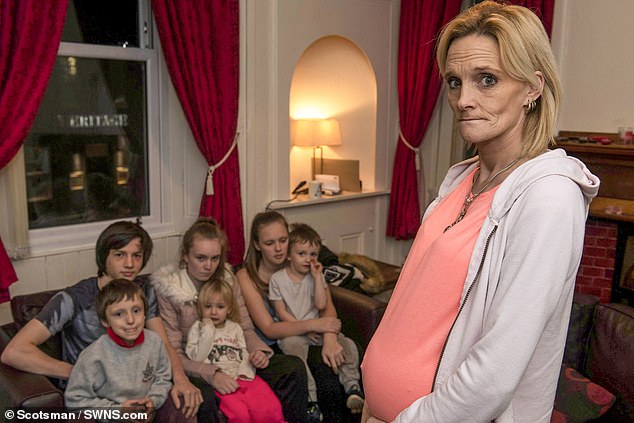
38-year-old single mother of seven, pregnant with twins, demands better government housing

38-year-old single mother with 7 kids, 2 more on the way

I saw this article about an unmarried woman, pregnant with twins, who already has 7 children from a variety of men. She is currently living in a 4-bedroom house paid for by taxpayers. She is angry because the government isn’t giving her enough money to pay for her lifestyle choices.

This article comes from the UK Daily Mail:

A 38-year-old mother-of-seven who is pregnant with twins is begging to be rehoused from her ‘hellish’ four-bedroom council flat which she says isn’t good enough for her.

[…]The single mother said: ‘My relationship with some of my children is at breaking point, we can’t keep living like this.

[…]’I just want to get out of this hell. I’d rather live anywhere else, as long as it is not in here. It has been really tough.

‘I’m feeling down every night and sometimes you just feel like giving up. But I just have to keep going for the sake of the kids.’

She can fix everything that’s gone wrong with a little more taxpayer money. That will make it unnecessary for her to choose men who commit before sex, and let her have the freedom to choose the “best” men for relationships.

More:

After spending a month in various hotels, West Lothian Council found them the flat in Bathgate and they moved in on September 20.

But after moving into her new Bathgate property, Ms Burns complained that the flat did not come with a television…

She wasn’t even provided with a taxpayer-funded telly! How else to people get televisions except from welfare programs?

Anyway, how did this happen? Well, it happens because women are increasingly choosing men who are not willing to marry first, and using premarital sex and cohabitation to land them. Something that the previous generation of married women from 50 years ago would never have done.

The Daily Caller explains:

Unmarried couples are having roughly 40 percent of all births in the U.S., marking a trend that may be detrimental to the upbringing of those children.

For the first time in U.S. history, out-of-wedlock births in America are largely a result of cohabitation, according to the United Nations Population Fund 2018 State of World report released Wednesday. Single mothers had nearly 90 percent of out-of-wedlock births in 1968, but that number decreased to 53 percent in 2017, according to the Pew Research Center.

“Compared to children of married parents, those with cohabiting parents are more likely to experience the breakup of their families, be exposed to ‘complex’ family forms, live in poverty, suffer abuse, and have negative psychological and educational outcomes,” according to the Institute for Family Studies (IFS).

[…]Children with single parents have the highest rates of poverty followed by children living with unmarried, cohabiting parents, the IFS reported.

Between 2006 and 2010, 23 percent of births to married women were unintended while 51 percent of births to unmarried cohabiting women were unintended. That number rose to 67 percent for unmarried women not cohabiting.

Two-thirds of cohabiting parents split up before their child reaches age 12, while only a quarter of married parents divorce, according to an April 2017 Brookings Institution report.

The problem of fatherless children is getting worse. And taxpayers will be on the hook to pay for it – that’s what the story of the 38-year-old woman shows. Productive people have to pay when women are not persuaded to make better decisions about which men to have relationships with, and when to have sex.

My experience

I know three young women who are cohabitating right now. I have had a few conversations with them about what they are studying, what jobs they want to get, and what their plans for the future are.

All three of these women have never married, and are in their early 20s and attractive. Two of them have children. The live-in boyfriends are getting sex without having to commit first. The boyfriends (judging from photos) seem to have been chosen purely for looks. Tall, muscles, beards, tattoos, piercings, etc. Obviously, none of them is a Christian. There just isn’t anything in society telling young women that a Christian worldview matters in a relationship. And none of the men has a STEM degree, a career or savings -they’re too young to have those things to prove their ability to provide. But they’re still co-habitating, and get all the benefits of a wife without having to have proven themselves capable of the responsibilities, expectations and obligations of a husband.

Each of these women is spending the young and attractive period of her life in unstable relationships with men who think of sex as recreational, rather than something that is saved for inside the marriage covenant. If their past relationships fail, they will have a much harder time finding a good man. They will have sexual baggage. They will probably have children from another man. They will have bitterness and mistrust towards men. They will be selfish and unwilling to give to a future husband. The same women who will complain that no one will marry them at age 35 are the ones who could easily have had a marriage-ready man at age 25.

Large-scale UK study confirms the importance of fathers to children

A family praying and reading the Bible

Dina sent me this article from the UK Daily Mail.

Excerpt:

A father’s love is as important to a child’s emotional development as a mother’s, a large-scale study has confirmed.

Examining the cases of more than 10,000 sons and daughters revealed how a cold or distant father can damage a child’s life, sometimes for decades to come.

The review of 36 studies from around the world concluded that his love is at least as important to youngsters as that of their mothers.

Researcher Professor Ronald Rohner said that fatherly love is key to  development and hopes his findings will motivate more men to become involved in caring for their offspring.

‘In the US, Great Britain and Europe, we have assumed for the past 300 years that all children need for normal healthy development is a loving relationship with their mother,’ he said.

‘And that dads are there as support for the mother and to support the  family financially but are not required for the healthy development of the children.

‘But that belief is fundamentally wrong. We have to start getting away from that idea and realise the dad’s influence is as great, and sometimes greater, than the mother’s.’

His conclusions came after he examined data from studies in which  children and adults were asked how loving their parents were.

Questions included if they were made to feel wanted or needed, if their  parents went out of their way to hurt their feelings and if they felt loved.

Those taking part also answered questions about their personality. These ranged from ‘I think about fighting or being mean’ to ‘I think the world is a good, happy place’.

Tallying the results showed that those rejected in childhood felt more anxious and insecure as well as hostile and aggressive.

Many of the problems carried over into adulthood, reported the study published in the journal Personality and Social Psychology Review.

Crucially, a father’s love was often just as important as a mother’s. In some cases, it was even more so. One reason for this may be that rejection is more painful when it comes from the parent the child regards as more powerful or respected.

You can read more about how fatherlessness damages children here.

I think the first question we should ask the people who want to redefine marriage is this: “which parent to do you think that a child can do without? the mother or the father?”. We must do everything we can as a society to keep both of a child’s natural parents in the home while the child grows up. If we really care about children, then we should prefer to meet their needs, even if the grown-ups have to be a bit more responsible in their decision making. if the conflict is between innocent children and selfish grown-ups, then the children should win.

We need laws and policies that promote traditional marriage, not laws and policies that break it down and destroy it. Repealing no-fault divorce, lowering subsidies for single motherhood, and making shared parenting the default position, would all help solve the problem. Policies like school choice and lower corporate tax rates helps men to be able to perform in their role as provider. We have to be practical and ask: “what makes men capable of marriage and parenting?” If we want strong fathers, then it makes sense to ask how to make fatherhood more reasonable: what do men need in order to do what we want them to do?

Christians should be especially concerned about the presence of fathers, given the evidence I blogged about before showing how the presence of quality fathers is essential for passing Christian beliefs on to children. Churches need to ask themselves tough questions: Are we teaching women how to choose men based on practical concerns and proven abilities in our churches? And are we doing a good job of attracting men to churches by promoting the masculine, practical aspects of Christianity that men like – like science, apologetics debates, economics and foreign policy?

Jennifer Roback Morse lectures on sex and sexuality at Harvard University

Dr. Jennifer Roback Morse

Dr. Morse delivers a talk based on her book “Smart Sex” at Harvard University.

The MP3 file is here. (21 Mb) (Link in case that doesn’t work)

Topics:

  • the hook-up culture and its effects on men and women
  • cohabitation and its effect on marriage stability
  • balancing marriage, family and career
  • single motherhood by choice and IVF
  • donor-conceived children
  • modern sex: a sterile, recreation activity
  • the real purposes of sex: procreation and spousal unity
  • the hormone oxytocin: when it is secreted and what it does
  • the hormone vassopressin: when it is secreted and what it does
  • the sexual revolution and the commoditization of sex
  • the consumer view of sex vs the organic view of sex
  • fatherlessness and multi-partner fertility
  • how the “sex-without-relationship” view harms children

52 minutes of lecture, 33 minutes of Q&A from the Harvard students. The Q&A is worth listening to – the first question is from a gay student, and Dr. Morse pulls a William Lane Craig to defeat her objection. It was awesome! I never get tired of listening to her talk, and especially on the topics of marriage and family.