Tag Archives: Evidence

Four ways that the progress of science conflicts with naturalistic speculations

When people ask me whether the progress of science is more compatible with theism or atheism, I offer the follow four basic pieces of scientific evidence that are more compatible with theism than atheism.

Here are the four pieces of evidence best explained by a Creator/Designer:

  1. the kalam argument from the origin of the universe
  2. the cosmic fine-tuning (habitability) argument
  3. the biological information in the first replicator (origin of life)
  4. the sudden origin of all of the different body plans in the fossil record (Cambrian explosion)

And I point to specific examples of recent discoveries that confirm those four arguments. Here are just a few of them:

  1. An explanation of 3 of the 6 experimental evidences for the Big Bang cosmology (From an article from Caltech)
  2. Examples of cosmic fine-tuning (there at least 40 examples of cosmic fine-tuning), (From the New Scientist)
  3. Evidence that functional protein sequences are beyond the reach of chance, (from Doug Axe’s JMB article)
  4. Evidence showing that Ediacaran fauna are not precursors to the Cambrian fossils, (from the journal Nature)

Atheists will typically reply to the recent scientific discoveries that overturned their speculations like this:

  1. Maybe the Big Bang cosmology will be overturned by the Big Crunch/Bounce so that the universe is eternal and has no cause
  2. Maybe there is a multiverse: an infinite number of unobservable, untestable universes which makes our finely-tuned one more probable
  3. Maybe the origin of life could be the result of chance and natural processes
  4. Maybe we will find a seamless chain of fossils that explain how the Cambrian explosion occurred slowly, over a long period time

Ever heard any of these responses?

Below I list some resources to help you to respond to the four responses of atheists to the experimental data.

1) The Big Crunch/Bounce has been disproved theoretically and experimentally.

Theoretically:

Nature 302, 505 – 506 (07 April 1983); doi:10.1038/302505a0

The impossibility of a bouncing universe

ALAN H. GUTH* & MARC SHER†

*Center for Theoretical Physics, Laboratory for Nuclear Science and Department of Physics, Massachusetts Institute of Technology, Cambridge, Massachusetts 02139, USA

†Department of Physics, University of California, Irvine, California 92717, USA

Petrosian1 has recently discussed the possibility that the restoration of symmetry at grand unification in a closed contracting Robertson–Walker universe could slow down and halt the contraction, causing the universe to bounce. He then went on to discuss the possibility that our universe has undergone a series of such bounces. We disagree with this analysis. One of us (M.S.) has already shown2 that if a contracting universe is dominated by radiation, then a bounce is impossible. We will show here two further results: (1) entropy considerations imply that the quantity S (defined in ref. 1 and below), which must decrease by ~1075 to allow the present Universe to bounce, can in fact decrease by no more than a factor of ~2; (2) if the true vacuum state has zero energy density, then a universe which is contracting in its low temperature phase can never complete a phase transition soon enough to cause a bounce.

Experimentally:

The universe is not only expanding, but that expansion appears to be speeding up. And as if that discovery alone weren’t strange enough, it implies that most of the energy in the cosmos is contained in empty space — a concept that Albert Einstein considered but discarded as his “biggest blunder.” The new findings have been recognized as 1998’s top scientific breakthrough by Science magazine.

[…]The flood of findings about the universe’s expansion rate is the result of about 10 years of study, said Saul Perlmutter, team leader of the Supernova Cosmology Project at Lawrence Berkeley National Laboratory.

Perlmutter and others found such a yardstick in a particular kind of exploding star known as a Type 1A supernova. Over the course of several years, the astronomers developed a model to predict how bright such a supernova would appear at any given distance. Astronomers recorded dozens of Type 1A supernovae and anxiously matched them up with redshifts to find out how much the universe’s expansion was slowing down.

To their surprise, the redshift readings indicated that the expansion rate for distant supernovae was lower than the expansion rate for closer supernovae, Perlmutter said. On the largest scale imaginable, the universe’s galaxies appear to be flying away from each other faster and faster as time goes on.

“What we have found is that there is a ‘dark force’ that permeates the universe and that has overcome the force of gravity,” said Nicholas Suntzeff of the Cerro Tololo Inter-American Observatory, who is the co-founder of another group called the High-z Supernova Search Team. “This result is so strange and unexpected that it perhaps is only believable because two independent international groups have found the same effect in their data.”

There has only been one creation of the universe, and the universe will never reverse its expansion, so that it could oscillate eternally. That view is popular, perhaps in part because many people watched videos of Carl Sagan speculating about it in public school classrooms, but all it was was idle naturalistic speculation, (Sagan was a naturalist, and held out hope that science would vindicate naturalism), and has been contradicted by good experimental science. You should be familiar with the 3 evidences for the Big Bang (redshift, light element abundances (helium/hydrogen) and the cosmic microwave background radiation. There are others, (radioactive element abundances, second law of thermodynamics, stellar lifecycle), but those are the big three. Point out how the experimental evidence for the Big Bang has piled up, making the problem even worse for the eternal-universe naturalists. Leave no doubt.

2) The multiverse has not been tested experimentally, it’s pure speculation.

Speculation:

Multiverse thinking or the belief in the existence of parallel universes is more philosophy or science fiction than science. ”Cosmology must seem odd to scientists in other fields”.

George Ellis, a well-known mathematician and cosmologist, who for instance has written a book with Stephen Hawking, is sceptical of the idea that our universe is just another universe among many others.

A few weeks ago, Ellis, professor emeritus of applied mathematics at the University of Cape Town, reviewed Brian Greene’s book The Hidden Reality: Parallel Universes and the Deep Laws of the Cosmos (Knopf/Allen Lane, 2011) in the journal Nature. He is not at all convinced that the multiverse hypothesis is credible: ”Greene is not presenting aspects of a known reality; he is telling of unproven theoretical possibilities.”

According to professor Ellis, there is no evidence of multiverses, they cannot be tested and they are not science.

Ellis is not the only multiverse sceptic in this universe. A few months ago, science writer John Horgan wrote a column in Scientific American, expressing his doubt in multiverses.

When you get into a debate, you must never ever let the other side get away with asserting something they have no evidence for. Call them on it – point out that they have no evidence, and then hammer them with evidence for your point. Pile up cases of fine-tuning on top of each other and continuously point out that they have no experimental evidence for their speculations. Point out that more evidence we get, the more cases of fine-tuning we find, and the tougher the problem gets for naturalists. Leave no doubt.

3) Naturalistic theories for the origin of life have two problems: can’t make the amino acids in an oxydized atmosphere and can’t make protein and DNA sequences by chance in the time available.

Building blocks:

The oxidation state of Hadean magmas and implications for early Earth’s atmosphere

Dustin Trail, E. Bruce Watson & Nicholas D. Tailby

Nature 480, 79–82 (01 December 2011) doi:10.1038/nature10655

[…]These results suggest that outgassing of Earth’s interior later than ~200?Myr into the history of Solar System formation would not have resulted in a reducing atmosphere.

Functional protein sequences:

J Mol Biol. 2004 Aug 27;341(5):1295-315.

Estimating the prevalence of protein sequences adopting functional enzyme folds.

Axe DD.

The Babraham Institute, Structural Biology Unit, Babraham Research Campus, Cambridge CB2 4AT, UK. doug.axe@bbsrc.ac.uk

Proteins employ a wide variety of folds to perform their biological functions. How are these folds first acquired? An important step toward answering this is to obtain an estimate of the overall prevalence of sequences adopting functional folds.

[…]Starting with a weakly functional sequence carrying this signature, clusters of ten side-chains within the fold are replaced randomly, within the boundaries of the signature, and tested for function. The prevalence of low-level function in four such experiments indicates that roughly one in 10(64) signature-consistent sequences forms a working domain. Combined with the estimated prevalence of plausible hydropathic patterns (for any fold) and of relevant folds for particular functions, this implies the overall prevalence of sequences performing a specific function by any domain-sized fold may be as low as 1 in 10(77), adding to the body of evidence that functional folds require highly extraordinary sequences.

So atheists are in double jeopardy here. They don’t have a way to build the Scrabble letters needed for life, and they don’t have a way to form the Scrabble letters into words and sentences. Point out that the more research we do, the tougher the problem gets to solve for naturalists, and the more it looks like an effect of intelligence. Write out the calculations for them. Leave no doubt.

4) The best candidate to explain the sudden origin of the Cambrian era fossils was the Ediacaran fauna, but those are now recognized as not being precursors to the Cambrian fossils.

Science Daily reports on a paper from the peer-reviewed journal Science:

Evidence of the single-celled ancestors of animals, dating from the interval in Earth’s history just before multicellular animals appeared, has been discovered in 570 million-year-old rocks from South China by researchers from the University of Bristol, the Swedish Museum of Natural History, the Paul Scherrer Institut and the Chinese Academy of Geological Sciences.

[…]This X-ray microscopy revealed that the fossils had features that multicellular embryos do not, and this led the researchers to the conclusion that the fossils were neither animals nor embryos but rather the reproductive spore bodies of single-celled ancestors of animals.

Professor Philip Donoghue said: “We were very surprised by our results — we’ve been convinced for so long that these fossils represented the embryos of the earliest animals — much of what has been written about the fossils for the last ten years is flat wrong. Our colleagues are not going to like the result.”

Professor Stefan Bengtson said: “These fossils force us to rethink our ideas of how animals learned to make large bodies out of cells.”

The trend is that there is no evolutionary explanation for the body plans that emerged in the Cambrian era. If you want to make the claim that “evolution did it”, then you have to produce the data today. Not speculations about the future. The data we have today says no to naturalism. The only way to affirm naturalistic explanations for the evidence we have is by faith. We need to minimize our leaps of faith, though, and go with the simplest and most reasonable explanation – an intelligence is the best explanation responsible for rapid generation of biological information.

Conclusion

I do think it’s important for Christians to focus more on scientific apologetics and to focus their academic careers in scientific fields. So often I look at Christian blogs, and I see way too much G. K. Chesterton, Francis Chan and other untestable, ineffective jibber-jabber. We need to bring the hard science, and stop making excuses about not being able to understand it because it’s too hard. It’s not too hard. Everyone can understand “Who Made God?” by Edgar Andrews – start with that! Then get Lee Strobel’s “The Case for a Creator“. That’s more than enough for the average Christian on science apologetics. We all have to do our best to learn what works. You don’t want to be anti-science like atheists are. I recommend reading Uncommon Descent and Evolution News every day for a start.

UPDATE: Jeffery Jay Lowder (a naturalist) replies here.
Michael Behe and Keith Fox debate theistic evolution vs intelligent design

Michael Behe and Keith Fox debate evolution and intelligent design. (See below for link to MP3 file)

Details:

Michael Behe is professor of biochemistry at Lehigh University, Pennsylvania and the founder of the modern Intelligent Design movement. His book “Darwin’s Black Box” ignited the controversy 14 years ago when it claimed that certain molecular machines and biological processes are “irreducibly complex” and cannot be explained by Darwinian evolution.

His new book “The Edge of Evolution” takes his conclusions further, arguing that the Darwinian processes of random mutation and natural selection are incapable of producing the variation and complexity we see in most of life.

So can we conclude that life was intelligently designed by a creator?

Keith Fox is Professor of biochemistry at the University of Southampton and chairman of Christians in Science. As a theistic evolutionist he believes that Evolution is the best explanation going for the complexity we see and that ID is a blind scientific alley and theologically unappealing to boot.

They debate whether micromachines in the cell such as the “bacterial flagellum” could have evolved by a Darwinian process of evolution. When inference to design is and isn’t acceptable in science. Whether random mutation can mathematically stack up to complex life, and whether God is reduced to a divine “tinkerer” by ID.

I get the impression that Fox learned everything he knows about ID by reading Darwinists.

The MP3 file is here.

The summary below is rated VERY SNARKY.

Summary

Michael Behe:

  • ID is not Biblical creationism
  • ID is not religion
  • ID is a scientific research program
  • People refuse to discuss ID because of personal philosophical assumptions
  • ID is like the Big Bang – it is based on evidence, but it has broad religious implications

Keith Fox:

  • ID is not Biblical creationism, but it isn’t science

Michael Behe:

  • ID is compatible with common descent
  • ID is only opposed to unplanned, unguided evolution (Darwinism)
  • ID is not necessarily opposed to long periods of time

Behe’s first book – the bacterial flagellum

Keith Fox:

  • Here are a couple of papers that show how parts of the flagellum evolved
  • They are possible pathways

Michael Behe

  • No, those are studies that show that there are similarities between bacterial flagella in multiple organisms
  • Similarities of proteins between different organisms do not necessarily imply a developmental pathway
  • The problem of having the instructions to BUILD the flagellum still remains

Keith Fox:

  • Maybe parts of the flagellum had other functions before they were used in the flagellum
  • Maybe you can use the parts of the flagellum for other purposes
  • Maybe, one can imagine, it’s possible that!

Michael Behe:

  • No, parts have to be modified and re-purposed in order to be used for other functions

Keith Fox:

  • But maybe the proteins can be used in other systems for other things
  • I re-purpose parts from of designed things to other purposes in my house when I do maintenance

Michael Behe

  • Uh, yeah – but aren’t you an intelligent designer? What does your home maintenance have to do with Darwinian evolution?

Is ID another God-of-the-gaps argument?

Michael Behe:

  • Well consider the Big Bang… there was a build-up of scientific evidence for that theory
  • Just because a theory has religious implications, doesn’t mean that it isn’t true
  • You really have to look at the specific evidence for a theory, and not decide in advance

Keith Fox: (I’m paraphrasing/inventing/mocking from now on)

  • But the Big Bang is based on discoveries, and intelligent design is based on gaps in our scientific knowledge
  • What if I did have evidence of a step by step pathway (which I don’t right now)? Then I would win the argument – what would you do then?

Michael Behe:

  • Well, if tomorrow you do manage to find expiremental evidence of a pathway, which you don’t have today, then I would be wrong
  • ID is falsifiable by experimental evidence
  • But what about your your view? Is that falsifiable by experimental evidence?
  • What if someone goes into a lab (someone like Scott Minnich?) and performs gene knockout experiments, and publishes the results
  • You knock out a gene from the bacterial flagellum, you wait for a large number of generations, and it never develops the missing gene
  • You repeat this with every one of the 50 genes in the bacterial flagellum and it never recovers for any of the 50 genes
  • There is no pathway to build up even one of the 50 genes – according to actual experiments
  • What do Darwinists do with experimental evidence that falsifies Darwinism?

Keith Fox:

  • No, I would not accept that experimental evidence could falsify Darwinism
  • Just because known published experimental evidence that we have today falsifies Darwinism, it doesn’t mean Darwinism is false because it’s not falsifiable
  • We don’t know how Darwinism even works – it happened so long ago, and it’s not repeatable or testable, so how could lab ,experiments falsify it?
  • Darwinism is science and intelligent design is faith, though

Which side has the experimental evidence?

Michael Behe:

  • Consider the largest longest-running lab experiment of evolution, Richard Lenski’s experiments on e. coli
  • Lenski has presided over 50,000 generations, (millions of years of evolution)
  • The bacterium did evolve and they did get better but not by evolving features, but by disabling features

Keith Fox:

  • But those are just LAB EXPERIMENTS! What do lab experiments prove?
  • What if? What if? What if? You don’t know, it happened so long ago, and you weren’t there! You weren’t there!
  • (clutches Flying Spaghetti Monster idol tighter and sobs pitifully)

Michael Behe:

  • See, the thing is that I have actual experiements, and here’s some more evidence that just got published last week
  • So I’ve got evidence and then some more evidence and them some other evidence – experimental evidence
  • And all the evidence shows that adaptation is done losing traits not by gaining traits
  • And the published observations are what we see in nature as well

Keith Fox:

  • But doesn’t Darwinism explain some things that we observe?

Michael Behe:

  • Well, I am not saying that micro-evolution doesn’t explain some things – it explains bacterial resistance, and other micro-evolution
  • it just doesn’t explain macro-evolution, and that’s what the experiments show

Keith Fox:

  • But ID is a science stopper! It stops science! You can’t produce experimental evidence to falsify Darwinism – that would stop science!

Michael Behe:

  • Well, you have to understand that the Big Bang postulated a non-material cause to the entire physical universe and yet the experimental evidence was allowed to stand because it was testable and verifiable evidence, even if the theory does have religious implications
  • All explanations in science are design to settle a question and it stops rival explanations that are not as good at explaining the observations
  • Finding the best explanation stops further study because it is better than rival explanations

Keith Fox:

  • Well you have to come up with a materialist explanation because that’s the only kind that a functional atheist like me will allow

Michael Behe:

  • Well, what if the best explanation for an observed effect in nature is non-material, as with the Big Bang?

Keith Fox:

  • But I have to have a material explanation because I am a functional atheist! (i.e. – a theistic evolutionist = functional atheist)

Michael Behe:

  • Well what about the cosmic fine-tuning argument? Do you accept that?
  • That’s an inference to design based on the latest scientific discoveries

Keith Fox:

  • Well I do accept that argument, but I don’t accept design in biology
  • When you apply it to biology, somehow it’s bad and you can’t do that or you losing research money and get fired
  • Anyway, your argument is based on a gap in our current knowledge

Michael Behe:

  • No, back in Darwin’s time we had a gap in our knowledge – we didn’t know what the cell was – we thought it was jello
  • Now, we know what the cell is really like, it’s irreducibly complex, and you can’t build up those molecular machines in a step-wise manner
  • The inference to design is based on the progress of science revealing the increasing levels of complexity
  • In experiments, Darwinian mechanisms cannot build anything useful, instead genes are disabled or dropped
  • You guys don’t have the evidence to prove your view that naturalistic mechanisms can do the creating
  • You keep issuing promissory notes

Keith Fox:

  • Well, you’re just seeing design subjectively, because you are a non-scientist
  • I’m being objective when I tell you that we will discover a materialist explanation later on – really really soon now, maybe even tomorrow, yeah
  • You won’t accept my speculations and you insist on these published experiments
  • You’re subjective and I’m objective
  • Just give me more research money so I can hide the decline better

Michael Behe:

  • Uh, you’re the one who is subjective – I cited evidence, and you are the one who is speculating
  • You have arguments from credulity, and I’ve got the lab experiments
  • You refuse to be skeptical, I am the one who is being skeptical

Keith Fox:

  • Maybe, maybe, maybe! Maybe tomorrow! Maybe in a parallel universe! Maybe aliens from Planet X!
  • Who knows! I certainly don’t know! And that somehow means you don’t know either! See?

Michael Behe:

  • Well, to prove me wrong, go into the lab, and run experiments and evolve some new genes (using Darwinian mechanisms) that have new useful functionality

Are there limits to what evolution can do?

Michael Behe:

  • You need multiple changes in the genome to get a new helpful feature (let’s say two specific mutations)
  • One specific change is possible
  • the odds are against getting multiple beneficial changes are really really small – you need two SPECIFIC changes to occur in order

Keith Fox:

  • Well, lots of things are really unlikely – any permutation of dice rolls is as unlikely as any other

Michael Behe:

  • Well, we are talking about TWO SPECIFIC mutations that are needed to get a beneficial function – lots of other mutations are possible, but we are looking for a specific outcome that requires two SPECIFIC mutations out of the whole genome
  • You aren’t going to get useful outcomes unless you direct the mutations

Keith Fox:

  • But then why does God allow evil!!!!1!1!!one!!!

Brian Auten interviews pro-life debater Scott Klusendorf on pro-life apologetics

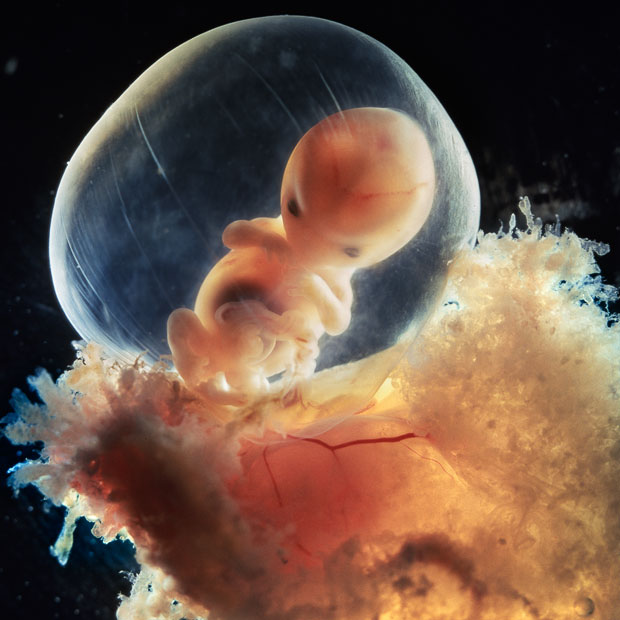
Unborn baby scheming about pro-life apologetics

Scott Klusendorf is the director of the excellent Life Training Institute, and he’s been interviewed by Brian Auten on Apologetics 315.

Details of the interview:

Today’s interview is with Scott Klusendorf, president of Life Training Institute. LTI is the first place to look for excellent resources to get better equipped to defend the pro-life position. Scott talks about defining abortion and its terms, the issue of the debate, the legal history of abortion, defending the pro-life view using science and philosophy, the four pillars of the pro-life argument, answering a litany of objections to the pro-life position, the right and wrong use of emotional appeals, taking on the right tone in the debate, how to get better equipped, and more.

Grab the MP3 file here at Apologetics 315.

The article Scott mentions “How to Defend Your Pro-Life Views in 5 Minutes or Less” is worth the read, and it’s a good summary of some of the points he makes in the lecture.

If you like this interview, please be sure and buy the best basic book on pro-life apologetics – Scott Klusendorf’s “The Case for Life“.

And there is actually a full transcript, and here’s an excerpt:

BA: Great stuff. Now I want you to go into these pillars if you will of defending the pro-life position with science and philosophy, and in your web site prolifetraining.com one of the things that you provide is sort of a four point acronym, some would say sled S-L-E-D. Can you lay out what those main pillars are and their relevance to the issue?

SK: Well as I mentioned a moment ago, pro-life advocates argue that elective abortion unjustly takes the life of a developing human being, and we defend that claim using science and philosophy. We use science to determine what kind of thing the unborn is, and we use philosophy to show that there’s no relevant deference between the embryos we once were and the adults we are today that would justify killing us at that earlier stage of development. Scientifically, as I mentioned just moments ago embryology text books worldwide indicate that from the very beginning you and I were distinct living whole human beings. You can’t see that I’m doing this right now, Brian, but at the moment I’m picking cells off the back of my hand. These cells, which we call somatic cells, contain my entire DNA and coding. But you don’t thing I just committed mass murder by sending a couple hundred of those puppies hurling to their deaths on the floor in front of me. And the reason is, you know that these cells though they contain my DNA and coding are merely part of a larger human being, me. They are not distinct whole living organisms the way that you were when you were an embryo. The way I was when I was an embryo. In other words, there is a difference in kind between each of our bodily cells and the embryonic human beings we once were. That’s what science teaches us; that’s what the science of embryology lays down for us.Philosophically, we argue using that SLED acronym that you mentioned a moment ago that there’s no difference between that embryo we once were and the adult we are today. The adults we are today that justify killing us at that earlier stage of development and as Steven Schwarz points out, the differences between that embryo and the adult that you are today are one of size, level of development, environment and degree of dependency. Think of the acronym SLED and you will remember those four differences. Size, yeah you were smaller as an embryo, but since when does body size determine the rights that you have. Shaquille O’Neal, the seven foot two basketball star with the Boston Celtics, is a foot taller than I am, but he doesn’t have a greater right to life simply because he’s bigger.

Level development? Sure, we were less developed as embryos but since when is a matter of principal does that mean we can kill you? Two-year-old girls are less developed than twenty-year-old young women. We don’t think though the two year old girl has less to a right to life simply because she can’t function at the level that the twenty year old can. Level of size, I should say level of development. What about environment; where you are located there is the letter “E” in that SLED acronym. You were once in the womb now you’re out but sense when does were you are determine what you are? When you walk from your living room into the studio to do this interview. You changed location but you didn’t stop being you. When I jump on an airplane and fly from Atlanta to London’s Heathrow airport. I get off the plane I’m in a new location, but I’m the same being as I was when I left Atlanta. If that’s true how does a journey of eight inches down the birth canal suddenly change me from non-human, non-valuable thing that we can kill? To a valuable human being that we can’t kill. And the answer is, if I wasn’t already human and valuable I’m not going to get there by changing my address. And then finally, degree of dependency—yes we depended on our mother for survival but sense when does dependency on another human being mean we can kill you? Conjoined twins depend on each other for survival and unless one of the twins is killing its partner we don’t go ahead and slit the throat of both twins simply because they can’t live independent of each other. Size, level of development, environment, degree of dependency, think “SLED” those are the only four differences between that embryo you once were and the adult you are today. And the pro-lifer would argue that not one of those four differences justifies killing you at that earlier stage.

You can see Scott in a debate about abortion right here.

And if you like that interview, I have some more things for you to read from Dr. Francis Beckwith.

Learn more by reading

Frank Beckwith is the author of “Defending Life: A Moral and Legal Case Against Abortion Choice“. He wrote that book for Cambridge University Press, a top academic press. But before Cambridge University Press, Beckwith wrote easy-to-understand essays for the Christian Research Journal.

Here are four essays that answer common arguments in favor of legalized abortion.

I have a copy of Dr. Beckwith’s previous book “Politically Correct Death”, which I read bit-by-bit on my lunch hours 10 years ago. Excellent stuff.