Tag Archives: Economics

Does the free market work to reduce poverty?

Economist Walter Williams

From Investors Business Daily.

Excerpt:

There has never been a purely free market economic system, just as there has never been a purely communist system. However, we can rank economies and see whether ones that are closer to the free market end of the economic spectrum are better than ones that are closer to the communist end.

Let’s try it.

First, list countries according to whether they are closer to the free market or the communist end of the economic spectrum. Then rank countries according to per capita gross domestic product. Finally, rank countries according to Freedom House’s “Freedom in the World” report.

People who live in countries closer to the free market end of the economic spectrum have far greater income than people who live in countries toward the communist end — and enjoy far greater human rights protection.

According to the 2012 “Economic Freedom of the World” report by James Gwartney, Robert Lawson and Joshua Hall, nations ranking in the top quartile with regard to economic freedom had average per capita GDP of $37,691 in 2010 compared with $5,188 for those in the bottom quartile.

In the freest nations, the average income of the poorest 10% of their populations was $11,382. In the least free nations, it was $1,209.

Remarkably, the average income of the poorest 10% in the economically freer nations is more than twice the average of those in the least free nations.

Free market benefits aren’t only measured in dollars and cents.

Life expectancy is 79.5 years in the freest nations and 61.6 years in the least free.

Political and civil liberties are considerably greater in the economically free nations than in unfree nations.

Leftists might argue that the free market doesn’t help the poor. That argument can’t even pass the smell test.

Imagine that you are an unborn spirit and God condemned you to a life of poverty but gave you a choice of the country in which to be poor. Which country would you choose?

To help with your choice, here are facts provided by Robert Rector and Rachel Sheffield in their report “Understanding Poverty in the United States: Surprising Facts About America’s Poor.”

  • Eighty percent of American poor households have air conditioning.
  • Nearly three-fourths have a car or truck, and 31% have two or more.
  • Almost two-thirds have cable or satellite TV.
  • Half have one or more computers.
  • Forty-two percent own their homes.
  • The average poor American has more living space than the typical non-poor person in Sweden, France and the U.K. Ninety-six percent of poor parents stated that their children were never hungry; in other words, they could afford food.

The bottom line is that there is little or no material poverty in the U.S.

At the time of our nation’s birth, we were poor, but we established an institutional structure of free markets and limited government and became rich.

This might be a good article send along to people who want to bash our free-market system. It’s easy for them to make assertions that we have to do this or that policy to redistribute wealth. But the real solution to helping the poor is not to take from one and give to another, it’s to put into place a system that causes wealth to be created for all. That’s what happened in the United States, and you can see how it happened in other capitalist economies like Chile, Hong Kong and Singapore. Capitalism turns poor nations into rich nations.

Is cohabitation a better way to prepare for marriage than courting?

Matt from Well Spent Journey sent me this assessment of cohabitation from the liberal New York Times.

Excerpt:

AT 32, one of my clients (I’ll call her Jennifer) had a lavish wine-country wedding. By then, Jennifer and her boyfriend had lived together for more than four years. The event was attended by the couple’s friends, families and two dogs.

When Jennifer started therapy with me less than a year later, she was looking for a divorce lawyer. “I spent more time planning my wedding than I spent happily married,” she sobbed. Most disheartening to Jennifer was that she’d tried to do everything right. “My parents got married young so, of course, they got divorced. We lived together! How did this happen?”

Cohabitation in the United States has increased by more than 1,500 percent in the past half century. In 1960, about 450,000 unmarried couples lived together. Now the number is more than 7.5 million. The majority of young adults in their 20s will live with a romantic partner at least once, and more than half of all marriages will be preceded by cohabitation. This shift has been attributed to the sexual revolution and the availability of birth control, and in our current economy, sharing the bills makes cohabiting appealing. But when you talk to people in their 20s, you also hear about something else: cohabitation as prophylaxis.

In a nationwide survey conducted in 2001 by the National Marriage Project, then at Rutgers and now at the University of Virginia, nearly half of 20-somethings agreed with the statement, “You would only marry someone if he or she agreed to live together with you first, so that you could find out whether you really get along.” About two-thirds said they believed that moving in together before marriage was a good way to avoid divorce.

That’s a nice idea – wanting protection against divorce. But I think these hopeful attitudes that young people have about cohabitation and the utility / harmlessness of premarital sex, is so much whistling past the graveyard. The fact is that cohabitation does not improve marital stability. Young people believe it because they want to believe it. Let’s look at the evidence to see why.

Cohabitation is a bad idea because what it says is that sex is not to be confined to marriage, but it is instead for recreational purposes outside of marriage. If men and women cannot demonstrate that they are capable of self-control prior to marrying by functioning in a relationship based on commitment and not based on pleasure, then they are not qualified for marriage. Cohabitation is associated with higher risks of divorce because it works to undermine the need for quality communication during courting and the need for commitment that is based on discipline, instead of pleasure.

Research has shown that pre-marital chastity produces more stable and higher quality marriages. And that’s because chastity helps people to focus on conversations and obligations instead of the recreational sex which clouds the judgment and glosses over the seriousness of marriage. Premarital sex rushes the relationship to the point where it is harder to break it off because of the sunk costs of sex and the pain of the break-up. Courtship is the time to discuss the things that break up marriages, like finances and division of labor. It is also the time to demonstrate self-control and fidelity.

More:

Couples who cohabit before marriage (and especially before an engagement or an otherwise clear commitment) tend to be less satisfied with their marriages — and more likely to divorce — than couples who do not. These negative outcomes are called the cohabitation effect.

Researchers originally attributed the cohabitation effect to selection, or the idea that cohabitors were less conventional about marriage and thus more open to divorce. As cohabitation has become a norm, however, studies have shown that the effect is not entirely explained by individual characteristics like religion, education or politics. Research suggests that at least some of the risks may lie in cohabitation itself.

As Jennifer and I worked to answer her question, “How did this happen?” we talked about how she and her boyfriend went from dating to cohabiting. Her response was consistent with studies reporting that most couples say it “just happened.”

“We were sleeping over at each other’s places all the time,” she said. “We liked to be together, so it was cheaper and more convenient. It was a quick decision but if it didn’t work out there was a quick exit.”

She was talking about what researchers call “sliding, not deciding.” Moving from dating to sleeping over to sleeping over a lot to cohabitation can be a gradual slope, one not marked by rings or ceremonies or sometimes even a conversation. Couples bypass talking about why they want to live together and what it will mean.

The problem with young people today is that they want marriage as “a blissful state where I will get whatever I want without having to do anything, and where I am free from the consequences of my own selfishness”.  They don’t want marriage as commitment, moral obligations, serving others and self-sacrifice. By avoiding conversations about who will do what, and what needs doing, they can fool themselves by thinking that happy sex and happy drinking and happy dancing will naturally turn into happy marriage. But marriage isn’t about feeling happy, it’s about being a sinful person who now has to learn to love another sinful person and has to train and lead selfish, rebellious children so they are able to serve God and others.

If you asked me, I would tell you that courting is protection against a bad marriage. And the aim of courting is to interview the other person so that you can see whether they understand the demands of the marriage and whether they can perform their duties to their spouse and children. In particular, men should investigate whether the woman has prepared (or is willing to prepare now) to perform her roles as wife and mother, and women should investigate whether the man has prepared to perform his roles as protector, provider and moral/spiritual leader (or is willing to prepare now). Courting is not designed to be fun, although it can be fun. It is not meant to make people feel happy, it is mean to prepare them for marriage. And this is because you cannot translate fun and happy into marriage, because marriage is about well-defined roles, self-sacrifice and commitment. Marriage is about following through for the other person, whether you get what you want or not.

And that’s why I encourage men to very gently and subtly guide the relationship in a way that will allow both the woman and himself to practice their expected marital duties, see how they feel about their duties and get better at being able to perform them.

Narendra Modi (BJP) election win good for Indian economy, but scary for Christian minority

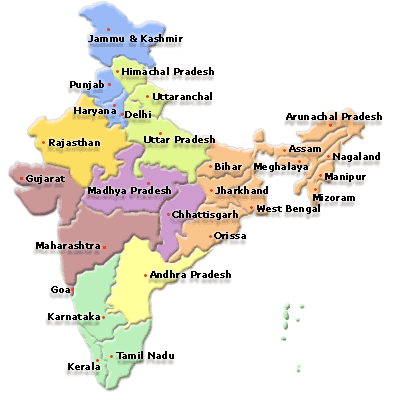
Map of India
Map of India – Modi was the leader in Gujarat state

From Asia News.

Excerpt:

“The electoral result, declared so far, indicates a landslide win for the BJP, which should propel the stock markets to new heights,” said Clifton Desilva, director of Altina Securities Pvt Ltd, as he spoke to AsiaNews about India’s election results and the BJP victory.

According to the latest projections, Modi’s party has 277 seats out of 543. The BJP and its coalition partners together now hold 336 seats. However, “Now that the BJP is likely to attain a sweeping mandate it does not have to depend on allies as was the case with the UPA government,” Desilva said. The UPA or United Progressive Alliance was the Indian Congress Party-led coalition that lost the election.

What is more, the BJP “has the reputation of being a business-oriented party,” Desilva noted. Thus, “all the big reforms that the UPA could not implement it is hoped that the BJP will implement them. [. . .] In fact the last five to six years we have seen the stock market sliding to new lows with the GDP [growth] slipping from 9.5 per cent to 4.5 per cent”.

Under a BJP administration, “it is expected that the investment cycle, which was stalled for various reasons, will get a kick start.” As a result, “projects worth over Rs 6 trillion (US$ 100 billion) that were stalled are likely to be revived, which will have a positive impact on reviving the growth of the Indian economy”, especially in terms of infrastructure, capital goods and banking sectors.

As soon as the BJP victory appeared to be a foregone conclusion, foreign governments rushed to congratulate the new leader.

But, Religious Freedom Coalition reports a concern.

Excerpt:

Advocacy officials say policies of the influential Bharatiya Janata Party (BJP) has contributed to an atmosphere of hatred towards Christians. The BJP is the ruling party in three of the five Indian states with laws that forbid forced religious conversions.

The legislation is frequently used to shut down churches or intimidate Christians who speak about their faith, according to rights activists.

The party has proposed stiffer penalties in one of those states, Madhya Pradesh, India’s second-largest.

Narendra Modi, chief minister of Gujarat, another BJP-ruled state with anti-conversion laws on the books, is “the poster child for India’s failure to punish the violent,” said Katrina Lantos Swett, vice chairwoman of the U.S. Commission on International Religious Freedom, and Commissioner Mary Ann Glendon in a joint November opinion column.

While under BJP rule, Karnataka state had the country’s highest rate of attacks against Christians from 2010 through 2012, according to Christian estimates.

[…]National parliamentary elections are scheduled for May, and Narendra Modi is the BJP’s candidate for prime minister.

Hindu militants have expressed anger over the spread of Christianity in India, a predominantly Hindu nation of over 1 billion people.

In a reaction, the World Evangelical Alliance (WEA) made clear it was closely monitoring the situation saying it had urged believers to “Pray for God’s protection over all Christians living in Andhra Pradesh” especially “for pastors and Christian workers…that they would continue to place their trust in the Lord and engage in missions in spite of the present situation.”

It was also important to “Pray that the Lord would grant repentance to those who are instigating violence against Christians,” stressed the WEA, which claims to represent some 600 million evangelical Christians in 128 countries.

I want India to do well, and Modi’s pro-business record in Gujarat cannot be questioned. However, I am worried about his Hindu Nationalism and the price that Christians might pay for evangelizing, which is a normal part of the Christian faith. Hinduism is a non-cognitive religion, so they are not used to arguments and evidence. It’s a community/family/culture thing. So they don’t understand how a person can evangelize except by non-cognitive means, e.g. – bribes. I am worried especially for the Dalits and other low-caste Indians in this environment.

Please pray for Christians in India. Do it now.