
Tag Archives: Divorce

New study: father absence is a strong predictor of depression for young girls

Does government provide incentives for people to get married?
If you want your children to grow up happy, commit yourself to marriage

The study is here on PubMed.

And here’s an article about it posted at The Family in America, a public policy journal.

Excerpt:

Who has benefitted from the war radical feminists have waged against marriage? Certainly not young women. A very large new Canadian study concludes that one of the strongest predictors of depression among young women is the loss of a biological parent. And it is the easy divorces that feminists have pushed for that have typically occasioned such a loss.

Conducted by researchers at the University of Northern British Columbia, this new study isolates the factors predicting depression among Canadians ages 16 to 20. The researchers limn these factors by scrutinizing data collected between 1994 and 2007 from a nationally representative sample of 1,715 individuals tracked during this 13-year period.

Predictably, the researchers adduce evidence that such things as parental rejection and childhood anxiety predict depression between a young person’s 16th birthday and his or her 21st.  But gender makes a difference: consistent with other inquiries, this study finds that “girls reported more [depression] than boys.” However, not all girls are equally vulnerable: the data reveal that “The loss of a parent by the ages of 4 to 8 years predicted depression at ages 16 to 20 years for girls [p = 0.008] but not for boys.”

Of course, a girl can lose a parent through death. But the researchers realize that such tragedy occurs far less often than the trauma of parental divorce. Consequently, they know how to interpret parental loss as a predictor of girls’ depression at the threshold between adolescence and young adulthood. This is a finding, they realize, that fits hand-in-glove with the results of a 2008 study establishing that “the effects of parental divorce . . . differ between genders in respect to the development of depression with risk increasing for girls but not for boys.” They further realize that their study harmonizes with a 1997 study concluding that “young women whose parents had divorced reported higher levels of depression compared to young men from divorced families.”

Given the paralyzing effects of depression as “a leading cause of disability worldwide,” the researchers hope their study will lead to “targeted, specific and personalized intervention” that will curb such depression. More particularly, they hope that “girls may benefit from interventions designed to address parental loss due to death, divorce, and other causes.”

But since nothing takes a parent away from a daughter more often in the 21st century than does parental divorce, it is very clear that the kind of intervention girls most need is the kind that will keep their parents together. Just how quickly that intervention comes will depend heavily on how much reality can puncture feminist ideology.

This study makes me think of the problems that we have these days getting married and staying married. I think that there are three kinds of challenges. The first challenge is ideology, e.g. – radical feminism. The second challenge is cultural, e.g. – the hook-up culture on campus. The third challenge is political, e.g. – no-fault divorce. It seems likes the odds are really stacked against marriage-minded people.

Most people like the idea of having someone of the opposite sex commit to them for life. I write a lot about what people should be looking for in a mate. Factors that predict a person’s ability to commit, what their worldview should be, etc. But we also have to remember that we have to be turning ourselves into people who are suited to a lifetime commitment, involving self-denial and self-sacrifice.

A lot of people seem to think that if they meet the right person – the person who makes them feel good – then they won’t have to do any self-denying or any self-sacrificing. But that’s not true. Feelings change. It’s possible for two serial killers to feel good about each other, and to having things in common, but marriage isn’t about whether you “like” the other person and whether they “like” you. Marriage works when you have two people who are comfortable making commitments. Two people who are comfortable with responsibilities, expectations and obligations.

The point I am trying to make here is that not only must we be looking for someone who can be faithful, loyal, commitment through thick and thin, but we must also prepare to become a person like that. If we make choices for our own happiness every day – fun and thrills – then we are not making ourselves into the kind of people who take responsibility and make commitments.

The strange thing is that those who choose fun over and over and over again seem to make the worst decisions when it comes to choosing mates. Of course it’s easier to pick someone who is not too moral and not too religious. Then they won’t be able to judge you. They’ll just let you do whatever you want and never shame you for anything.

The problem is that marriage works best when two people are comfortable with moral obligations to others. You have to be someone who is comfortable with obligations over the long term. And you have to choose someone who has a strong sense of morality, otherwise they won’t honor their moral obligations to others. Commitment means doing what is right regardless of how you feel about it, It means giving up on the pursuit of fun, in order to build something strong that will take you into your old age.
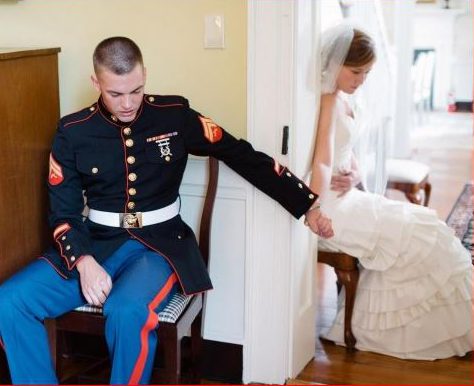

Can we raise declining marriage rates by telling men to “man up”?

Marine prays with his wife on their wedding day

The latest Prager University video features pro-marriage scholar Brad Wilcox:

I watched this video, and, as a card-carrying member of the Christian men’s rights movement, I was concerned that nothing was said about how radical feminism has weakened the attractiveness of marriage to men. I mean specifically things like women carrying debt, having liberal political views, being unchaste and even promiscuous, initiating the majority of divorces (70%), withholding sex if they do marry, and denying men child visitation if they divorce, single mother welfare making men superfluous, big government replacing men as providers, etc. The consequences of divorce for men are catastrophic, and I don’t just mean financially, but emotionally as well.

I contacted Wilcox to ask him why he did not recognize how radical feminism undermines the value of marriage to men, and he pointed me to this article he wrote in the leftist Washington Post.

He writes:

These days, 20something marriage has gotten a reputation for being a bad idea. That’s partly because parents, peers, and the popular culture encourage young adults to treat their twenties as a decade for exploration and getting one’s ducks in a row, not for settling down. In the immortal words of Jay-Z, “Thirty’s the new twenty.”

Indeed, the median age-at-first marriage has climbed to nearly 30 for today’s young adults, up from about 22 in 1970. Of course, there’s an upside to that. As my coauthors and I report in  Knot Yet: the Benefits and Costs of Delayed Marriage in America, women who put off marriage and starting a family earn markedly more money than their peers who marry earlier.

And here he sort of takes on my concerns about chastity, delayed marriage, and fertility:

First, you are more likely to marry someone who shares your basic values and life experiences, and less likely to marry someone with a complicated romantic or family history.  Those who marry in their twenties, for instance, are more likely to marry someone who isn’t previously married and shares their level of educational attainment as well as their religious faith. Marrying at this stage in your life also allows couples to experience early adulthood together. In the words of Elizabeth Gilbert, a 31-year-old woman who married in her mid-twenties, “My husband and I got to grow up together—not apart. We learned sacrifice, selflessness, compromise, and became better people for it.”

Women who marry in their 20s generally have an easier time getting pregnant, and having more than one child, than their peers who wait to marry in their thirties.  You’ll also be around to enjoy the grandchildren for longer.

You’re less likely to lose the best possible mate for fear of getting started too young on the adventure that is married life. One single, thirtysomething woman struggling to find a good partner put it this way to psychologist Meg Jay, the author of The Defining Decade: Why Your Twenties Matter and How to Make the Most of Them Now, and whose TED Talk on twentysomethings has garnered 6.9 million views: “The best boyfriend I ever had was in my mid-twenties. I just didn’t think I was supposed to be [married] with someone then.” And as psychotherapist Lori Gottlieb explains in her book, Marry Him, there’s a higher likelihood of finding a true peer and more appealing partner-for-life in one’s twenties, before those most appealing potential mates marry somebody else by their thirties.

I cannot fault Wilcox or Prager for being ignorant of the social changes that have undermined the value proposition of marriage for men, and that have also undermined men’s ability to fulfill their roles. Far from being a man-blamer, Prager is a warrior against radical feminism, and just today Wilcox tweeted a study showing the boys benefit from single-sex education – a position I favor myself. But I do want to head off the common “men need to man up” objection made by those who deny that the real problem is radical feminism.

Contrary to the “be a man / man up” crowd, my objections to marriage don’t come from a desire to be lazy about education, career and finance. Rest assured that I have a BS and MS in STEM, and nearly two decades of STEM work experience (internships, summer jobs, full-time employment). I do make six figures, like the person Wilcox discussed in the video, and I have the savings you would expect with a gapless STEM resume. So, complaining about “man up” isn’t going to work on me, and probably not on most men who have concerns about marriage.

Radical feminism causes women to delay marriage in order to have fun, travel and ride the carousel of promiscuity in their 20s. Women have been told that they will have more fun by delaying marriage and staying single in their 20s. Church leaders, friends and family should be discussing and demonstrating the value of marriage to women, and showing them how the lasting contentment of marriage is better than the temporary fun of drinking, sex, travel and career. Marriage is a better platform for lasting joy and for quality relationships. It’s up to the woman’s friends and family to make the case for marriage as more fun and fulfilling than the alternatives offered by radical feminism. Her friends and family need to be countering the feminist message that is everywhere in the culture: marriage is boring, children are a burden, and that husbands are needy and demanding fools. And women need to be told how spending a decade being selfish in their 20s undermines their suitability for marriage.

A woman’s friends and family should train her not to view the moral and spiritual leadership of a man as threatening and dangerous, just because it disagrees with her feelings and desires. Instead of recoiling in horror when a well-educated, successful, wealthy man tells a woman with a history of poor decision-making to get a full-time job, pay off her debts, and start investing, her friends and family ought to welcome it. A good man’s practical advice should not be seen as stifling a woman’s freedom to “follow her heart”. And her friends and family certainly should not celebrate when she chooses a penniless, unemployed, empty-resume man who never questions her reckless decisions. Women should be encouraged to choose men who have demonstrated ability as protectors, providers and moral and spiritual leaders, even if she would rather have a doormat who lets her be wild, selfish and irresponsible. Doormats are not intimidating, but they are also not decisive about marriage. When a man wants to marry a woman, he is very interested in encouraging her to be practical and responsible. This is a good thing.

Lesbian relationships are the most unstable and shortest-lived relationships. This suggests that there is a tendency in women to reject commitment when it goes against their feelings and self-interest. Women’s emotions can make them unstable, and less capable of commitment. Friends and family need to recognize that tendency, and help women to learn practicality, responsibility and unselfishness at a young age, so that they are capable of making commitments.Men look for women who have demonstrated that they are able to complete things that they start. We know that women initiate 70% of divorces, and mostly because of feelings of unhappiness. Finish a tough STEM degree, work a tough job for a few years, pay off debts, pay off a car loan, etc. Men look for women who can make and keep commitments through good times and bad times, even when it goes against their self-interest.

A good basic book to read on this issue is Helen Smith’s “Men On Strike“.

Here’s a short video about her book:

A longer interview from News Max:

And an even longer interview with a homeschooling man:

Some men are ignorant of how radical feminism makes women less suitable for marriage while simultaneously making school and work more difficult to boys and men. It is these men who need to “man up” and “be a man” by challenging women to reject radical feminism and embrace early marriage to strong men who lead. If you’re not willing to fight the radical feminism that causes the underlying problems, then you can’t complain when men wisely reject marriage to women who aren’t ready to be wives and mothers.

Jennifer Roback Morse lectures on marriage and family

Marriage and family
Marriage and family

I am sure you will all LOVE this lecture delivered by Dr. Jennifer Roback Morse at Houston Baptist University. (60 minutes, start listening at 11:15 though!)

Topics:

  • what is the purpose of marriage in society?
  • do children really need a mother and a father?
  • is each child entitled to a relationship with their 2 bio-parents?
  • how is the purpose of marriage being re-defined today?
  • how does same-sex marriage redefine traditional marriage?
  • should the state be able to determine who counts as a parent?
  • are mothers and fathers interchangeable?
  • how did no-fault divorce redefine marriage?
  • does the government provide an incentive to divorce?
  • are men interchangeable with women?
  • where did feminism come from? how did it start?
  • how does the Marxist worldview view marriage and family?
  • who do feminists believe should be raising the children?
  • how Christianity conflicts with Utopian views
  • what can a Christian university do to turn the tide?

This is a fun lecture to watch, because she’s very articulate, informed, and passionate. She’s an excellent speaker, because she taught economics at Yale University and George Mason University.

I’ve learned a ton about marriage and economics by listening to Jennifer Roback Morse. I like to complain a lot about women today not thinking much about love, marriage and parenting. But Dr. J knows everything about those topics. It’s useful stuff for young people to know – it’s never a bad idea to think deeply about marriage as an enterprise, and to understand the challenges to marriage.