Tag Archives: Dependence

How much wealth do the poor in America have?

A recently published paper from the Heritage Foundation.

Excerpt:

Each year for the past two decades, the U.S. Census Bureau has reported that over 30 million Americans were living in “poverty.” In recent years, the Census has reported that one in seven Americans are poor. But what does it mean to be “poor” in America? How poor are America’s poor?

For most Americans, the word “poverty” suggests destitution: an inability to provide a family with nutritious food, clothing, and reasonable shelter. For example, the Poverty Pulse poll taken by the Catholic Campaign for Human Development asked the general public: “How would you describe being poor in the U.S.?” The overwhelming majority of responses focused on homelessness, hunger or not being able to eat properly, and not being able to meet basic needs.[1] That perception is bolstered by news stories about poverty that routinely feature homelessness and hunger.

Yet if poverty means lacking nutritious food, adequate warm housing, and clothing for a family, relatively few of the more than 30 million people identified as being “in poverty” by the Census Bureau could be characterized as poor.[2] While material hardship definitely exists in the United States, it is restricted in scope and severity. The average poor person, as defined by the government, has a living standard far higher than the public imagines.

As scholar James Q. Wilson has stated, “The poorest Americans today live a better life than all but the richest persons a hundred years ago.”[3] In 2005, the typical household defined as poor by the government had a car and air conditioning. For entertainment, the household had two color televisions, cable or satellite TV, a DVD player, and a VCR. If there were children, especially boys, in the home, the family had a game system, such as an Xbox or a PlayStation.[4] In the kitchen, the household had a refrigerator, an oven and stove, and a microwave. Other household conveniences included a clothes washer, clothes dryer, ceiling fans, a cordless phone, and a coffee maker.

The home of the typical poor family was not overcrowded and was in good repair. In fact, the typical poor American had more living space than the average European. The typical poor American family was also able to obtain medical care when needed. By its own report, the typical family was not hungry and had sufficient funds during the past year to meet all essential needs.

Poor families certainly struggle to make ends meet, but in most cases, they are struggling to pay for air conditioning and the cable TV bill as well as to put food on the table. Their living standards are far different from the images of dire deprivation promoted by activists and the mainstream media.

Regrettably, annual Census reports not only exaggerate current poverty, but also suggest that the number of poor persons[5] and their living conditions have remained virtually unchanged for four decades or more. In reality, the living conditions of poor Americans have shown significant improvement over time.

These are the people that the elites on the left are constantly making us feel guilty about. But keep in mind that it is very easy to avoid poverty in America (link no longer active). A person just has to make four decisions, as economist Walter Williams explains.

Excerpt:

Avoiding long-term poverty is not rocket science. First, graduate from high school. Second, get married before you have children, and stay married. Third, work at any kind of job, even one that starts out paying the minimum wage. And, finally, avoid engaging in criminal behavior.

If you graduate from high school today with a B or C average, in most places in our country there’s a low-cost or financially assisted post-high-school education program available to increase your skills.

Most jobs start with wages higher than the minimum wage, which is currently $5.15. A man and his wife, even earning the minimum wage, would earn $21,000 annually. According to the Bureau of Census, in 2003, the poverty threshold for one person was $9,393, for a two-person household it was $12,015, and for a family of four it was $18,810. Taking a minimum-wage job is no great shakes, but it produces an income higher than the Bureau of Census’ poverty threshold. Plus, having a job in the first place increases one’s prospects for a better job.

The Children’s Defense Fund and civil rights organizations frequently whine about the number of black children living in poverty. In 1999, the Bureau of the Census reported that 33.1 percent of black children lived in poverty compared with 13.5 percent of white children. It turns out that race per se has little to do with the difference. Instead, it’s welfare and single parenthood. When black children are compared to white children living in identical circumstances, mainly in a two-parent household, both children will have the same probability of being poor.

How much does racial discrimination explain? So far as black poverty is concerned, I’d say little or nothing, which is not to say that every vestige of racial discrimination has been eliminated. But let’s pose a few questions. Is it racial discrimination that stops black students from studying and completing high school? Is it racial discrimination that’s responsible for the 68 percent illegitimacy rate among blacks?

The 1999 Bureau of Census report might raise another racial discrimination question. Among black households that included a married couple, over 50 percent were middle class earning above $50,000, and 26 percent earned more than $75,000. How in the world did these black families manage not to be poor? Did America’s racists cut them some slack?

In America, poverty is self-inflicted. But that doesn’t mean that the Democrats don’t help the poor to stay poor.

Democrats wants to raise minimum wage, which promotes higher unemployment among younger workers – and more dependence on government programs. They want to subsidize single motherhood and enact no-fault divorce laws, to destroy marriage. And they want to push gay history and green propaganda in the public schools, to diminish the economic value of a high school education. They don’t want the poor to lift themselves out of poverty so that they are independent of government. Redistribution of wealth makes Democrats feel good about themselves – so they need the poor to stay poor. Democrats take money from the wealthy, causing them not to hire workers, and then give that money to the poor, so that they don’t need to work for anything.
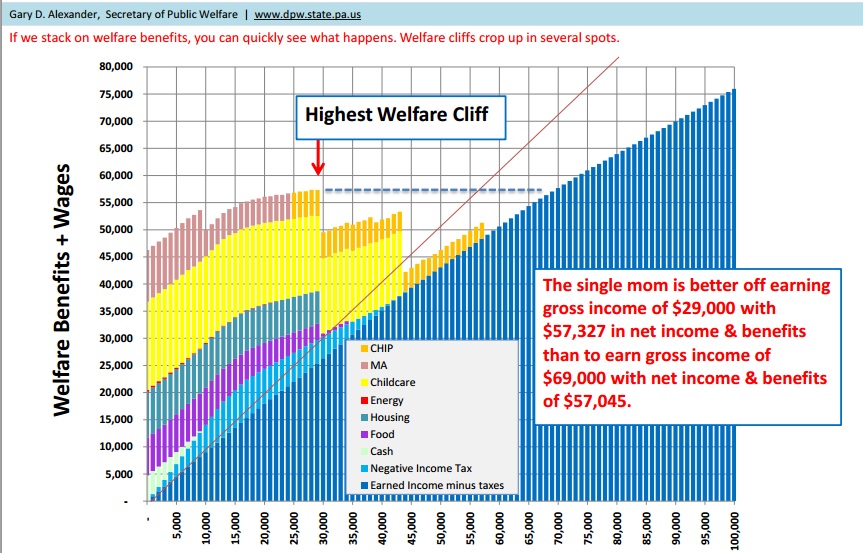
Single mothers are better off with a $29,000 job and welfare than with a $69,000 job

Socialism subsidizes single motherhood by choice

(click for larger image)

James Pethokoukis of the American Enterprise Institute explains how the welfare state discourages women from getting married before they have children.

Excerpt:

The U.S. welfare system sure creates some crazy disincentives to working your way up the ladder. Benefits stacked upon benefits can mean it is financially better, at least in the short term, to stay at a lower-paying jobs rather than taking a higher paying job and losing those benefits. This is called the “welfare cliff.”

Let’s take the example of a single mom with two kids, 1 and 4. She has a $29,000 a year job, putting the kids in daycare during the day while she works.

As the above chart  – via Gary Alexander, Pennsylvania’s secretary of Public Welfare — shows, the single mom is better off earning gross income of $29,000 with $57,327 in net income and benefits than to earn gross income of $69,000 with net income & benefits of $57,045.

It would sure be tempting for that mom to keep the status quo rather than take the new job, even though the new position might lead to further career advancement and a higher standard of living. I guess this is something the Obama White House forgot to mention in its “Life of Julia” cartoons extolling government assistance.

Fatherlessness is absolutely horrible for children across the board. Not just in terms of their development, but also their material well-being and their physical safety. Fatherlessness is a loss in three ways for children. The federal government should NOT be taking money from good married households and transferring it to women who decline to marry before choosing to have reckless, irresponsible recreational sex.

New York Times columnist exposes the moral hazards created by welfare programs

Ultra-leftist Nicholas Kristoff writes about the incentives created by welfare programs in the New York Times.

Excerpt:

This is what poverty sometimes looks like in America: parents here in Appalachian hill country pulling their children out of literacy classes. Moms and dads fear that if kids learn to read, they are less likely to qualify for a monthly check for having an intellectual disability.

Many people in hillside mobile homes here are poor and desperate, and a $698 monthly check per child from the Supplemental Security Income program goes a long way — and those checks continue until the child turns 18.

“The kids get taken out of the program because the parents are going to lose the check,” said Billie Oaks, who runs a literacy program here in Breathitt County, a poor part of Kentucky. “It’s heartbreaking.”

This is painful for a liberal to admit, but conservatives have a point when they suggest that America’s safety net can sometimes entangle people in a soul-crushing dependency. Our poverty programs do rescue many people, but other times they backfire.

Some young people here don’t join the military (a traditional escape route for poor, rural Americans) because it’s easier to rely on food stamps and disability payments.

Antipoverty programs also discourage marriage: In a means-tested program like S.S.I., a woman raising a child may receive a bigger check if she refrains from marrying that hard-working guy she likes. Yet marriage is one of the best forces to blunt poverty. In married couple households only one child in 10 grows up in poverty, while almost half do in single-mother households.

Most wrenching of all are the parents who think it’s best if a child stays illiterate, because then the family may be able to claim a disability check each month.

“One of the ways you get on this program is having problems in school,” notes Richard V. Burkhauser, a Cornell University economist who co-wrote a book last year about these disability programs. “If you do better in school, you threaten the income of the parents. It’s a terrible incentive.”

About four decades ago, most of the children S.S.I. covered had severe physical handicaps or mental retardation that made it difficult for parents to hold jobs — about 1 percent of all poor children. But now 55 percent of the disabilities it covers are fuzzier intellectual disabilities short of mental retardation, where the diagnosis is less clear-cut. More than 1.2 million children across America — a full 8 percent of all low-income children — are now enrolled in S.S.I. as disabled, at an annual cost of more than $9 billion.

That is a burden on taxpayers, of course, but it can be even worse for children whose families have a huge stake in their failing in school. Those kids may never recover: a 2009 study found that nearly two-thirds of these children make the transition at age 18 into S.S.I. for the adult disabled. They may never hold a job in their entire lives and are condemned to a life of poverty on the dole — and that’s the outcome of a program intended to fight poverty.

Charles Murray of the American Enterprise Institute is delighted that a leftist has finally discovered what welfare programs actually do in practice:

Several people have tagged me and Losing Ground since Nicholas Kristoff’s column on Friday about the ways that social programs can backfire. It was a praiseworthy column—all of us on both sides of the political spectrum should be as ready as Kristoff to acknowledge problems with our beliefs. But it also offers an opportunity to recall the three laws of social programs in Losing Ground, because the backfires are not idiosyncratic. They occur everywhere and always for inherent reasons.

1. The Law of Imperfect Selection. Any objective rule that defines eligibility for a social transfer program will irrationally exclude some persons.

This law accounts for the reason that programs like Food Stamps and the Supplemental Security Income program constantly expand. Whenever the people who administer the programs run into a case of a genuinely needy person who has been excluded under a current rule, they tend to redefine the rule or otherwise alter the program’s administration to be more inclusive, which in turn brings more people who don’t need the social transfer under its umbrella.

2. The Law of Unintended Rewards. Any social transfer increases the net value of being in the condition that prompted the transfer.

Kristoff referenced the increased net value of being illiterate because of the “intellectual disability” payment of $698 per month that leads parents to withdraw their children from literacy classes. But the same thing is true of every payment of any kind that requires people to demonstrate that they have a problem before they qualify for the payment. It is not a defect in program design. It is inescapable whenever you give rewards for having a problem.

3. The Law of Net Harm. The less likely it is that the unwanted behavior will change voluntarily, the more likely it is that a program to induce change will cause net harm.

This is not as obvious as the first two laws, but just as inexorable. My favorite chapter of Losing Ground is a thought experiment about a government program that uses financial rewards to reduce smoking. If the rewards are small, nothing will change. If they are large enough to induce a significant number of people to quit smoking, the program will inevitably lead to more people who take up smoking in the first place and the net number of inveterate smokers.

Fewer and fewer people are old enough to remember, but once upon a time almost all children were born to married couples and almost all young men were physically able to work and knew how to show up on time and work hard. Then, in the mid-1960s, before globalization, before manufacturing jobs disappeared, while working-class wages were still going up, we decided that compassion should be bureaucratized. The three laws of social programs explain a lot of what has happened to the working class since then.

The Daily Caller reported that food stamp usage reached a record high – now up to 47.7 million. That’s about 1 in 6 Americans. We used to be a country of independence, entrepreneurship and hard work. But things changed – we had an explosion in welfare spending. Welfare spending changed the incentives and that changed behaviors. We have to understand that having the government reward laziness gets us more laziness. Taxing people who create jobs gets us fewer jobs. It’s that simple – people respond to incentives.