
Tag Archives: Degree

Equal pay and women: does Obama give his female employees pay equity?

Obama talks a lot about equal pay for women and pay equity, but what is his record?

The Daily Caller explains:

Government records show that despite the Democratic National Convention’s early focus on salary equality for women, President Barack Obama has consistently paid his own female staffers less than men who perform similar or identical duties.

The convention is Obama’s show, but Tuesday night in Charlotte belonged to Lilly Ledbetter. The failed lawsuit plaintiff whose name was ultimately attached to a wage parity law Obama signed in 2009 — the first bill to win his signature — addressed the convention, and at least five other speakers raised her signature issue. One was the president himself.

A video of Obama played in the convention hall at around 9:35 p.m. Tuesday, in which he observed that women in the U.S. workforce are “still earning just 77 cents for every dollar a man does.”

“Overall,” he said, “a woman with a college degree doing the same work as a man will earn hundreds of thousands of dollars less over the course of her career.”

Such a gender pay gap, he claimed, “weakens families; it weakens communities; it’s tough on our kids; it weakens our entire economy.”

But data from the Obama White House’s 2011 annual report show that female staffers there earn a median salary 18 percent lower than that of men.

And nearly four years ago, at the height of the 2008 election season, Scripps Howard syndicated columnist Deroy Murdock wrote that female staffers in Obama’s U.S. Senate office, too, were shortchanged.

“Obama’s average male employee earned $54,397,” Murdock determined from online Senate salary records. But the future president’s “30 female employees … [earned] $45,152, on average.”

But there is a broader question that needs to be answered. Are the differences in the salaries between men and women due to discrimination, or are they due to the different choices that men and women make?

Here’s a popular article by Carrie Lukas, writing in the Wall Street Journal. (H/T Mary)

Excerpt:

The unemployment rate is consistently higher among men than among women. The Bureau of Labor Statistics reports that 9.3% of men over the age of 16 are currently out of work. The figure for women is 8.3%. Unemployment fell for both sexes over the past year, but labor force participation (the percentage of working age people employed) also dropped. The participation rate fell more among men (to 70.4% today from 71.4% in March 2010) than women (to 58.3% from 58.8%). That means much of the improvement in unemployment numbers comes from discouraged workers—particularly male ones—giving up their job searches entirely.

Men have been hit harder by this recession because they tend to work in fields like construction, manufacturing and trucking, which are disproportionately affected by bad economic conditions. Women cluster in more insulated occupations, such as teaching, health care and service industries.

[…]The Department of Labor’s Time Use survey shows that full-time working women spend an average of 8.01 hours per day on the job, compared to 8.75 hours for full-time working men. One would expect that someone who works 9% more would also earn more. This one fact alone accounts for more than a third of the wage gap.

Choice of occupation also plays an important role in earnings. While feminists suggest that women are coerced into lower-paying job sectors, most women know that something else is often at work. Women gravitate toward jobs with fewer risks, more comfortable conditions, regular hours, more personal fulfillment and greater flexibility. Simply put, many women—not all, but enough to have a big impact on the statistics—are willing to trade higher pay for other desirable job characteristics.

Men, by contrast, often take on jobs that involve physical labor, outdoor work, overnight shifts and dangerous conditions (which is also why men suffer the overwhelming majority of injuries and deaths at the workplace). They put up with these unpleasant factors so that they can earn more.

Recent studies have shown that the wage gap shrinks—or even reverses—when relevant factors are taken into account and comparisons are made between men and women in similar circumstances. In a 2010 study of single, childless urban workers between the ages of 22 and 30, the research firm Reach Advisors found that women earned an average of 8% more than their male counterparts. Given that women are outpacing men in educational attainment, and that our economy is increasingly geared toward knowledge-based jobs, it makes sense that women’s earnings are going up compared to men’s.

That makes sense. For example, I think that most women find careers like teaching and nursing more fulfilling than careers in automobile repair or computer programming. And some fields just pay more than others because of supply and demand. But if you look at what people of both sexes earn for the same degrees, the same years of experience, in the same jobs, and correct for time off for child care, and so on, then there is no pay gap. It’s a made-up crisis designed to trick women into thinking that they are victims, and that they need government to save them from the bad, bad men. And most single women do fall for this rhetoric, as a recent poll showed. I think it’s especially true for fatherless women and women who make poor choices in relationships, which is why fiscal conservatives and libertarians need to promote marriage, family and fatherhood more. These things are all related.

There is a gender pay gap – but not the one you might expect

However, there actually is a gender pay gap in the largest cities in the country – but it’s not a pay gap that favors men.

Well, first of all, it’s important to note for those who didn’t know that salary differences are purely the result of individual lifestyle choices, not the result of sexist discrimination. Who says? The US Labor Department, that’s who.

Here are the details.

Excerpt:

Economists who have studied the pay gap have observed that numerous factors other than discrimination contribute to the wage gap, such as hours worked, experience, and education. For example, Professor June O’Neil has written extensively about how time out of the workforce, or years spent working part-time, can reduce future pay. Likewise, economist Diana Furchtgott-Roth, in her book Women’s Figures, has written about the decisions that women are more likely to make to choose flexibility, a friendly workplace environment, and other nonmonetary factors as compared to men.

Recognizing the importance of unbiased research on the pay gap, the Labor Department recently contracted with CONSAD Research Corporation for a review of more than 50 existing studies as well as a new economic and statistical analysis of the pay gap. CONSAD’s Report, which was finalized on January 12, 2009, found that the vast majority of the pay gap is due to several identifiable factors and that the remainder may be due to other specific factors they were not able to measure.

CONSAD found that controlling for career interruption and other factors reduced the pay gap from about 20 percent to about 5 percent. Data limitations prevented it from considering many other factors. For example, the data did not permit an examination of total compensation, which would examine health insurance and other benefits, and instead focused solely on wages paid. The data were also limited with respect to work experience, job tenure, and other factors.

The Labor Department’s conclusion was that the gender pay gap was the result of a multitude of factors and that the “raw wage gap should not be used as the basis for [legislative] correction. Indeed, there may be nothing to correct. The differences in raw wages may be almost entirely the result of individual choices being made by both male and female workers.”

It turns out that the pay gap, which was always entirely due to lifestyle choices, is now working against men. Here is Carrie Lukas  again, writing in National Review this time, explaining the latest research on the pay gap.

She cites the radically left-wing Time magazine:

…according to a new analysis of 2,000 communities by a market research company, in 147 out of 150 of the biggest cities in the U.S., the median full-time salaries of young women are 8% higher than those of the guys in their peer group. In two cities, Atlanta and Memphis, those women are making about 20% more. This squares with earlier research from Queens College, New York, that had suggested that this was happening in major metropolises. But the new study suggests that the gap is bigger than previously thought, with young women in New York City, Los Angeles and San Diego making 17%, 12% and 15% more than their male peers, respectively. And it also holds true even in reasonably small areas like the Raleigh-Durham region and Charlotte in North Carolina (both 14% more), and Jacksonville, Fla. (6%).

It would have been nice if Romney could have explained all of this during the debate, but there are some things that are dangerous to explain when you are running for President.
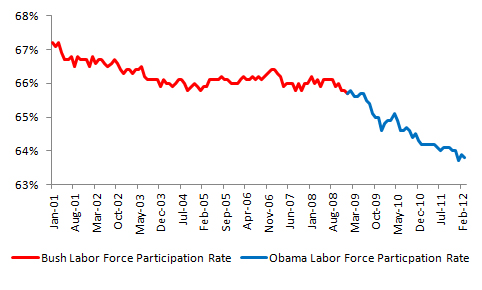
Despite record youth unemployment, young people support Obama 52-27

Labor Force Participation 2012 (click for larger image)

From Breitbart.

Excerpt:

Even as unemployment among college graduates remains stuck above the national average at 9.3 percent, a Reuters/Ipsos poll of four-year college graduates finds that President Barack Obama leads his Republican challenger Mitt Romney 52 percent to 27 percent.

The poll’s findings are especially surprising given reports last month that, for the first time in American history, unemployment for college graduates eclipsed that of high school graduates.   As Jed Graham of Investor’s Business Daily reported, “Out of 9 million unemployed in April, 4.7 million had gone to college or graduated and 4.3 million had not, seasonally adjusted Labor Department data show.”

Still, some unemployed college graduates say they are sticking with Mr. Obama in 2012: “I was really excited when Obama won,” said Joe Zmudczynski, a 2011 graduate of Michigan’s Ferris State University who now lives at home with his parents. “He’s still my favorite. It’s not like you can snap your fingers and everything gets better.”

Leftist PBS explains:

Returning to the nest with mom and dad after college and even into the thirties is becoming increasingly more common, but also less stigmatized. Young adults who live with their folks are cheerful, upbeat even, about their choice.

That’s the finding of a new Pew report, released Thursday morning. Three in 10 young adults (aged 25 to 34) say they’ve lived at home recently during the down economy, and 78 percent said they were satisfied doing so. Another 77 percent said they were optimistic about their future finances.

The number of young adults living in a multi-generational household — which can be any combination of grandparents, parents and adult children — saw a steep uptick during the recent recession, after being on the rise since 1980, said Kim Parker, the study’s lead author and a senior researcher with Pew’s Social & Demographic Trends Project. Historically, such high rates of moving back home haven’t been seen since the late 1940s.

Here’s an Associated Press piece on Yahoo News:

The college class of 2012 is in for a rude welcome to the world of work.

A weak labor market already has left half of young college graduates either jobless or underemployed in positions that don’t fully use their skills and knowledge.

Young adults with bachelor’s degrees are increasingly scraping by in lower-wage jobs — waiter or waitress, bartender, retail clerk or receptionist, for example — and that’s confounding their hopes a degree would pay off despite higher tuition and mounting student loans.

[…]Taking underemployment into consideration, the job prospects for bachelor’s degree holders fell last year to the lowest level in more than a decade.

[…]The figures are based on an analysis of 2011 Current Population Survey data by Northeastern University researchers and supplemented with material from Paul Harrington, an economist at Drexel University, and the Economic Policy Institute, a Washington think tank. They rely on Labor Department assessments of the level of education required to do the job in 900-plus U.S. occupations, which were used to calculate the shares of young adults with bachelor’s degrees who were “underemployed.”

About 1.5 million, or 53.6 percent, of bachelor’s degree-holders under the age of 25 last year were jobless or underemployed, the highest share in at least 11 years. In 2000, the share was at a low of 41 percent, before the dot-com bust erased job gains for college graduates in the telecommunications and IT fields.

Out of the 1.5 million who languished in the job market, about half were underemployed, an increase from the previous year.

The EPI is a left-wing think tank.

As if this were not bad enough, remember that the secular socialists have run the national debt up from 8 trillion to 16 trillion since taking over the House and Senate in January 2007. Labor union bailouts, green energy payoffs to Democrat fundraises, health care takeovers, and massive welfare spending, have to be paid back. Who is going to pay all of this back? Students with degrees in feminist studies and peace studies? And yet, incredibly, the government-run public school system and the universities have brainwashed these young fools into voting for their own dependence and enslavement. That’s what secularism and leftism offers young people: the road to serfdom.

Rising student debt will impact future housing demand

Bad news for homeowners from the California Association of REALTORS. (H/T Captain Capitalism)

Excerpt:

At May’s midyear legislative meetings held by the National Association of Realtors in Washington, DC, a panel of experts in a session titled “Shifting Demographics and Housing Choice: A Whole New World?” discussed future housing market demand and trends to keep in mind as we think about the future of housing in the U.S.

The biggest takeaway was that baby boomers will increasingly contribute to housing supply as they age, yet echo boomers are in a difficult position to absorb the inventory. The echo boomers, also called Millennials, are those currently ages 17 to 31, and account for 62 million people. And although future housing demand highly dependents on different rates of household formation among Echo Boomers, this generation is in a precarious position.

In addition to having seen the worst housing downturn, these younger buyers have been hit hard by the recession. Faced with an uncertain job market, no real income growth, tighter mortgage lending rules, and mounting student and credit card debt, it is no surprise that some of them do not put priority on homeownership.

The concern over student debt is particularly alarming. According to a number of recent research studies, college seniors who graduated with student loans each owed an average of $25,250, up significantly from an average of $12,750 in 1996. Parents have accumulated student debt as well, $34,000 on average. The aggregate amount of student loan debt in the U.S. is over $1 trillion currently. The pace at which debt is mounting adds to the concern. Between March 31, of this year and 2011, student loan debt rose by $64 billion. However, over the same period, all other forms of household debt fell by $383 billion. Put another way, since the peak in household debt in the third quarter of 2008, student loan debt has increased by $293 billion, while other forms of debt fell by $1.53 trillion.

The rise in student debt is attributable to rising cost of education. Since 1978, the cost of tuition in the U.S. has increased more than 900 percent, 650 points above inflation. Between1990 and 2010 alone, tuition rose by 116 percent while the median household incomes inched a mere 2.1 percent.

The libertarian Cato Institute knows what the problem is (see my bold below) and they know how to fix it too.

Excerpt:

The real answer is for the federal government to get out of the higher education subsidy business altogether, as a Cato essay argues.

The following are some key points from the essay:

  • The effect of subsidy programs, in part, is to impose taxes on blue collar workers—who have not attended college—to pay for the tuition of future white-collar professionals. Why should the government subsidize future high earners at the expense of average working people?
  • Federal student aid programs transfer wealth from taxpayers to academic institutions. That’s because the rise in student subsidies over the decades appears to have fueled inflation in education costs. Tuition and other college costs have soared as subsidies have risen. College cost inflation induced by federal aid probably hurts low-income families—the people that federal aid was supposed to target—more than others.
  • Federal aid has probably helped increase student enrollment, but many of those additional students may not have been ready, or suited, for college. This is evidenced by the rising shares of college students who require remedial work, and the fact that institutions have lowered their standards to adapt to the rise in second-rate students.
  • Increasing top-down control and subsidization of higher education from Washington is creating a threat to the strength of the American system. As we have seen in K-12 education, the growth in federal subsidies is usually accompanied by calls for more oversight, micromanagement, and rising levels of red tape imposed by Washington.
  • Federal student loan and grant programs have been subject to waste and fraud for decades. The Pell grant program (which SAFRA would enlarge) costs taxpayers hundreds of millions of dollars per year in fraud. Another ongoing problem is the high default rate on student loan programs.

Will the student debt problem be fixed through privatization? Not while Obama is in office. The universities are dominated by secular leftists – they are the ones who benefit from these rising tuition costs. Obama isn’t going to do a thing to stop them from getting your money through subsidies, otherwise he would lose lots of campaign donations!

In the meantime, the best policy is to make sure that you do your degree in a STEM field (science, technology, engineering or math). Non-STEM degrees, according to Captain Capitalism, are not recommended.