
Tag Archives: Darwin

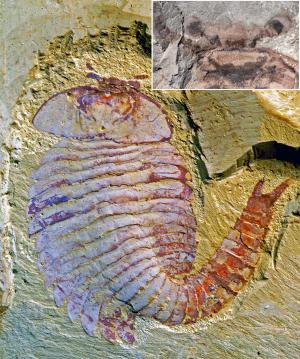
Nature publishes discovery of fossil with complex brain dated just after the Cambrian explosion

New fossil discovery shows advanced brain structures

Casey Luskin writes about it at Uncommon Descent.

Excerpt:

Over at PhysOrg.com, there’s a study being reported highlighting a 520 million year old fossil arthropod with a highly-developed brain. So soon in evolutionary time, and an already developed brain??? (To go beside the very complex eye of the Trilobites)

Here’s what one scientist said:

“No one expected such an advanced brain would have evolved so early in the history of multicellular animals,” said Strausfeld, a Regents Professor in the UA department of neuroscience.

Sorry, Darwinists, but IDers would expect it.

Let’s keep track of the problems that this good scientific discovery creates for naturalists.

Problem #1: Darwinism does not support rapid change from single-celled organisms just before the Cambrian explosion to complex brains just after the Cambrian explosion. Darwinian evolution has to go gradually from simple to complex.

Now for some more:

And, to add insult to injury for our Darwinist brethren, here’s this confirmation of “genetic entropy” and Behe’s QRB “rule”:

“The shape [of the fossilized brain] matches that of a comparable sized modern malacostracan,” the authors write in Nature. They argue the fossil supports the hypothesis that branchiopod brains evolved from a previously complex to a more simple architecture instead of the other way around.

So, that’s another problem.

Problem #2: Darwinism does not support going from more complex to less complex organisms, in general. This is especially true for complex biological systems like brains. Darwnists must explain how complex brains can be built from simpler parts through a long sequence of likely mutations. 

And more:

Here’s how the article ends:

The fossil supports the idea that once a basic brain design had evolved, it changed little over time[Translation: ID is completely correct!!!], he explained. Instead, peripheral components such as the eyes, the antennae and other appendages, sensory organs, etc., underwent great diversification and specialized in different tasks but all plugged into the same basic circuitry. “It is remarkable how constant the ground pattern of the nervous system has remained for probably more than 550 million years,” Strausfeld added. “The basic organization of the computational circuitry that deals, say, with smelling, appears to be the same as the one that deals with vision, or mechanical sensation.”

Yet another problem.

Problem #3: Darwinism does not work if organisms are observed to remain changeless and static over time. Darwinism requires change over time from simple to complex. Backwards change or no change falsifies Darwinism.

Read the whole post.

It’s just another prediction of Darwinian orthodoxy falsified by experimental evidence published in the top scientific peer-reviewed journal. Will this cause Darwinians to revise their theory to fit the evidence? Not likely. Their motivations for clinging to naturalism, the religion that undergirds Darwinism, are entirely beyond correction by evidence.

I wonder what people like P.Z. Myers and Larry Moran do when their religion comes into conflict with scientific evidence? Do they bitterly cling to their mythology from the 19th century? Or do they adjust their worldview to be in line with the progress of science?

Let Richard Dawkins explain evolution and the role of evidence:

“My argument will be that Darwinism is the only known theory that is in principle capable of explaining certain aspects of life. If I am right it means that, even if there were no actual evidence in favour of the Darwinian theory (there is, of course) we should still be justified in preferring it over all rival theories.” — p. 287, Blind Watchmaker” (1986)

Or Richard Lewontin:

“Our willingness to accept [naturalistic]  scientific claims that are against common sense is the key to an understanding of the real struggle between science and the supernatural. We take the side of science in spite of the patent absurdity of some of its constructs, in spite of its failure to fulfill many of its extravagant promises of health and life, in spite of the tolerance of the scientific community for unsubstantiated just-so stories, because we have a prior commitment, a commitment to materialism. It is not that the methods and institutions of science somehow compel us to accept a material explanation of the phenomenal world but, on the contrary, that we are forced by our own a priori adherence to material causes to create an apparatus of investigation and a set of concepts that produce material explanations, not matter how counterintuitive, no matter how mystifying to the uninitiated. Moreover, that materialism is absolute, for we cannot allow a divine foot in the door.” (Richard Lewontin in New York Review of Books, January 9, 1997, p. 28)

Last month, we saw a peer-reviewed published paper that falsified the Darwinian predictions about junk DNA. Recently, the Darwnists were proven wrong again about vestigial organs. Before that, we had another discovery of oxygen on the early Earth’s atmosphere, which blocks naturalistic origin of life scenarios. Did these scientific discoveries stop the worship of the Flying Spaghetti Monster by the Darwinian faithful? Of course not. And they don’t want to debate it with you, either.

Naturalists don’t want to have to explain why they are always believing things that are falsified by the progress of science. Naturalists fought the Big Bang tooth and nail, trying to save their eternal universe from the progress of science. Naturalists invented the now discredited oscillating model of the universe in order to “explain” the evidence for a cosmic beginning. Naturalists invented the unobservable, untestable multiverse to “explain” the cosmic fine-tuning. Unobservable aliens were posited in order to “explain” the origin of life so soon after the cooling of the Earth. Precursor fossils are invented without evidence in order to “explain” the Cambrian era explosion in biological complexity. And so on.

Evidence doesn’t matter to people who are motivated by naturalistic faith. Like belief in a flat-Earth, the delusion of naturalism is not accountable to scientific evidence. They believe what they want to believe. It’s not up for debate. For some people like Richard Dawkins, a prior lifestyle commitment makes theism (and the moral law!) an impossibility a priori. But rational people know that believing something just so that your actions are “justified” doesn’t make what you believe true.

Speaking of Richard Dawkins, if you haven’t seen the video of that coward being “Eastwooded” by William Lane Craig, here’s the link. Dr. Craig has obviously seen a lot of Clint Eastwood movies, and he manages to work in about a half-dozen Clint Eastwood lines into a careful philosophical and scientific refutation of Dawkins’ faith-based atheist delusions. I don’t mind if Dawkins wants to have his religious beliefs for comfort in the privacy of his home or church, but I don’t think that we should be making policy off of his subjective preferences. In the public square we need to be guided by public evidence – like the evidence from science.

Philip E. Johnson lectures on science, evolution and religion

I found this fun lecture by the grandfather of the big-tent intelligent design movement, Berkeley law professor Philip E. Johnson.

I’ll bet you guys have all heard of him, but you’ve never heard him speak, right? Well, I was a young man, I used to listen to Phil’s lectures and his debates with Eugenie Scott quite a bit. This is one of my favorite lectures. Very easy to understand, and boilerplate for anything else in the origins debate. This is a great lecture – funny, engaging and useful. You will definitely listen to this lecture several times if you listen to it once.

The MP3 is here. (91 minutes, 62 megabytes)

The Inherit the Wind stereotype

  • Many people get their understanding of origins by watching movies like “Inherit the Wind” (or reading science fiction)
  • The actual events of the Scopes trial are nothing like what the movie portrays
  • The law forbidding the teaching of evolution was symbolic, not meant to be enforced
  • The actual Scopes trial was a publicity stunt to attract attention to Dayton, TN to bring business to the town
  • The ACLU advertised for a teacher who would be willing to be sued
  • They found a substitute physical education teacher who would be willing to “break” the law
  • The movie is nothing like the actual events the movie is a morality play
  • The religious people are evil and stupid and ignorant and bigoted
  • The scientists and lawyers are all intelligent, romantic, and honest seekers of the truth
  • The religious people think that the Bible trumps science and science is not as reliable as the Bible
  • The movie argues that the reason why there is ANY dissent to evolution is because of Biblical fundamentalism
  • The movie presents the idea that there are no scientific problems with evolution
  • The movie says that ONLY Biblical fundamentalists who believe in 6 day, 24-hour creation doubt evolution
  • The movie says that Biblical fundamentalism are close-minded, and not open to scientific truth
  • The movie says that people who read the Bible as making factual claims are misinterpreting the Bible
  • The movie says that smart people read the Bible for comfort and feelings and arbitrary values, not for truth

Guided evolution and methodological naturalism

  • What scientists mean by evolution is that fully naturalistic, unguided, materialistic mechanisms caused the diversity of life
  • Scientists do not allow that God had any real objective effect on how life was created
  • Scientists think that nature did all the creating, and any mention of God is unnecessary opinion – God didn’t DO ANYTHING
  • Scientists operate with one overriding rule – you can only explain the physical world with physical and material causes
  • Scientists DO NOT allow that God could have done anything detectable by the sciences
  • Scientists WILL NOT consider the idea that natural, material processes might be INSUFFICIENT for explaining everything in nature
  • You cannot even ask the question about whether natural laws, matter and chance can explain something in nature
  • Intelligent causes can NEVER be the explanation for anything in nature, and you can’t even test experimentally to check that
  • Scientists ASSUME that everything can be explained with natural laws, matter and chance – no questioning of natural causes is allowed
  • Where no natural explanation of a natural phenomenon is available, scientists SPECULATE about undiscovered natural explanations
  • The assumption of naturalistic sufficiency is called “methodological naturalism”
  • To question the assumptions that natural is all there is, and that nature has to do its own creating, makes you an “enemy of science”
  • But Johnson says that naturalists are the enemies of science, because they are like the Biblical fundamentalists
  • Naturalists have a presumption that prevents them from being willing to follow the evidence where it is leading
  • Experiments are not even needed, because the presumption of naturalism overrides any experimental finding that falsifies the sufficiency of natural causes to explain some natural phenomenon

What can natural selection and mutation actually do?

  • what evolution has actually been observed to do is explain changing populations of moths and finches
  • finches with smaller or larger beaks are observed to have differential survival rates when there are droughts or floods
  • no new body plan or new organ type has been observed to emerge from these environmental pressures
  • the only kind of evolution that has been observed is evolution within types – no new genetic instructions are created
  • in textbooks, only confirming examples are presented – but what is required is a broad pattern of gradual development of species
  • if you look at the fossil record, what you see in most cases is variation within types based on changing environments
  • the real question is: can natural law and chance be observed to be doing any creating of body plans and organ types?

What kind of effect requires an intelligent cause?

  • the thing to be explained in the history of life is the functional information sequences
  • you need to have a sequence of symbols or characters that is sufficiently long
  • your long sequence of characters has to be sequenced in the right order to have biological function
  • the only thing that can create long sequences of functional information is an intelligent cause
  • intelligent design people accept micro-evolution – changes within types – because that’s been observed
  • the real thing to be explained is the first living cell’s functional information, and the creation of new function information

Critical response

The next 15 minutes of the lecture contain a critical response from a philosophy professor who thinks that there have been no developments in design arguments since Aquinas and Paley. He basically confirms the stereotypes that Johnson outlined in the first part of the lecture. I recommend listening to this, because it shows how weak the counter arguments are, and how these pseudo-intellectuals mislead unprepared students to question their Christian faith – especially dangerous since they have the power of the grading pen. Notice especially how he never mentions any arguments that Christians actually use, nor does he mention any actual science. Everything is “words, words, words” as Hamlet might say – no talking about experiments.

Here’s what he says:

1) Don’t take the Bible literally, even if the genre is literal.

  • all opposition to evolution is based on an ignorant, fundamentalist, literal reading of the Bible
  • Christians need to reinterpret the Bible so that it is basically relaying personal preferences, and not factual information, regardless of the genre intended
  • the Bible really doesn’t communicate anything about the way the world really is
  • the Bible is just meant to suggest certain opinions and experiences which you may find fetching, or not, depending on your feelings and community
  • if Christians would just interpret the Bible as myths and opinions on par with other personal preferences, then evolution is no threat to religious belief

2) As long as you treat the design argument as divorced from evidence, it’s not very effective

  • the latest and best version of the design argument is Paley’s argument which involves no experimental data, so I’ll critique that
  • this 200-year old argument which doesn’t rely on science has serious problems, and unnamed Christians agree with me!
  • Christians should NOT try to prove God’s existence using evidence from the natural world (as Romans 1 says), and in fact it’s “Pelagianism” to even try
  • Christians should divorce their faith from logic and evidence even though the Bible says that Jesus performed miracles to supply evidence for his claims
  • Christians should not tie their faith to the best science available today, because science is always changing – what happens if we discover that the universe is eternal tomorrow?
  • What if! What if! Just because you guys have the facts on your side today, tomorrow science might prove that the universe is eternal! What would you do then?
  • It’s a good idea for me to critique the arguments of 1000-year old people who did not know anything about the cosmic fine-tuning argument – that’s fair!
  • I find it very useful to tell people that the argument from design is false without mentioning any scientific evidence of design from things like DNA and fine-tuning
  • We need to assume that the natural world is explainable using only natural causes
  • We should assume that natural causes create all life, and then rule out all experimental evidence for intelligent causes that we have today
  • As long as you accept that God is a personal opinion that has nothing to do with reality, then you can do science
  • The non-Christian process theologian Teilhard de Chardin is actually a Christian, and he accepts evolution, so quit complaining you ignorant fundies!
  • Remember when theists said God caused thunder because he was bowling in the clouds and then we found out he didn’t? Yeah well – maybe tomorrow we’ll find out that functional sequences of amino acids and proteins have natural causes! What would you do then?

3) What the Bible really says is that you should be a political liberal

Q&A time

The lecture concludes with 13 minutes of questions.

A parent’s guide to intelligent design and science education

An excellent PDF report prepared by the Discovery Institute’s Center for Science and Culture.

Here are the contents:

Introduction

  • Part 1: What Is Intelligent Design?
  • Part 2: What Is Evolution?
  • Part 3: What are the Scientific Problems with Neo-Darwinian Evolution?
  • Part 4: How Can Parents Influence Evolution-Education in Local Schools?
  • Part 5: What is Theistic Evolution?
  • Part 6: What Can Parents do to Support Intelligent Design?
  • Part 7: Basic Tips for Parents and Students
  • Part 8: Recommended Resources

First, there’s a definition of intelligent design: (the thing that people in the news media never define correctly!)

Intelligent design (“ID”) is a scientific theory which holds that some features of the universe and living things are best explained by an intelligent cause rather than an undirected process such as natural selection. ID theorists argue that design can be inferred by studying the informational properties of natural objects to determine if they bear the type of information that, in our experience, arises from an intelligent cause.

Proponents of neo-Darwinian evolution contend that the information in life arose via purposeless, blind, and unguided processes. ID proponents contend that the information in life arose via purposeful, intelligently guided processes. Both claims are scientifically testable using scientific methods employed by standard historical sciences. ID is based upon the claim that there are “telltale features of living systems and the universe which are best explained by an intelligent cause.”

Scientists investigating ID compare observations of how intelligent agents design things to observations of phenomena whose origin is unknown. Human intelligent agents provide a large dataset for studying the products of the action of intelligent agents. Mathematician and philosopher William Dembski observes that “[t]he principal characteristic of intelligent agency is directed contingency, or what we call choice.” When “an intelligent agent acts, it chooses from a range of competing possibilities” to create some complex and specified event. Dembski calls ID “a theory of information” where “information becomes a reliable indicator of design as well as as a proper object for scientific investigation.” ID seeks to find in nature the types of information which are known to be produced by intelligent agents, thus inferring a prior action of intelligence.

The type of information which indicates design is generally called “specified complexity” or “complex and specified information” (CSI). Dembski suggests that design can be detected when one finds a rare or highly unlikely event (making it complex) that conforms to an independently derived pattern (making it specified).

Intelligent design looks at features of nature, like cosmic fine-tuning and DNA, and infers an intelligent cause because of the nature of the effect. Information is best explained by an intelligence. Computer programs are best explained by an intelligence. Blog posts are best explained by an intelligence. Cross stitched art is best explained by an intelligence. Intelligence can create complex things that are composed of simple parts that are sequenced together in such a way that they have meaning and purpose that is independent of the properties of the components themselves.

Here’s a good video explaining intelligent design applied to biological information in proteins and DNA: (suitable for complete beginners)

For anyone who is looking for a good basic book on intelligent design, I recommend “The Politically Incorrect Guide to Darwinism and Intelligent Design” by Johnathan Wells. He holds a Ph.D in biology from the University of California at Berkeley. The best intermediate book on intelligent design is Stephen Meyer’s “Signature in the Cell“. He has a Ph.D in the philosophy of science from Cambridge University. The best advanced book is Michael Behe’s “The Edge of Evolution“. He has a Ph.D in biochemistry from the University of Pennsylvania. For Christians looking to understand the relationship between science, evolution and monotheism, I recommend “God and Evolution” edited by Jay Richards. He has a Ph.D in philosophy and theology from Princeton University.