Tag Archives: Cohabitation

New study: men and women have different goals and expectations when cohabitating

Men who cohabitate are not certain that the relationship is permanent
Cohabitating men don’t see cohabitation as permanent, but married men do see marriage as permanent

Consider this fascinating article from the radically-leftist The Atlantic, authored by marriage researcher W. Bradford Wilcox. The article discusses the different beliefs of cohabitating men and women regarding goals and expectations for relationships.

Excerpt:

According to a new paper from RAND by sociologists Michael Pollard and Kathleen Mullan Harris, cohabiting young adults have significantly lower levels of commitment than their married peers. This aversion to commitment is particularly prevalent among young men who live with their partners.

Pollard and Harris found that the majority of cohabiting young men do not endorse the maximum indicator of relationship permanence: 52 percent of cohabiting men between ages 18 and 26 are not “almost certain” that their relationship is permanent. Moreover, a large minority (41 percent) of men report that they are not “completely committed” to their live-in girlfriends. By contrast, only 39 percent of cohabiting women in the same age group are not “almost certain” their relationship will go the distance, and only 26 percent say they are not “completely committed”. Not surprisingly, the figures above and below also indicate that married women and men are much less likely to exhibit the low levels of commitment characteristic of many cohabiting relationships today.

[…]The only thing worse than being in a relationship for years with an uncommitted person, it would seem, is marrying one. Research by psychologists Scott Stanley and Galena Rhoades, spotlighted in a New York Times op-ed last year, suggests that cohabiting couples are in for trouble when they “slide” into cohabitation and then marriage rather than “decide” to take the same steps. Their work indicates that many couples begin living together without clear expectations, common values, or a shared commitment to one another. And after a time, some of these couples get married, in part because friends, family, and they themselves think it’s the logical next step. But without common values and a shared sense of commitment, the couples who slide into cohabitation and marriage, instead of purposely deciding to deepen their commitment to one another, are more likely to divorce.

Stanley and Rhoades illustrate this point by pointing to the research on cohabitation, engagement, and divorce. Women who cohabit prior to engagement are about 40 percent more likely to divorce, compared to those who do not cohabit. By contrast, couples who cohabit after an engagement do not face a higher divorce risk. Those who cohabit only after engagement or marriage also report higher marital quality, not just lower odds of divorce. Stanley and Rhoades think that “sliders” are more likely than “deciders” to cohabit prior to an engagement, and to have trouble in their marriage if they go on to tie the knot. On the other hand, couples who deliberately choose to move in together after a public engagement or wedding are more likely to enjoy the shared commitment that will enable their relationship to last.

So, given the low levels of commitment and the gender mismatch in expectations often found among today’s cohabiting couples, young men and especially women who aspire to a strong and stable marriage should take caution when considering moving in together.

You can click through the article to see the graphs he is talking about in the excerpt. Highly recommended. Just be aware Wilcox that accepts feminism (i.e. – promiscuity, no-fault-divorce, career-focus, day care, etc.) as non-negotiable improvements that should not be rolled back. His view is that men should just man up and continue to marry feminists like they used to marry non-feminists, even though marriage isn’t as good of a deal for men as it used to be before feminism.

It turns out that women cannot just pick a good-looking guy and drift into a commitment by stringing together good days and good experiences. A man who is looking for recreational premarital sex with a woman before marriage is not looking for marriage, but recreation. Marriage is a commitment to work hard, be disciplined, be self-sacrificial and to compromise with another person – all in close quarters. When choosing a mate, you need to look for someone who is good at commitments. Not someone who is good at fun.

The ability to have fun with a man is not a good predictor of marital success because fun is unrelated to the things that a man really does in a marriage: protect, provide, and lead on moral and spiritual issues. Similarly, the ability to impress your friends with a man’s appearance or entertainment value does not make a commitment work. What makes a commitment work… is a man who demonstrates that he is good at making plans and achieving goals through discipline and hard work. Marriage requires making plans and achieving goals more than it requires having fun. Recreational premarital sex is about having fun – not making plans and achieving goals. Instead of talking about the next good time with a man, maybe women need to learn to talk about the mechanics of marriage with a man. And talk about the man’s roles in a marriage with a man. And then they need to learn to avoid men who don’t have plans and who aren’t ready to perform those roles. There are plenty of men who are not “bad boys” who do have plans and who are ready to perform traditional male roles. Young women: don’t waste your youth and beauty on men who are not ready to commit.

A final point. I have noticed today that women tend to avoid men who have strong, exclusive views on moral questions and spiritual questions. The minute a man expresses a moral point of view or a theological argument, women tend to want to avoid him. Sometimes they fear rejection from men with definite convictions. Sometimes they resent male leadership. And there are other reasons to avoid strong men. The problem is that a man who has definite moral views is exactly the kind of man who is likely to be trustworthy and predictable in the marriage. And a man who has definite spiritual views is exactly the kind of man who is going to have some sort of overarching plan for the marriage (AND PARENTING) beyond mere pleasure. You wouldn’t choose someone who was guided by hedonism to be your stock broker or your medical doctor, because doing a hard job requires self-sacrifice and discipline. The same rule applies to choosing husbands. Husbands have duties that are typically best performed by moral, spiritual men.

My conversation about morality with an atheist millennial man

This is one of the memes from the Wintery Knight facebook page
A meme that was posted on the WK Facebook page, by the new meme admin

I spent some time talking to an atheist millennial recently. He considers himself a moral person, and he is very helpful to others. I asked him to define morality, and he said that morality was feeling good, and helping other people to feel good. I was trying to think of a way to punch a hole in his feelings-based utilitarianism. How could I show him that happy feelings are not a good basis for morality?

Now, you’re probably thinking that abortion is the most obvious example of something that is morally wrong – it’s just killing a baby because adults don’t want to take responsibility for their foolish pursuit of pleasure. But atheists typically don’t think of unborn children as people. They usually believe in naturalistic evolution, and they are committed to a view of reality where the universe is an accident, human beings are accidents, there are no objective human rights, and biological evolution progresses because the strong survive while the weak die. So you aren’t going to be able to generate a moral standard that includes compassion for weak unborn children on that scenario. If the rule is “let’s do what makes us happy”, and the unborn child can’t voice her opinion, then the selfish grown-ups win.

Instead, I decided to focus on fatherlessness. I asked him whether he thought that fatherlessness harmed children. Surprisingly, he said that it didn’t, and that he had a relative who was doing a great job raising fatherless kids. I asked him if he had ever looked at the research on what father absence does to children. He hadn’t. Then I asked him if a system of sexual rules based on “me feeling good, and other people around me feeling good”, was likely to protect children. He went silent.

Well, that was the end of that conversation. And I think it was a nice window into how millennials – who are absolutely clueless about what research says about sex, dating, marriage and parenting – think about relationships. They’re making decisions based on their feelings, then acting surprised when their “common sense” decisions based on happiness “in the moment” blow up in their faces, and destroy the lives of their children, including their unborn children.

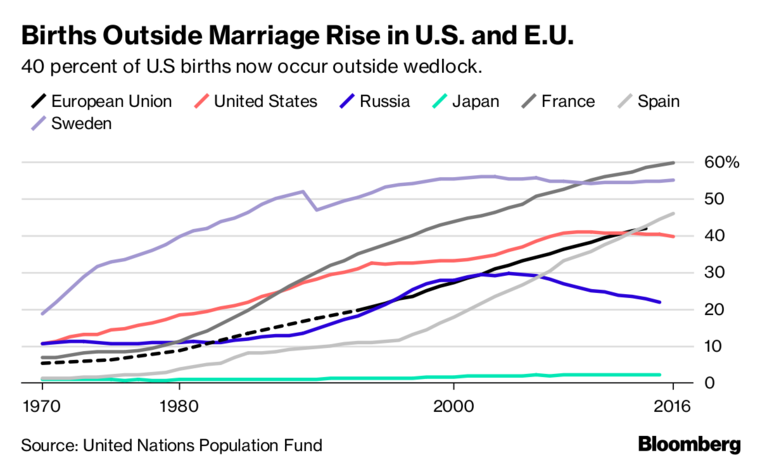
Unfortunately, young people are having children outside of a marriage commitment more and more.

Out-of-wedlocks births rising as cohabitation replaces marriage

Far-left Bloomberg News reports:

Forty percent of all births in the U.S. now occur outside of wedlock, up from 10 percent in 1970, according to an annual report released on Wednesday by the United Nations Population Fund (UNFPA), the largest international provider of sexual and reproductive health services. That number is even higher in the European Union.

The EU has a higher rate of fatherless births because they have high taxes and big government to allow women to have children without having to commit to a husband:

The EU likely sees more births out of wedlock because many member countries have welfare systems that support gender-balanced child care, said Michael Hermann, UNFPA’s senior adviser on economics and demography, in an interview. Public health care systems, paid paternal leave, early education programs and tax incentives give unwed parents support beyond what a partner can provide.

More welfare and more government services make it easier for women to pursue relationships with men who aren’t interested in marriage. Hot bad boys who give them all the tingles. Big government makes those boring, predictable marriage-ready men dispensable. Big government also makes it much harder for a man who does marry to afford a stay-at-home mother for his kids, because he has to pay higher taxes for big government.

More:

The data show such births in the U.S. and EU are predominantly to unmarried couples living together rather than to single mothers, the report says.

[…]Jones also noted that the rise in births outside of marriage is closely correlated to delays in childbearing. “Women are claiming their ground professionally,” she said. “Delaying motherhood is a rational decision when you consider the impact it can have on your career, and that’s contributing to this trend.”

[….]The traditional progression of Western life “has been reversed,” said John Santelli, a professor in population, family health and pediatrics at Columbia’s Mailman School of Public Health. “Cohabiting partners are having children before getting married. That’s a long-term trend across developing nations.”

Regardless of marital status, more couples are choosing not to have kids at all. The U.S. fertility rate hit a historic 30-year low last year, according to the Centers for Disease Control and Prevention. Hermann said the rise in births outside of wedlock has actually mitigated the decline in fertility, which “would be much steeper if women weren’t having children outside marriage.”

What’s interesting about this anti-marriage article is that they have nothing to say about the research showing that cohabitation – and also marriages that occur after a period of cohabitation – are inferior to no-cohabitation marriages. People who are serious about self-control, and who are serious about committing through thick and thin, tend to have longer lasting marriages. But we don’t prioritize chastity, fidelity and self-sacrificial commitment anymore, because that relationships that require self-denial make us unhappy.

The article concludes: “We can’t go back to the ’50s”. Right. Because if feelings-based “morality” is assumed, then any choice between adult happiness and children’s happiness will favor the adults. Today’s young people carefully AVOID any evidence that contradicts their new “happiness-morality”. They act surprised when their unstable relationships dissolve, leaving children separated from their fathers. Marriage requires that both partners have a system of morality that puts the commitment above happy feelings. People have to be accustomed to doing things that feel bad, just because they are good and moral things to do according to an objective standard of morality. The new atheist morality of happy feelings doesn’t develop the character needed for commitment.

If you ask an atheist millennial, they think they are doing a great job of being “moral”. They don’t see the messes they are making for children as something that they are causing themselves, with their own foolish feelings-based decision-making. They think they know everything about relationships through their feelings. They think that they are exempt from the patterns of cause and effect in the peer-reviewed research.

Jennifer Roback Morse lectures on sex and sexuality at Harvard University

Dr. Jennifer Roback Morse

Dr. Morse delivers a talk based on her book “Smart Sex” at Harvard University.

The MP3 file is here. (21 Mb) (Link in case that doesn’t work)

Topics:

  • the hook-up culture and its effects on men and women
  • cohabitation and its effect on marriage stability
  • balancing marriage, family and career
  • single motherhood by choice and IVF
  • donor-conceived children
  • modern sex: a sterile, recreation activity
  • the real purposes of sex: procreation and spousal unity
  • the hormone oxytocin: when it is secreted and what it does
  • the hormone vassopressin: when it is secreted and what it does
  • the sexual revolution and the commoditization of sex
  • the consumer view of sex vs the organic view of sex
  • fatherlessness and multi-partner fertility
  • how the “sex-without-relationship” view harms children

52 minutes of lecture, 33 minutes of Q&A from the Harvard students. The Q&A is worth listening to – the first question is from a gay student, and Dr. Morse pulls a William Lane Craig to defeat her objection. It was awesome! I never get tired of listening to her talk, and especially on the topics of marriage and family.