Tag Archives: Child

Does science support mothers who leave their young children to go to work?

Dina is very concerned about the UK’s leftist coalition government’s attempt to punish women who stay at home with their young children. (H/T Dina)

Excerpt:

Under plans unveiled in the Budget on Wednesday, families will only benefit from the generous new deal, which will come into force in 2015, if ‘all parents’ have a job. If one parent works but the other stays at home looking after their young children, they will get nothing.

It is the second time in just a few months that the Government has triggered controversy with its changes to the tax and benefit systems, which appear to penalise stay-at-home mothers.

As a result of the recent child benefit changes, a couple can both earn £50,000 and keep their child benefit, worth £1,752 a year for two children.

But a couple where one parent earns £60,000 and the other earns nothing – but have a far lower joint income – do not get a penny.

Again, this week’s initiative favours those couples where both parents go out to work. It will even benefit parents who each earn a salary of £149,999.

Note that this plan is being put forward by socialist Liberal Democrat Party, as well as the “Conservative” Party.

Dina thinks that the science is pretty clear that children suffer if their mothers leave them at a young age. Take a look at the video above, and then the brain scan below.
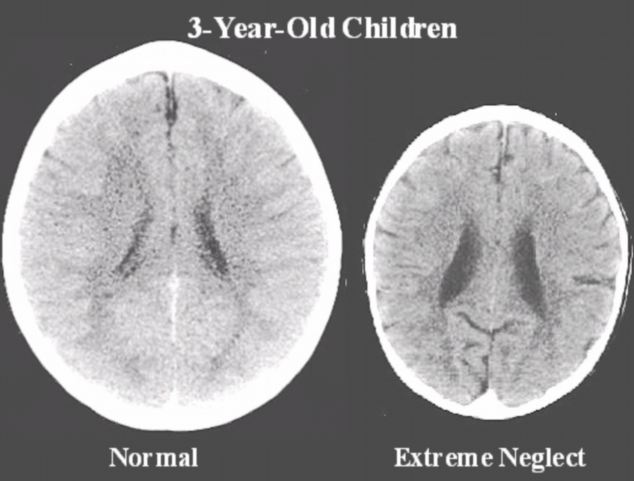
Brain scans of 3-year old children: normal vs neglected

Here’s the article that goes with the brain scan from the UK Daily Mail.

Excerpt:

Both of these images are brain scans of a two three-year-old children, but the brain on the left is considerably larger, has fewer spots and less dark areas, compared to the one on the right.

According to neurologists this sizeable difference has one primary cause – the way each child was treated by their mothers.

The child with the larger and more fully developed brain was looked after by its mother – she was constantly responsive to her baby, reported The Sunday Telegraph.

But the child with the shrunken brain was the victim of severe neglect and abuse.

According to research reported by the newspaper, the brain on the right worryingly lacks some of the most fundamental areas present in the image on the left.

The consequences of these deficits are pronounced – the child on the left with the larger brain will be more intelligent and more likely to develop the social ability to empathise with others.

But in contrast, the child with the shrunken brain will be more likely to become addicted to drugs and involved in violent crimes, much more likely to be unemployed and to be dependent on state benefits.

The child is also more likely to develop mental and other serious health problems.

Professor Allan Schore, of UCLA, told The Sunday Telegraph that if a baby is not treated properly in the first two years of life, it can have a fundamental impact on development.

He pointed out that the genes for several aspects of brain function, including intelligence, cannot function.

[…]The study correlates with research released earlier this year that found that children who are given love and affection from their mothers early in life are smarter with a better ability to learn.

The study by child psychiatrists and neuroscientists at Washington University School of Medicine in St. Louis, found school-aged children whose mothers nurtured them early in life have brains with a larger hippocampus, a key structure important to learning, memory and response to stress.

The research was the first to show that changes in this critical region of children’s brain anatomy are linked to a mother’s nurturing, Neurosciencenews.com reports.

The research is published online in the Proceedings of the National Academy of Sciences Early Edition.

Lead author Joan L. Luby, MD, professor of child psychiatry, said the study reinforces how important nurturing parents are to a child’s development.

This is why I argue that feminism, which is the ideology that demands that women work outside the home in order to be “equal” to men, is harmful to children. If we really cared about children, then we need to not be subsidizing the child abuse schemes of Liberal Democrats like Nick Clegg. We need to be clear that gender feminism (third-wave feminism) is an anti-child ideology and it should be opposed. The science is settled on this issue. Feminism harms innocent young children. And feminism isn’t just opposed to the rights of born children. They oppose the right to life of unborn children, too.

Assistant to Kermit Gosnell admits to killing ten born-alive babies

WARNING: this story is really horrific. Reader discretion is advised.

CNS News points out that Gosnell joked with his staff about later-term abortions.

Excerpt:

Dr. Kermit Gosnell, an abortionist now on trial in Philadelphia charged with seven counts of first-degree murder–he allegedly cut the spinal cords of late-term aborted babies who were born alive–apparently used to joke about the large size of some the infants he aborted and in one case, according to what a co-worker told the grand jury, said, “This baby is big enough to walk around with me or walk me to the bus stop.”

Gosnell, 72, who ran a multi-million dollar abortion business in West Philadelphia, was arrested on Jan. 19, 2011, and his trial started Monday, Mar. 18, 2013. The first-degree murder counts refer to seven late-term aborted babies who were born alive and then killed, their spinal cords cut with scissors.

Gosnell is also charged with the third-degree murder of a pregnant woman, Karnamaya Mongar, 41, who died after being given a pain killer at Gosnell’s office. He also faces several counts of conspiracy and violation of Pennsylvania’s law against post-24-week abortions.

In testimony on Monday, Adrienne Moton, who used to work for Gosnell at the Women’s Medical Society in West Philadelphia, said she recalled one baby – “Baby Boy A” – who was aborted  in July 2008. Baby A was so large, Moton took a photo of the child with her cell phone before Gosnell took the baby out of the room.

“I just saw a big baby boy. He had that color, that color that a baby has,” Moton said in court. “I just felt he could have had a chance. … He could have been born any day.”

Moten described how she helped to kill at least 10 born-alive babies by cutting their spinal cords.

More on the story from Life Site News.

Excerpt:

The grand jury report includes the account of another of Gosnell’s employees, Kareema Cross, describing the moment of Baby A’s birth:

After the baby was expelled, Cross noticed that he was breathing, though not for long. After about 10 to 20 seconds, while the mother was asleep, “the doctor just slit the  neck,” said Cross. Gosnell put the boy’s body in a shoebox. Cross described the baby as so big that his feet and arms hung out over the sides of the container. Cross said that she saw the baby move after his neck was cut, and after the doctor placed it in the shoebox. Gosnell told her, “it’s the baby’s reflexes. It’s not really moving.”

A neonatologist who testified on behalf of the grand jury said that Gosnell’s explanation for the baby’s movements was false, and that in all likelihood Gosnell failed immediately to kill the baby, and that his “few moments of life were spent in excruciating pain.”

The neonatologist also estimated the baby’s age as around 32 weeks gestation.

[…]Gosnell’s lawyer is arguing that the prosecution can’t prove that any of the seven babies he stands accused of murdering were born alive. He told the courtroom yesterday that the prosecution of his client is a racist-inspired “lynching.”

Gosnell is calling the charges against him an “elitist, racist prosecution”.

What causes homosexuality?

Here’s a post from NARTH by Julie Hamilton, Ph.D, that explains what most people already know about the causes of homosexuality.

Excerpt:

While environmental factors may include experiences of sexual abuse or other traumatic events, a common contributor to same-sex attractions is a disruption in the development of gender identity. Gender identity refers to a person’s view of his or her own gender; that is, his or her sense of masculinity or femininity. Gender identity is formed through the relationships that a child has with the same-sex parent and same-sex peers.

The process of gender identification begins approximately between age two and a half and four. For boys, it is during this phase that they begin to move from their primary attachment with the mother to seeking out a deeper attachment with the father. For males, the relationship between a boy and his father is the initial source of developing a secure gender identity. It is through the father-son relationship that a boy discovers what he needs to know about being male, including who he is as a boy, how boys walk, how they talk, how they act, and so forth. As the father spends time with the son, shows interest in the son, and gives the son affirmation and affection, the father imparts to the son a sense of masculinity. The boy begins to develop a sense of his own gender by understanding himself in relation to his father.

When the child reaches the age of five, he begins to face another task, that is, to begin to attach to same-sex peers. At this age, he starts school and begins to look to the other boys to answer the same questions that his dad has been answering. He looks to the other boys to discover how they walk, how they talk, how they play, and how he measures up in relation to them. He seeks to be included, accepted, and acknowledged. Through the relationships he forms with other boys, he continues to gain a sense of masculinity, discovering more about others boys and therefore more about himself as a boy.

[…]The female development of homosexuality is a bit more complex. As with the male development, there are a number of factors that can contribute. For some women who end up with same-sex attractions, the development is similar to the male development previously described. For others, negative perceptions regarding femininity may lead to an internal detachment from their own femininity. For example, if a girl watches her father abuse her mother, the girl might conclude that to be feminine is to be weak. At an early age she might make an unconscious decision to detach from her female identity. She might detach from her own gender in an effort to protect herself from the perceived harmful effects of being female.

Sexual abuse is another factor that can contribute to a homosexual orientation. In these cases men are seen as unsafe, and lesbianism becomes a way of protecting against further hurt from a male. For some there might be a disconnection from the mother, and lesbianism becomes a search for motherly love. For others, same-sex attractions may not initially be present, but may later develop as a result of entering into a non-sexual friendship which becomes emotionally dependent. An emotionally dependent relationship is one in which two people seek to have their needs met by one another. It is a relationship in which healthy boundaries are not in place. The absence of appropriate emotional boundaries can then lead to a violation of physical boundaries.

I think this is very sad because it turns out that it’s really the parents who make the decisions that will push someone towards or away from homosexuality. It would be better for everyone, homosexuality aside, if people who have children think twice about the needs of those children. Maybe the adults need to be a little more informed and accommodating about what children need? And maybe we need to do a better job of picking spouses based on their ability to provide for the needs of children?

Speaking as a Christian, I know why I want to have children, and I would be very interested in bonding with them and developing them. And people can see that in me because of the way that I mentor and support so many younger Christians in their studies and plans. We need to get better at caring for young people and just spending time with them instead of always doing our own thing and handing them off to strangers. It’s wrong to have children and not give them the attention and time they need to grow up.

You may also be interested in this post by Dr. Trayce Hansen on the identical twin studies that show that homosexuality is not determined by genetics, although that certainly is a factor. I also recommend the book “A Parent’s Guide to Preventing Homosexuality” by Dr. Joseph Nicolosi for more background on these issues.