Tag Archives: Catholicism

Obama revises contraception mandate but Catholic groups still pay for abortion drugs

Life News explains.

Excerpt:

The Obama administration has revised its controversial mandate that had forced religious employers to pay for health insurance coverage that includes birth control and drugs like Plan B, the morning after pill, and ella that can cause abortions.

Responding to a firestorm of opposition from pro-life organizations, Catholics groups and even some Democrats, the Obama administration has revised the mandate in a way that pro-life advocates are saying is even worse.

The revised Obama mandate will make religious groups contract with insurers to offer birth control and the potentially abortion-causing drugs to women at no cost. The revised mandate will have religious employers refer women to their insurance company for coverage that still violates their moral and religious beliefs. Under this plan, every insurance company will be obligated to provide coverage at no cost.

Essentially, religious groups will still be mandated to offer plans that cover both birth control and the ella abortion drug.

According to Obama administration officials on a conference call this morning, a woman’s insurance company “will be required to reach out directly and offer her contraceptive care free of charge. The religious institutions will not have to pay for it.”

The birth control and abortion-causing drugs will simply be “part of the bundle of services that all insurance companies are required to offer,” White House officials said.

“We are actually more comfortable having the insurance industry offer and market this to women than religious institutions,” the White House said on the conference call LifeNews listened to because they “understand how contraception works” and it “makes sense financially.”

[…]Republican Study Committee Chairman Jim Jordan told LifeNews in response to the revised mandate that it violates the right to religious freedom guaranteed by the First Amendment to the Constitution.

“This ObamaCare rule still tramples on Americans’ First Amendment right to freedom of religion. It’s a fig leaf, not a compromise. Whether they are affiliated with a church or not, employers will still be forced to pay an insurance company for coverage that includes abortion-inducing drugs,” he said. “This is not just a problem for church-affiliated hospitals and charities. Under these rules, a small business owner with religious objections to abortion-inducing drugs and contraception must either violate his religious beliefs or violate the law.”

“The liberal Obama administration thinks its political goals trump the religious faith of American citizens. That isn’t right, fair, or constitutional,” he said.

The abortions will still be paid for by the religious groups. They are going to pay for the drugs through medical insurance premiums. So religious organizations are still being forced to provide abortions for their workers.

Who is to blame for this? I blame Catholic bishops. Catholic bishops do believe in socialism. They do want a secular government to take money from religious people. And they do want government to hand out medical care to people, instead of letting individuals, businesses and charities provide health care.

Rick Santorum agrees with me on this.

Consider this interview with Rick Santorum in which he reacts Obama’s health care mandate.

Excerpt:

HH: Now I want to talk to you about two substantive issues, Senator Santorum. The first are these new regulations from the Obama administration. I read the letter from Archbishop Olmstead of Phoenix on the air. Archbishop Jose Gomez of Los Angeles has written a new article in First Things. It’s shocking, actually, what’s going on. Should this be a centerpiece of whoever the nominee’s campaign is?

RS: I talked about it in every speech I’ve given today. And here’s what I said, though, Hugh. I said that I took issue with the Catholic Bishops Conference, because Hugh, you may remember, they embraced Obamacare.

HH: Yes.

RS: They embraced it and said…here’s what I said to them. Be careful when you have government saying that they can give you rights, that you have a right to health care, and government’s going to give you something, because once you are now dependant on government, they, not only can they take that right away, they can tell you how to exercise that right, and you can either like it or not. And that’s the problem. That’s what the Catholic Bishops Conference didn’t get, that there’s no free lunch here, folks. If you’re going to give people secular power, then they’re going to use it in a secular fashion. And that’s why, you know, I hate to say it, but you know, you had it coming. And it’s time to wake up and realize that government isn’t the answer to the social ills. It’s people of faith, and it’s families, and it’s communities, and it’s charities that need to do this as it has in America so successfully for so long.

HH: Rick Santorum, what do you advise Catholic hospitals, Catholic colleges, Catholic…the centers of poverty assistance, the adoption agencies? What do you advise them to do in the face of, as Archbishop Olmstead said, we cannot comply with this unjust law?

RS: Civil disobedience. This will not stand. There’s no way they can make this stand. The Supreme Court, eventually, this thing’s going to get to the Supreme Court just like the ministerial hiring issue that was just decided by the Supreme Court the other day. And it was a 9-0 decision that said the Obama administration can’t roll over people of faith when it comes to hiring. Yet in the face of that decision, this radical, secular government of Barack Obama continues to have faith be the least important of the 1st Amendment. And I just think they fight. They fight in the courts, and they fight by civil disobedience, and go to war with the federal government over this one.

Evangelical protestants feel comfortable with Catholics like Rick Santorum. He gets it. If the bishops are wrong on socialized medicine and wrong on the death penalty and wrong on other things, then so much the worse for the bishops.

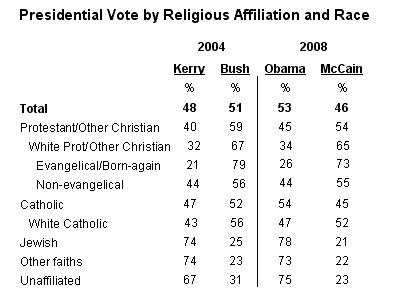
Obama did very well with Catholics in 2008 even though Obama is the most pro-abortion president in the history of the United States. Catholics tend to be more liberal on economic issues than evangelicals, which is why many of them voted for Obama. Evangelicals oppose economic liberalism, because they oppose government taking tax money from workers in order to provide services for other people aren’t trying to be self-sufficient. Evangelicals oppose increasing the dependence of individuals on a secular government. Evangelicals don’t want a secular government to take money from individuals and then use it to push secular leftist ideas like global warming, Darwinism and sex education in government run institutions, e.g. – public schools, public broadcasting, etc. Evangelicals trust individuals to care for the poor, and they don’t want to make it too easy for people to make reckless decisions and then get a check in the mail or a free abortion.

What causes this difference between Catholics and evangelicals? Evangelicals believe in salvation through grace ALONE through faith ALONE in Christ ALONE. Evangelicals put the emphasis on what you believe – it has to be true in order to please God. Catholics, just like Mormons, Jews and other religions, emphasize good works as a requirement for salvation. Many Catholics also support inclusivism, which is the view that you can be saved in other religions like Judaism and Islam. This means that for these Catholics, specific Christian doctrines are not essential for salvation, so long as you have sincerity and good works. On the other hand, evangelicals are exclusivists who emphasize the need for each person to arrive at true beliefs about God in order to be saved, and good works are just natural outworkings of their beliefs.

Evangelicals emphasize the responsibility of the individual to discover truth with their Bibles, reasoning, science and history. This belief in individual responsibility carries over into their approach to charity. Evangelicals believe individuals are responsible for deciding what to do about charity – you earn your own money and then you choose yourself how to share with others. But the responsibility to give away money wisely is an individual responsibility – you share your money in a way that is consistent with your beliefs. Evangelicals don’t generally accept the idea of handing money off to someone else and letting them decide what to do with it. We think that everything is our responsibility, starting with Bible study and theology, and going on through to economics and politics.

And this emphasis on individuals over big government has this effect:
(Source)

Note that this chart puts evangelicals together with born-again Christians. But evangelical Christians differ from born-again Christians, because they are firm on exclusive salvation and evangelism. Evangelicals like to study so that they can discuss their beliefs in public, using reasons and evidence to persuade others. A born-again Christian does not have that same emphasis on study and persuasion, because they don’t focus on evangelism. So, if you separate out the born-agains from that 26%, number for Obama support, then you are likely to get a much lower number for evangelicals who support Obama. We don’t like health care mandates covering abortion. Evangelicals are used to having to puzzle things out for themselves – so they puzzled out what Obama believed and then they voted against him.

Christianity and the doctrines of exclusivism, inclusivism and pluralism

Are you familiar with the differences between exclusivism, inclusivism and pluralism? This article from Leadership University explains all three of them.

Here’s exclusivism:

The following is a succinct explanation of the central characters and ideas behind each position. The exclusivist position has been the dominant position of the church as a whole through much of its history until the Enlightenment. Major representatives include Karl Barth, Emil Brunner, Hendrick Kraemer, D.A. Carson, William Lane Craig, and R. Douglas Geivett.

Key to this position is the understanding of God’s general and special revelations. God is manifested through creation (general revelation), but Man has responded by freely going against this revelation and, thus, stands guilty before a holy God. However, God has demonstrated a reconciliatory mercy through His word and deed, fulfilled completely in Jesus Christ. The historical person of Jesus, then, is the unique, final, decisive, and normative self-revelation of God to Man (special revelation). Exclusivists believe that Jesus Christ is the sole criterion by which all religions, including Christianity, should be understood and evaluated. Calvin Shenk explains:

Christ did not come just to make a contribution to the religious storehouse of knowledge. The revelation which he brought is the ultimate standard. Since in Christ alone is salvation and truth, many religious paths do not adequately reflect the way of God and do not lead to truth and life. Jesus is not, therefore, just the greatest lord among other lords. There is no other lord besides him.

Specific texts often employed by exclusivists include Acts 4:12; John 14:6; 1 Corinthians 3:11; and 1 Timothy 2:5-6.

And inclusivism:

Inclusivism is a blanket term to characterize a sort of “middle way” between exclusivism and pluralism. Most prominent within mainline Protestantism and post-Vatican II Catholicism, its notable proponents (in one formor another) include Karl Rahner, Raimundo Panikkar and Stanley Samartha, and Hans Kung. Evangelical theologians such as Clark Pinnock, Norman Anderson, and John Sanders have also identified themselves with this position. Herein, the agnosticism associated with the latter option above is replaced with outright optimism. Christian salvation is not confined to the historical or geographic extent special revelation has spread, rather it must be available to all cultures, irrespective of age or geography.Salvation is still posited wholly in Christ and his salvific work. Specific knowledge of this work, however, is not necessary for the effect (i.e., salvation) to apply to those within a different religious culture who have responded to the general revelation available. Once again, Shenk explains:

Inclusivists want to avoid monopolizing the gospel of redemption. They acknowledge the possibility of salvation outside of Christian faith or outside the walls of the visible church, but the agent of such salvation is Christ, and the revelation in Jesus is definitive and normative for assessing that salvation. Jesus Christ is believed to be the center, and other ways are evaluated by how they relate to him. Other religions are not just a preparation for Christ, but Christ is actually present in them.

The fundamental differences between exclusivism and inclusivism… are the nature and the content of “saving faith.” The former emphasizes explicit faith while the latter points to an implicit faith.

And pluralism:

Finally, there is the pluralist position. This is undoubtedly the most difficult of the three to define in any general sense. The spectrum of pluralistic thought is as wide as it is long. The focusof this particular study will examine the contributions of its key figures: Paul Knitter, John Hick, and Wilfred Cantwell Smith. Just as in the previous positions, the interpretative range within just these three individuals varies. It is fitting, however, to focus primarily on them since they are the most vocal and influential figures espousing pluralism today.

Hick and Knitter argue the case for pluralism on the following grounds: (1) ethically, it is the only way to promote justice in an intolerant world; (2) in terms of the “ineffability of religious experience,” so no religion can claim an absolutist stance; and (3) through the understanding that historical and cultural contexts must be the filter for any absolute religious claim. Hick has argued that all world religions attempt to relate to the unknowable Ultimate Reality (or, the Real), but because of their various cultural and historical contexts these attempts are all naturally different. Hence the various conceptions of the Real and the salvation(s) sought. The common soteriological goal, toward which all religions strive, though, is rooted in the desire to transcend self-centeredness and, in turn, encounter a new (unexplainable) experience with the Real. But, he emphatically emphasizes the fact that there is “no public evidence that any one religion is soteriologically unique or superior to others and thus has closer access to Ultimate Reality.”

Therefore, with pluralism, Christ is no more definitive or normative than any religious figure or concept. Or, as Andrew Kirk explains, “Rather than confessing that Jesus Christ is the one Lord over all, this view asserts that the one Lord who has manifested himself in other names is also known as Jesus.” By “crossing the Rubicon,” as Hick and Knitter illustrate, Christians are encouraged to abandon any claim of Christian uniqueness and the possibility of absolute revelation, accepting the fact that the Christian faith is one among many options.

Now maybe you didn’t know this, but Roman Catholics seem to have taken a turn away from exclusivism and towards inclusivism in the last century.

So, I thought I would post a rebuttal to the Roman Catholic embrace of inclusivism from one of my favorite Christian apologists, Greg Koukl.

Excerpt:

There are some issues of Christianity that are intra-Nicene, intramural discussions between believers, in which I think a charitable person can easily see how another Christian can hold a different view because there are things that are difficult to understand in Scripture. For instance, though I’m Reformed in my soteriology, my understanding of salvation–I’m a Calvinist–I am sympathetic to an Arminian perspective because I can see how they, in lines of reasoning from the New Testament and verses themselves from the New Testament, can come to their view. So, though I would disagree, and I think they’re mistaken, I understand how they can see it.But there are other positions that I cannot understand because there is no New Testament evidence in favor of it, and, to the contrary, almost to a word, as the New Testament touches the issue, it says quite the opposite.

Earlier this week, I was honored, flattered, and, frankly, humbled to have a very unique opportunity on Monday to address an audience of about 150 Jewish people that were in the midst of Jewish High Holy Day services–morning services, evening services–at kind of a pause time in the afternoon, in which my host and I and another guest had a discussion about Jews and Christians. The three of us were on the panel:  my host, Dennis Prager, a man I have a tremendous admiration and affection for, and Greg Coiro, a Roman Catholic priest and a professional friend. I’ve known both of these men over 20 years and have been in many discussions, both in private and public on the air with Dennis and Greg Coiro.

It was in this opportunity that, in a sense, the ancient quarrel of sorts, theologically, was revisited, that I’ve had in the past many years ago when we were talking about this in interfaith dialogues. This difference of opinion is a historically new development in Roman Catholicism that stunned me when I first encountered it in the early days of being on Religion on the Line in the late eighties, a radio panel Dennis Prager hosted for many years. The priests on the panel uniformly held the conviction, informed by Vatican II, that Jews don’t have to believe in Jesus in order to receive the benefits of Jesus’ salvation. This is a view called “inclusivism.” It’s not the same as pluralism, but in my view, it seems to have the same impact: “Yes, Jesus is necessary for salvation, but you don’t have to believe in Jesus to benefit from Jesus.”

Now, at this afternoon panel recently, the very first question that came up was whether trust in Jesus is necessary for salvation. “Greg, do you believe that? Do Protestants believe that?” I answered, “Yes, I believe that. And no, not all Protestants believe that. But let me try to explain it to you in a way that doesn’t sound so stark. Let me try to give it some perspective.” I explained that it wasn’t as if God was up there looking down at a bunch of religious clubs and prefers some over others. He used to prefer the Jewish club and now He prefers the Christian club. It may sound that way to many when this doctrine of Christianity is put forward: Jesus is the only way of salvation; you must believe in Jesus in order to benefit from what Jesus did.

Talk about Daniel in the lions’ den. Anyway, click through and read the whole article to get an idea of how to make your stand for exclusivism in difficult places.

For a general article defending the Christian doctrine of exclusivism, check out this article by William Lane Craig. One of my favorites, from way way back to when I was an undergraduate.

And, if you would like to listen to a debate on pluralism, then here is a debate featuring pluralist John Hick.

Jennifer Roback Morse lectures on marriage at Stanford University

Dr. Jennifer Roback Morse

Stanford University is one of the top 5 universities in the United States.

Details:

Dr J gave this talk at Stanford University’s Anscombe Society on the reasons for marriage, and the ways in which it shapes society and the next generation. After Dr J’s talk at Stanford University, she took questions and answers from the students in attendance.  They had quite the lively discussion…  Please be advised–some of these questions may be overly explicit for very young listeners.

The files:

Here’s her biography:

Jennifer Roback Morse, Ph.D. is the founder and President of the Ruth Institute, president of the Ruth Institute a project of the National Organization for Marriage to promote life-long married love to college students by creating an intellectual and social climate favorable to marriage.

She is also the Senior Research Fellow in Economics at the Acton Institute for the Study of Religion and Liberty.

She is the author of Smart Sex: Finding Life-long Love in a Hook-up World, (2005) and Love and Economics: Why the Laissez-Faire Family Doesn’t Work (2001), recently reissued in paperback, as Love and Economics: It Takes a Family to Raise a Village.

Dr. Morse served as a Research Fellow for Stanford University’s Hoover Institution from 1997-2005. She received her Ph.D. in economics from the University of Rochester in 1980 and spent a postdoctoral year at the University of Chicago during 1979-80. She taught economics at Yale University and George Mason University for 15 years. She was John M. Olin visiting scholar at the Cornell Law School in fall 1993. She is a regular contributor to the National Review Online, National Catholic Register, Town Hall, MercatorNet and To the Source.

Dr. Morse’s scholarly articles have appeared in the Journal of Political Economy, Economic Inquiry, the Journal of Economic History, Publius: the Journal of Federalism, the University of Chicago Law Review, and the Harvard Journal of Law and Public Policy, Social Philosophy and Policy, The Independent Review, and The Notre Dame Journal of Law Ethics and Public Policy.

[…]Her public policy articles have appeared in Forbes, Policy Review,The American Enterprise, Fortune, Reason, the Wall Street Journal, Vital Speeches, and Religion and Liberty.

She currently lives in San Diego, CA. She and her husband are the parents of a birth child, an adopted child. From March 2003 to August 2006, Dr. Morse and her husband were foster parents for San Diego County. During that time, they cared for a total of eight foster children.

Her talent is to apply the economic way of thinking to social issues like marriage, family and parenting.