Tag Archives: Atheists

The worst mistake you can make when defending the Christian worldview

I have a key that will unlock a puzzling mystery

So, this is just an advice post for doing apologetics.

Here are three situations I’ve run into while doing apologetics in the last month.

First situation. I was talking with a lady who is an atheist. I had a copy of “God’s Crime Scene” in my hand, and she asked me about it. I told her that it was a book written by the guy who solved the homicide case that I asked her to watch on Dateline. She remembered – it was the two-hour special on the woman who was killed with a garrotte. She pointed at the book and said “what’s in it?” I said, it has 8 pieces of evidence that fit better with a theistic worldview than with an atheistic one, and some of them scientific. Her reply to me was – literally – “which denomination do you want me to join?”

Second situation. I was talking with a friend of mine who teaches in a Catholic school. She was telling that she got the opportunity to talk to her students about God, and found out that some of them were not even theists, and many of them had questions. So she asked them for questions and got a list. The list included many hard cases, like “what about the Bible and slavery” and “why do Christians oppose gay marriage?” and so on.

Third situation. Talking to a grad student about God’s existence. I’m laying out my scientific arguments for her, holding up the peer-reviewed papers for each discovery. I get to the Doug Axe paper on protein folding probabilities, and she holds up her hand. One question: “Am I going to Hell?”

So think about those three situations. In each case, the opponent is trying to reject Christianity by jumping way, way ahead to the very end of the process. When you do Christian apologetics, you do not take the bait and jump to the end of the process dealing with nitty gritty details until you have made your case for the core of the Christian worldview using your strongest evidence. Let me explain.

So, your strongest evidence as a Christian are the scientific arguments, along with the moral argument. Those would include (for starters) the following:

  1. kalam cosmological argument
  2. cosmic fine-tuning
  3. galactic and stellar habitability
  4. origin of life / DNA
  5. molecular machines / irreducible complexity
  6. the moral argument

The problem I am seeing today is that atheists are rejecting discussions about evidence because they think that all we are interested in is getting them to become Christians. Well, yes. I want you to become a Christian. But I know perfectly well what that entails – it entails a change of life priorities. Both of the women I spoke to are living with their boyfriends, and the kids in the Catholic school just want to have fun. None of them wants to believe in a God who will require self-denial, self-control, and self-sacrifice. Nobody wants God to be in that leader position in their lives. Christianity is 100% reversed from today’s me-first, fun-seeking, thrill-seeking, fear-of-missing-out travel spirit of the age.

So, how to answer all these late-game questions? The answer is simple. You don’t answer any late-game questions until the person you are talking with accounts for the widely-accepted data in your list. These are things that have got to be accepted before any discussion about minor issues like one angel vs two angels at the empty tomb can occur. When we discuss all the basic issues where the evidence is the strongest, then we can go on to discuss issues where the evidence is debatable, then finally, in the last bits before the end, we can discuss these other kinds of questions.

How to explain why this process must be followed to the person who asks specific questions about minor issues? Simple. You explain that your goal is not to get them to become a Christian right now. That you want to let them believe anything thing they want. That’s right. They can believe anything they want to believe. As long as what they believe is consistent with the evidence. And what I am going to do is give them the evidence, and then they can believe whatever they want – so long as it’s consistent with the evidence.

So, for example, I’m going to tell them 3 pieces of evidence for a cosmic beginning of the universe: the expanding universe (redshift), the cosmic microwave background radiation, and the light element abundances. That’s mainstream science that shows that the universe came into being out of nothing, a finite time in the past. And I will charge them not to believe in any religion that assumes that the universe has always been here. For example, Mormonism is ruled out, they believe in eternally existing matter. See how that works? Hey, Ms. Atheist. You can believe anything you want. As long as what you believe is consistent with the evidence. 

I think this approach of not letting them rush you to the end at the beginning is important for two reasons. First, we can get our foot in the door to talk about things that are interesting to everyone, in a non-stressed environment. Everyone can talk about evidence comfortably. Second, we show that we hold our beliefs because we are simply letting evidence set boundaries for us on what we are allowed to believe. We can’t believe not-Christianity, because not-Christianity is not consistent with the evidence. And you start with the most well-supported evidence, and eliminate worldviews that are falsified by the most well-supported evidence. Atheism actually gets falsified pretty quickly, because of the scientific evidence.

So, that’s my advice. Had a friend of mine named William try this out about a week ago. It went down like this:

William to me:

This guy I know messaged me and bragged for a while about how easy he can dismantle Christianity. He said: “present the gospel to me as you understand it. I’ll simply ask questions to demonstrate it is not worth your belief.”

WK to William:

First of all, he isn’t allowed to just sit there and poke holes in your case, he has to present a positive case for atheism. Second, don’t discuss Christianity with him at all until you first discuss the evidence for theism – start with the good scientific evidence.

And William wrote this to his friend:

The way I’m wired is that I process all competing theories and go with the best one. By doing a comparative analysis of worldviews I find that Christian theology easily explains the most about the world I find myself living in.

I’m pretty sure that a God of some sort exists because of the scientific evidence for the origin of the universe and the fine tuning in physics. From there I find it quite intuitive that if a God went through the trouble of creating and tuning a universe for life that this God likely has some sort of interest in it and has revealed Himself to humanity in some way.

From there I can look at the major world religions and compare them to see which one explains the past and the present the best. Christianity easily comes out on top.

And then a few days later, I got this from William:

I finally got the agnostic to tell me what he thinks about origin and fine tuning. When I started pointing out that his views were unscientific, he blew a gasket, called me dishonest and told me he didn’t want to discuss anything further.

And that’s where you want to be. Cut off all discussions where the challenger tries to jump to the end and get you to debate the very last steps of your case. Present the strongest evidence for your core claims, and get him to account for this evidence within his own worldview. Lead the discussion with public, testable evidence. All warfare depends on picking the terrain, weapons and tactics that allow you to match your strength against your opponent’s weakness.


Should Christian men expect a wife / mother candidate to know how to defend the Christian worldview?

C.S. Lewis has some words to live by for you

Over the weekend I debated with Christian feminists about marriage on The Transformed Wife Facebook page. At one point, I asserted that Christian women ought to have some knowledge of how to defend their faith using scientific and historical evidence. Some women asked me: “are you joking?” In this post,  I’ll explain why I’m serious, and then I’ll ask them some questions of my own.

Let’s start with Jesus. Jesus set an example by showing the importance of knowing how to answer questions and challenges from skeptics in the New Testament. His favorite way to answer a challenge was by using evidence to support his truth claims.

So, take this story that’s in Mark 2:1-12, Matthew 9:1-8 and Luke 5:17-26. This story is accepted even by skeptical historians because it’s in three different books, and one of them is early (Mark).

In each version of the story, there are 4 steps:

  1. Jesus forgives the sins of a paralyzed man
  2. The Pharisees say that he doesn’t have authority to forgive sins
  3. Jesus miraculously heals the paralyzed man
  4. Jesus explains the evidence of the healing supports his claim that he has authority to forgive sins

And this is an example that you will find repeated in many places in the life of Jesus. You can see it in the Old Testament as well, where God performs miracles so that people who don’t believe in his existence or respect the Scriptures can still be convinced.

Christian apologetics is the skill of being able to give a defense for the Christian worldview when presented with a challenge from a non-Christian.

So, who has to be ready with a defense?

Look at 1 Peter 3:15-16:

15 But in your hearts revere Christ as Lord. Always be prepared to give an answer to everyone who asks you to give the reason for the hope that you have. But do this with gentleness and respect,

16 keeping a clear conscience, so that those who speak maliciously against your good behavior in Christ may be ashamed of their slander.

This passage applies to every one who claims to be a disciple of Jesus, whether they like to prepare a defense or not. How much work must you put into it? It depends on the sophistication of the challenges you get. In the mountains of Pakistan, you don’t need to know much because there might not be a sophisticated challenge. In an American society filled with college graduates, the challenges are more difficult. So you will need to prepare a lot more, because the challenges will be a lot harder.

Those who take this passage seriously are doing something difficult, and time-consuming, in order to serve Christ. Buying books costs money. Reading books takes time. Debating with non-Christians can make you look bad to others. But the Bible commands us to be ready with answers for the people around us. Sometimes, doing what the Bible says makes us feel bad, or look bad to others. But we have do what the Bible says anyway. Part of being a real Christian is being obedient even if it feels bad or makes you look bad.

William Lane Craig on apologetics and the culture

What’s in an apologetics book?

So, with that said, let’s look at the table of contents of my favorite introduction to Christian apologetics, which is “Is God Just a Human Invention?” written by Sean McDowell and Jonathan Morrow.

In that book, you will find 18 topics.

  1. Is Faith Irrational? (Commentary by: Gregory Koukl)
  2. Are Science and Christianity at Odds? (Commentary by: John Warwick Montgomery)
  3. Are Miracles Possible? (Commentary by: Gary R. Habermas)
  4. Is Darwinian Evolution the Only Game in Town? (Commentary by: William A. Dembski)
  5. How Did the Universe Begin? (Commentary by: R. Douglas Geivett)
  6. How Did Life Begin? (Commentary by: Fazale R. Rana)
  7. Why Is the Universe Just Right for Life? (Commentary by: Jay W. Richards)
  8. Has Science Shown There Is No Soul? (Commentary by: Dale Fincher and Jonalyn Fincher)
  9. Is God Just a Human Invention? (Commentary by: Garry DeWeese)
  10. Is Religion Dangerous? (Commentary by: Douglas Groothuis)
  11. Does God Intend for Us to Keep Slaves? (Commentary by: Paul Copan)
  12. Is Hell a Divine Torture Chamber? (Commentary by: Frank Turek)
  13. Is God a Genocidal Bully? (Commentary by: Clay Jones)
  14. Is Christianity the Cause of Dangerous Sexual Repression? (Commentary by: Kerby Anderson)
  15. Can People Be Good Without God? (Commentary by: Mark D. Linville)
  16. Is Evil Only a Problem for Christians? (Commentary by: Randy Alcorn)
  17. What Good Is Christianity? (Commentary by: Glenn S. Sunshine)
  18. Why Jesus Instead of the Flying Spaghetti Monster? (Commentary by: Darrell L. Bock)

Prominent atheist scholars are quoted in each chapter to introduce the challenges, and then scholarly arguments and evidence are presented to defend the Christian worldview. The language is simple enough, but the material is solid enough to use in a real debate. I would say that introductory books like this one are more than enough to equip you for everyone who will challenge you.

Why are these 18 topics important? Because these are the questions that atheists ask. These are the questions that cause Christians to leave the faith. These are the questions that your children will face in high school and college, which might cause them to leave the faith.

Let’s start with chapter one. One of the most prominent arguments by atheists is that faith is irrational. This chapter allows you to define faith using the Bible’s definition of faith, which relies on logic and evidence.

Atheists also say that Christianity is at war with science. In chapter 2, they discuss the history of science and how Christianity provided the framework that allowed scientific method to take root and flourish.

Atheists like to claim that miracles are impossible. Chapter 3 defends the view that God, if he exists, is capable of interacting with his created world.

Atheists love to put forward Darwinism as means to deny that God is the designer of life. Chapter 4 explains the concept of intelligent design, and why intelligent design is a better explanation for the history of life.

Atheists love to talk about how the universe has always existed, and there’s no need for a Creator. Chapter 5 contains a philosophical argument that is supported by mainstream science to argue that the universe had a beginning, just like the Bible says.

Atheists love to argue that life can emerge from non-life, and the process is simple. Chapter 6 is written by a biochemist, and it takes a look at the real complexity of the simplest living cell.

Atheists like to argue that the universe itself is just an accident, and there is no need for a Designer. Chapter 7 introduces the scientific evidence for fine-tuning and habitability.

Atheists like to say that there is no soul and no afterlife. Chapter 8 gives some arguments for the existence of the soul.

Atheists like to argue that Christians invent God because God makes them feel good. But chapter 9 explains that having an all-powerful God who can hold humans accountable is the last thing any human would want to invent.

Atheists like to talk about how religion, with it’s habit of teaching to believe in things that can’t be tested, causes religious people to do a lot of harm. Chapter 10 takes a look at the real record of Christianity as a force for good in the world.

Atheists like to talk about slavery in the Bible. Chapter 11 talks about what the Bible really says, and provides some rational responses to the accusation.

Atheists like to talk about eternal punishment in Hell isn’t a just punishment for just getting a few questions wrong on a theology exam. Chapter 12 provides an explanation and defense of the concept of Hell.

Atheists love to talk about how God commanded the Israelites to attack their enemies in the Bible. Chapter 13 explains who their enemies really were, and what was really happening in those wars.

Atheists feel that unrestricted sexual activity is very healthy and normal, and that the Biblical prohibitions outside of male-female marriage are repressive and unhealthy.  Chapter 14 explains why God has these rules in place, and supports his rules with evidence.

Atheists love to assert that they don’t need God, because they can behave morally on their own. Chapter 15 explains how to answer this claim by talking about how well atheism grounds objective moral values, objective moral duties, free will and moral accountability: the minimum requirements for objective morality.

Atheists think that the mere existence of natural disasters and human immorality are incompatible with the God of the Bible. Chapter 16 explains why this argument doesn’t work, and why even the concept of evil requires God to exist.

I have an atheist friend in my office who can’t defeat my scientific arguments for the origin of the universe, the fine-tuning and the origin of life. But still, he says to me, even if God exists, why would that matter to my life? Chapter 17 explains what difference Christianity makes in a person’s life.

Atheists think that the life of Jesus has no relevance to their life, and that he has nothing to offer them anyway. Chapter 18 explains the uniqueness of Jesus and explains why his resurrection is relevant to our lives today.

It’s important to understand that this book is not on the level of A. W. Tozer, G.K. Chesterton, Francis Chan, John Piper, etc. Those authors write for a Christian audience and therefore they do not equip you to answer realistic challenges from non-Christians. But the apologetics book we looked at actually equips you to answer challenges from non-Christians using logical arguments and evidence from mainstream history and science. You can use the material in that book in discussions outside the confines of your home and your church.

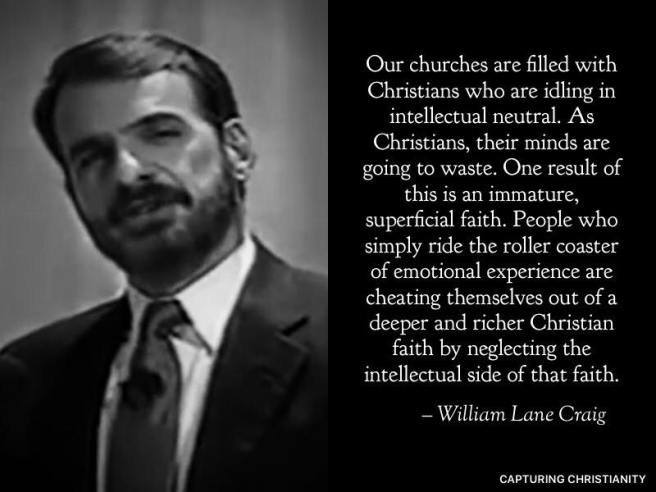
Dr. William Lane Craig says churches aren't preparing Christians to give an answer
Dr. W. L. Craig: churches don’t prepare Christians to answer skeptics

Wife candidates ought to know apologetics

So, back to my original point about how some Christian feminists responded when I said that during courtship, I ask women questions about how much preparation they have done to answer objections from atheists, like the ones answered in this book. Am I joking?

Well, I think the problem is that Christian feminists don’t understand how Christian men view marriage. Christian men are interested in marriage because they think that their marriage will be an enterprise that produces a return for God. They like the idea of having a clean, comfortable home to host debate viewings and discussions over dessert with skeptics. They like the idea of raising children who will be effective and influential. Men don’t see marriage a means of making us feel better, or having fun, or getting our peers to approve of us. We see it as a way to promote Jesus’ agenda in the world. A Christian man loves his wife precisely because she is his partner in serving God.

So, some questions for all the Christian feminists out there. Are you aware of the actual objections that non-Christians have to the Christian worldview? Have you ever put in any effort to prepare to respond to these objections? Have you trained yourself to be calm and persuasive during discussions about Christianity?

Reading devotions or authors like Rachel Hollis, Beth Moore, and Jen Hatmaker won’t teach a Christian woman anything useful about defending the Christian worldview against atheist objections. And those books also won’t teach you how to evaluate a man to see whether he knows how to defend the Christian worldview, either. You have to study apologetics to know how to evaluate how much a candidate for husband and father roles knows about defending his faith. You have to protect yourself from men who lie about being Christians.

Having a rationally-grounded Christian worldview is essential to the roles of wife and mother. A Christian man cannot be confident about the trustworthiness of a Christian woman’s convictions unless she demonstrates her ability to defend those convictions to non-Christians in the ordinary way that she can surely defend other truth claims in areas where she does have the knowledge. If I ask a Christian nurse to defend the claim that germs are real, she will appeal to logic and evidence. I expect her to have put in as much work into defending the claims of Christianity, and to use the same methods: logic and evidence.

Colorado shooter hated Christians for disagreeing with homosexuality, praised Democrat Obama

Richard Dawkins on atheism, morality, free will and human rights

This is just a quick post of the straight facts from the reliable Washington Times. The Washington Times reported on his views and values from his social media accounts. It turns out he’s a Democrat who attacked President Trump, praised President Obama, and posted all sorts of hateful criticism of Christians, because of the Bible’s teaching on sexuality and natural marriage.

The Washington Times reports:

Devon Erickson, 18, has been held in the attack at STEM School Highlands Ranch in which seven students were injured and one killed, reported 9News, the Denver NBC news outlet.

[…]Mr. Erickson had said on social media, according to a report in Heavy.com, that he hated Christians for their teaching on homosexuality and his accounts suggested suggested he was not a fan of President Trump.

“You know what I hate? All these Christians who hate gays, yet in the bible, it says in Deuteronomy 17:12-13, if someone doesn’t do what their priest tells them to do, they are supposed to die. It has plenty of crazy stuff like that. But all they get out of it is ‘ewwwwww gays,’” he wrote on Facebook a couple years ago.

In 2016, his account shared a video of Seth Meyers attacking President Trump, and in 2015, “he shared an Occupy Democrats post praising then President Barack Obama,” according to Heavy.

In addition, the Washington Examiner reports that one of the other suspects is a transgender male (biological female):

The second suspect in yesterday’s shooting at STEM School Highlands Ranch has been identified as a “juvenile female,” although the person is reportedly transgender.

Authorities say the shooting, which left one student dead and eight others wounded, was perpetrated by 18-year-old Devon Erickson and an unnamed minor. The ABC local affiliate has reported the minor is transgender and is transitioning from woman to man.

That’s all we know right now, but I think it’s useful for us to consider whether the majority of these shootings are committed by people on the secular left.

I can’t think of a single act of violence committed by a Bible-believing conservative, because such acts are forbidden by the Bible. But for people who don’t like the Bible, these things are natural and normal. The universe is an accident, humans evolved from slime, there is no such thing as divine-grounded human rights, there’s no free will, no life after death, no design for how we ought to be, and life is just Darwinian survival of the fittest.

So many shooters are on the secular left

I remember when that socialist support of Bernie Sanders shot up the Republicans at their softball game.

The Washington Examiner reported on that shooting:

The shooter blamed for Wednesday’s bloody attack on a Republican congressional baseball team shared a tie with the 2012 gunman who attacked the conservative Family Research Council in Washington.

Both were fans of the Southern Poverty Law Center.

James T. Hodgkinson, 66, of Illinois, liked the SPLC on his Facebook page, along with other liberal groups such as Media Matters and MoveOn.org. Since the shooting, his page has been dismantled, but Secrets saw it as did WND and Conservative Review.

[…]In the 2012 shooting at FRC that injured a security guard, convicted domestic terrorist Floyd Lee Corkins II said he targeted the group because the Southern Poverty Law Center (SPLC) identified them as a “hate group” due to their traditional marriage views.

“Southern Poverty Law lists anti-gay groups,” Corkins told interrogators in a video, which FRC obtained from the FBI. “I found them online, did a little research, went to the website, stuff like that.”

At the time, Secrets reported that Corkins, who pleaded guilty to terrorism charges, said in court that he hoped to “kill as many as possible and smear the Chick-Fil-A sandwiches in victims’ faces, and kill the guard.”

The shooting occurred after an executive with Chick-Fil-A announced his support for traditional marriage, angering same-sex marriage proponents.”

The Southern Poverty Law Center still lists FRC as an “anti-gay” hate group on the “hate map” Corkins used. “The SPLC’s reckless labeling has led to devastating consequences,” said FRC President Tony Perkins. “Because of its ‘hate group’ lists, a deadly terrorist had a guidemap to FRC and other organizations. Our staff is still reeling from the attack, and the chilling effect this could have on organizations that are simply fighting for their values is outrageous.”

And what about Devin Kelley, the Texas shooter who shot unarmed Christians in a church?

The New York Post reports:

Texas church shooter Devin Kelley was a “creepy” atheist “outcast” who never fit in and berated religious believers on social media, according to former friends and classmates.

“He was always talking about how people who believe in God we’re stupid and trying to preach his atheism,” wrote former classmate Nina Rose Nava in a Facebook post, according to the Daily Mail.

I could go on and on and on… Navy Yard shooter Aaron Alexis – Obama supporter. Discovery Channel shooter James Lee – radical environmentalist and anti-capitalist. Arizona shooter Jared Loughner – Marxist and atheist.

Do you know any progressive atheists who think that religious people are “stupid”? Who think that the Bible’s teachings on chastity and marriage are “evil”? I see them all the time in the mainstream media news channels, and on the Comedy Channel shows. There seems to be a lot of them in Hollywood, and in the Democrat Party, etc. It seems as though it’s very popular for mass murderers to think that Christians are “stupid” and their moral values are “evil”.

Update:

The male shooter is fatherless, son of an illegal immigrant with criminal convictions.