
Tag Archives: Apologetics

Should Christian men expect a wife / mother candidate to know how to defend the Christian worldview?

Is the Christian worldview an accurate picture of the world?
Is the Christian worldview true? Can we know that it is true?

A while back, I was debating some Christian feminists about what men want from a wife and mother. At one point, I asserted that Christian women ought to have some knowledge of how to defend their faith using scientific and historical evidence. Some women asked me: “are you joking?” In this post,  I’ll explain why I’m serious, and then I’ll ask them some questions of my own.

Let’s start with Jesus. Jesus set an example by showing the importance of knowing how to answer questions and challenges from skeptics in the New Testament. His favorite way to answer a challenge was by using evidence to support his truth claims.

So, take this story that’s in Mark 2:1-12, Matthew 9:1-8 and Luke 5:17-26. This story is accepted even by skeptical historians because it’s in three different books, and one of them is early (Mark).

In each version of the story, there are 4 steps:

  1. Jesus forgives the sins of a paralyzed man
  2. The Pharisees say that he doesn’t have authority to forgive sins
  3. Jesus miraculously heals the paralyzed man
  4. Jesus explains the evidence of the healing supports his claim that he has authority to forgive sins

And this is an example that you will find repeated in many places in the life of Jesus. You can see it in the Old Testament as well, where God performs miracles so that people who don’t believe in his existence or respect the Scriptures can still be convinced.

Christian apologetics is the skill of being able to give a defense for the Christian worldview when presented with a challenge from a non-Christian.

So, who has to be ready with a defense?

Look at 1 Peter 3:15-16:

15 But in your hearts revere Christ as Lord. Always be prepared to give an answer to everyone who asks you to give the reason for the hope that you have. But do this with gentleness and respect,

16 keeping a clear conscience, so that those who speak maliciously against your good behavior in Christ may be ashamed of their slander.

This passage applies to every one who claims to be a disciple of Jesus, whether they like to prepare a defense or not. How much work must you put into it? It depends on the sophistication of the challenges you get. In the mountains of Pakistan, you don’t need to know much because there might not be a sophisticated challenge. In an American society filled with college graduates, the challenges are more difficult. So you will need to prepare a lot more, because the challenges will be a lot harder.

Those who take this passage seriously are doing something difficult, and time-consuming, in order to serve Christ. Buying books costs money. Reading books takes time. Debating with non-Christians can make you look bad to others. But the Bible commands us to be ready with answers for the people around us. Sometimes, doing what the Bible says makes us feel bad, or look bad to others. But we have do what the Bible says anyway. Part of being a real Christian is being obedient even if it feels bad or makes you look bad.

William Lane Craig on apologetics and the culture

What’s in an apologetics book?

So, with that said, let’s look at the table of contents of my favorite introduction to Christian apologetics, which is “Is God Just a Human Invention?” written by Sean McDowell and Jonathan Morrow.

In that book, you will find 18 topics.

  1. Is Faith Irrational? (Commentary by: Gregory Koukl)
  2. Are Science and Christianity at Odds? (Commentary by: John Warwick Montgomery)
  3. Are Miracles Possible? (Commentary by: Gary R. Habermas)
  4. Is Darwinian Evolution the Only Game in Town? (Commentary by: William A. Dembski)
  5. How Did the Universe Begin? (Commentary by: R. Douglas Geivett)
  6. How Did Life Begin? (Commentary by: Fazale R. Rana)
  7. Why Is the Universe Just Right for Life? (Commentary by: Jay W. Richards)
  8. Has Science Shown There Is No Soul? (Commentary by: Dale Fincher and Jonalyn Fincher)
  9. Is God Just a Human Invention? (Commentary by: Garry DeWeese)
  10. Is Religion Dangerous? (Commentary by: Douglas Groothuis)
  11. Does God Intend for Us to Keep Slaves? (Commentary by: Paul Copan)
  12. Is Hell a Divine Torture Chamber? (Commentary by: Frank Turek)
  13. Is God a Genocidal Bully? (Commentary by: Clay Jones)
  14. Is Christianity the Cause of Dangerous Sexual Repression? (Commentary by: Kerby Anderson)
  15. Can People Be Good Without God? (Commentary by: Mark D. Linville)
  16. Is Evil Only a Problem for Christians? (Commentary by: Randy Alcorn)
  17. What Good Is Christianity? (Commentary by: Glenn S. Sunshine)
  18. Why Jesus Instead of the Flying Spaghetti Monster? (Commentary by: Darrell L. Bock)

Prominent atheist scholars are quoted in each chapter to introduce the challenges, and then scholarly arguments and evidence are presented to defend the Christian worldview. The language is simple enough, but the material is solid enough to use in a real debate. I would say that introductory books like this one are more than enough to equip you for everyone who will challenge you.

Why are these 18 topics important? Because these are the questions that atheists ask. These are the questions that cause Christians to leave the faith. These are the questions that your children will face in high school and college, which might cause them to leave the faith.

Let’s start with chapter one. One of the most prominent arguments by atheists is that faith is irrational. This chapter allows you to define faith using the Bible’s definition of faith, which relies on logic and evidence.

Atheists also say that Christianity is at war with science. In chapter 2, they discuss the history of science and how Christianity provided the framework that allowed scientific method to take root and flourish.

Atheists like to claim that miracles are impossible. Chapter 3 defends the view that God, if he exists, is capable of interacting with his created world.

Atheists love to put forward Darwinism as means to deny that God is the designer of life. Chapter 4 explains the concept of intelligent design, and why intelligent design is a better explanation for the history of life.

Atheists love to talk about how the universe has always existed, and there’s no need for a Creator. Chapter 5 contains a philosophical argument that is supported by mainstream science to argue that the universe had a beginning, just like the Bible says.

Atheists love to argue that life can emerge from non-life, and the process is simple. Chapter 6 is written by a biochemist, and it takes a look at the real complexity of the simplest living cell.

Atheists like to argue that the universe itself is just an accident, and there is no need for a Designer. Chapter 7 introduces the scientific evidence for fine-tuning and habitability.

Atheists like to say that there is no soul and no afterlife. Chapter 8 gives some arguments for the existence of the soul.

Atheists like to argue that Christians invent God because God makes them feel good. But chapter 9 explains that having an all-powerful God who can hold humans accountable is the last thing any human would want to invent.

Atheists like to talk about how religion, with it’s habit of teaching to believe in things that can’t be tested, causes religious people to do a lot of harm. Chapter 10 takes a look at the real record of Christianity as a force for good in the world.

Atheists like to talk about slavery in the Bible. Chapter 11 talks about what the Bible really says, and provides some rational responses to the accusation.

Atheists like to talk about eternal punishment in Hell isn’t a just punishment for just getting a few questions wrong on a theology exam. Chapter 12 provides an explanation and defense of the concept of Hell.

Atheists love to talk about how God commanded the Israelites to attack their enemies in the Bible. Chapter 13 explains who their enemies really were, and what was really happening in those wars.

Atheists feel that unrestricted sexual activity is very healthy and normal, and that the Biblical prohibitions outside of male-female marriage are repressive and unhealthy.  Chapter 14 explains why God has these rules in place, and supports his rules with evidence.

Atheists love to assert that they don’t need God, because they can behave morally on their own. Chapter 15 explains how to answer this claim by talking about how well atheism grounds objective moral values, objective moral duties, free will and moral accountability: the minimum requirements for objective morality.

Atheists think that the mere existence of natural disasters and human immorality are incompatible with the God of the Bible. Chapter 16 explains why this argument doesn’t work, and why even the concept of evil requires God to exist.

I had an atheist co-worker who couldn’t really defeat the scientific arguments for God’s existence, but he would say that even if God exists, why would that matter to my life? Chapter 17 explains what difference Christianity makes in a person’s life.

Atheists think that the life of Jesus has no relevance to their life, and that he has nothing to offer them anyway. Chapter 18 explains the uniqueness of Jesus and explains why his resurrection is relevant to our lives today.

I guess that many people think that reading a Christian book means reading Christian fiction or Christian devotions – things that are entertaining or produce feelings. But fiction and devotions do not equip you to answer realistic questions from non-Christians.
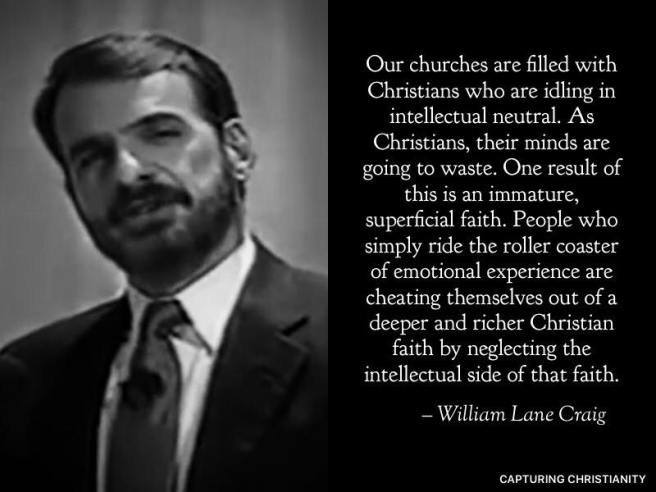
Dr. William Lane Craig says churches aren't preparing Christians to give an answer
Dr. W. L. Craig: churches don’t prepare Christians to answer skeptics

Wife candidates ought to know apologetics

So, back to my original point about how some Christian feminists responded when I said that during courtship, I ask women questions about how much preparation they have done to answer objections from atheists, like the ones answered in this book. Am I joking?

Well, I think the problem is that Christian feminists don’t understand how Christian men view marriage. Christian men are interested in marriage because they think that their marriage will be an enterprise that produces a return for God. They like the idea of having a clean, comfortable home to host debate viewings and discussions over dessert with skeptics. They like the idea of raising children who will be effective and influential. Men don’t see marriage a means of making us feel better, or having fun, or getting our peers to approve of us. We see it as a way to promote Jesus’ agenda in the world. Men are looking for a woman who think that Christianity is true, so that they will have a wife who will act like a Christian when it goes against her self-interest. Men want a wife who knows how to persuade others that Christianity is true – first the children, then others.

Is Tim Keller right to say that New York City brings the gospel to Christians?

Can New York City can teach Christians about the gospel?
Can New York City teach Christians about the gospel?

(Source)

Here is a short guest post from my friend the software engineer.

Tim Keller dusted off an old pearl of wisdom of his and re-posted it on twitter. I discovered it on Facebook as many of my friends were making fun of it. One Twitter user remarked:

I think it’s been three years since the last time you tweeted this. I predict no misunderstanding this time.

To which Keller responded:

It happens every time. Hard to understand this–unless you realize how much the city can teach us and how much we learn about Christ through common grace, other Christians, the humbling that happens here. Oh well.

I can conjure up in my mind a way for this to not be meaningless tripe. It could be that Keller has in mind the number of ways men made in the image of god remind him of god’s grace and represent an opportunity to live out the sacrifice Jesus called us to.

But I have a hard time believing it doesn’t mean something else. That Keller has in mind here that we should allow the city and its emergent values to exert undue influence over us. I have a hard time believing this because I don’t see Keller’s church actively changing the culture around them and thereby setting an example for the rest of us to follow.

I would further submit that one of the reasons Tim Keller’s church has not been successful in changing the city is that they are too busy succumbing to the social justice influences that are popular today.

Why don’t people take churches like Keller’s seriously anymore? Perhaps it’s precisely because those churches have, as Keller tweeted, allowed the city to bring them the gospel.


OK That’s it for my friend’s post. I was supposed to add two of my beefs with Tim Keller. The first one is that he’s far left on questions of origins.

Here’s an article from Creation.com. I am not a young Earth creationist, I’m an old Earth creationist. Still, my YEC software engineer friend (a different software engineer) tells me that they are the best and largest YEC site.

They say:

Timothy Keller, author of The Reason for God (see our review), recently authored a paper for the theistic evolutionary organization Biologos (see Evolutionary syncretism: a critique of Biologos) titled “Creation, Evolution, and Christian Laypeople” (read the entire paper here). In this paper, he wrestles with how to present science to Christian laypeople in such a way that evolution and the Bible seem compatible.

[…]Keller devotes several pages to showing that believing that evolution happened as a biological process does not necessarily mean that one has to embrace the “Grand Theory of Evolution” involving naturalism and social Darwinism.

The young Earth creationists are concerned that evolution is not what God described in the Bible. Old Earth creationists think it’s worse than that. Not only does evolution not agree with the Bible, it doesn’t agree with good science either. The problem with Keller is his disagreement with what mainstream science shows about the origin of life, the Cambrian explosion, molecular machines, irreducible complexity, etc.

But that’s not the only problem with Tim Keller.

Here is what he says about a statement signed by conservative Christians disagreeing with “social justice”:

A controversial statement signed by more than 9,000 evangelicals and Christian organizations deploring social justice as a dangerous concept to the Gospel, belittles Christians who talk about race and justice, says Tim Keller, founding pastor of Redeemer Presbyterian Church in New York City.

[…]The Statement on Social Justice & the Gospel was released early this month with initial signers including John MacArthur of Grace Community Church, who recently denounced evangelicalism’s “newfound obsession” with social justice.

Among other things, the statement notes that: “Specifically, we are deeply concerned that values borrowed from secular culture are currently undermining Scripture in the areas of race and ethnicity, manhood and womanhood, and human sexuality. The Bible’s teaching on each of these subjects is being challenged under the broad and somewhat nebulous rubric of concern for ‘social justice.’

If you want to know what Tim Keller really thinks about moral issues, you can read his opinion / editorial in the far-left New York Times, where he has nothing to say about the traditional teachings of the Christian worldview (voluntary charity, chastity, pro-life, natural marriage, not coveting your neighbor’s wealth, limited government, people defined by the content of their character instead of the color of their skin).

Moderate conservative Doug Wilson notes:

So get the vantage of two hundred years from now, and have a doctoral student in American history examine Keller’s op-ed piece for any reference at all to abortion, or to the fact that Planned Parenthood, subsidized by our tax dollars, sells baby parts. It is not there.

[…]So why didn’t more churches apply what the Bible requires of slave-owners two hundred years ago? The answer is that back then it would have taken courage to do so, just as it would take courage today for Keller to denounce Planned Parenthood in The New York Times.

Keller does denounce sins in this piece. But he is still being careful because the sins he denounces are safe sins to denounce—we know this because they are all the sins that the secular world routinely uses to denounce the conservative Christian world. There is the sin of not working for “better public schools,” or not working for a “justice system weighted against the poor,” or “to end racial segregation,” or failing to “lift up the poor.” It is as though we found John the Baptist chiding the Israelites for failing to see the moral imperatives contained within Herod’s economic stimulus programs.

And that’s because the readers of the New York Times, and the residents of the city of New York are pro-abortion (which is the equivalent of slavery in our modern times).  In fact, New York is pro-infanticide – they have a law that allows infanticide. And this did not deserve a mention from Tim Keller in his New York Times editorial. Perhaps he thinks that infanticide is one of the things that New York city has to teach traditional Christians about the gospel.

William Lane Craig: Christians are idling in intellectual neutral

The video is 40 minutes long.

The full transcript is available here on the Reasonable Faith web site. (H/T Think Apologetics)

Excerpt:

No one has issued a more forceful challenge to Christians to become intellectually engaged than did Charles Malik, former Lebanese ambassador to the United States, in his address at the dedication of the Billy Graham Center in Wheaton, Illinois. Malik emphasized that as Christians we face two tasks in our evangelism: saving the soul and saving the mind, that is to say, not only converting people spiritually, but converting them intellectually as well. And the Church is lagging dangerously behind with regard to this second task. Our churches are filled with people who are spiritually born again, but who still think like non-Christians. Mark his words well:

I must be frank with you: the greatest danger confronting American evangelical Christianity is the danger of anti-intellectualism. The mind in its greatest and deepest reaches is not cared for enough. But intellectual nurture cannot take place apart from profound immersion for a period of years in the history of thought and the spirit. People who are in a hurry to get out of the university and start earning money or serving the church or preaching the gospel have no idea of the infinite value of spending years of leisure conversing with the greatest minds and souls of the past, ripening and sharpening and enlarging their powers of thinking. The result is that the arena of creative thinking is vacated and abdicated to the enemy.

Malik went on to say:

It will take a different spirit altogether to overcome this great danger of anti-intellectualism. For example, I say this different spirit, so far as philosophy alone—the most important domain for thought and intellect—is concerned, must see the tremendous value of spending an entire year doing nothing but poring intensely over the Republic or the Sophist of Plato, or two years over the Metaphysics or the Ethics of Aristotle, or three years over the City of God of Augustine. But if a start is made now on a crash program in this and other domains, it will take at least a century to catch up with the Harvards and Tübingens and the Sorbonnes—and by then where will these universities be?

What Malik clearly saw is the strategic position occupied by the university in shaping Western thought and culture. Indeed, the single most important institution shaping Western society is the university. It is at the university that our future political leaders, our journalists, our lawyers, our teachers, our scientists, our business executives, our artists, will be trained. It is at the university that they will formulate or, more likely, simply absorb the worldview that will shape their lives. And since these are the opinion-makers and leaders who shape our culture, the worldview that they imbibe at the university will be the one that shapes our culture.

And:

The great Princeton theologian J. Gresham Machen warned on the eve of the Fundamentalist Controversy that if the Church loses the intellectual battle in one generation, then evangelism would become immeasurably more difficult in the next:

False ideas are the greatest obstacles to the reception of the gospel. We may preach with all the fervor of a reformer and yet succeed only in winning a straggler here and there, if we permit the whole collective thought of the nation or of the world to be controlled by ideas which, by the resistless force of logic, prevent Christianity from being regarded as anything more than a harmless delusion. Under such circumstances, what God desires us to do is to destroy the obstacle at its root.

The root of the obstacle is to be found in the university, and it is there that it must be attacked. Unfortunately, Machen’s warning went unheeded, and biblical Christianity retreated into the intellectual closets of Fundamentalism, from which it has only recently begun to re-emerge. The war is not yet lost, and it is one which we must not lose: souls of men and women hang in the balance.

This lecture is an excellent opportunity for us all to ask ourselves: what are we doing to influence the university? Do you have a plan?

Many of the strongest people who are now opposed to Christianity raised in two-parent Christian homes, and went to church for a decade before going off to the university. I’m thinking especially of people like Tim Gill, in Colorado. At university (and even increasingly in high school) they turned away from Christianity. All their peers and the adults could not answer their questions. As adults, they were able to get money, power and influence. Many of them are using it against Christ and his kingdom – kicking away the ladder that they climbed to success on. Why is this? Unfortunately, many of us are not willing to do what works – pick up the Lee Strobel books and read them. Especially “The Case for a Creator”.