Physicist Michael Strauss discusses Christianity and science at Stanford University

Christianity and the progress of science

This is one of my favorite lectures.

The lecture:

Dr. Strauss delivered this lecture at Stanford University in 1999. It is fairly easy to understand, and it even includes useful dating tips.

Here is a clip:

The full video can be watched on Vimeo:

Summary:

What does science tell us about God?
– the discoveries of Copernicus made humans less significant in the universe
– the discoveries of Darwin should that humans are an accident
– but this all pre-modern science
– what do the latest findings of science say about God?

Evidence #1: the origin of the universe
– the steady state model supports atheism, but was disproved by the latest discoveries
– the oscillating model supports atheism, but was disproved by the latest discoveries
– the big bang model supports theism, and it is supported by multiple recent discoveries
– the quantum gravity model supports atheism, but it pure theory and has never been tested or confirmed by experiment and observation

Evidence #2: the fine-tuning of physical constants for life
– there are over 100 examples of constants that must be selected within a narrow range in order for the universe to support the minimal requirements for life
– example: mass density
– example: strong nuclear force (what he studies)
– example: carbon formation

Evidence #3: the fine-tuning of our planet for habitability
– the type of galaxy and our location in it
– our solar system and our star
– our planet
– our moon

It’s a good lecture explaining a couple of basic arguments for a cosmic Creator and Designer. If you add the origin of life and the Cambrian explosion (Stephen C. Meyer’s arguments), then you will be solid on the basic scientific arguments for a Creator and Designer of the universe.

Positive arguments for Christian theism

Christian woman finds a way to discuss her faith with non-Christians

I found an interesting article where a Christian woman explains how she used to share her testimony with non-Christians. But that wasn’t working. So she decided to try something different.

She writes:

I’ll never forget the first time I shared my personal testimony with a non-Christian.

When the opportunity arose and I shared my story with an unbelieving friend, she replied, “That’s so cool. I’m so happy you found something that works for you.”

For me?

“It’s not about what works for me,” I said, trying to hide my discouragement. “It’s about what’s true for everyone.”

“That doesn’t make sense,” she responded. “That’s your experience, not mine. I had a similar revelation when I realized I could leave the church, and I’ve become a better person for my decision. Just as you were freed from your heaviest burdens by finding God, I was freed from mine by leaving God behind.”

I was devastated but I chalked it up to my friend’s hardheartedness. I decided to shake the dust off my feet and look forward to the next opportunity.

But time after time of sharing my testimony resulted in similar responses. People expressed enthusiasm that I was happy, that Christianity worked for me, and that I had “found my niche.” Yet no one considered my experience as anything more than just that—my own personal experience.

[…]I had been taught that sharing what God had done in my life was the ideal way to witness to non-Christians. A personal testimony was interesting yet non-confrontational, compelling but inoffensive. And yet, despite having shared my testimony with dozens of unbelievers, not a single person felt challenged to consider the truth claims of Christianity.

She noticed that her approach wasn’t actually in the Bible. There was a different approach being demonstrated by Jesus, and later by his disciples.

She writes:

When Jesus called his first disciples, he taught truth and provided evidence (miracles) to support his claims, then he asked people to follow him (Luke 5:1–11). In fact, this was his method whenever he went into new regions (see Luke 4:14–44; John 4:7–26). People decided to follow Jesus not on blind faith or a subjective feeling, but based on the evidence they had seen and heard.[i]

Jesus also used evidence to assuage the doubts of even those who had been with him a long time. John the Baptist was Jesus’ cousin, who leapt in the womb during Mary’s visit (Luke 1:39–45), baptized Jesus in the Jordan River, heard God’s voice from heaven, and saw the Holy Spirit descend on Jesus in bodily form like a dove (Luke 3:21–22). Yet when John experienced unexpected suffering, he began to doubt.

Jesus didn’t respond as many do today, by insisting that John “just believe” or “have faith” or “prayer harder.” Rather, he responded with more evidence, saying, “Go and tell John what you hear and see: the blind receive their sight and the lame walk, lepers are cleansed and the deaf hear, and the dead are raised up, and the poor have good news preached to them. And blessed is the one who is not offended by me.” (Matt. 11:2–6).

[…]At Pentecost, the apostle Peter offered signs and wonders, fulfilled prophecy, and relayed eyewitness testimony to persuade people from all over the Roman Empire that the most reasonable explanation for what they were seeing was not morning drunkenness, but a risen Messiah (Acts 2:1–41).

On his missionary journeys, the apostle Paul reasoned with the Jews from the Scriptures, explaining and proving that Jesus was the Messiah who needed to suffer and rise from the dead (Acts 17:1–3, 17). And he reasoned with the Gentiles from outside the Scriptures, making a case with their own accepted beliefs to convince them (Acts 17:17–34).

In fact, in describing his mission, Paul told the Philippians, “I am put here for the defense of the gospel” (1:7, 16). This word translated defense is the same word from which we get our English word “apologetics,” meaning to make reasoned arguments or to provide evidence as justification. Using this same word, Peter commanded believers to “always [be] prepared to make a defense to anyone who asks you for a reason for the hope that is in you”(1 Pet. 3:15).

So, she decided to dump the testimony approach, and try the Biblical approach. But she had to change it a little bit, since she couldn’t perform miracles herself:

We are not eyewitnesses to Jesus’s life and resurrection, but we have the accounts of those who were. We don’t typically see miracles, but we have millennia of biblical scholarship and archaeology that provide reasons to believe the accounts are trustworthy. We don’t often hear God speaking audibly or see him parting seas, but we have significant scientific evidence that shows the universe had a beginning, and millennia of observation to confirm the scientific principle that everything that begins to exist has a cause.

I think a lot of Christians never move on from approach she described that wasn’t getting results. And there’s a reason for that – studying evidence is hard work. But I can tell you from my experience as a software engineer, there is no better way to convince other people to adopt your view than to show them working code that produces results. If they have a prototype, they will adopt your design. Similarly with Christianity. If you have evidence, then you will be persuasive.

When talking about spiritual things with non-Christians, always remember the joke about the two men walking in the woods who meet a bear. One man starts to put on his running shoes. The other man says “what are you doing? you can’t outrun a bear!” And the first man says “I don’t have to. I only have to outrun you”. It’s the same with apologetics. You don’t have to be William Lane Craig to talk about your faith to non-Christians. You just have to know more than your non-Christian opponent knows about evidence.

The way things are going these days with the public schools and the mainstream news media, this is actually pretty easy to do. One or two introductory books on the origin of the universe, the fine-tuning for intelligent life, the origin of biological information, the origin of body plans, the historical reliability of the New Testament, the minimal facts case for the resurrection, etc. will do the job. You might need another one on philosophical challenges like evil, suffering, divine hiddenness, etc. But we’re talking no more than 5 books, and you’ll be effective in the vast majority of your conversations. If you can only get one book, I like Sean McDowell and Jonathan Morrow’s “Is God Just a Human Invention?” best.

Tad Hopp accumulated $100,000 of college debt, now he wants a taxpayer bailout

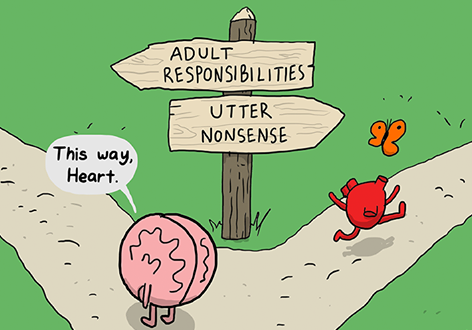
Brain vs Heart, from: theawkwardyeti.com

Here’s an interesting editorial from a “Christian” left blog. (H/T Acton Institute)

The author, Tad Hopp is graduating a PCUSA seminary – an extremely liberal, left-wing denomination.

He writes:

I graduated college in 2007.

[…] I majored in English, not exactly what most people consider a ‘marketable’ or ‘practical’ degree…

[…]I went to a somewhat expensive private school…

[…]I did what many students in their last year of high school do: I went to the school where I felt I was being called…

[…]I do not regret my four years at my undergraduate institution one bit.

[….]When I graduated college, I owed nearly $50,000 in student loan debt and was unemployed for almost six months before I finally found a low-paying office job.

[…]“Can’t find a job? Well, you should have majored in something more ‘practical’, like economics or business or medicine.” Yeah, that would be great…if those were the subjects where my skills and passions lie. They’re not.

[…]I felt called to go to seminary.

[…]I will graduate seminary with close to six figures worth of student loan debt.

Let’s take stock of what he’s said so far:

  • he studied English, a language that he already spoke, which has one of the lowest employment rates
  • he was warned by people who knew something about earning and saving money not to study English
  • he went to a school he couldn’t afford to go to, and he graduated with $50,000 in debt
  • he went to seminary, another subject that doesn’t pay, and added another $50,000 or so of debt
  • he says that he doesn’t have to study subjects that lead to a career because he isn’t “passionate” about them
  • he “followed his heart” by going to the school that he had mystical, emotional, intuitions about = “calling”

My advice to Tad at this point would be for him to take the Bible seriously when it says this:

2 Thessalonians 3:10:

10 For even when we were with you, we used to give you this order: if anyone is not willing to work, then he is not to eat, either.

And 1 Timothy 5:8:

8 But if anyone does not provide for his own, and especially for those of his household, he has denied the faith and is worse than an unbeliever.

The Bible is giving us the goal of working. So what should we do to be able to reach that goal? Why should anyone hire us? What is working really about? It’s those kinds of questions that should guide what we study in school, and what jobs we pursue.

We know what careers have the highest starting salaries and mid-career salaries:

Starting and Mid-Career salaries by profession (click for larger image)

(Source)

Why do some people get paid more than others? The answer is supply and demand. Prices are a way of determining what is most valued by your fellow man. Business owners pay more to people who offer their customers more value. If you really want to serve your neighbor, you have to learn something they really want, but can’t easily obtain. And then you will be paid more. You can’t do what makes you happy. You have to do what makes customers happy. That’s how the free market works – you make money when you provide something of value to others. You make money when you serve others. This is something that is very hard for self-centered, feelings-driven young progressives to grasp. But it’s something older Americans all know.

More Tad:

Is the PCUSA doing anything to address this crisis?

[…]What has our government done to address this issue?

[…]I, like so many in my generation, voted for Obama…

[…]It seems to me that we’ve bought into the lie that student loan debt is brought on by the individual person…

[…]You know what I think might stimulate the economy? Automatically cancelling every single outstanding student loan!

He insists that the results of his own choices aren’t his fault. But didn’t he make the choices about what to study? Didn’t he make the choice to follow his heart? Didn’t he disregard the advice of people who urged him to be practical? Who is to blame, if not he, himself?

Tad needs to push away all his friends who told him to “follow his heart” and stick close by his friends who told him to focus on providing value to others. Don’t look for advice from dreamers, look for advice from doers. Dreamers talk. But doers have demonstrated the ability to create plans that work to achieve results.

By the way, some of you might be wondering how serious this person was about his Christianity. Well, in another post, he comes out as gay. So clearly the Bible is being interpreted in a way where feelings are overturning the plain meanings of words. People who read the Bible closely never come away with the message that they should follow their hearts.