
Dennis Prager debates Howard Zinn on American exceptionalism

First, a little bit about Howard Zinn from Roger Kimball, writing in National Review.

Excerpt:

Zinn’s biography tells us that he was the author of “more than 20 books.” But only one matters: A People’s History of the United States. Published in 1980 with appropriately modest expectations — it had, I read somewhere, an initial print run of only 5,000 copies — the book went on to sell some 2 million and is still going strong. Its Amazon sales rank as of February 1, 2010, was 7. Seven.

[…]A People’s History is the textbook of choice in high schools and colleges across the country. No other account of our past comes even close in influence or ubiquity. No other, more responsible, telling of the American story had a chance. How could it? Given a choice between a book that portrayed America honestly — as an extraordinary success story — and a book that portrayed the history of America as a litany of depredations and failures, which do you suppose your average graduate of a teachers college, your average member of the National Education Association, would choose? To ask the question is to answer it. What this means is that most American students are battened on a story of their country in which Blame America First is a cardinal principle. No element of our heritage, from the derring-do of Christopher Columbus to the valor of the U.S. military in World War II, escapes the perverting alchemy of Howard Zinn’s exercise in deflationary revision.

How does Zinn defend his anti-American views against Jewish scholar Dennis Prager?

Part 1:

Part 2:

Part 3:

Part 4:

I remember hearing this live and wondering what has gone wrong with American education that a buffoon like this could write a textbook that would be the most popular history textbook used in American public schools. We need to have school choice and to avoid paying for any school other than the one we send our children to. It makes no sense to purchase education differently than the way we purchase anything else. On Amazon.com, you get what you want or your money back. Why is education different?

If you can’t see the videos and just want to read some of the debate, you can look here and here.
How Obama’s new 2011 budget fails the poorest children in two ways

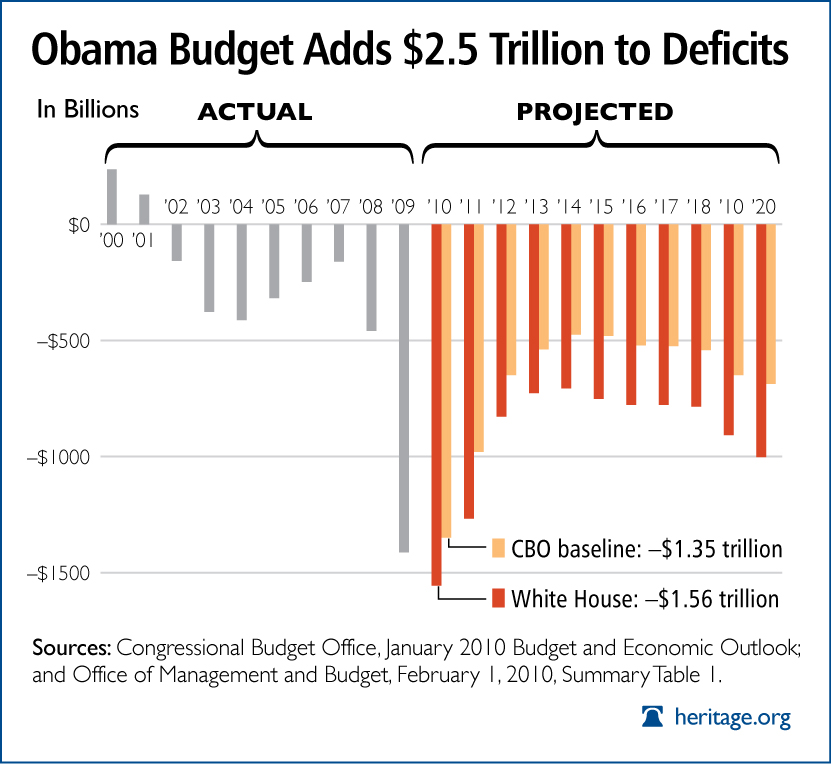
First of all, Obama’s budget ensures that future generations will be saddled with debt, paying for the entitlement programs (Social Security and Medicare) of their aging parents and grandparents.

Behold, the evidence of generational theft:

(Click for larger image)

Recall that the Democrats gained control of Congress at the beginning of 2007.

The second way that Obama’s budget hurts the poorest children is by denying them the right to access better schools.

Excerpt:

The president’s proposed FY2011 budget increases funding to the Department of Education by $3.5 billion. But despite this significant increase, his budget effectively cuts the freedom of choice and educational opportunities from the lives of children living in the District of Columbia. What began last year as a low-profile attempt to quietly phase out the D.C. Opportunity Scholarship Program has become a noticeable agenda of denying school choice to District families.

[…]The most recent casualty in the struggle to save the successful voucher program’s future is Holy Redeemer Catholic School. The Pre-K through 8th grade school, which has served the community of Northwest Washington, D.C. since 1955, is closing its doors. The Washington, D.C. Archdiocese’s decision to close or combine four Catholic schools in the area speaks to the difficult situation face by Catholic schools in general and the important role voucher programs play in the schools’ ability to provide a high quality, private school education.

This is in spite of the fact that school choice works.

Excerpt:

A recent report from School Choice Wisconsin presented an analysis of the number of calls made to 911 from schools in Milwaukee, similar to a Heritage analysis from last summer written up in The Washington Post. The Milwaukee School Safety report found that choice schools appeared to be relatively safer than Milwaukee’s traditional public schools:

Taking into account enrollment differences, police calls to [Milwaukee public schools] occur at a notably higher rate than at independent charter schools or at schools in the [Milwaukee parental choice program]. The [Milwaukee Public School] call rate per pupil in 2007 is more than three times that at schools in the [Milwaukee Parental Choice Program].

In addition, a new report out this week from Dr. John Robert Warren of the University of Minnesota analyzed the graduation rates of students attending high schools in Milwaukee, comparing the graduation rate of students participating in the school voucher program with the graduation rate of students who attend traditional public schools in the city. Warren found that during the 2007-08 school year, 77 percent of students in the school voucher program graduated compared to 65 percent in the traditional Milwaukee public school system.

Obama is in the pocket of the teacher unions, and he must ensure that they keep their jobs regardless of failure, so that the teacher unions can continue to contribute union dues into Democrat coffers. He doesn’t care about children – he cares about getting elected. It’s just another way that the irresponsible grown-ups attack the things that children need to succeed: a good education, low taxes, a job, and an intact family.

J.P. Moreland asks: does truth matter when choosing a religion?

This lecture contains Moreland’s famous “Wonmug” illustration. Ah, memories!

The MP3 file is here.

Topics:

  • Is it intolerant to think that one religion is true?
  • Is it more important to be loving and accepting of people regardless of worldview?
  • How should Christians approach the question of religious pluralism?
  • How does a person choose a religion anyway?
  • Who is Wonmug, and would you like to be like Wonmug?
  • Is it enough that a belief “works for you”, or do you want to believe the truth?
  • Can all the religions in the world be true?
  • Is it wise to pick and choose what you like from all the different religions?
  • Is it possible to investigate which religion is true? How?
  • Which religions are testable for being true or false?
  • How you can test Christianity historically (very brief)

If you don’t know about Wonmug, you’re not even a Christian, (I’m pretty sure). Just kidding. Maybe.

Seriously, this is the most fun lecture to listen to, you should listen to it, if you like fun.