
Do children do better when raised by married fathers?

A study from the Heritage Foundation explains the roles that married fathers play in raising children.

Excerpt:

As Father’s Day 2011 approaches, it’s a good time to reconsider the evidence as to why. Decades of academic research show that the father’s role in the family has a powerful and long-term impact on the future of the next generation.

In terms of economic well-being, children who grow up in homes where both parents are present are 82 percent less likely to live in poverty. Intact families tend to fare better in a wide range of economic measures; on average they have a higher net worth, higher income, more household assets, and greater savings.

A father’s role goes far beyond that of breadwinner, however, influencing his children’s well-being, behavior, and futures, which can have a profound impact on the health of civil society. Married fathers especially can have life-long influences on their children.

Youths growing up with both a mother and father in the home are less likely to engage in high-risk behavior. They are also less likely to become sexually active or to give birth in high school or outside of marriage. In addition, with both a mom and a dad in the home, adolescents are less likely to be involved with substance abuse such as drug and alcohol use and binge drinking.

The two-parent family, likewise, provides a safeguard against delinquent and anti-social behavior. On average, youths living with both parents are less likely to engage in violent behavior, commit a property crime, or be incarcerated.

In addition, teens with both moms and dads at home tend to fare better on a range of emotional and psychological outcomes: They tend to experience better emotional health and have higher levels of self-esteem and social competence, and they are less likely to experience psychological distress and anxiety.

Given all of the above, it is not surprising that children raised by married fathers tend to have greater academic achievement and higher levels of educational attainment, and they tend to score higher in math and reading in even the earliest grades.

And fathers’ impact goes beyond the effects of family structure. Dads’ involvement and relationship with their children is associated with greater psychological well-being, lower levels of behavioral problems, greater educational attainment, and a decrease in the likelihood of teen substance use.

I removed all the links to their sources, you have to click through to their site for the linked research.
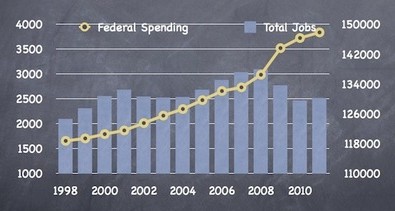
Obama spent $80 billion dollars on green jobs so where are the jobs?

Government Spending Vs Jobs

From left-wing Politico, an evaluation of Barack Obama’s green jobs stimulus spending.

Excerpt:

President Barack Obama heads to an energy plant in North Carolina on Monday to talk once again about the job-creating power of a green economy.

The catch? Nearly three years into Obama’s presidency, the White House can’t point to much solid evidence that significant numbers of Americans are scoring the green jobs the president has been touting.

Monthly Labor Department employment reports say nothing about the new clean energy workforce, while an effort to document how many Americans actually make a living in the “green collar” field may not be done by November 2012.

Obama’s Council of Economic Advisers suggests 225,000 clean energy jobs were either created or preserved through the third quarter of 2010 thanks to more than $80 billion in the economic stimulus package. But those are estimates at best.

White House officials say asking about the connection between the 9.1 percent unemployment rate and the administration’s concerted green jobs campaign is the wrong question.

And we should not have tried this, because Spain tried spending money on green jobs and it raised unemployment.

Excerpt:

Pajamas Media has received a leaked internal assessment produced by Spain’s Zapatero administration. The assessment confirms the key charges previously made by non-governmental Spanish experts in a damning report exposing the catastrophic economic failure of Spain’s “green economy” initiatives.

[…]Unsurprisingly for a governmental take on a flagship program, the report takes pains to minimize the extent of the economic harm. Yet despite the soft-pedaling, the document reveals exactly why electricity rates “necessarily skyrocketed” in Spain, as did the public debt needed to underwrite the disaster. This internal assessment preceded the Zapatero administration’s recent acknowledgement that the “green economy” stunt must be abandoned, lest the experiment risk Spain becoming Greece.

The government report does not expressly confirm the highest-profile finding of the non-governmental report: that Spain’s “green economy” program cost the country 2.2 jobs for every job “created” by the state. However, the figures published in the government document indicate they arrived at a job-loss number even worse than the 2.2 figure from the independent study.

Green jobs programs don’t work. They haven’t worked anywhere.

Does Obama look around the world and evaluate what policies work and what policies don’t work? Or does he just decide how to spend private sector money based on what makes him feel good, and what makes him look good? Is that what being President is about? Wasting tons of taxpayer money and bankrupting the country so that you can feel good about yourself because people think you are doing something good?

Lee Strobel interviews Brian Auten (Apologetics 315) on the state of apologetics

Brian Auten of Apologetics 315

From Bible Gateway, an interview by Lee Strobel featuring Brian Auten, webmaster of Apologetics 315.

Intro:

As creator of the best website for resources to defend Christianity, Brian Auten offers a unique perspective on the current apologetics scene—the good, the bad, and the hopeful.

Apologetics 315 features a terrific compilation of material for Christians to equip themselves to better define and defend the faith. It’s full of links to resources dealing with every imaginable area of apologetics. As a regular reader of the site, I became curious what its creator, Brian Auten, thinks about the current state of apologetics around the world—and he was willing to share his insights by answering a few questions.

Excerpt:

• What trends do you see in apologetics?

Consider books like The DaVinci Code, writings by agnostic professor Bart Ehrman, or the various publications of the so-called New Atheists. All these attacks on Christianity have generated a lot of buzz. However, each of these attacks has been met with a strong counter-response from scholars, theologians, and apologists. Christianity hasn’t been defeated. Instead, it has weathered storm after storm. In the meantime, the resources available that answer these challenges have increased dramatically. Over and over again, what has been intended to bring Christianity down has only served to strengthen it.

But the tendency is this: too many times Christians are only responding to the challenges. That seems to be the trend. Why are we not running to the battle? Instead of just reacting to the next challenge, I long for the day when more and more Christians would equip themselves with this vast armory of resources and use it to take the battle to the enemy’s camp, so to speak. Apologetic-savvy educators, scientists, public officials, businessmen, actors, novelists, movie-makers—all people with a heart of evangelism who are able to defend and contend for the faith in the public square could have an immense impact for the Gospel.

And more:

• You’re passionate about churches starting apologetics ministries. Are you seeing more of them doing this?

I want to see churches start their own apologetics ministries because it is our scriptural mandate to “always be prepared to give an answer.” Yet there often is very little preparation going on! When challenges to faith come, people struggle to find substantive answers. This may cause some believers to resort to a sort of “believe it anyway” mentality; for others it causes them to abandon the faith altogether.

Research by the Barna Group has shown that a majority of young people walk away from the faith around the time they go to college or university. They simply have not been equipped to deal with the secular challenges that come against their faith when they go to college. But what if they had been properly equipped to understand and answer these sorts of challenges? They would not only be able to stand up under the attacks, but they would also be able to share Christ with more confidence, knowing that they have good reasons undergirding their faith.

So I think it’s so crucial that our churches become training grounds where believers learn why they believe what they believe. Apologetics ministries and small group studies provide a venue for discipleship where people can work through the tough questions that they constantly face from the secular world. And what’s more, our faith is enriched to even deeper levels when we experience the joy of loving God with our minds.

Thankfully, I think we are seeing a rise in the number of churches that both see this need and are beginning to equip their congregations through apologetic teaching, small groups, conferences, and resources.

Read the whole thing. Tweet it, share it. Think about it!

There’s a great list of scholars and ministries in there as well. If you guys want to know what you should be reading to prepare your defense of theism and Christianity, leave a comment with your intended audience, and I will suggest some resources. I may even BUY YOU the resource, if you are a budding apologist who is conservative on economics and politics and foreign policy. Yes, I do that a lot on this blog – mailed out a dozen books this month already to people. Get to know me, I can help you to defend your faith.