Christians embracing premarital sex, despite increased risk of divorce

I’ve posted before about how premarital sex wrecks the stability of marriages by making divorce more likely. And I wanted to begin this post by showing that this is not a controversial point in the research.

Here another good study on relationship tempo and relationship quality.

Abstract:

Rapid sexual involvement may have adverse long-term implications for relationship quality. This study examined the tempo of sexual intimacy and subsequent relationship quality in a sample of married and cohabiting men and women. Data come from the Marital and Relationship Survey, which provides information on nearly 600 low- to moderate-income couples living with minor children. Over one third of respondents became sexually involved within the first month of the relationship. Bivariate results suggested that delaying sexual involvement was associated with higher relationship quality across several dimensions. The multivariate results indicated that the speed of entry into sexual relationships was negatively associated with marital quality, but only among women. The association between relationship tempo and relationship quality was largely driven by cohabitation. Cohabiting may result in poorer quality relationship because rapid sexual involvement early in the romantic relationship is associated with entrance into shared living.

The authors are from Cornell University and University of Wisconsin – Madison. Hardly bastions of conservatism! This is not complicated, this is black and white.

Here’s another recent study that shows that if a woman has more than her husband as a premarital sex partner, her risk of divorce increases.

His findings:

Using nationally representative data from the 1995 National Survey of Family Growth, I estimate the association between intimate premarital relationships (premarital sex and premarital cohabitation) and subsequent marital dissolution. I extend previous research by considering relationship histories pertaining to both premarital sex and premarital cohabitation. I find that premarital sex or premarital cohabitation that is limited to a woman’s husband is not associated with an elevated risk of marital disruption. However, women who have more than one intimate premarital relationship have an increased risk of marital dissolution.

Here’s another study that makes it even more clear.

Findings:

Data from the 1988 US National Survey of Family Growth (NSFG) were utilized to assess the impact of premarital sexual activity on subsequent marital stability. Among white NSFG subjects first married in 1965-85, virgin brides were significantly less to have become separated or divorced (25%) than women who had not been virgins at marriage (35%).

[…]The lower risk of divorce on the part of white women with no premarital sexual experience persisted even after numerous intervening and background variables were controlled.

This study supports what the Bible says about chastity and premarital sex:

1 Cor. 7:8-9:

8 To the unmarried and the widows I say that it is good for them to stay single as I am.

9 But if they cannot exercise self-control, they should marry. For it is better to marry than to burn with passion.

The idea of “burning” here has to do with sexual desire. Here Paul tells all unmarried people that if they cannot control their sexual desires, they need to get married. Why? Because Paul assumes that one cannot fulfill this sexual desire outside of the marital bed. While Paul would love for them to remain single (1 Cor. 7:7), he believes that sex outside of marriage is a destructive sin and cannot be used as a gratifying release of our sexual passions.

Now despite studies supporting the Biblical prohibition on premarital sex, Christians are actually embracing it. Why is that? Well, church pastors are very, very set in the idea that the Bible is assumed to be inerrant in church, and they feel that supporting what the Bible says with actual evidence is “putting evidence at the same level as the Bible”. That’s their approach – don’t confirm the Bible with evidence, just tell people to assume that the Bible is true, and tell them to believe it, in the face of mounting culture pressure, secular policies and a resurgence of atheism. 

Take a look at this review by a pious pastor of a recent apologetics book, if you don’t believe me.

Excerpt:

Cold-Case Christianity places far too much emphasis on the role of extrabiblical sources. No doubt there is a legitimate role for biblical archaeology and extrabiblical writing from antiquity. Christianity is, after all, a faith firmly rooted in human history. But there is a grave danger when truth is suspended because of an apparent lack of corroboration from extrabiblical sources. And Wallace, I’m afraid, wanders too close to this dark side of apologetics.

All of chapter 12, for instance, is devoted to proving the Gospels have external corroborative evidence—“evidence that are independent of the Gospel documents yet verify the claims of the text” (183). Wallace then addresses the historicity of the pool of Bethesda and makes another worrying statement: “For many years, there was no evidence for such a place outside of John’s Gospel. Because Christianity makes historical claims, archaeology ought to be a tool we can use to see if these claims are, in fact, true” (201-202, emphasis added).

In other words, Wallace seems to suggest we cannot affirm the truth of the Gospel accounts without the stamp of approval from archaeology and other extrabiblical sources. Such reasoning is dangerous, not least because it cannot affirm the inerrancy of the Bible. But also, it places the final court of appeal in the realm of extrabiblical sources rather than of God’s all-sufficient, all-powerful Word.

So does the approach of Bible-thumping church pastors work? Are young people really convinced by proclamations and assertions, piously expressed?

Majority of Christians embrace premarital sex

Consider this article that Dina tweeted from the Christian Post.

Excerpt:

[A] new Christian Mingle study suggests that it is increasingly commonplace for Christians to sleep together outside of a marital context.

In a survey of 716 Christians released in January, only 11 percent said they save sex exclusively for marriage. Instead, 60 percent said they would be willing to have sex without any strings attached, while 23 percent said they would have to be “in love.” Five percent said they would wait to get engaged.

This data supports a 2011 Relevant Magazine poll that revealed that 80 percent of “young, unmarried Christians have had sex” and that “two-thirds have been sexually active in the last year.”

While the findings of a 2012 National Association of Evangelicals (NAE) and Grey Matter Research poll did not show outcomes as high as the two previous polls, according to its research, 44 percent of unmarried evangelicals between ages 18-29 said that they had sex, including 25 percent who said they had had sex in the last three months.

You know, if just invoking the Bible piously, and asserting that it’s without error, were enough, then that’s what you’d see people like William Lane Craig doing in debates at the top universities when he faces off against atheists. But he doesn’t do that. Dr. Craig appeals to evidence outside the Bible in order to explain why the Bible ought to be respected when we make our decisions. There is no such thing as pious fideism when you are in front of a crowd of students at a major secular university. And young people, no matter how “nice” they behave in church, are not going to behave like Christians outside of church – especially when they get to an alcohol-soaked, sex-saturated university campus. They need reasons and evidence to support the claims they read in the Bible before they get challenged.

We need to train pastors who understand how to construct an argument and how to support arguments with evidence. Because when the kids get to college, they are going to face a tsunami of propaganda from the pro-sexual-immmorality crowd. (WARNING: that link describes what happens during “Sex Week” on college campuses. Reader discretion is advised!) They need to be able to explain their views using something other than praise songs and Bible verse memorization, or they are going to fall away under peer pressure and shaming by secular leftist professors. And they need to have that information BEFORE they make the decisions that ruin their ability to commit.

By the way, another great book on the topic of premarital sex is “Hooked: New Science on How Casual Sex is Affecting Our Children” by Joe S. McIlhaney Jr., M.D. and Freda McKissic Bush, M.D. Again – look at the research and be persuaded, and be persuasive with others. Don’t be like these pastors who think that praise hymns and charismatic preaching are enough to make young people do the right thing, because it’s not working. It’s not working.
Conservative Party of Canada on track to deliver budget surplus in 2015

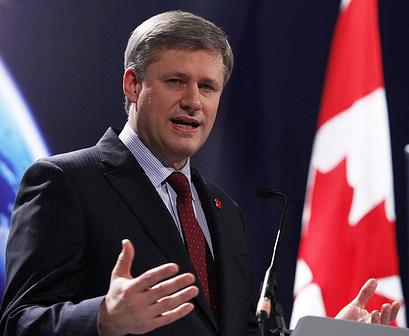
Prime Minister Stephen Harper
Prime Minister Stephen Harper (Conservative Party)

Story from Yahoo News about the results delivered by the Conservative Party of Canada.

Note: To understand the numbers in the article, simply multiple the numbers by 10 to compare with American numbers – Canada’s economy is about 1/10 the size of ours. For example, our GDP is $15.7 trillion and theirs is $1.8 trillion. Our national debt is $17 trillion, while their’s is $1.2 trillion.

Excerpt:

Canada’s Conservative government looks set to comfortably balance its books in 2015 or even sooner, its latest budget showed on Tuesday, with cuts in spending on the public service more than offsetting a series of modest new expenditures.

The low-key spending plan leaves Prime Minister Stephen Harper well-positioned to offer tax breaks and other initiatives in the runup to an election scheduled for October next year.

“Some people will say this budget is boring,” Finance Minister Jim Flaherty told reporters ahead of the budget speech. “Boring is good.”

The budget shows a deficit of C$2.9 billion ($2.63 billion)in the 2014-15 fiscal year, up from the previous estimate of C$5.5 billion. That balance includes a C$3 billion contingency fund, which in fact reveals an underlying surplus that year.

Flaherty acknowledged the budget would be narrowly balanced this coming year without the contingency fund, but said he preferred to have a “nice clean surplus next year”.

The government estimates a bigger-than-expected C$6.4 billion surplus in 2015-16. In the year ending March 31 of this year, the deficit is pegged at C$16.6 billion.

[…]Flaherty, who is 64 and battling a rare skin disease, has staked his reputation on eliminating Canada’ small deficit, equivalent to about 1 percent of gross domestic product (GDP), and restoring the reputation the country had before the global financial crisis as having the strongest fiscal record in the Group of Seven major economies.

Germany is currently the only G7 country running a surplus, but Canada’s ratio of debt to GDP is substantially less and it is one of a handful of countries with a triple-A rating from rating agencies.

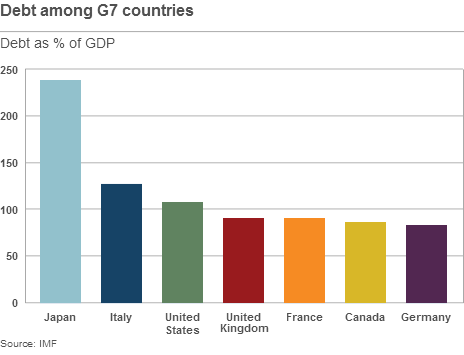
Canada is beating us in debt to GDP:

G7 Debt to GDP as of 2013
G7 % Debt to GDP as of 2012 (lower is better)

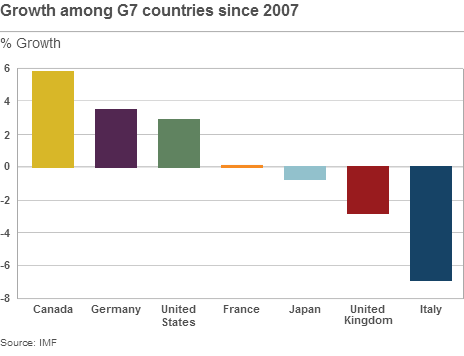
Canada is beating us in economic growth:

G7 GDP growth for 2013
G7 % GDP growth from 2007 to 2012 (higher is better)

Source: BBC Business

The next Canadian election is in 2015. I know that the Liberal Party is currently leading in the polls, but I found some good news. The Canadians just redistricted after their census, and there are 30 new electoral districts. If the same turnout occurs in 2015 which occurred in the 2011 election, then the Conservative Party of Canada would get 22 out of 30 of those new seats. However, I am concerned. I want Harper to keep his majority, as he and Tony Abbott (Australia) are two bright conservative stars who show people what conservatives can do. 

Upcoming Greer-Heard forum on cosmology, featuring Sean Carroll and William Lane Craig

(Video: William Lane Craig debates the fine-tuning argument with Duke University philosopher Alex Rosenberg)

Christian Post reports on what promises to be one of the best debates in William Lane Craig’s career.

Excerpt:

The debate over God’s existence heats up next week as leading physicist and atheist Sean Carroll is pitted against William Lane Craig, a top theologian and philosopher, to discuss their views about philosophy, cosmology, and the role of God and the cosmos.

The two experts will debate on Feb. 21 under the theme “God and Cosmology: The Existence of God in Light of Modern Cosmology.” Organizers announced Wednesday that the event will be held at New Orleans Baptist Theological Seminary as part of a Greer-Heard Point-Counterpoint Forum in Faith and Culture Weekend Conference. Modern cosmology is dominated by the Big Bang theory, which attempts to bring together observational astronomy and particle physics.

“Though Carroll is as fiercely anti-theistic as other cosmologists I have debated, he differs in being philosophically informed and civil in demeanor,” Craig wrote in a statement about the event.

Craig is a philosopher, professor, author and founder of ReasonableFaith.org, a web-based ministry “whose purpose is to provide, in the public arena, an intelligent and articulate perspective about the existence of God.” He has debated some of the most notable atheists, including the late Christopher Hitchens, Richard Dawkins, and, most recently, Lawrence Krauss. Some 250,000 people have watched the Craig-Krauss dialogues since they took place last August in Australia.

Over the years, Craig has developed “Eight Reasons for God.” These form his case for theism, showing that God is the best explanation for why anything exists at all; the origin of the universe; the application of mathematics to the physical world; the fine-tuning of the universe for intelligent life; intentional states of consciousness in the world; objective moral values and duties in the world; the historical facts concerning Jesus’ resurrection; and personal experience of God.

Sean Carroll is a physicist at the California Institute of Technology. His research focuses on theoretical physics and cosmology, especially the origin and constituents of the universe. He has contributed to models of interaction between dark matter, dark energy, and ordinary matter; alternative theories of gravity; and violations of fundamental symmetries. He has appeared on TV shows including “The Colbert Report” and Through the Wormhole with Morgan Freeman, and frequently serves as a science consultant for film and television. He is the author of several books including the upcoming The Particle at the End of the Universe.

Each has selected two commentators to round out the discussion, philosophers Tim Maudlin and Alex Rosenberg on Carroll’s tag team and philosopher Robin Collins and physicist James Sinclair on Craig’s. A follow-up discussion is planned for that Saturday.

“I selected the physicist James Sinclair, with whom I co-authored the article on the kalam cosmological argument in the Blackwell Companion to Natural Theology, and Robin Collins, who is writing what will be the definitive book on the fine-tuning of the universe,” said Craig. “Carroll and I will be afforded the opportunity to give brief responses to each of their papers.

“There will also be opportunity for audience interaction with all the participants. Not only will the entire proceedings be video-recorded, but the transcript of the debate, papers, and responses will be published by Fortress Press. So this promises to be a very substantive and important engagement. It will also be live-streamed on the Internet, so you can join in if you’d like.”

The post includes a link to the live stream, which is provided by Tactical Faith.

Dr. Carroll’s blog post about the debate

Dr. Carroll posted about this upcoming debate on his blog, and it seems like he is is going to be a fine opponent for Dr. Craig.

Excerpt: (links removed)

Next month I’ll be doing something related, although under quite different circumstances. On February 21 I’ll be debating William Lane Craig at the Greer-Heard Forum, an event sponsored by the New Orleans Baptist Theological Seminary. It will actually be a two-day event; a debate between Craig and me on Friday night, and follow-ups on Saturday from other speakers — Tim Maudlin and Alex Rosenberg for Team Naturalism, Robin Collins and James Sinclair for Team Theism.

[…]William Lane Craig (or WLC as we call him in the business) is of course a very well-known figure, largely for his many public debates, on theism/atheism as well as on various other specific theological issues. As far as debating goes: he’s very good at it! If his debates were being judged by a panel of experts as in an intercollegiate debate tournament, he would have a very good record indeed. This has led many people to conclude that atheists just shouldn’t debate him at all, or at least not until they have devoted 10,000 hours to learning how to be a good debater.

Daniel Dennett warned me that, as soon as word got out that I would be debating WLC, I would be deluged with opinions and unsolicited advice. Which is great! Always happy to hear other perspectives, although I don’t promise to actually follow any of the advice. I won’t reproduce the various emails I’ve received, but here are a few very different perspectives online: Jerry Coyne, Luke Barnes (and another), and Wintery Knight. (WK is relatively restrained, but others predict “pummelings,” presumably for me.)

Dr. Carroll explained his goals for the event:

Just so we’re clear: my goal here is not to win the debate. It is to say things that are true and understandable, and establish a reasonable case for naturalism, especially focusing on issues related to cosmology. I will prepare, of course, but I’m not going to watch hours of previous debates, nor buy a small library of books so that I may anticipate all of WLC’s possible responses to my arguments. I have a day job, and frankly I’d rather spend my time thinking about quantum cosmology than about the cosmological argument for God’s existence. If this event were the Final Contest to Establish the One True Worldview, I might drop everything to focus on it. But it’s not; it’s an opportunity to make my point of view a little clearer to a group of people who don’t already agree with me.

Recently, Dr. Carroll debated Christian philosopher Hans Halvorson, who is a professor at Princeton University, and Hugh Ross was in attendance. In a podcast, Dr. Ross said that Carroll was a gentleman, and it was a good debate, although he wanted Halvorson to disagree with Carroll more. (You can watch the “debate” here, although it really wasn’t a debate because Halvorson didn’t engage Carroll for the most part). Reasons to Believe has since pulled the podcast. However, I was able to find it, (I am a software engineer!), and I’ve posted it here. I have no idea why they pulled it, because it was a good review. If you want a good introduction to the issues they’ll be debating from a particle physicist, check out this recent lecture by Dr. Michael Strauss.

The two duelists choose their seconds

My understanding is that Dr. Carroll has already made one mistake. He selected Alex Rosenberg (see video above) as a respondent. Dr. Rosenberg is not a good spokesman for naturalism, and in his debate with Dr. Craig, he did very poorly. A better wingman would have been someone like Graham Oppy or Quentin Smith. Dr. Carroll’s other choice (Tim Maudlin) looks solid, though.

On Dr. Craig’s side, he’s chosen Robin Collins and James Sinclair. Collins recently had a chapter in “Debating Christian Theism” (Oxford University Press, 2013) and Collins and Sinclair both had chapters in “The Blackwell Companion to Natural Theology” (Wiley-Blackwell, 2009). Collins is an engaging public speaker, and I featured a lecture by him on the fine-tuning argument in this post.

Please pray that God would reach out to Dr. Carroll and for other non-theists listening to the debate so they can see that there are good reasons for them to rethink their views about God.

Dr. Luke Barnes previews the debate

If you would like to read some comments from an accomplished cosmologist, check out these posts (post one, post two, post three, post four) on Dr. Luke Barnes’ Letters to Nature blog. You might remember him because I wrote about his paper critical of atheist physicist Victor Stenger in this blog post. Note that Barnes’ paper has now been published in a peer-reviewed journal. The journal is published by Cambridge University.