Survey of scientific literature finds that children need their mom for first 3 years

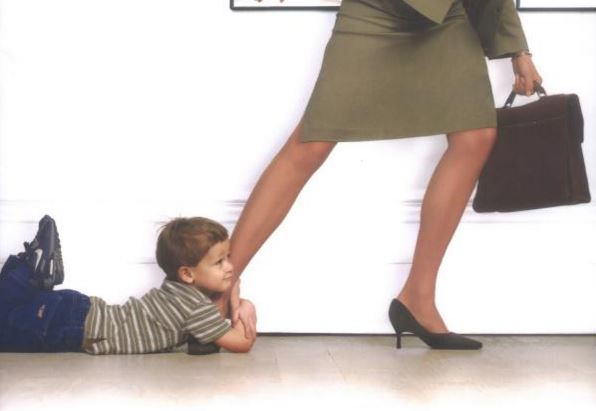
Child grabs for his mom, who is leaving for work

Recently, an article published in the Wall Street Journal reported on research survey done why a far-left Democrat psychotherapist based in far-left New York City. Surprisingly, her book caused an uproar among the author’s left-wing allies. How come?

Excerpt:

Motherhood used to be as American as apple pie. Nowadays it can be as antagonistic as American politics. Ask Erica Komisar.

Ms. Komisar, 53, is a Jewish psychoanalyst who lives and practices on the Upper West Side of Manhattan. If that biographical thumbnail leads you to stereotype her as a political liberal, you’re right. But she tells me she has become “a bit of a pariah” on the left because of the book she published this year, “Being There: Why Prioritizing Motherhood in the First Three Years Matters.”

[…]The premise of Ms. Komisar’s book—backed by research in psychology, neuroscience and epigenetics—is that “mothers are biologically necessary for babies,” and not only for the obvious reasons of pregnancy and birth. “Babies are much more neurologically fragile than we’ve ever understood,” Ms. Komisar says. She cites the view of one neuroscientist, Nim Tottenham of Columbia University, “that babies are born without a central nervous system” and “mothers are the central nervous system to babies,” especially for the first nine months after birth.

What does that mean? “Every time a mother comforts a baby in distress, she’s actually regulating that baby’s emotions from the outside in. After three years, the baby internalizes that ability to regulate their emotions, but not until then.” For that reason, mothers “need to be there as much as possible, both physically and emotionally, for children in the first 1,000 days.”

What’s interesting about this is how the left responds to the science. You might have heard that the left is very fond of science, but veterans of debates about God’s existence know that people on the left tend to be hostile to science that goes against their view: the Big Bang cosmology, cosmic fine-tuning, biological information, irreducible complexity, molecular machines, habitability, etc. And early childhood education is no exception.

More:

Christian radio stations “interviewed me and loved me,” she says. She went on “Fox & Friends,” and “the host was like, your book is the best thing since the invention of the refrigerator.” But “I couldn’t get on NPR,” and “I was rejected wholesale—particularly in New York—by the liberal press.” She did appear on ABC’s “Good Morning America,” but seconds before the camera went live, she says, the interviewer told her: “I don’t believe in the premise of your book at all. I don’t like your book.”

[…]Ms. Komisar tells of hosting a charity gathering for millennials at her apartment. One young woman “asked me what my book was about. I told her, and she got so angry. She almost had fire coming out of her eyes, she was so angry at my message. She said, ‘You are going to set women back 50 years.’ I said, ‘Gosh, I wouldn’t want to do that.’ ”

[…]The needs of children get lost in all this—and Ms. Komisar hears repeatedly that the hostility to her message is born of guilt. When she was shopping for a literary agent, she tells me, “a number of the agents said, ‘No, we couldn’t touch that. That would make women feel guilty.’ ” Another time she was rejected for a speaking gig at a health conference. She quotes the head of the host institution as telling her: “You are going to make women feel badly. How dare you?”

[…]“The thing I dislike the most is day care,” she says. “It’s really not appropriate for children under the age of 3,” because it is “overstimulating” given their neurological undevelopment. She cites the “Strange Situation experiments,” devised in 1969 by developmental psychologist Mary Ainsworth, a pioneer of attachment theory: “A mother and the baby are on the floor playing. The mother gets up and leaves the baby in the room alone. The baby has a separation-anxiety response. A stranger walks in; the baby has a stressed reaction to the stranger.”

[…]Researchers sample the infant’s saliva and test it for cortisol, a hormone associated with stress (and inversely correlated with oxytocin). In a series of such experiments in which Ms. Komisar herself participated, “the levels were so high in the babies that the anticipation was that it would . . . in the end, cause disorders and problems.” In a more recent variant of the experiment, scientists use functional magnetic resonance imaging to look directly at the brain of an infant reacting to photos of the mother and of a stranger.

I spoke to a millennial co-worker in my office who is very proud of his strong feminist views. His wife just had a baby, and they stuck the baby in daycare after 3 months so that she could go back to work. I did speak to him about what the research says (daycare and public school studies are a hobby of mine!), but I try to only disagree with him on one thing at a time, and right now, we’re disagreeing about cohabitation and marital stability. It’s amazing how confident millennials are about taking positions on things like daycare, cohabitation, public schools, etc. without ever having consulted the relevant peer-reviewed science.

Let’s look at one of the studies, to see some evidence.

Brain scans of 3-year old children: normal vs neglected

The UK Telegraph reported on a recent study that measured the brain development of 3-year-old children.

Excerpt:

Take a careful look at the image of two brains on this page. The picture is of the brains of two three-year-old children. It’s obvious that the brain on the left is much bigger than the one on the right. The image on the left also has fewer spots, and far fewer dark “fuzzy” areas.

To neurologists who study the brain, and who have worked out how to interpret the images, the difference between these two brains is both remarkable and shocking. The brain on the right lacks some of the most fundamental areas present in the image on the left. Those deficits make it impossible for that child to develop capacities that the child on the left will have: the child on the right will grow into an adult who is less intelligent, less able to empathise with others, more likely to become addicted to drugs and involved in violent crime than the child on the left. The child on the right is much more likely to be unemployed and to be dependent on welfare, and to develop mental and other serious health problems.

[…]The primary cause of the extraordinary difference between the brains of these two three-year-old children is the way they were treated by their mothers. The child with the much more fully developed brain was cherished by its mother, who was constantly and fully responsive to her baby.

The child with the shrivelled brain was neglected and abused. That difference in treatment explains why one child’s brain develops fully, and the other’s does not.

[…]Professor Allan Schore, of UCLA, who has surveyed the scientific literature and has made significant contributions to it, stresses that the growth of brain cells is a “consequence of an infant’s interaction with the main caregiver [usually the mother]”.

The growth of the baby’s brain “literally requires positive interaction between mother and infant. The development of cerebral circuits depends on it.”

Prof Schore points out that if a baby is not treated properly in the first two years of life, the genes for various aspects of brain function, including intelligence, cannot operate, and may not even come into existence. Nature and nurture cannot be disentangled: the genes a baby has will be profoundly affected by the way it is treated.

I always like to consult the findings of science to find out the right way to achieve a goal. This puts off some prospective mates, who want to avoid planning and preparation so they can ride a roller-coaster of emotions and just do whatever they want to be happy in the moment. But in every other area of life, I’ve found that doing things the right way always involves studying and planning, then careful execution of a plan. Nobody passes an exam by going clubbing when they should be studying. Going clubbing is more fun “in the moment”, but studying always gets better results.

In this case, it’s very clear that keeping a mother at home for the first three years of each child would require some earning and saving by me, since men are the principal providers. And I expect that women who are looking for husbands to raise their children with will look for men who have made preparations to give the young children what they need. Not everything a man does is about looks and fun – there are real requirements here. It’s very important for young people to prepare for marriage and raising children by working backward from what the science says about children’s needs.

The more you read about the science, the less wiggle-room there is for feelings. Doing the right thing (saving money for a stay-at-home mom) is hard because it feels bad. But when you inform yourself with science, it makes it easier to override your bad feelings, because you know you’re doing the right thing to achieve a result. If you can’t bring yourself to prepare now to do things right later, then you should read more science, and that might make it easier to do the right thing.

William Lane Craig lectures on the moral argument at Georgia Tech

Making sense of the meaning of atheism

This video has 3 parts, as well as questions and answers in individual clips.

For those who cannot watch the video, you can read this essay by Dr. Craig which covers exactly the same ground as the video. The essay is for Christians already familiar with basic apologetics.

Part 1 of 3:

Part 2 of 3:

Part 2 of 3:

Here’s a quick couple of quotes from the essay for those who cannot watch:

If there is no God, then any ground for regarding the herd morality evolved by homo sapiens as objectively true seems to have been removed. After all, what is so special about human beings? They are just accidental by-products of nature which have evolved relatively recently on an infinitesimal speck of dust lost somewhere in a hostile and mindless universe and which are doomed to perish individually and collectively in a relatively short time. Some action, say, incest, may not be biologically or socially advantageous and so in the course of human evolution has become taboo; but there is on the atheistic view nothing really wrong about committing incest. If, as Kurtz states, “The moral principles that govern our behavior are rooted in habit and custom, feeling and fashion,”5 then the non-conformist who chooses to flout the herd morality is doing nothing more serious than acting unfashionably.

The objective worthlessness of human beings on a naturalistic world view is underscored by two implications of that world view: materialism and determinism. Naturalists are typically materialists or physicalists, who regard man as a purely animal organism. But if man has no immaterial aspect to his being (call it soul or mind or what have you), then he is not qualitatively different from other animal species. For him to regard human morality as objective is to fall into the trap of specie-ism. On a materialistic anthropology there is no reason to think that human beings are objectively more valuable than rats. Secondly, if there is no mind distinct from the brain, then everything we think and do is determined by the input of our five senses and our genetic make-up. There is no personal agent who freely decides to do something. But without freedom, none of our choices is morally significant. They are like the jerks of a puppet’s limbs, controlled by the strings of sensory input and physical constitution. And what moral value does a puppet or its movements have?

[…]Moreover, if atheism is true, there is no moral accountability for one’s actions. Even if there were objective moral values and duties under naturalism, they are irrelevant because there is no moral accountability. If life ends at the grave, it makes no difference whether one lives as a Stalin or as a saint. As the Russian writer Fyodor Dostoyevsky rightly said: “If there is no immortality, then all things are permitted.”

If you want a much shorter, slicker version of this argument to share, Reasonable Faith has produced this nice 5-minute video that you can tweet or share on your Facebook page or whatever:

The moral argument is the easiest argument in the world to discuss with non-Christians, as everyone has to have an answer to questions like “what makes humans valuable?” and “why should I do the right thing when it goes against my self-interest?” and “will evildoers who escape justice in this life be punished when they die?” and “do humans have free will to make moral choices?” These are interesting questions, and people can just give their opinion and then think about it as they discuss it.

If you want to show this lecture and Q&A to your apologetics group, you can find the DVD here.

You can also read a debate transcript where Dr. Craig puts his ideas to the test, against Dr. Richard Taylor. I found this debate very helpful for answering the question that everyone should be able to answer: “why should I be moral?”

Reformation Day celebrates the supremacy of Scripture and reason in theology

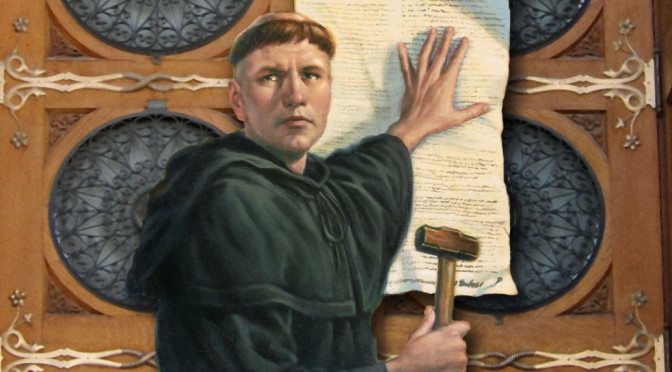
Martin Luther defies the Roman Catholic hierarchy with his 95 Theses

The Ligonier Ministries web site has a summary of the event that kicked off the Reformation.

Excerpt:

On October 31, 1517, Martin Luther tacked up 95 theses on the church door at Wittenberg. With this act, he hoped to provoke a discussion among the scholars about the abuses of the indulgences by the Roman Catholic Church. He was not trying to create a public furor by any means, but within a fortnight, these theses had spread through the country like wildfire. The last thing Luther had in mind was to start some kind of major controversy, but nevertheless major controversy did begin.

From the discussions at Wittenberg, the disputations began to accelerate and escalate. Copies of the theses reached Rome and critical meetings were scheduled with the young monk. In these debates, Luther was maneuvered into proclaiming publicly that he had questions about the infallibility of church councils and also that he thought that it was possible that the pope could err. In 1520 a papal encyclical was issued which condemned Martin Luther as a heretic. Luther burned the document in a public bonfire and his defiance before the church was now a matter of record.

In response, Martin Luther picked up his pen to challenge the entire penitential system of the Roman Catholic Church, which undermined in principle the free remission of sins that is ours in the gospel. By doing so, he was unswervingly advocating his commitment to sola fide, the doctrine of justification by faith alone.

In 1521, Luther was summoned to the Imperial Diet, an authoritative meeting that involved the princes of the church, called by the Emperor of the Holy Roman Empire to be held in the city of Worms in Germany. Luther was an outlaw. For him to appear at the Diet was to risk his very life; therefore, he was given safe conduct by the Emperor to attend. With a few friends, Luther traveled from Wittenberg to Worms. The eyewitnesses of that episode tell us that when Luther’s little covered wagon appeared around the corner of the bend, there were lookouts posted in the church tower at Worms. All the people were agog waiting for the arrival of this notorious person. When Luther’s caravan was sighted, people were throwing their hats in the air, blowing trumpets, and creating all the fanfare of the arrival of the hero. It was the 16th century answer to a ticker-tape parade.

Things, however, became very solemn in a hurry because the next day he appeared before the Diet. His books were stacked on a table in the room, and he was asked and ordered to recant of his writings. This surprised Luther because he thought he was going to have an opportunity to defend his writings; but the only question really of any importance that was asked of him was this: “Are these your writings?” And when he said yes, they said, “Are you ready to recant of them?”

Hollywood has their version of Luther standing there boldly with his fist in the air saying, “Here I stand!” and so on. But instead he dropped his chin on his chest and muttered something that nobody could understand, so they asked him to speak up. “What did you say?” He said, “May I have 24 hours to think about it.” And so Luther was granted a reprieve of 24 hours to return to his room to contemplate the seriousness of this occasion.

The prayer that Luther wrote in that ensuing 24-hour period was one of the most moving prayers I have ever read in my life. In that prayer, Luther cried out for God in his sense of total loneliness fearing that God had abandoned him, and proclaimed, “O Lord, I am Thine, and the cause is Thine, give me the courage to stand.”

And on the morrow, Luther was called once again back to the court and was told to reply to the question. He said to the Diet, “Unless I am convinced by sacred Scripture or by evident reason, I cannot recant, for my conscience is held captive by the Word of God, and to act against conscience is neither right nor safe. Here I stand. I can do no other. God help me.” And with that there was an instant uproar.

The Protestant Reformation emphasizes the responsibility of each person to become familiar with what the Bible teaches for themselves and to make sense of it using the laws of logic for themselves. There is an enormous focus on the individual’s responsibility to puzzle theology out for himself, using the tools available to him: reason, science, Scripture, and history. When doing theology, Protestants do not accept the authority of someone who has a fancy title, fancy hat, fancy robe or fancy staff. Everyone is responsible to read the Bible, read systematic theology, consult history, and determine what the truth is based on evidence, not authority.

The Reformation put forward the famous five Solas: “Sola Scriptura” (Scripture Alone); “Sola Gratia” (Grace Alone); “Sola Fide” (Faith Alone); “Solus Christus” (Christ Alone); and “Soli Deo Gloria” (To God Alone Be Glory). The vertical relationship with God is seen as more important than making people feel good here and now. True beliefs about God are deemed to be more important than being a good social worker. And that’s why Jesus said that the most important commandment is to love God, then secondly, to love your neighbor. It’s important to get that in the right order, because true beliefs about God’s existence, God’s character, and God’s actions in history are the most important things.

The Reformation was the beginning of evangelical Protestantism, which is really the view that the Christian religion ought to be rooted in actual historical events that are documented in the Bible.