Category Archives: News

Wage gap: are women paid less than men because of discrimination?

The pay gap is caused by women's own choices
The pay gap is caused by women’s preference for having children

Liberal feminist Hanna Rosin takes a look at this question in the far-left Slate, of all places.

Excerpt:

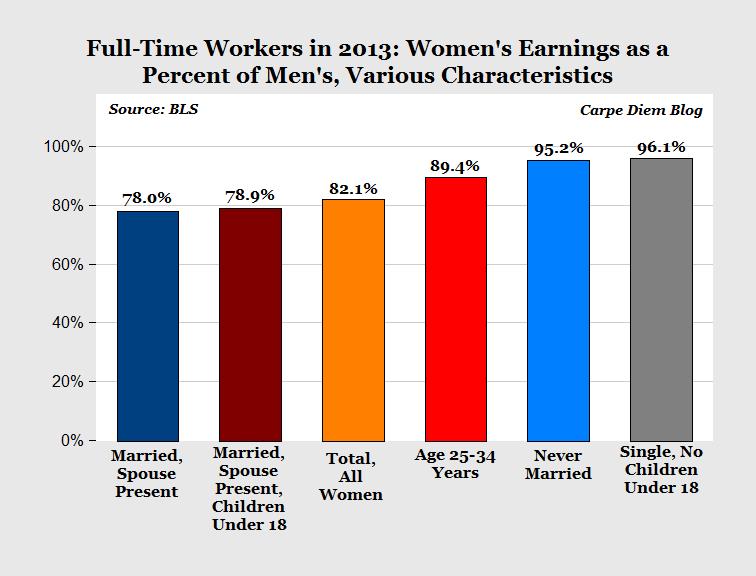
The official Bureau of Labor Department statistics show that the median earnings of full-time female workers is 77 percent of the median earnings of full-time male workers. But that is very different than “77 cents on the dollar for doing the same work as men.” The latter gives the impression that a man and a woman standing next to each other doing the same job for the same number of hours get paid different salaries. That’s not at all the case. “Full time” officially means 35 hours, but men work more hours than women. That’s the first problem: We could be comparing men working 40 hours to women working 35.

How to get a more accurate measure? First, instead of comparing annual wages, start by comparing average weekly wages. This is considered a slightly more accurate measure because it eliminates variables like time off during the year or annual bonuses (and yes, men get higher bonuses, but let’s shelve that for a moment in our quest for a pure wage gap number). By this measure, women earn 81 percent of what men earn, although it varies widely by race. African-American women, for example, earn 94 percent of what African-American men earn in a typical week. Then, when you restrict the comparison to men and women working 40 hours a week, the gap narrows to 87 percent.

But we’re still not close to measuring women “doing the same work as men.” For that, we’d have to adjust for many other factors that go into determining salary. Economists Francine Blau and Lawrence Kahn did that in a recent paper, “The Gender Pay Gap.”.”They first accounted for education and experience. That didn’t shift the gap very much, because women generally have at least as much and usually more education than men, and since the 1980s they have been gaining the experience. The fact that men are more likely to be in unions and have their salaries protected accounts for about 4 percent of the gap. The big differences are in occupation and industry. Women congregate in different professions than men do, and the largely male professions tend to be higher-paying. If you account for those differences, and then compare a woman and a man doing the same job, the pay gap narrows to 91 percent. So, you could accurately say in that Obama ad that, “women get paid 91 cents on the dollar for doing the same work as men.”

I believe that the remainder of the gap can be accounted for by looking at other voluntary factors that differentiate men and women.

The Heritage Foundation says that a recent study puts the number at 95 cents per dollar.

Excerpt:

Women are more likely than men to work in industries with more flexible schedules. Women are also more likely to spend time outside the labor force to care for children. These choices have benefits, but they also reduce pay—for both men and women. When economists control for such factors, they find the gender gap largely disappears.

A 2009 study commissioned by the Department of Labor found that after controlling for occupation, experience, and other choices, women earn 95 percent as much as men do. In 2005, June O’Neil, the former director of the Congressional Budget Office, found that “There is no gender gap in wages among men and women with similar family roles.” Different choices—not discrimination—account for different employment and wage outcomes.

A popular article by Carrie Lukas in the Wall Street Journal agrees.

Excerpt:

The Department of Labor’s Time Use survey shows that full-time working women spend an average of 8.01 hours per day on the job, compared to 8.75 hours for full-time working men. One would expect that someone who works 9% more would also earn more. This one fact alone accounts for more than a third of the wage gap.

[…]Recent studies have shown that the wage gap shrinks—or even reverses—when relevant factors are taken into account and comparisons are made between men and women in similar circumstances. In a 2010 study of single, childless urban workers between the ages of 22 and 30, the research firm Reach Advisors found that women earned an average of 8% more than their male counterparts. Given that women are outpacing men in educational attainment, and that our economy is increasingly geared toward knowledge-based jobs, it makes sense that women’s earnings are going up compared to men’s.

When women make different choices about education and labor that are more like what men choose, they earn just as much or more than men.


What kind of man is Christian athlete Lolo Jones trying to date for marriage?

I saw that 38-year-old athlete named Lolo Jones was complaining about how hard it was for her to find a husband. Apparently, she’s been trying very hard to get married all along, and has not had any success. Let’s take a look at her Instagram page and Twitter page, then her previous boyfriend, and see what she’s doing wrong.

So, here’s her Instagram. She claims to be a Christian, but it’s a constant stream of glamorous pictures of herself, many featuring swimwear or workout apparel. Her Twitter feed is more of the same. Lots of inconsequential things about herself. What she had for breakfast. When she got up from sleeping. That she prefers voice notes to texts. What video games she likes. Etc. The only mention of God I saw is when God helped her win a gold medal. Because that’s what God’s priority was in the world that day – her happiness. Is that what the Bible teaches – that it’s God job is to make his human pets happy? That seems to be a popular view among the books that Christian women are reading today. But is that what Jesus was telling us about God with his life?

Anyway, why aren’t marriage-minded men interested in her?

What marriage-minded men are looking for

So, I have a list of questions that I use when evaluating women for wife and mother roles. I’m trying to see whether the woman is capable of making a marriage to me achieve the goals that God has for his world and his creatures. Right now, the primary threats to God’s view of the world and us that I see are atheism, feminism and socialism. (I’m open to adding or subtracting from this list)

I’m looking for capabilities like these in a wife:

  • demonstrate the existence of God objectively using philosophical arguments and scientific evidence
  • demonstrate the truth about who Jesus was and his resurrection using historical evidence
  • answer philosophical, scientific and historical objections to the Christian worldview
  • explain why other major religions and ideologies are false
  • understand and defend the Bible’s teachings about moral issues (chastity, abortion, divorce, etc.) using philosophical arguments and/or scientific evidence
  • explain her Christian role models and what they have done for Christ and his Kingdom that makes you admire them
  • explain what your goal is for your children, and what you intend to do to achieve those goals
  • explain male and female roles in marriage, what you have done to prepare to perform your roles, and how you evaluate marriage candidates for performance of their roles

So, looking at her Instagram and Twitter, I don’t see anything relevant to a Christian marriage enterprise there. Bikini photos and tweets about silly personal details are unrelated to the Christian marriage enterprise. Even when she promotes virginity, she talks about herself, which is not rationally persuasive to anyone else, since it’s just her subjective opinion. The right way to persuade people that the Bible is correct about sex and sexuality, (and I’ve been doing that for 12 years on this blog), is by appealing to evidence, such as the evidence from research papers.

Lolo Jones So Good Looking
Lolo Jones “He’s So Good Looking”

What is she looking for in a man?

Lots of Christian women like to talk about their desire for marriage, but their actions are not focused on choosing men who demonstrate ability to perform husband and father roles, e.g. – defending truth, providing, charitable giving, chastity, sobriety, romantic love, selflessness, mentoring, etc. What about Lolo?

Consider Lolo’s comments about a man she is impressed by:

Double Agents rookie Nam has been described as “hot” (by Wes), “a physical specimen” (Jay) and “built like a statue” (Kam). But what does his partner, fellow newbie Lolo Jones, think of the Ultimate Beastmaster competitor?

“My teammate’s kind of growing on me. I don’t know if it’s because I’ve seen him come out of the shower a few times, but I’m really liking this chemistry we have,” the Olympian stated during this week’s Challenge episode. “He’s so good-looking.”

[…]Lolo (wants) him to pursue her (since she’s the lady), but he hasn’t.

“I’m throwing everything out his way, but he’s just stoic,” she admitted in a confessional.

If you click through to that article, you’ll see her postive reaction to how “good-looking” this man is. She bends her head forward, and lifts up both arms in excitement. She’s not excited by (or respectful of) marriage-related capabilities or willingness to commit. She’s not raving about a man’s chastity or his sobriety or his theology or his apologetics ability or his mentoring of other Christians or his charitable giving. She’s excited by his height and his appearance.

Her last boyfriend was apparently a basketball player. He’s 7 years younger than she is, 6’7″ tall, and he can really put a basketball into the basketball hoop. But is that relevant for making a marriage that impacts the world for Christ and His Kingdom? Not at all. What a man does in marriage is teach people (church, university, workplace, etc.) about the truth of God’s existence, his character and his interaction with his creatures in history. Men are equipped to be persuasive with reason and evidence when discussing behaviors that cause harm to children, like abortion, divorce, promiscuity, same-sex parenting, etc.  Men are equipped to defend the policies that promote marriage and family, like low tax rates, limited government, the rule of law, etc. Men invest in other Christians, partnering with them to promote Christian truths and Christian convictions to those who don’t accept them. And men know how to help and support their wives as they do their mothering and ministry.

Serious Christian men do not marry women who don’t understand the importance and value of marriage-related capabilities and achievements.

1 Samuel 16:7
1 Samuel 16:7

It’s very important for conservative marriage activists like Mark Regnerus, Brad Wilcox, Greg Stanton, pious pastors, etc. to understand that for Christian men there is more to being a wife and mother than holding a Bible, attending church and singing in the choir. I am a man who has the marriage character and the marriage ability. I can pull the trigger on a commitment – I’m equipped to do that, and do it well. But I want my marriage to fight against atheism, feminism and socialism. Lolo Jones is fit and attractive. She is not equipped for a Christian marriage.

The psychological motivation of those who embrace postmodernism

Can a person be postmodern and a Christian? Not for long

Famous analytical philosopher John Searle has written a book “Mind, Language And Society: Philosophy In The Real World”, explaining what’s factually wrong with postmodernism. In the introduction, he explains what postmodernism is, and what motivates people to accept postmodernism.

He writes:

[…][W]hen we act or think or talk in the following sorts of ways we take a lot for granted: when we hammer a nail, or order a takeout meal from a restaurant, or conduct a lab experiment, or wonder where to go on vacation, we take the following for granted: there exists a real world that is totally independent of human beings and of what they think or say about it, and statements about objects and states of affairs in that world are true or false depending on whether things in the world really are the way we say they are. So, for example, if in pondering my vacation plans I wonder whether Greece is hotter in the summer than Italy, I simply take it for granted that there exists a real world containing places like Greece and Italy and that they have various temperatures. Furthermore, if I read in a travel book that the average summer temperature in Greece is hotter than in Italy, I know that what the book says will be true if and only if it really is hotter on average in the summer in Greece than in Italy. This is because I take it for granted that such statements are true only if there is something independent of the statement in virtue of which, or because of which, it is true.

[…]These two Background presuppositions have long histories and various famous names. The first, that there is a real world existing independently of us, I like to call “external realism.” “Realism,” because it asserts the existence of the real world, and “external” to distinguish it from other sorts of realism-for example, realism about mathematical objects (mathematical realism) or realism about ethical facts (ethical realism). The second view, that a statement is true if things in the world are the way the statement says they are, and false otherwise, is called “the correspondence theory of truth.” This theory comes in a lot of different versions, but the basic idea is that statements are true if they correspond to, or describe, or fit, how things really are in the world, and false if they do not.

The “correspondence theory of truth” is the view of truth assumed in books of the Bible whose genre is such that that they were intended by the authors to be taken literally, (with allowances for symbolism, figures of speech, metaphors, hyperbole, etc.).

But what about the postmodernists, who seek to deny the objectivity of external reality?

More Searle:

Thinkers who wish to deny the correspondence theory of truth or the referential theory of thought and language typically find it embarrassing to have to concede external realism. Often they would rather not talk about it at all, or they have some more or less subtle reason for rejecting it. In fact, very few thinkers come right out and say that there is no such thing as a real world existing absolutely, objectively, and totally independently of us. Some do. Some come right out and say that the so-called real world is a “social construct.”

What is behind the denial of objective reality, and statements about external reality that are warranted by evidence?

It is not easy to get a fix on what drives contemporary antirealism, but if we had to pick out a thread that runs through the wide variety of arguments, it would be what is sometimes called “perspectivism.” Perspectivism is the idea that our knowledge of reality is never “unmediated,” that it is always mediated by a point of view, by a particular set of predilections, or, worse yet by sinister political motives, such as an allegiance to a political group or ideology. And because we can never have unmediated knowledge of the world, then perhaps there is no real world, or perhaps it is useless to even talk about it, or perhaps it is not even interesting.

Searle is going to refute anti-realism in the rest of the book, but here is his guess at what is motivating the anti-realists:

I have to confess, however, that I think there is a much deeper reason for the persistent appeal of all forms of antirealism, and this has become obvious in the twentieth century: it satisfies a basic urge to power. It just seems too disgusting, somehow, that we should have to be at the mercy of the “real world.” It seems too awful that our representations should have to be answerable to anything but us. This is why people who hold contemporary versions of antirealism and reject the correspondence theory of truth typically sneer at the opposing view. 

[…]I don’t think it is the argument that is actually driving the impulse to deny realism. I think that as a matter of contemporary cultural and intellectual history, the attacks on realism are not driven by arguments, because the arguments are more or less obviously feeble, for reasons I will explain in detail in a moment. Rather, as I suggested earlier, the motivation for denying realism is a kind of will to power, and it manifests itself in a number of ways. In universities, most notably in various humanities disciplines, it is assumed that, if there is no real world, then science is on the same footing as the humanities. They both deal with social constructs, not with independent realities. From this assumption, forms of postmodernism, deconstruction, and so on, are easily developed, having been completely turned loose from the tiresome moorings and constraints of having to confront the real world. If the real world is just an invention-a social construct designed to oppress the marginalized elements of society-then let’s get rid of the real world and construct the world we want. That, I think, is the real driving psychological force behind antirealism at the end of the twentieth century.

Now, I’ll go one step further than Searle.

People, from the Fall, have had the desire to step into the place of God. It’s true that we creatures exist in a universe created and designed by God. But, there is a way to work around the fact that God made the universe and the laws that the universe runs on, including logic, mathematics and natural laws. And that way is to deny logic, mathematics and natural laws. Postmodernists simply deny that there is any way to construct rational arguments and support the premises with evidence from the real world. That way, they imagine, they are free to escape a God-designed world, including a God-designed specification for how they ought to live. The postmoderns deny the reliable methods of knowing about the God-created reality because logic and evidence can be used to point to God’s existence, God’s character, and God’s actions in history.

And that’s why there is this effort to make reality “optional” and perspectival. Everyone can be their own God, and escape any accountability to the real God – the God who is easily discovered through the use of logic and evidence. I believe that this is also behind the rise of atheists, who feign allegiance to logic and science, but then express “skepticism” about the origin of the universe, the fine-tuning of the universe, objective morality, the minimal facts concerning the historical Jesus, and other undeniables.