All posts by Wintery Knight

https://winteryknight.com/

The importance of having a narrative when confronting the assumption of naturalism

Apologetics and the progress of science

How do you present theism as a rational belief to a person who thinks that the progress of science has removed the need for God?

Canadian science writer Denyse O’Leary writes about the history of cosmology at Evolution News.

Excerpt:

What help has materialism been in understanding the universe’s beginnings?

Many in cosmology have never made any secret of their dislike of the Big Bang, the generally accepted start to our universe first suggested by Belgian priest Georges Lemaître (1894-1966).

On the face of it, that is odd. The theory accounts well enough for the evidence. Nothing ever completely accounts for all the evidence, of course, because evidence is always changing a bit. But the Big Bang has enabled accurate prediction.

In which case, its hostile reception might surprise you. British astronomer Fred Hoyle (1915-2001) gave the theory its name in one of his papers — as a joke. Another noted astronomer, Arthur Eddington (1882-1944), exclaimed in 1933, “I feel almost an indignation that anyone should believe in it — except myself.” Why? Because “The beginning seems to present insuperable difficulties unless we agree to look on it as frankly supernatural.”

One team of astrophysicists (1973) opined that it “involves a certain metaphysical aspect which may be either appealing or revolting.” Robert Jastrow (1925-2008), head of NASA’s Goddard Institute for Space Studies, initially remarked, “On both scientific and philosophical grounds, the concept of an eternal Universe seems more acceptable than the concept of a transient Universe that springs into being suddenly, and then fades slowly into darkness.” And Templeton Prize winner (2011) Martin Rees recalls his mentor Dennis Sciama’s dogged commitment to an eternal universe, no-Big Bang model:

For him, as for its inventors, it had a deep philosophical appeal — the universe existed, from everlasting to everlasting, in a uniquely self-consistent state. When conflicting evidence emerged, Sciama therefore sought a loophole (even an unlikely seeming one) rather as a defense lawyer clutches at any argument to rebut the prosecution case.

Evidence forced theorists to abandon their preferred eternal-universe model. From the mid 1940s, Hoyle attempted to disprove the theory he named. Until 1964, when his preferred theory, the Steady State, lost an evidence test.

Here is a quick summary of some of the experimental evidence that emerged in the last few decades that caused naturalists to abandon the eternal universe that they loved so much when they were younger.

The importance of having a narrative

Now I want to make a very, very important point about Christianity and the progress of science. And that point is that it is very important that Christians present the evidence in exactly the way that Denyse presented it in that article – in its historical context, featuring the conflict between naturalists and the experimental evidence.

All Christians should be familiar with the following basic pieces of evidence which fit the war between science and naturalism narrative:

  1. The origin of the universe
  2. The cosmic fine-tuning
  3. The origin of life (biological information)
  4. The sudden origin of the Cambrian phyla
  5. The habitability/observability correlation

When you talk about these evidences as a Christian theist to non-Christians, you have to have cultivated a genuine interest in reconciling your beliefs with science. You have to accept that there are two books that reveal God’s character and attributes. The book of nature, and the book of Scripture. And you need to be flexible about getting these two books to fit together. The book of nature gives us natural theology (see Romans 1). It tells us that God is Creator and Designer. The book of Scripture tells us that God stepped into history as a man to save us by taking the punishment for our headlong rush away from God, which the Bible calls sin. Science is one way that humans can recover some of basic knowledge about God. Knowledge that is only possible because God created and designed the universe (and us) in such a way that we are capable of making discoveries, and that the universe is capable of being explored and understood.

It’s very important to present these five basic evidences to non-Christians in the historical context. And here is the story you must tell: “In the beginning, there was the naturalism, and the naturalism tried to argue from ignorance that God was not Creator and God was not Designer. And then came the science, and now people have to give up their naturalism in order to not be crazy and irrational”. That’s the narrative you use when talking to non-Christians about science.

In the beginning was the naturalism:

  1. In pre-scientific times, atheists maintained that the universe was eternal
  2. In pre-scientific times, atheists maintained that a life-permitting universe was as likely as a life-prohibiting universe
  3. In pre-scientific times, atheists maintained that the cell was a simple blob of jello that could spontaneously emerge in some warm pond
  4. In pre-scientific times, atheists maintained that the sudden origin of the Cambrian phyla would be explained by subsequent fossil discoveries
  5. In pre-scientific times, atheists maintained that there was nothing special about our galaxy, solar system, planet or moon

But then science progressed by doing experiments and making observations:

  1. Scientists discovered redshift and the cosmic microwave background radiation (evidence for a cosmic beginning) and more!
  2. Scientists discovered the fine-tuning of gravity and of the cosmological constant and more!
  3. Scientists discovered protein sequencing and exposed the myth of “junk DNA” and more!
  4. Scientists discovered an even shorter Cambrian explosion period and the absence of precursor fossils and more!
  5. Scientists discovered galactic habitable zones and circumstellar habitable zones and more!

And now rational people – people who want to have true beliefs about reality – need to abandon a false religion (naturalism).

Now naturally, science is in a state of flux and things change. But you have to look at the trend of discoveries, and those trends are clearly going against naturalism, and in favor of Christian theism. No one is arguing for a deductive proof here, we are simply looking at the evidence we have today and proportioning our belief to the concrete evidence we have today. People who are guided by reason should not seek to construct a worldview by leveraging speculations about future discoveries and mere possibilities. We should instead believe what is more probable than not. That’s what a rational seeker of truth ought to do. Proportion belief to probabilities based on current, concrete knowledge.

Atheism, as a worldview, is not rooted in an honest assessment about what science tells us about reality. Atheism is rooted in a religion: naturalism. And the troubling thing we learn from looking at the history of science is that this religion of naturalism is insulated from correction from the progress of science. Nothing that science reveals about nature seems to be able to put a dent in the religion of naturalism, at least for most atheists.

It falls to us Christian theists, then, to hold them accountable for their abuse and misrepresentation of science. And that means telling the story of the progress of science accurately, and accurately calling out the religion of naturalism for what it is – a religion rooted in blind faith and ignorance that has been repeatedly and convincingly falsified by the progress of science in the modern era.

Positive arguments for Christian theism

Why you should read “Up From Slavery” by Booker T. Washington

What's the best way to get up from slavery?
What’s the best way to get up from slavery?

Lately, my friends have been very excited that I’m a non-white conservative. They want me to answer the grievances of BLM people, and explain from my own experiences what Christianity and conservative policies have to say about making the lives of non-whites better. My friend Wes recommended “Up From Slavery” by Booker T. Washington to help me focus my thoughts.

Here’s a summary of the book:

Dignity through Labor

Over the course of Up From Slavery, Washington develops the idea and ideal of dignity through labor. For Washington, the gravest aspect of the institution of slavery is the denigration of labor for both blacks and whites. Because the enslaved had no personal investment or return on their labor, they did not complete their work with an attitude toward improvement. Likewise, whites, largely deprived of meaningful labor, were robbed of the ability to achieve self-sufficiency. In both races, this produced personalities and characters that seek to escape labor. Washington emphasizes labor as the only way to make oneself useful in an interdependent, modern society. Throughout the whole of Up From Slavery, Washington searches for and obtains work. Further, once he obtains it, Washington completes all labor to best of his ability, no matter how lowly the task. At the Tuskegee Institute, Washington makes this idea and ideal a foundational ethos. All students who study at the Tuskegee Institute must learn a trade or industry alongside their more traditional academic pursuits. In addition, many of the buildings, most of the furniture, the wagons, and the materials used at the school are produced by students. This level of practical skill and diligence also acts as the foundation of Washington’s theory and program for racial uplift.

Selflessness, Desire to Be Useful to One’s Community

The people that Washington most admires and models himself after are those he labels selfless. Washington defines this as the willingness to work on the behalf of others. For Washington, this is not only about duty or labor, but also about the willingness to do one’s best for the benefit of the collective good. Washington believes that racial prejudice can be overcome if black people make themselves indispensable to their communities and their nation. The brick-making episode provides an example. Though the brick-making enterprise at Tuskegee felled three kilns before successfully producing bricks, the venture eventually proved successful and the school began to sell its bricks on the open market. Washington describes how whites who were unsympathetic or apathetic to the education of blacks and the overall project of the Tuskegee Institute were willing to purchase Tuskegee bricks due to their quality and convenience. Washington suggests that if black race can find their niche in society by fulfilling a need, then they can co-exist peacefully and productively with whites.

Impracticality of Political Agitation

Throughout Up From Slavery, Washington defends his ideas about racial advancement and uplift by subtly undermining the proposals of his critics. Though Washington does not explicitly state his objection to the strategies of specific thinkers like W.E.B. Dubois or even his predecessor, Frederick Douglass, he nevertheless highlights the wastefulness of political agitation for equal rights at every chance he gets. To do this, Washington shows that political agitation results in worse relations and outcomes than those that existed before. For example, when he goes home to Malden after his second year at the Hampton Institute, Washington finds that both the salt-furnace and the coal-mine are not in operation due to worker’s strikes. In Chapter IV, Washington describes how strikers usually spent all their savings during the strikes and returned to work in debt, but at the same wages. He raises the impracticality of political agitation again after his controversial Atlanta Exposition speech. After the success of his speech, he hypothetically asks if a black man would have been invited to give a speech had people agitated to put a black person on the program. He answers in the negative, saying that such opportunities can only arise through merit.

And here’s a summary of his most famous speech:

On September 18, 1895, Booker T. Washington was selected to give a speech that would open the Cotton States and International Exposition in Atlanta, Georgia. The speech, which is often referred to as the “Atlanta Compromise,” was the first speech given by an African American to a racially-mixed audience in the South. In it, Washington suggested that African Americans should not agitate for political and social equality, but should instead work hard, earn respect and acquire vocational training in order to participate in the economic development of the South. By doing so, eventually, he stated, African Americans would gain the respect of white society and be granted the rights of full citizenship.

There’s a free full audio version of the book, and the full text is online. I recommend this book to people of all races, because as the sexual anarchy brought on by feminism becomes widespread, the majority of the children of tomorrow will face the same kinds of challenges.

I see Washington’s ideas as consistent with a Christian worldview, where we don’t expect to be treated fairly. We expect sinful people to treat us badly. What Christianity says is to be patient, and focus on your relationship with God and loving your neighbor. And one way to love your neighbor is to sell them something valuable that you made through your labor. Another way is to work and save, and give to charity.

Government solutions to problems like racism and poverty aren’t a top priority for Christians. Most of all, we need the freedom to be good, and to do good. That’s priority one. You may not make your life better by being moral and diligent, but it’s rare that doing so causes you to harm yourself. It’s very important that you not harm yourself.

So, this dovetails nicely with my own story. My married non-white parents were not smart enough or willing enough to monitor my education, but they were clear that they wanted me to do well in order to find good-paying work. So I completed my BS and MS in a STEM field, and went to work right away, and I’ve been at it continuously for 20 years now. I save most of what I earn for charity and early retirement.

I’ve never experienced any of the racism or police brutality that American blacks complain about. And that’s because I follow what Washington is teaching. I dress in a clean way that doesn’t communicate danger to others. I’m careful to spend my time reading apologetics, economics and military history. I don’t listen to popular music or watch popular TV or movies. I don’t hang out with people who blame other people for their lack of success.

I got my first job by volunteering to do it for free on Saturdays for 7 months. My first full-time job salary after college was $50,000. Then I got a raise of $6,000 and then a raise of $9,000. I used to work 70 hour weeks in my 20s. I graduated college with $9,000 dollars in the black, and my net worth is now about $1.25 million. By the way, the secret to becoming wealthy is to not spend money on showing off. You can be very generous to your friends and still get rich. Just never buy anything that is designed to communicate “status” to anyone. And never spend money on alcohol or chasing sex outside of marriage.

At no time did I accept that the problems defined by the secular left were my real problems. And at no time did I accept their “solutions” as real solutions to anything. As black economist Thomas Sowell writes, the “solutions” of the left are not effective at helping people like me. The “solutions” of the left are designed to make leftists feel better, and look more virtuous to others. You are much better off reading the Bible, Christian apologetics, free market economics, American military history, etc., and then respecting what you learn from that in your decision-making. I think that reading the right stuff is even more important than having good parents or attending church.

If we seriously want men to marry and become fathers, let’s repeal no-fault divorce

I saw a very good article at the Heritage Foundation web site about the importance of fathers for children. The author Virginia Allen listed out some of the benefits that fathers provide to children:

Studies have found that children raised without a father are:

  • At a higher risk of having behavioral problems.
  • Four times more likely to live in poverty.
  • More likely to be incarcerated in their lifetime.
  • Twice as likely to never graduate high school.
  • At a seven times higher risk of teen pregnancy.
  • More vulnerable to abuse and neglect.
  • More likely to abuse drugs and alcohol.
  • Twice as likely to be obese.

From education to personal health to career success, children who lack a father find themselves at a disadvantage to their peers raised in a two-parent household.

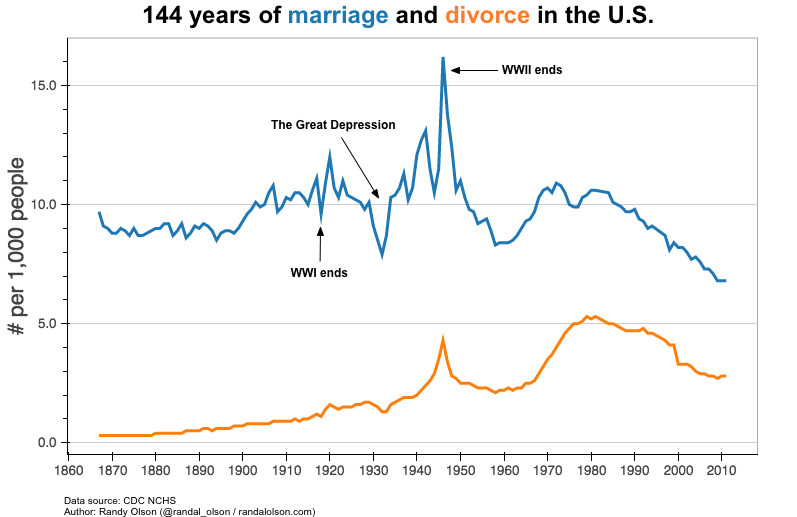
I was looking for a good analysis of why there’s been a decline of marriage and fatherhood, and I found an article by Joe Carter on far-left The Gospel Coalition, of all places. By looking at marriage rates and historical events that changed the marriage rate, he was able to identify the cause of the decline of marriage – and fatherhood.

Marriage and divorce rates per capita

I’ll spare you the statistical analysis, which is excellent, and give you the conclusion – although you can guess it from the graph above:

Now that we’ve explored the data, what year should we use as the marker for the beginning of the decline of marriage in the United States? I would argue for 1985, the last year that the marriage rate topped 10 percent.

[…]What changed in 1985 that could have led to the decline in marriage? There are likely numerous factors—which we’ll examine in future articles—but one stands out in particular: By 1985, all states (except for New York) had enacted no-fault divorce legislation.

The most helpful book I know of about no-fault divorce is “Taken Into Custody”, by Dr. Stephen Baskerville. He wrote a column  for Crisis magazine that summarizes some of his ideas.

Excerpt:

Feminists were drafting no-fault divorce laws in the 1940s, which the National Association of Women Lawyers now describes as “the greatest project NAWL has ever undertaken.”

The result effectively abolished marriage as a legal contract. Today it is not possible to form a binding agreement to create a family.

The new laws did not stop at removing the requirement of citing grounds for a divorce, to allow divorce by mutual consent, as deceptively advertised at the time. Instead they created unilateral and involuntary divorce, so that one spouse may dissolve a marriage without any agreement or fault by the other.

Here’s what divorce does to the spouse who is the victim of the unilateral “no-fault” divorce:

Though marriage is a civil matter, the logic quickly extended into the criminal, including a presumption of guilt against the involuntarily divorced spouse (“defendant”). Yet formal due process protections of criminal proceedings did not apply, so forcibly divorced spouses became quasi-criminals not for recognized criminal acts but for failing or refusing to cooperate with the divorce by continuing to claim the protections and prerogatives of family life: living in the common home, possessing the common property, or—most vexing of all—parenting the common children.

Following from this are the horrendous civil liberties violations and flagrant invasions of family and individual privacy that are now routine in family courts. A personalized criminal code is legislated by the judge around the forcibly divorced spouse, controlling their association with their children, movements, and finances. Unauthorized contact with their children can be punished with arrest. Involuntarily divorced parents are arrested for running into their children in public, making unauthorized telephone calls, and sending unauthorized birthday cards.

In my conversations with men, no-fault divorce laws, and anti-male divorce courts are the main reasons given for why they do not pursue marriage and fatherhood. Men do not want to be coerced in a marriage with the threat of divorce by an unhappy wife. Men do not want to be subject to the government in so many areas of their lives if the wife does carry out the threat. They especially don’t want to be separated from their children. One my secular male friends told me that he would not marry unless the woman had evidence in her past of hating radical feminism and no-fault divorce. This was the main criteria. He actually was able to find a woman who was a men’s rights activist who hated divorce. But that was the only way he would marry.

Statistically speaking, the wife is more likely to initiate divorce than the husband. Women initiate 70% of divorces, the majority of those just because she is “unhappy”. I think this is because women get into marriage based on their feelings, and they think that it is the husband’s job to make them feel good. They see their happiness as the primary goal of the marriage, and see a marriage that does not make them happy as a marriage that needs to be ended.

Are we going to repeal no-fault divorce, then?

No-fault divorce was seen as a boon to women who had married the wrong men by following their hearts. It’s an interesting question to ask whether women really would want no-fault repealed. It would mean that they would have to get serious about who they marry, instead of just getting into marriage based on feelings. They would have to evaluate men according to expectations of what a man does in a marriage, instead of on feelings. They would have to think about what men want out of a marriage, and prepare themselves to provide for his needs. They would have to say no to their feelings, when choosing a man, and in keeping a man after the wedding.

If women aren’t willing to demand the repeal of no-fault divorce laws and get serious about men and marriage, then what’s the point of complaining that men don’t want to marry and become fathers? If you’re not willing to fix the root cause of the problem, then don’t complain about the problem.