
By now regular readers know that birds are my favorite creatures of all, especially parrots. Pretty much any new study about how great birds are will be blogged about here. Partly to bolster the argument for design in nature, and partly just because I think that birds are so awesome!
Here is the latest bird news from Science Daily.
Excerpt:
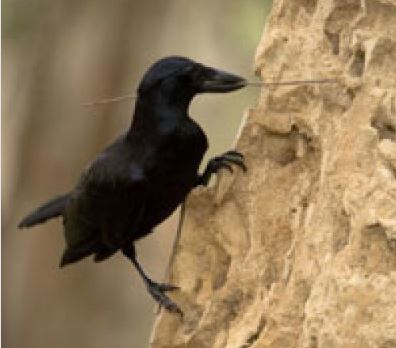
Scientists have been given an extraordinary glimpse into how wild New Caledonian crows make and use ‘hooked stick tools’ to hunt for insect prey.
Dr Jolyon Troscianko, from the University of Exeter, and Dr Christian Rutz, from the University of St Andrews, have captured first video recordings documenting how these tropical corvids fashion these particularly complex tools in the wild.
The pair developed tiny video ‘spy-cameras’ which were attached to the crows, to observe their natural foraging behaviour.
They discovered two instances of hooked stick tool making on the footage they recorded, with one crow spending a minute making the tool, before using it to probe for food in tree crevices and even in leaf litter on the ground.
The findings are reported in the Royal Society’s journal Biology Letters on Wednesday, December 23.
[…]”In one scene, a crow drops its tool, and then recovers it from the ground shortly afterwards, suggesting they value their tools and don’t simply discard them after a single use.” According to Rutz, this observation agrees with recent aviary experiments conducted by his group: “Crows really hate losing their tools, and will use all sorts of tricks to keep them safe. We even observed them storing tools temporarily in tree holes, the same way a human would put a treasured pen into a pen holder.”
New Caledonian crows (Corvus moneduloides) are found on the South Pacific island of New Caledonia.
They can use their bills to whittle twigs and leaves into bug-grabbing implements; some believe their tool-use is so advanced that it rivals that of some primates.
OK, that is pretty cool, but on crows are not the most cuddly birds. However, Goffin cockatoos are pretty cuddly, and there was a related story about them.
First, this one from November 2012: (Science Daily)
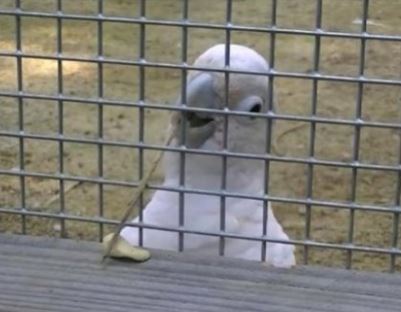
A cockatoo from a species not known to use tools in the wild has been observed spontaneously making and using tools for reaching food and other objects.
A Goffin’s cockatoo called ‘Figaro’, that has been reared in captivity and lives near Vienna, used his powerful beak to cut long splinters out of wooden beams in its aviary, or twigs out of a branch, to reach and rake in objects out of its reach. Researchers from the Universities of Oxford and Vienna filmed Figaro making and using these tools.
How the bird discovered how to make and use tools is unclear but shows how much we still don’t understand about the evolution of innovative behaviour and intelligence.
A report of the research is published this week in Current Biology…
And then an update to the story – a new study showing that the cockatoo is actually able to teach other birds how to make tools as well: (Science Daily)
Goffin’s cockatoos can learn how to make and use wooden tools from each other, a new study has found.
The discovery, made by scientists from Oxford University, the University of Vienna, and the Max Planck Institute at Seewiesen, is thought to be the first controlled experimental evidence for the social transmission of tool use in any bird species.
Goffin’s cockatoo (Cacatua goffini) is a curious species of Indonesian parrot not known to use tools in the wild. At a laboratory in Austria the researchers had observed a captive adult male Goffin’s cockatoo named ‘Figaro’ spontaneously start to sculpt stick tools out of wooden aviary beams to use them for raking in nuts out of his reach. To investigate if such individual invention could be passed on to other cockatoos the team used Figaro as a ‘role model’, exposing other birds to tool use demonstrations, some with Figaro as ‘teacher’ and others without his ‘students’ seeing him at work.
In the experiments one cockatoo group was allowed to observe Figaro skilfully employing a ready-made stick tool, while another could see what researchers called ‘ghost demonstrations’ — either seeing the tools displacing the nuts by themselves, while being controlled by magnets hidden under a table, or seeing the nuts moving towards Figaro without his intervention, again using magnets to displace the food. The birds were all then placed in front of an identical problem, with a ready-made tool lying on the ground nearby.
Three males and three females that saw Figaro’s complete demonstration interacted much more with potential tools and other components of the problem than those seeing ghost demos. They picked up sticks more than the ghost demo control groups and generally seemed more interested in achieving the result. Remarkably, all three males in this group acquired proficient tool use, while neither the females in the same group nor males and females in the ghost demo groups did.
A report of the research is published in the journal Proceedings of the Royal Society B.
During the Christmas holidays, I’ve been working on a technical project that is now deployed and functioning on a cloud service, backed by a data store. One of the reasons I have been able to keep at it despite all the festivities going on, is because my pet bird has been flying and landing on top the computer monitor and urging me to get cracking on the next feature in the feature list. He is very bossy.
Related posts
- New study: parrots capable of using and sharing tools
- Remarkable: the Clark’s nutcracker can remember up to 20,000 maps
- Federal court cripples Obama administration’s bird-killing green energy agenda
- New study: tiny songbirds fly extremely long distances each year
- New study: Crows capable of analytical reasoning
- New study: bird origins poses a convergence challenge to common ancestry
- New study: another biological Big Bang, this time for bird development
- New study: how the hummingbird performs stunning feats of aerobatics
- New $2.2 billion solar plant kills one bird every two minutes
- The best explanation for the design of bird wings is intelligent design
- Are green energy sources like solar power and wind power good for the environment?
- Obama administration issues permits to wind energy companies to kill rare birds
- Obama administration won’t prosecute wind farms for killing thousands of endangered birds
- New peer-reviewed article argues for irreducible complexity in birds

 WINTERY KNIGHT