What do ancient non-Christian sources tell us about the historical Jesus?

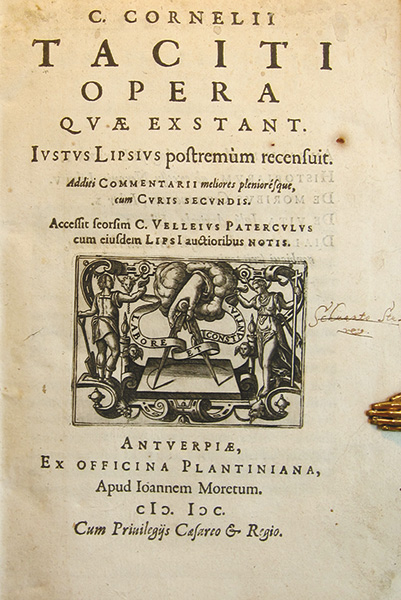
The Annals, by Roman historian Tacitus

This article from Biblical Archaeology covers all the non-Christian historical sources that discuss Jesus.

About the author:

Lawrence Mykytiuk is associate professor of library science and the history librarian at Purdue University. He holds a Ph.D. in Hebrew and Semitic Studies and is the author of the book Identifying Biblical Persons in Northwest Semitic Inscriptions of 1200–539 B.C.E. (Atlanta: Society of Biblical Literature, 2004).

Here are the major sections:

  • Roman historian Tacitus
  • Jewish historian Josephus
  • Greek satirist Lucian of Samosata
  • Platonist philosopher Celsus
  • Roman governor Pliny the Younger
  • Roman historian Suetonius
  • Roman prisoner Mara bar Serapion

And this useful excerpt captures the broad facts about Jesus that we get from just the first two sources:

We can learn quite a bit about Jesus from Tacitus and Josephus, two famous historians who were not Christian. Almost all the following statements about Jesus, which are asserted in the New Testament, are corroborated or confirmed by the relevant passages in Tacitus and Josephus. These independent historical sources—one a non-Christian Roman and the other Jewish—confirm what we are told in the Gospels:31

1. He existed as a man. The historian Josephus grew up in a priestly family in first-century Palestine and wrote only decades after Jesus’ death. Jesus’ known associates, such as Jesus’ brother James, were his contemporaries. The historical and cultural context was second nature to Josephus. “If any Jewish writer were ever in a position to know about the non-existence of Jesus, it would have been Josephus. His implicit affirmation of the existence of Jesus has been, and still is, the most significant obstacle for those who argue that the extra-Biblical evidence is not probative on this point,” Robert Van Voorst observes.32 And Tacitus was careful enough not to report real executions of nonexistent people.

2. His personal name was Jesus, as Josephus informs us.

3. He was called Christos in Greek, which is a translation of the Hebrew word Messiah, both of which mean “anointed” or “(the) anointed one,” as Josephus states and Tacitus implies, unaware, by reporting, as Romans thought, that his name was Christus.

4. He had a brother named James (Jacob), as Josephus reports.

5. He won over both Jews and “Greeks” (i.e., Gentiles of Hellenistic culture), according to Josephus, although it is anachronistic to say that they were “many” at the end of his life. Large growth
in the number of Jesus’ actual followers came only after his death.

6. Jewish leaders of the day expressed unfavorable opinions about him, at least according to some versions of the Testimonium Flavianum.

7. Pilate rendered the decision that he should be executed, as both Tacitus and Josephus state.

8. His execution was specifically by crucifixion, according to Josephus.

9. He was executed during Pontius Pilate’s governorship over Judea (26–36 C.E.), as Josephus implies and Tacitus states, adding that it was during Tiberius’s reign.

Some of Jesus’ followers did not abandon their personal loyalty to him even after his crucifixion but submitted to his teaching. They believed that Jesus later appeared to them alive in accordance with prophecies, most likely those found in the Hebrew Bible. A well-attested link between Jesus and Christians is that Christ, as a term used to identify Jesus, became the basis of the term used to identify his followers: Christians. The Christian movement began in Judea, according to Tacitus. Josephus observes that it continued during the first century. Tacitus deplores the fact that during the second century it had spread as far as Rome.

I remember reading the 1996 book by Gary Habermas entitled “The Historical Jesus: Ancient Evidence for the Life of Christ“. This book is a little before the time of most of you young Christian apologists, but back before the time of Lee Strobel and J. Warner Wallace, this is the stuff we all read. Anyway, in the book he makes a list of all that can be known about Jesus from external sources. And fortunately for you, you don’t have to buy the book because you can read chapter 9 of it right on his web site.

From Tacitus he gets this:

From this report we can learn several facts, both explicit and implicit, concerning Christ and the Christians who lived in Rome in the 60s A.D. Chronologically, we may ascertain the following information.

(1) Christians were named for their founder, Christus (from the Latin), (2) who was put to death by the Roman procurator Pontius Pilatus (also Latin), (3) during the reign of emperor Tiberius (14 37 A.D.). (4) His death ended the “superstition” for a short time, (5) but it broke out again, (6) especially in Judaea, where the teaching had its origin.

(7) His followers carried his doctrine to Rome. (8) When the great fire destroyed a large part of the city during the reign of Nero (54 68 A.D.), the emperor placed the blame on the Christians who lived in Rome. (9) Tacitus reports that this group was hated for their abominations. (10) These Christians were arrested after pleading guilty, (11) and many were convicted for “hatred for mankind.” (12) They were mocked and (13) then tortured, including being “nailed to crosses” or burnt to death. (14) Because of these actions, the people had compassion on the Christians. (15) Tacitus therefore concluded that such punishments were not for the public good but were simply “to glut one man’s cruelty.”

And from Josephus he gets this:

(1) Jesus was known as a wise and virtuous man, one recognized for his good conduct. (2) He had many disciples, both Jews and Gentiles. (3) Pilate condemned him to die, (4) with crucifixion explicitly being mentioned as the mode. (5) The disciples reported that Jesus had risen from the dead and (6) that he had appeared to them on the third day after his crucifixion. (7) Consequently, the disciples continued to proclaim his teachings. (8) Perhaps Jesus was the Messiah concerning whom the Old Testament prophets spoke and predicted wonders. We would add here two facts from Josephus’ earlier quotation as well. (9) Jesus was the brother of James and (10) was called the messiah by some.

So when you are reading the New Testament, these facts are the framework that you read within. It’s a good starting point when dealing with people who have never looked into who Jesus was and what he taught and what his followers believed about him, right from the start.

Ten scientific problems with global warming alarmism

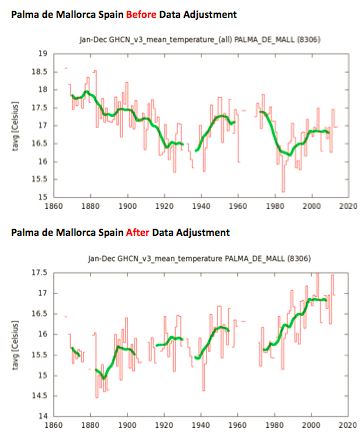
How climate scientists adjust the data to prove they need more grant money
How climate scientists adjust the data to prove they need more grant money (see #10 in the list below)

My friend Bruce posted this article from the the Daily Wire, and I think it’s a good summary of the scientific evidence against global warming alarmism. After we go over this, I’ll take a stab at explaining why so many non-scientists desperately want to believe that global warming is true, and why they try to push everyone else to believe it, too.

First, the list:

  1. Temperature records from around the world do not support the assumption that today’s temperatures are unusual.
  2. Satellite temperature data does not support the assumption that temperatures are rising rapidly
  3. Current temperatures are always compared to the temperatures of the 1980’s, but for many parts of the world the 1980’s was the coldest decade of the last 100+ years
  4. The world experienced a significant cooling trend between 1940 and 1980
  5. Urban heat island effect skews the temperature data of a significant number of weather stations
  6. There is a natural inverse relationship between global temperatures and atmospheric CO2 levels
  7. The CO2 cannot, from a scientific perspective, be the cause of significant global temperature changes
  8. There have been many periods during our recent history that a warmer climate was prevalent long before the industrial revolution
  9. Glaciers have been melting for more than 150 years
  10. “Data adjustment” is used to continue the perception of global warming

So, we can’t look at all of these in one post. Obviously, the satellite measurements are the best thing to look at, since they cannot be tampered with as easily as the ground measurements, and they show no warming for 18 years.

But let’s look at number 8 instead:

Even in the 1990 IPCC report a chart appeared that showed the medieval warm period as having had warmer temperatures than those currently being experienced.  But it is hard to convince people about global warming with that information, so five years later a new graph was presented, now known as the famous hockey stick graph, which did away with the medieval warm period.  Yet the evidence is overwhelming at so many levels that warmer periods existed on Earth during the medieval warm period as well as during Roman Times and other time periods during the last 10,000 years.  There is plenty of evidence found in the Dutch archives that shows that over the centuries, parts of the Netherlands disappeared beneath the water during these warm periods, only to appear again when the climate turned colder.  The famous Belgian city of Brugge, once known as “Venice of the North,” was a sea port during the warm period that set Europe free from the dark ages (when temperatures were much colder), but when temperatures began to drop with the onset of the little ice age, the ocean receded and now Brugge is ten miles away from the coastline.  Consequently, during the medieval warm period the Vikings settled in Iceland and Greenland and even along the coast of Canada, where they enjoyed the warmer temperatures, until the climate turned cold again, after which they perished from Greenland and Iceland became ice-locked again during the bitter cold winters.  The camps promoting global warming have been systematically erasing mention of these events in order to bolster the notion that today’s climate is unusual compared to our recent history.

That’s right, the world was much warmer than it is now during the Medieval Warming Period… so warm that you could actually farm on Greenland. But now it’s all frozen over.

Bruce also posted this article from Forbes magazine about the so-called consensus about global warming among scientists.

It says:

It is becoming clear that not only do many scientists dispute the asserted global warming crisis, but these skeptical scientists may indeed form a scientific consensus.

[…]Only 36 percent of geoscientists and engineers believe that humans are creating a global warming crisis, according to a survey reported in the peer-reviewed Organization Studies. By contrast, a strong majority of the 1,077 respondents believe that nature is the primary cause of recent global warming and/or that future global warming will not be a very serious problem.

The survey results show geoscientists (also known as earth scientists) and engineers hold similar views as meteorologists. Two recent surveys of meteorologists (summarized here and here) revealed similar skepticism of alarmist global warming claims.

According to the newly published survey of geoscientists and engineers, merely 36 percent of respondents fit the “Comply with Kyoto” model. The scientists in this group “express the strong belief that climate change is happening, that it is not a normal cycle of nature, and humans are the main or central cause.”

The authors of the survey report, however, note that the overwhelming majority of scientists fall within four other models, each of which is skeptical of alarmist global warming claims.

[…]Taken together, these four skeptical groups numerically blow away the 36 percent of scientists who believe global warming is human caused and a serious concern.

Many people listen to Obama, who never passed a science class in his life, talk about how most scientists support the idea of man-made global warming. But the truth is that his statements are just more “you can keep your health plan” and “you can keep your doctor”. He says what he wants people to believe so they will like him and rely on him to save them. But he has no knowledge of climate science any more than he has knowledge of health care policy.

Why do people believe weird things?

So why do people believe these things? People believe these things for the same reason that primitive people would sacrifice animals in order to get a bountiful harvest or be spared being struck by lightning. They fear the future, and they want to believe that they are doing something in order to save themselves from doom. There is something credulous in us that seeks to know and control the future. When we are told a noble lie by grant-seeking, attention-craving academics, we believe it because we want to believe it. We want to believe that the future is going to be OK, especially when all we have to do to make it OK is recycle cans and turn off our lights when we are not using them.

This is the real psychological motivation behind the desperate desire to believe in the global warming myth. We are scared, and we want someone to save us from the future. And we jump at the chance of controlling the future, especially when it means recycling cans, rather than having to deal with our own sinfulness. We invent a new morality that justifies us rather than having to comply with the old morality. Freedom to commit adultery, as long as we recycle cans to save the planet. Sanctification through purchasing carbon credits, instead of  sanctification through chastity, sobriety and self-control.

Hate crime hoax: Houston Muslim arrested for setting his own mosque on fire

Suspect arrested for arson of Houston mosque, liberals hardest hit

Here’s the raw story from the leftist Houston Chronicle.

It says:

A Houston man has been arrested in connection with a suspected arson at a mosque on Christmas Day, but the motive for the crime remains a mystery, with the suspect maintaining he was a regular at the mosque.

A spokeswoman for the federal Bureau of Alcohol, Tobacco, Firearms and Explosives confirmed that the suspect, 37-year-old Gary Nathaniel Moore of Houston, was arrested early Wednesday. Moore appeared in court at 7 a.m., spokeswoman Nicole Strong said, and bond was set at $100,000.

According to a charging instrument released by the Harris County District Clerk, Moore told investigators at the scene that he has attended the storefront mosque for five years, coming five times per day to pray seven days per week.

Moore said he had been at the mosque earlier on Dec. 25 to pray, and had left at about 2 p.m. to go home, according to authorities and court papers. Moore said he was the last person to leave the mosque and saw no smoke or other signs of fire when he departed, authorities said. He maintained he had returned to the scene after hearing about the fire from a friend.

Now, I wouldn’t post this if there was not something to learn from it at a higher level, and there is. There is something to learn about the left-wing, shame the good, praise the evil, mindset.

Breitbart News documents the initial reactions from the mainstream media to the story before it was known who the guilty person was.

Excerpt: (links to other sites removed)

CBS News:

Advocacy groups believe there has been a spike in anti-Muslim incidents across the United States in recent weeks that can be linked to the mass shooting in California and the inflammatory rhetoric of Donald Trump and other Republican presidential candidates. And they say that Muslims are fearful the backlash could lead to further harassment and violence.

CNN:

The Houston chapter of the Council on American-Islamic Relations called on authorities to investigate the fire for an anti-Muslim motive.

“Because of the recent spike in hate incidents targeting mosques nationwide, we urge law enforcement authorities to investigate a possible bias motive for this fire,” Mustafaa Carroll, the chapter’s executive director, said in a statement.

NBC News:

The Houston chapter of the Council on American-Islamic Relations called on authorities to investigate a possible bias motive in the case, citing what it called a “recent spike in hate incidents targeting mosques nationwide.

Now that a devout Muslim has been charged, the DC Media will forget all about the incident.

The media’s playbook is always to immediately use any disaster or crime as a means to make the GOP answer for it. Then, once the facts come out and point to a member of the Protected Class, the story is memory-holed and the accusation against the Republican lingers.

That was very bad, and it should teach you a lesson about how anxious the media is to make traditional groups (conservatives, Christians, orthodox Jews, etc.) feel ashamed, while protecting and praising radical Islamists. They want to force everyone to be “equal” on the moral scale, so that no one can judge anyone else. The problem is, as we see in this story, that not shaming evil causes evil people to more evil, not less evil.

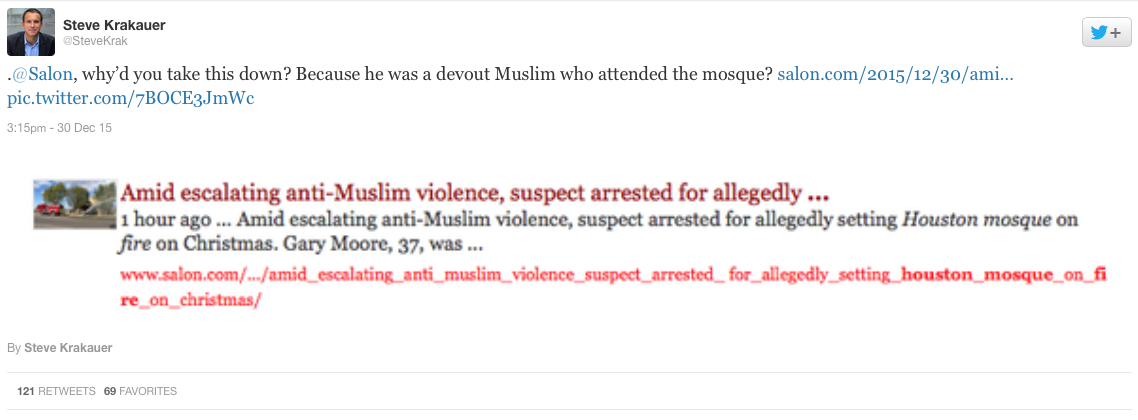
Anyway, all that is well and good, but we haven’t seen the worst media bias. That prize goes to the radically, radically leftist Salon, which not only put up a story blaming conservatives for the arson, but then took it down once the news came out about who was arrested for it: (H/T Weasel Zippers)

Salon took down their entire post to protect radical Islamists

(click for larger image)

Why did they do it? Because the story only had value to them when it could give America, Christians, Republicans, etc. a black eye. When it gave radicalized Muslim terrorists a black eye, then Salon had to take it down. They didn’t want to make their allies in the culture war look bad. And do you know what else Salon doesn’t report on? Crucifixions, torture, rape and murder by radical Muslims (often against other Muslims!) in other parts of the world. That doesn’t fit their narrative, either.

Do you ever wonder where so many people have an emotional reaction of sympathy for people who do evil? It’s because they’ve been conditioned by the media to think that somehow, some way, evil people are actually justified in doing their evil. And somehow, some way, good people are all hypocrites who shouldn’t judge anyone, because it is mean and makes people feel bad. If you went to public schools in America and listened to the mainstream media, you’ve been indoctrinated in that from birth to present day. It all comes from the shame that people on the left feel for their own immoral actions, and their desperate desire to stop all moral judging as a way of escaping from the misdeeds they committed in the past. This is their way of dealing with their own guilt – stopping everyone else from making moral judgments about anything.

To learn more about media bias from peer-reviewed studies that document it, click here.