I saw that Stand to Reason’s Amy Hall blogged about a lecture by Jay Richards, a Christian expert in economics. Amy linked to this post by Justin Taylor which summarizes the talk (above).
Summary:
Establish and maintain the rule of law.
Focus the jurisdiction of government on maintaining the rule of law, and limit its jurisdiction over the economy and the institutions of civil society.
Implement a formal property system with consistent and accessible means for securing a clear title to property one owns.
Encourage economic freedom: Allow people to trade goods and services unencumbered by tariffs, subsidies, price controls, undue regulation, and restrictive immigration policies.
Encourage stable families and other important private institutions that mediate between the individual and the state.
Encourage belief in the truth that the universe is purposeful and makes sense.
Encourage the right cultural mores—orientation to the future and the belief that progress but not utopia is possible in this life; willingness to save and delay gratification; willingness to risk, to respect the rights and property of others, to be diligent, to be thrifty.
Instill a proper understanding of the nature of wealth and poverty—that wealth is created, that free trade is win-win, that risk is essential to enterprise, that trade-offs are unavoidable, that the success of others need not come at your expense, and that you can pursue legitimate self-interest and the common good at the same time.
Focus on your comparative advantage rather than protecting what used to be your competitive advantage.
Work hard.
His book “Money, Greed and God” is a perfect introduction to economics and how it relates to the Christian worldview. I always encourage Christians to move beyond good intentions to good results by studying economics. We are supposed to be helping the poor, but how should we do it? Economics is the science that allows us to understand which policies we should support to do that.
Wilcox and Lerhman found that growing up in a two-parent family correlated with many positive outcomes for kids, well into adulthood. For example:
Growing up with both parents reduced the probability for dropping out of high school by 15 percent for men and 9 percent for women.
Growing up in an intact family reduced women’s chances of becoming single mothers by 12 percent and men’s chances of being nonresidential fathers by 5 percent.
Both men and women who grew up in intact families enjoyed substantial marriage premiums. Young men who grew up in intact families earned, on average, more than $6,500 more in personal income and more than $16,000 more in family income than their peers who grew up in single-parent families. Young women from intact families earn more than $4,700 in personal income and more than $12,000 more than their peers from single-parent families.
Growing up with both parents also increased young adults chances of marrying themselves. Men who grew up in intact homes were 10 percent more likely to get married than their peers who grew up in single-parent families. Women who grew up in intact homes were 12 percent more likely to marry.
Individuals who grow up in intact homes are more likely to marry and once they do, they are the recipients of a host of benefits associated with being married.
Married men age 28–30 earn nearly $16,000 more, on average, than their single peers. Their family income is nearly $22,000 higher than their single peers. And the marriage premium for men extends to less-educated and minority men who are often at a disadvantage in the work force. Married young men with only high-school educations, for example, earned more than $17,000 more than their single peers.
I don’t like to blog about these things without solutions. I have some of my own (school choice, abstinence education funding, repeal no-fault divorce, defund Planned Parenthood, double the child tax credit for married couples, provide a carry forward tax credit to each married parent for ALL income earned by children before age 21, etc.).
But the new study has some solutions too:
Wilcox and Lehrman do make recommendations for strengthening lower and middle-class families. They recommend eliminating marriage penalties from the tax code, while increasing the child credit and the earned income credit maximum. They also recommend improving vocational training and launching a national campaign that encourages young adults to follow the ”success sequence”: education, job, marriage, children.
I think a lot of kids of my generation should be reading studies like this and wondering “what did the party of premarital sex, no-fault divorce, abortion and gay rights do for me?”. If your political party embraces policies that encourage people to see sex as recreational instead of a way of producing creatures who then become the responsibilities of parents, you are in the wrong political party. The Democrat party is the part of selfishness, and that’s why they attack marriage. Marriage is about restraining adults so that children benefit, and every selfish Democrat policy that damages marriage damages children.
Even today, after decades of feminism, most Americans agree that it is better for women and men — and society — when women and men marry. Yet when women marry, it is bad for the Democratic Party; and when women do not marry, even after — or shall we say, especially after — having children, it is quite wonderful for the Democratic Party.
Married women vote Republican. Unmarried women lopsidedly vote Democrat. It is both silly and dishonest to deny that it is in the Democrats’ interest that women not marry.
They have no reason to strengthen marriage, and their policies (sex education, no-fault divorce, single mother welfare, gay marriage, etc.) don’t strengthen marriage. It sounds like such a nice thing to want to not shame people for premarital sex and divorce. After all, we want people to feel good no matter what they choose, right? But there is a price to pay for this “tolerance” of adult selfishness – it’s paid by their children. That’s what happens when we put feelings about moral boundaries.
The success of children is due to their parents’ choices, not from outside racism
If the underperformance of blacks and Hispanics in America were caused by racism by whites, then it follows that Asian-Americans would be underperforming as well. But Asian-Americans are outperforming whites. Let’s look at three reasons why, and see if blacks and Hispanics can learn how to succeed by looking at the Asian example.
Here is the summary of this post:
Asian Americans marry before they have children
Asian Americans save more of what they earn
Asian Americans monitor their children’s educational progress
Now let’s take a look at each of these in order.
Asians marry before they have children, so the kids have two parents
1. Asian Americans marry before they have children
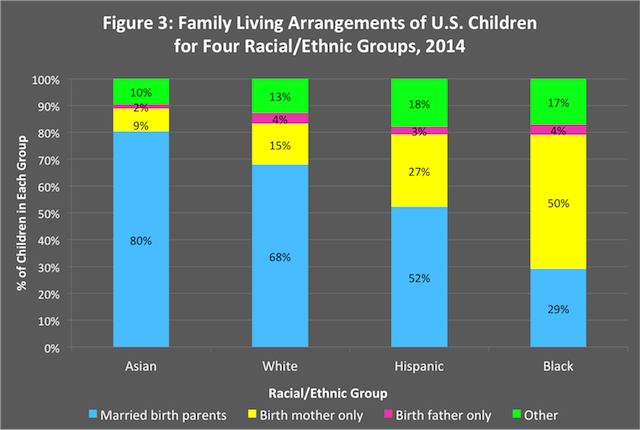
Eight in ten Asian-American kids live with married birth parents, compared with about seven in ten European-American kids, five in ten Hispanic-American kids, and only about three in ten African-American kids. Half of black children live with their mothers only, compared to three in ten Hispanic children, less than two in ten white children and less than one in ten Asian children.
Naturally, children who have two parents to look after them do better, because one parent alone cannot work and do household chores and monitor the children as easily as two parents can. The decision about whether to have sex before marriage is entirely under the control of the grown-ups. It cannot be blamed on racism, poverty and other non-moral pre-occupations of the secular left. Marriage is a moral issue, and Asian-Americans do the moral thing, and marry before they have children.
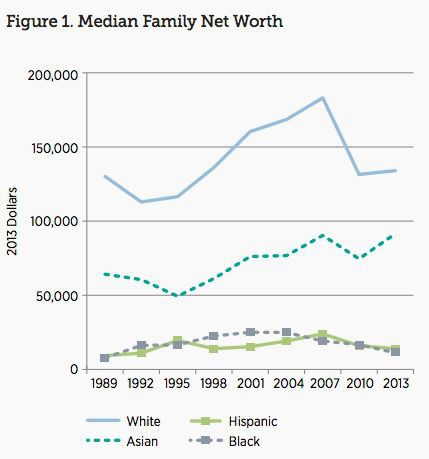
Asians have had higher median incomes than their white counterparts, according to a new study by the Federal Reserve Bank of St. Louis. The typical Asian family has brought home more money for most of the past two decades.
[…][Asians] will surpass whites in net worth in the next decade or two, Fed researchers said.
[…]In 1989, the median Asian family had about half the net worth of its white peer. By 2013, they had more than two-thirds.
The gap between whites and blacks and Hispanics, meanwhile, remained little changed over that time period.
Asians have similar financial habits to whites, in terms of investing and borrowing. Both groups are more likely than blacks and Hispanics to invest in stocks and privately-owned businesses and to have more liquid assets, which serves as a buffer against financial shocks. And, on average, the former have about half as much debt as the later.
As a result, Asians and whites have more financial stability than blacks and Hispanics, which also allows the former to build more wealth.
Everyone has to earn and save money, but in some cultures, it becomes normal to not save part of what you earn. That needs to stop. But it has nothing to do with discrimination due to skin color. In Asian culture, there is no glorification of consumer spending on sparkles, bling and other ostentatious wealth. Asians don’t want to appear to be wealthy, they want to actually be wealthy – by saving money.
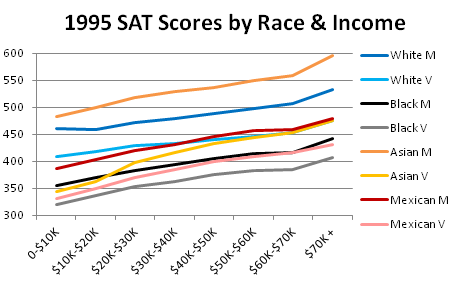
Composite SAT scores by race and income levels: Asians outperform at every income level
3. Asian Americans monitor their children’s educational progress
This article from Investors Business Daily explains how Asian parents don’t just make demands on their kids to learn, they actively monitor their progress and talk to their kids’ teachers:
Asian-American parents tend to oversee their children’s homework, hold them accountable for grades and demand hard work as the ticket to a better life. And it pays off: Their children are soaring academically.
[…]As a group, Americans need to take a page from the Asian parents’ playbook. American teens rank a dismal 28th in math and science knowledge, compared with teens in other countries, even poor countries.
Singapore, Hong Kong, South Korea, Japan and Taiwan are at the top. We’ve slumped. For the first time in 25 years, U.S. scores on the main test for elementary and middle school education (NAEP) fell. And SAT scores for college-bound students dropped significantly.
[…]Many [Asian students]from poor or immigrant families, but they outscore all other students by large margins on both tests, and their lead keeps widening.
In New York City, where Asian-Americans make up 13% of overall students, they win more than 50% of the coveted places each year at the city’s eight selective public high schools, such as Bronx Science and Stuyvesant.
What’s at work here? It’s not a difference in IQ. It’s parenting. That’s confirmed by sociologists from City University of New York and the University of Michigan. Their study showed that parental oversight enabled Asian-American students to far outperform the others.
No wonder many successful charter schools require parents to sign a contract that they will supervise their children’s homework and inculcate a work ethic.
It’s not enough to just outsource the education of your children to a bunch of non-STEM education-degree-holding teachers. Teachers can be good, and some work very hard. But the Democrat teacher unions prevent the firing of teachers who underperform. This is especially true in non-right-to-work states (Democrat states). So, you cannot depend on teachers to educate your children, and Asian parents don’t. That’s why their kids learn. Performance of children in school is not affected by discrimination against skin color, it’s affected by the level of involvement of parents.
Conclusion
We have learned that the success of Asian-Americans in America is all earned. And this proves that there is no such thing as “racism” that holds back non-whites. If blacks and Hispanics imitated the behaviors of Asians (not whites, but Asians), then they would achieve just as well as Asians do. It’s not a race problem, it’s a behavior problem. It’s not a “racism” problem, it’s a behavior problem. It’s an us problem, it’s not a them problem.


 WINTERY KNIGHT