As Father’s Day 2011 approaches, it’s a good time to reconsider the evidence as to why. Decades of academic research show that the father’s role in the family has a powerful and long-term impact on the future of the next generation.
In terms of economic well-being, children who grow up in homes where both parents are present are 82 percent less likely to live in poverty. Intact families tend to fare better in a wide range of economic measures; on average they have a higher net worth, higher income, more household assets, and greater savings.
A father’s role goes far beyond that of breadwinner, however, influencing his children’s well-being, behavior, and futures, which can have a profound impact on the health of civil society. Married fathers especially can have life-long influences on their children.
Youths growing up with both a mother and father in the home are less likely to engage in high-risk behavior. They are also less likely to become sexually active or to give birth in high school or outside of marriage. In addition, with both a mom and a dad in the home, adolescents are less likely to be involved with substance abuse such as drug and alcohol use and binge drinking.
The two-parent family, likewise, provides a safeguard against delinquent and anti-social behavior. On average, youths living with both parents are less likely to engage in violent behavior, commit a property crime, or be incarcerated.
In addition, teens with both moms and dads at home tend to fare better on a range of emotional and psychological outcomes: They tend to experience better emotional health and have higher levels of self-esteem and social competence, and they are less likely to experience psychological distress and anxiety.
Given all of the above, it is not surprising that children raised by married fathers tend to have greater academic achievement and higher levels of educational attainment, and they tend to score higher in math and reading in even the earliest grades.
And fathers’ impact goes beyond the effects of family structure. Dads’ involvement and relationship with their children is associated with greater psychological well-being, lower levels of behavioral problems, greater educational attainment, and a decrease in the likelihood of teen substance use.
Marriage plays a big role in the well-being of the U.S. economy, such that sound and stable marriages keep the economy healthy while divorce helps the economy regress, a new report suggests.
The findings released by the Family Research Council’s Marriage and Religion Research Institute show how intact married-couple families outperform other family types, including remarried families, divorced families, single-parent families, and cohabiting families, in all of the following economic segments: employment, income, net value, net worth, poverty, receipt of welfare and child economic well-being.
Basically the stats show that the more intact the family remains, the less the difficulties and the inefficiencies the family encounters.
Married-couple families generate the most income with “the median household income twice that of divorced households and four times that of separated households,” reads the report.
Divorced families on the other hand experience a sharp decrease in income after the separation. Divorced women are affected the most as they are 2.83 times more prone to live in poverty than women who remain married.
MARRI Director Pat Fagan, Ph.D, said couples that remain stably married can provide a sound environment where children can be securely fostered while divorce triggers society’s reliance on government welfare programs – programs that currently cost tax payers around $112 billion per year.
The economic well-being of the United States is strongly related to marriage, which is a choice about how we channel our sexuality. The implications of sexual choices are apparent when comparing family structures across basic economic measures such as employment, income, net worth, poverty, receipt of welfare, and child economic well-being. In all of these the stable, intact married family outperforms other sexual partnering structures; hence the economy rises with the former and encounters more difficulties and inefficiencies as it diverges from it.
Family Structures and Economic Outcomes:
Employment and Income. Married-couple families generate the most income, on average. Young married men are more likely to be in the labor force, employed, and working a full-time job than their nonmarried counterparts. Cohabiting men have less stable employment histories than single and married men. Married families generally earn higher incomes than stepfamilies, cohabiting families, divorced families, separated families, and single-parent families. According to one study, married couples had a median household income twice that of divorced households and four times the household income of separated households.
Net Worth. Intact, married families have the greatest net worth. A family’s net worth is the value of all its assets minus any liabilities it holds. Married households’ net worth is attributable to more than simply having two adults in the household: a longer-term economic outlook, thrift, and greater head-of-household earning ability (the marriage premium) all contribute to greater household net worth.
Poverty and Welfare. Poverty rates are significantly higher among cohabiting families and single-parent families than among married families. Over one third of single mothers live in poverty. Nearly 60 percent of non-teenage single mothers rely on food stamps or cash welfare payments.
Child Economic Mobility and Well-Being. Children in married, two-parent families enjoy more economic well-being than children in any other family structure. Children in cohabiting families enjoy less economic well-being than children in married families, but more than children in single-parent families. The children of married parents also enjoy relatively strong upward mobility. By contrast, divorce is correlated with downward mobility. A non-intact family background increases by over 50 percent a boy’s odds of ending up in the lowest socioeconomic level.
Having a high net worth is necessary if you want to have an impact. With money, you can buy people apologetics books, sponsor debates, get more degrees, and contribute to Michele Bachmann, and send your children to the best universities so they can have an influence. Therefore, we need to be extra careful who we marry, extra diligent about preparing for our roles in marriage, and extra persistent in staying married. We need the money for important things.
The FRC is my second favorite think tank, right behind the Heritage Foundation.
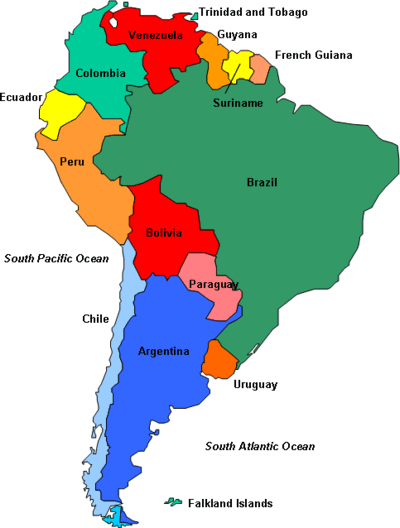
As the U.S. languishes, Chile posted a head-turning 15.2% yearly gain in GDP in March, and forecasts for the year are rising. Why can’t we do that here?
A year ago, Chile lay in rubble, victim of the world’s fifth most powerful earthquake. So Chile’s 15.2% growth is a big bounce from a bad setback.
But it shouldn’t be dismissed as an anomaly. It’s a showy number, but not the only one.
The same day Chile released its data, Goldman Sachs raised its 2011 growth forecast for the country to 6.4% from 6%. In its annual regional business index, Latin Business Chronicle ranked Chile as having the best business climate in Latin America in 2011.
Such numbers are so alien to the U.S. in the economically debilitated Obama era, it makes sense to look at what Chile has done.
First, Chile’s policies for long-term growth were put into effect in the 1980s by the group of Milton Friedman-inspired economists known as the Chicago Boys.
Under them, Chile’s pension privatization cost nothing and left the country with no net debt. The private funds now hold assets worth 90% of GNP ($185 billion) — capital used to develop the country. Already, Chile’s education and infrastructure are the best in Latin America as a result.
Second, there’s free trade, of which Chile is a global champion, signing at least 58 treaties to gain access to 2 billion customers.
That’s a big reason Chile is close to full employment and is scrambling to attract growth-hungry U.S. entrepreneurs — and getting them.
[…]Bamrud says Chile has been turning heads with investors the past year and a half because of its emphasis on improving its corporate environment, its tax regime and its economic freedom, all of which rate highly.
“Chile has always been held out as a model for Latin America, but the reality is … it’s now a model for the U.S.,” he said.
Corporate taxes are the second lowest in Latin America at 18%, behind Paraguay’s 10%. The Latin average is 28%.
Meanwhile, Goldman Sachs’ chief economist for Latin America, Alberto Ramos, says Chile has wisely fostered growth by reducing the size of government and not printing too much money.
In 2011, it cut government spending to 5% of GDP, or $700 million, more than its projected 5.5%. So GDP has room to grow 6.4%, rather than 6% as first estimated.
Chile is doing the exact opposite of the socialist Barack Obama. Chile is cutting government spending, removing tariffs, enacting free trade deals, and cutting corporate taxes. Businesses and investors are moving there, and there are not enough people to work at all the jobs that are being created. Meanwhile, in Venezuela, communist dictator Hugo Chavez just reported 0.6% gain in the last quarter of 2010.
May Day — socialists’ paean to class warfare — evokes memories of Soviet tanks in Red Square and leftist radicals rioting. But Chile celebrates the actual empowerment of workers.
May 1 marks the 30 years since Chile became the first nation to privatize its social security system. By turning workers into investors, the move solved an entitlement crisis much like the one America faces today.
“I like symbols, so I chose May Day as the birth date of Chile’s ‘ownership society’ that allowed every worker to become a small capitalist,” wrote Jose Pinera, former secretary of labor and social security and the architect of this pension revolution. He is now a senior fellow at the Cato Institute in Washington, D.C.
What he designed has succeeded beyond all expectations. Yet Congress remains reluctant to adopt anything like it, despite efforts by Presidents Bill Clinton and George W. Bush to partially privatize an American system.
Instead of paying a 12.4% Social Security tax as we do here, Chilean workers must pay in 10% of their wages (they can send up to 20%) to one of several conservatively managed and regulated pension funds. From the accumulated savings, they get a life annuity or make programmed withdrawals (inheriting any funds left over).
Over the last three decades these accounts have averaged annual returns of 9.23% above inflation. By contrast, U.S. Social Security pays a 1% to 2% (theoretical) return, and even less for new workers.
[…]In 2005, New York Times reporter John Tierney worked out his own Social Security contributions on the Chilean model and found that his privatized pension would have been $53,000 a year plus a one-time payout of $223,000. The same contributions paid into Social Security would have paid him $18,000.
The biggest threat to American solvency is the growth in entitlement spending on Medicare, Medicaid and Social Security. The Democrats are stubbornly opposed to reforming these benefits, because they like the idea of transferring wealth from children, who cannot vote, to people who depend on government hand-outs, who can vote. And the best part of their scheme is that young people can be easily indoctrinated by the public schools to believe that have their future mortgaged away to buy votes is a good idea. It’s really very sad and unfair to young people.

 WINTERY KNIGHT