
Tag Archives: University

Advice for Christian parents from a woman who left Christianity at university

If you want real confidence, try studying instead of yelling
If you want your children to accept Christianity, then apologetics is needed

This is from the Beyond Teachable Moments blog – a great blog for Christian parents who want to raise effective, influential children.

Intro:

I recently had the opportunity to meet an intelligent young Christian woman who is proactively learning how to discuss her faith in a secular society.

Why is she so dedicated to doing this?  Because her Christian upbringing had completely failed to prepare her for the challenges of secularism, religious pluralism and atheism at university.

This young woman grew up in close-knit, loving Christian home.  She faithfully attended church.  She was enrolled in a Christian school that taught subjects such as apologetics, hermeneutics, inductive Bible study and managing relationships.  Her parents cared about her spiritual formation.

And yet, this is how she describes her university experience:

“Although I was still living at home during the beginning of my freshman year, university was traumatic at best. I went from a class of 15 in a small Christian school, to 30,000 people at a public university.

The most troubling thing was the amount of differing beliefs and worldviews I encountered, from professors and other students. At the time I thought they had much better arguments than I did for the validity of their views.”

Added to her challenge was the fact that her faith was borrowed, not her own.

“I can honestly and sadly say that as I started my freshman year at age 19, my faith was very much borrowed. It was a set of rules to adhere too. Although I was well aware of the concept of a relationship with Jesus Christ, I did not have it. I was entrenched in the notion of conforming to what people wanted me to do in order to escape condemnation and judgment.”

“My faith at the university was non-existent. If you asked me what I believed I would say Christian, but I did not back that up with any action whatsoever.”

As a mom of two young boys, the top-of-mind question I had for her was: what did she wish she’d known before she went to university?

The rest of the post is her response, but I wanted to quote this part, because it reminds me of what Pastor Matt Rawlings posted about his own loss of faith a while back.

The mysterious Christian woman says this:

Don’t use me to make you look good in front of other people at church, I can see straight through that. It does not feel good and drives me far away. What matters is what is going on inside, not what is projected. Looking perfect and going through the motions does nothing. The very basis for Christianity is what is going on in the heart. Only by letting Jesus work in your heart can actions follow with true authenticity.

And here’s what Pastor Matt said:

Looking back, I had a very fuzzy understanding of the Gospel.  I (and I think many people who call themselves Christians) are what theologians call “semi-Pelagians.”  I believed anyone could come to the altar but if they wanted to continue to be welcomed in the pews, they had to clean up their act and do so almost overnight.  The culture of Christianity at large appeared to me to be that if you came to faith and continued to struggle with lust, a foul mouth or whatnot then there was just something wrong with you.  I felt the church was more about behavior modification than grace.

I needed someone who I knew loved me to sit down with me long before all of these problems arose, look me in the eye and tell me how easy and how difficult it is to be a Christian.  I needed someone cared for me to unpack 2 Corinthians 5:21 and point out that by being “in Christ” I would be judged by Christ’s perfect life instead of my own.  I needed to know that the faith is not about “keeping the rules” but about doing things and not doing certain things to show my love and gratitude to God for what He did for me.  I needed to be able to read the Bible, especially the Old Testament, in a way that always pointed to Jesus Christ.  I needed to understand that God has graciously given us the spiritual disciplines of fasting, prayer, serving the poor, worship, etc. to help me grow.  I needed to hear that all Christians struggle with sin and will, to a certain degree, until they go to be with the Lord or He returns to be with us.

I needed good theology, good spiritual practices, good apologetics and good relationships.  I needed  knowledge and it needed to come from someone who I knew loved me even though I was thoroughly unlovable.  You can’t just leave this to the church staff because they do not have to time to meet with everyone and people with a chip on their shoulder about the church (like I had) feel like they are just doing it as part of their job.  All young people in the church, especially the “troubled kids” need this.  It is a lot of work but anyone’s eternity is worth it, isn’t it?

As J.P. Moreland has pointed out, your beliefs are not something that you form by sheer acts of will. You cannot will to believe things. Your beliefs form naturally through study, and then outward actions come from those beliefs. You cannot focus on the outward actions of your children – you have to focus on the beliefs inside. And know that those beliefs are not formed by habit, singing, church attendance or any other non-cognitive approaches. Beliefs form through a careful study of the evidence on BOTH SIDES. The first thing that Christian parents should be showing their kids is debates with both sides represented. That shows them that there is more to a worldview than just being bullied into it by raising your voice at them.

Christian parents, take note. Don’t be focused on making your child behave nicely on the outside and making it impossible for them to talk about temptations and doubts.  Christianity comes from the inside – from the mind. You need to be helping them form a worldview that has been tested and approved by them, before they ever set foot on a university campus. The Christian faith is not adopted by habit or tradition, it is adopted by transferring knowledge and discussing opposing views openly and honestly.

Don’t be like this mother who is only focused on externals – what family and friends think of her:

The good news is that atheism is not generally adopted because of logic or evidence. That means that a little bit evidence for God’s existence goes a long way against no evidence. A little bit evidence for the reliability of the Bible goes a long way against no evidence. A little bit of the minimal facts case for the resurrection of Jesus goes a long way against no evidence. It’s very important that when your children get to university that they find a conflict between some evidence and no evidence. At that point, it becomes their choice to decide what to do, and it could go either way. You don’t have to make them William Lane Craig before they get to university, for example. But they should have at least read his popular-level essays and books, heard his podcasts, and seen him debate.

Peer pressure on a secular university is powerful – but if you’ve taught your children to value truth over popularity, vanity, selfishness and immorality, then you’ve done your job. Lots of people fall away from Christianity in university because of the hostile environment. Some fall away because they want to be approved of by their peers, some because they just want to be seen as tolerant or smart, some because they want to get good grades from liberal professors, some because they want to have a good time, etc. That’s not your concern. Your concern is to demonstrate your love of truth, and communicate to them  a sober assessment of the evidence pro and con on ultimate issues. After that, it’s up to them.
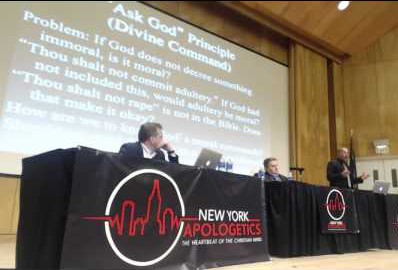
Frank Turek and Michael Shermer defend their debate to gay activists

Michael Shermer debates Frank Turek: atheism and morality

Remember how I blogged on the debate between Frank Turek and Michael Shermer a few days ago?

Well, apparently, a group of gay activists did not like the debate, and they complained – presumably in order to punish the debate organizers and shut down future debates.

Turek and Shermer have responded to their challenge, though, in this letter to the editor. And Shermer will even be on Turek’s radio show at 10 AM Eastern to discuss their joint response.

The show can be heard here on the Cross Examined web site.

CrossExamined Radio Program and Podcast

Listen to CrossExamined with Frank Turek on American Family Radio network

Saturday, 10-11 am Eastern on AFR network streaming audio and FM radio

Tune in to our weekly call-in radio program hosted by Frank Turek on American Family Radio network. Join Frank as he discusses challenging topics, takes calls from listeners, and interviews dynamic Christian apologists. Sponsored by CrossExamined.org, this apologetics program is both informative and entertaining!

If you miss the show, the podcast archive is here.

And here’s part of the joint letter:

It’s not often that an atheist and a Christian, who have just had a debate on campus, can be brought into agreement by a group in the audience. But the Graduate Queer Alliance (GQA) at Stony Brook University has managed to do that. Their letter to the editor on April 30 was so full of false assertions and totalitarian demands that we, Dr. Michael Shermer (an atheist) and Dr. Frank Turek (a Christian), felt compelled to write this letter together in response.

The central assertion of the GQA is that anyone who expresses a negative opinion of same sex marriage or homosexual behavior is guilty of “hate speech” and should be barred from speaking at Stony Brook University. The GQA says this while also claiming to believe “that a university should provide an open forum for controversial ideas to be discussed and debated.” We both wonder how the GQA can hold these two contradictory opinions at the same time. After all, they say they are for the debate of controversial issues, but apparently only if both debaters hold the same position and that position agrees with the GQA. Some debate!

How is disagreement over controversial moral and political issues “hate speech?” If it is then GQA’s position is “hate speech” because it disagrees with people who believe marriage should be defined in other ways. Calling people names or characterizing their arguments as “hate speech” is not good public discourse designed to discover the truth; it is bullying—the very thing GQA should be against.

If you remember my post, the clip I played had some back and forth on gay rights in it. I guess the GQA didn’t like hearing any ideas contrary to their own.

More:

The true motives of the GQA are revealed by what is not in the letter: the arguments made by Dr. Shermer in support of same sex marriage, arguments he made with great passion that elicited equal passion—on both sides of the issue—from the audience. If those in the GQA are so interested in advancing their position through sound reason and science—which was Dr. Shermer’s point—why would they not highlight the arguments offered in support of it? Instead, the GQA seems to think they have a right not to hear an opposing opinion lest they be challenged!

It’s a shame that those in GQA appear so uninterested in evidence.

Well, read the whole thing.

I think the letter from the gay activists and the response are particularly interesting, especially given what Dr. George Yancey said in his essay on educational dogma, which I talked about yesterday.

This:

For the dogmatic, ideas that violate the notions defended by education dogma are deemed “dangerous” and too much for the tender ears of our students. So in additional to shouting down speakers there have been calls for “trigger warnings” and “safe spaces” so that individuals do not have to listen to dangerous ideas. The true danger of these ideas is their threat to certain dogmatic beliefs of our students. These students are unwilling to consider the possibly that they are wrong, or perhaps not as right as they might believe. .

And:

For all practical purposes the students saw the speaker as a heretic. The use of the term heretic can bring up images of torturing, imprisoning and killing of those who disagree. This is not occurring. However, it is reasonable to ask whether the seemingly restraint of the students from such drastic actions is due to their moral compass or to the fact that they do not have the social power to engage in such actions. Education dogma has led to attempting to kick offending businesses off campus, attempts to fire professors, and the official “shunning” of students who hold the “wrong ideas.” Those with education dogma do punish those who violate their beliefs to the highest extent possible given their current level of institutional powers.

Dr. Yancey was talking about a different group of college leftists, but I think that’s exactly what’s going on here, too. For now, it’s shouting down and writing letters and getting people fired (which actually happened to Turek, before). But will they stop there?

Professor concerned by students who are unable to consider alternative views

This is a post by Dr. George Yancey, and he’s writing about the 5-minute video clip above.

Dr. Yancey writes:

Here is a great example of what I term education dogma. Note that the students are chanting about not being silenced while they are obviously silencing the speaker. My understanding of this situation is that the speaker published something that challenges some of the assertions about a campus rape culture. Such a challenge is an affront to the dogma of the students. Therefore, these students do not feel that the speaker has a right to speak on a different topic. The violation of beliefs they accept without question or doubt creates their incentive to shut down the proceedings.

[…]For the dogmatic, ideas that violate the notions defended by education dogma are deemed “dangerous” and too much for the tender ears of our students. So in additional to shouting down speakers there have been calls for “trigger warnings” and “safe spaces” so that individuals do not have to listen to dangerous ideas. The true danger of these ideas is their threat to certain dogmatic beliefs of our students. These students are unwilling to consider the possibly that they are wrong, or perhaps not as right as they might believe. .

[…]As I watch that video I did not see intellectual powerhouses but I symbolically saw individuals who were yelling nonsense with their hands over their ears so that they would not hear an idea that may confront their presuppositions about reality.

Here, Dr. Yancey compares the secular leftist students to religious fundamentalists: (links removed)

For all practical purposes the students saw the speaker as a heretic. The use of the term heretic can bring up images of torturing, imprisoning and killing of those who disagree. This is not occurring. However, it is reasonable to ask whether the seemingly restraint of the students from such drastic actions is due to their moral compass or to the fact that they do not have the social power to engage in such actions. Education dogma has led to attempting to kick offending businesses off campus, attempts to fire professors, and the official “shunning” of students who hold the “wrong ideas.” Those with education dogma do punish those who violate their beliefs to the highest extent possible given their current level of institutional powers.

So if the holding your hands over your ears and screaming doesn’t work, there is always calling the police, or using other means of coercion. Scary, especially when you consider the history of the secular left in communist countries where God is dead, and the state is all-powerful. How far would these leftist students go to silence people who disagreed with them?

More:

[…][H]igher education occurs in a specific social institution that promotes certain subcultural values and beliefs. Participants in these institutions are expected to accept these values and beliefs without question. These beliefs are not the result of gaining more facts but instead are the dogmatic adaptation of certain social values provided to them by this subculture.

The trouble here is that they don’t want more facts – that’s why they are holding their hands over their ears and screaming.

It makes me think of my own intellectual journey… the way I got started in apologetics in college was by reading transcripts of William Lane Craig debates that I found on the Leadership University web site. What was exciting was reading both sides and seeing what each person would say to respond. Would you go to a football game where only one side showed up? What if you already knew the score in advance, would you still go? What if one team didn’t play very hard, would that be worth watching? What makes intellectual inquiry fun and interesting is that two sides show up and play their best. Otherwise, it’s just brainwashing, not a search for truth. When I write a summary with a good atheist like Peter Millican, I actually feel like I have learned something – I have learned how far I can push each of my arguments, and what I need to study going forward. I care to learn more about what is discussed in a real debate.

This is the striking part of his essay:

Students are responsible for seeking out alternative perspectives and developing an attitude of inquiry allowing them to interrogate their own presuppositions. But their college and university teachers should be held to account since more than a few college professors have done a horrible job introducing critical thinking skills. These teachers come in with a certain set of assumptions and if students agree with those assumptions then they can leave college without any disturbance to their pre-college ideology. Then we have the gall to call that critical thinking. It is anything but critical thinking. It is confirmation thinking and we do our students a disservice with such an approach.

This is why I get so frustrated by non-STEM disciplines. I think those non-STEM areas are the places where what he described is most likely to happen. When you walk into a computer science classroom, you are there to learn something that you will be doing for money in a couple of years. You can go home and use what you just learned to write a sorting program, or improve the speed of your database queries, or write a mobile application and put it out for use. I just don’t get that feeling of usefulness from non-STEM disciplines, aside from maybe analytical philosophy, which is just computer science anyway (symbolic logic). The critical thinking in computer science comes from trying things yourself and seeing what works and doesn’t work in real life. Where is the testing against reality in non-STEM disciplines? There is none.

And then here is something hopeful for conservatives:

Ironically a conservative Christian Republican has a better opportunity to learn critical thinking in college than a progressive humanist Democrat because of the opportunity he/she gains to consider new ideas. When we allow students with certain perspectives to go through college without challenging them we not only promote dogma, we also do those students the disservice of never helping them to engage in the critical thinking necessary to intellectually grow. They are reduced to being a sounding board that regurgitated the latest expression of political correctness.

This is where all my hope lies. I really hope that the left educates itself into imbecility by refusing to consider different points of view, and that we conservatives are the ones who start to outperform them and take the high ground in the culture. To innovate, you have to do things better, and to do things better, you have to do things differently.

Read his whole essay.