
Tag Archives: Union

Veronique de Rugy debunks myths about public sector pension liabilities

From Reason magazine. (H/T Hyscience)

Bullet point summary:

Myth 1: Unfunded state pensions do not represent an immediate threat and are therefore not in crisis.
Fact 1: In the best case scenario, some state pension funds will run out as soon as 2017. And the longer the states wait to fully fund their pensions, the more drastic the financial consequences will be.

Myth 2: State debt accurately reflects state liabilities. And state default is not a concern because the federal government will bail the states out before they reach that point.
Fact 2: Many government pension liabilities are kept off the books, so most states and cities underestimate their actual debt.

Myth 3: State and local workers are not overpaid. And even if they are, changing their compensation won’t make a difference.
Fact 3: While this is a complex issue, the total compensation package for state workers does tend to exceed that of their private-sector counterparts.

Myth 4: The financial crisis, which caused a depreciation of pension assets, is the real culprit behind pension underfunding.
Fact 4:
While the recession dealt a severe blow to state pensions, the problem of pension underfunding dates back to the early 2000s. Many states had already failed to cover the cost of promised benefits even before they felt the full weight of the Great Recession.

And conclusion:

Here’s the bottom line: We can argue endlessly over when the pension plans will run out of cash, or what the true value of the unfunded liabilities is. We can even debate what the true meaning of being broke. But there is one issue where there is no room for debate. Once the pension plans run out of money, the payments will have to come out of general funds, meaning out of the pockets of taxpayers. If the states want to avoid this, they must push through reforms as soon as possible. A good first step would be to switch to accounting methods that show the true market value of their liabilities. Once those methods are in place, lawmakers should consider moving away from defined benefit pensions.

What states like Wisconsin and Ohio are doing is completely necessary. This is a real crisis, and we need to act now to make sure that taxpayers are not squeezed when the money runs out.
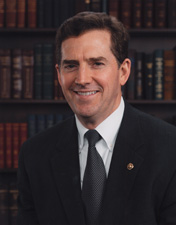
Republicans introduce national right-to-work legislation

Sen. James Demint

From the Hill.

Excerpt:

Eight Republican Senators introduced a bill Tuesday giving workers a choice as to whether to join labor unions, which they argue will boost the nation’s economy and provide an increase in wages.

Sen. Jim DeMint (R-S.C.), introduced the National Right to Work Act to “reduce workplace discrimination by protecting the free choice of individuals to form, join, or assist labor organizations, or to refrain from such activities,” according to a statement.

Seven other Republicans signed onto the effort: Sens. Tom Coburn (Okla.), Orrin Hatch (Utah), Mike Lee (Utah), Rand Paul (Ky.), James Risch (Idaho), Pat Toomey (Pa.) and David Vitter (La.).

“Facing a steady decline in membership, unions have turned to strong-arm political tactics to make forced unionization the default position of every American worker, even if they don’t want it,” Hatch said. “This is simply unacceptable. At the very least, it should be the policy of the U.S. government to ensure that no employee will be forced to join a union in order to get or keep their job.

“Republicans cited a recent poll they said shows that 80 percent of union members support having their policy and that “Right to Work” states outperform “forced-union” states in factors that affect worker well being.

From 2000 to 2008, about 4.7 million Americans moved from forced-union to right to work states and a recent study found that there is “a very strong and highly statistically significant relationship between right-to-work laws and economic growth,” and that from 1977 to 2007, right-to-work states experienced a 23 percent faster growth in per capita income than states with forced unionization.

“To see the negative impacts of forced unionization, look no further than the struggling businesses in states whose laws allow it,” Vitter said. “It can’t be a coincidence that right-to-work states have on balance grown in population over the last 10 years, arguably at the expense of heavy union-favoring states.”

DeMint blamed the problems faced by U.S. automakers on the unions.

“Forced-unionism helped lead to GM and Chrysler’s near bankruptcy and their requests for government bailouts as they struggled to compete in a global marketplace,” he said. “When American businesses suffer because of these anti-worker laws, jobs and investment are driven overseas.”

If you want to attract businesses, then you need to have pro-business laws. That’s where jobs come from – businesses.

Here’s an article about states who are trying to pass these laws to attract more employers.

Excerpt:

Currently 14 states beyond Indiana and Wisconsin are considering legislation that would limit union benefits and/or collective bargaining power. They are: Alaska, Hawaii, Maine, Michigan, Minnesota, Missouri, Montana, New Hampshire, New Mexico, Ohio, Pennsylvania, Virginia, Washington (state) and West Virginia. In any number of these states, supporters have planned or held rallies against the measures. But public support might be less than deep. According to a Rasmussen Poll conducted late last week and released Monday, 48 percent of likely U.S. voters sided with Wisconsin Governor Walker whereas only 38 percent sided with his union opponents; the other 14 percent were undecided. And 50 percent of the respondents favored reducing their home state’s government payroll by one percent a year for 10 years either by reducing the work force or reducing their pay. Only 28 percent opposed such action.

This is how we are going to turn the recession around. Cut off the spending on left-wing special interests – NPR, PBS, ACORN, Planned Parenthood, Unions. They all will have to pay their own way, just like the grown-ups do.

How much influence do labor unions have in the Democrat party?

I found this amazing Milwaukee Journel-Sentinel article on Marathon Pundit’s blog. It explains where the political contributions of the biggest unions go. Let’s take a look at a few of the unions.

Excerpt:

• National Education Association. Membership: 3.2 million; assets: $216 million. The NEA, representing most of the nation’s teachers, has 31 headquarters officers and employees who earn more than $200,000 in pay and benefits. The president, Dennis Van Roekel, received $397,721 in salary and benefits. Of the $3.7 million NEA spent on political activities in the last election cycle, 98% went to Democratic candidates. The NEA has 98,000 members in Wisconsin.

• Service Employees International Union. Membership: 1.8 million; assets: $187 million. The SEIU, whose membership has increased in recent years, has been organizing hospital, home care and nursing home workers, along with local and state government employees, janitors and security officers. The union has nine headquarters officers and employees who earn more than $200,000. The former president, Andy Stern, was paid $306,388 in salary and benefits from the union in 2009. Stern resigned in 2010 and was replaced by Mary Kay Henry, formerly the executive vice president. Over the past two years, SEIU gave almost $2 million to Democratic candidates and $8,500 to Republicans. It has 18,000 members in Wisconsin.

• United Food & Commercial Workers. Membership: 1.3 million; assets: $157 million. The UFCW, whose members work in meatpacking, food processing and retail grocery stores, has 17 headquarters officers and employees who earn more than $200,000. The president, Joseph T. Hansen, received $360,737 in compensation in 2009. Of the $1.9 million the union donated to political candidates over the past two years, 99% of it went to Democrats.

• International Brotherhood of Teamsters: Membership: 1.3 million; assets: $175 million. The Teamsters, whose origins date to the horse- and mule-team drivers of the late 1800s, represent truck drivers and a wide array of blue-collar and government workers. Eight headquarters officers and employees received more than $200,000 in 2009. The president, James P. Hoffa, was compensated $364,869. Over the past two years, the Teamsters have donated $2.3 million to Democratic candidates and $46,500 to Republicans.

• American Federation of State, County & Municipal Employees. Membership: 1.5 million; assets: $78 million. AFSCME, one of the fastest growing unions in the United States, was founded in Wisconsin almost 80 years ago. At union headquarters in Washington, 10 officers and employees receive more than $200,000 a year. McEntee was paid $479,328 in salary and benefits in 2009. Over the past two years, AFSCME has donated $2.3 million to Democratic candidates and $78,500 to Republicans.

Emphasis is from Marathon Pundit. The Democrat party is basically owned lock, stock and barrel by the unions.