
Tag Archives: Unborn

If unborn babies don’t have consciousness or don’t feel pain, may we kill them?

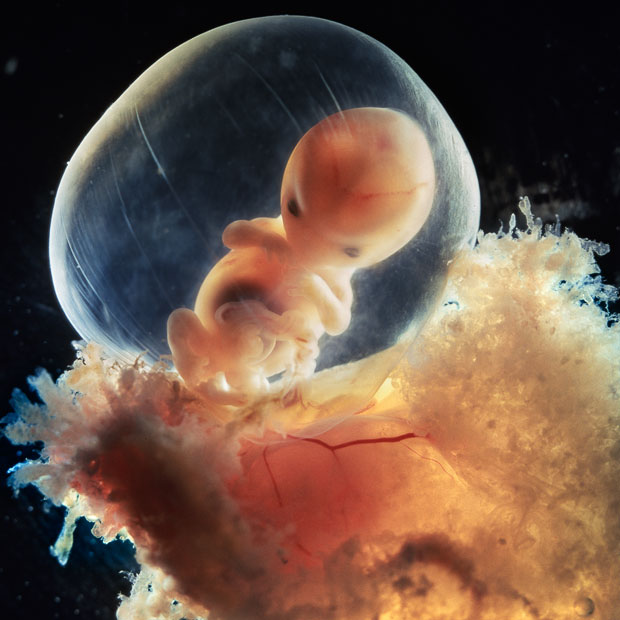
Unborn baby scheming about pro-life apologetics

Was having a conversation by e-mail yesterday with a pro-abortion atheist, and he gave two reasons why he supported abortion in the first and second trimester. First, he said that unborn babies can’t feel pain, so it’s OK to kill them. Second, he said that unborn babies don’t have consciousness, so it’s OK to kill them. I thought it might be useful to link to something that answers both of these objections.

Frank Beckwith is the author of “Defending Life: A Moral and Legal Case Against Abortion Choice“. He wrote that book for Cambridge University Press, a top academic press. But before Cambridge University Press, Beckwith wrote four easy-to-understand essays for the Christian Research Journal. Part IV is the one that has the response to the two questions raised by my atheist friend.

Part I. The Appeal to Pity

Part II. Arguments from Pity, Tolerance, and Ad Hominem

Part III. Is The Unborn Human Less Than Human?

Part IV. When Does a Human Become a Person?

Excerpt:

Some ethicists argue that the unborn becomes fully human sometime after brain development has begun, when it becomes sentient: capable of experiencing sensations such as pain. The reason for choosing sentience as the criterion is that a being that cannot experience anything (i.e., a presentient unborn entity) cannot be harmed. Of course, if this position is correct, then the unborn becomes fully human probably during the second trimester and at least by the third trimester. Therefore, one does not violate anyone’s rights when one aborts a nonsentient unborn entity. [13]

There are several problems with this argument. First, it confuses harm with hurt and the experience of harm with the reality of harm. [14] One can be harmed without experiencing the hurt that sometimes follows from that harm, and which we often mistake for the harm itself. For example, a temporarily comatose person who is suffocated to death “experiences no harm,” but he is nevertheless harmed. Hence, one does not have to experience harm, which is sometimes manifested in hurt, in order to be truly harmed.

Second, if sentience is the criterion of full humanness, then the reversibly comatose, the momentarily unconscious, and the sleeping would all have to be declared nonpersons. Like the presentient unborn, these individuals are all at the moment nonsentient though they have the natural inherent capacity to be sentient. Yet to countenance their executions would be morally reprehensible. Therefore, one cannot countenance the execution of some unborn entities simply because they are not currently sentient.

Someone may reply that while these objections make important points, there is a problem of false analogy in the second objection: the reversibly comatose, the momentarily unconscious, and the sleeping once functioned as sentient beings, though they are now in a temporary state of nonsentience. The presentient unborn, on the other hand, were never sentient. Hence, one is fully human if one was sentient “in the past” and will probably become sentient again in the future, but this cannot be said of the presentient unborn.

There are at least three problems with this response. First, to claim that a person can be sentient, become nonsentient, and then return to sentience is to assume there is some underlying personal unity to this individual that enables us to say that the person who has returned to sentience is the same person who was sentient prior to becoming nonsentient. But this would mean that sentience is not a necessary condition for personhood. (Neither is it a sufficient condition, for that matter, since nonhuman animals are sentient.) Consequently, it does not make sense to say that a person comes into existence when sentience arises, but it does make sense to say that a fully human entity is a person who has the natural inherent capacity to give rise to sentience. A presentient unborn human entity does have this capacity. Therefore, an ordinary unborn human entity is a person, and hence, fully human.

Second, Ray points out that this attempt to exclude many of the unborn from the class of the fully human is “ad hoc and counterintuitive.” He asks us to “consider the treatment of comatose patients. We would not discriminate against one merely for rarely or never having been sentient in the past while another otherwise comparable patient had been sentient….In such cases, potential counts for everything.” [15]

Third, why should sentience “in the past” be the decisive factor in deciding whether an entity is fully human when the presentient human being “is one with a natural, inherent capacity for performing personal acts?” [16] Since we have already seen that one does not have to experience harm in order to be harmed, it seems more consistent with our moral sensibilities to assert that what makes it wrong to kill the reversibly comatose, the sleeping, the momentarily unconscious, and the presentient unborn is that they all possess the natural inherent capacity to perform personal acts. And what makes it morally right to kill plants and to pull the plug on the respirator-dependent brain dead, who were sentient “in the past,” is that their deaths cannot deprive them of their natural inherent capacity to function as persons, since they do not possess such a capacity.

These four essays are a very good introduction to common responses to pro-abortion arguments. I recommend that people get familiar with this, as once you look into it, you will see that the abortion issue can be debated with as much confidence as William Lane Craig defends Christian theism. You will have the same access to scientific evidence and rational arguments on this topic, and so you will have the upper hand. And that’s fun.

The best introductory book on the abortion / right to life issue is “The Case for Life” by pro-life debater Scott Klusendorf. The best comprehensive book is a tie between “The Ethics of Abortion” by Christopher Kaczor, and Frank Beckwith’s “Defending Life: A Moral and Legal Case Against Abortion Choice“.
Democrats defeat bill to ban abortions of babies who can feel pain

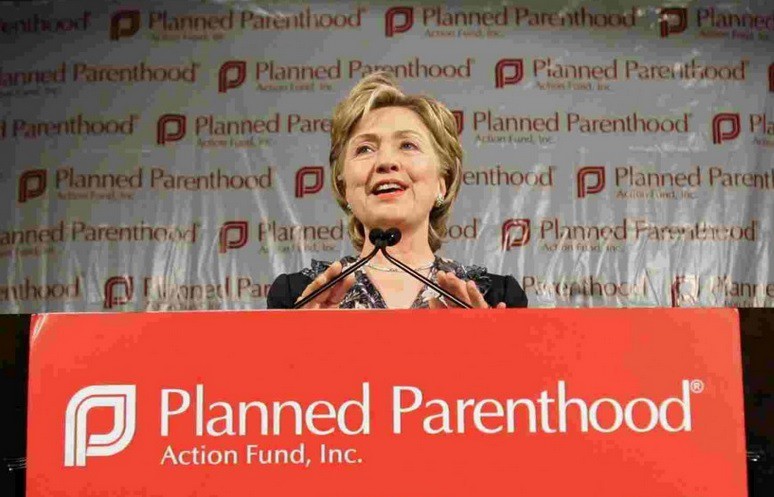
Hillary Clinton and Planned Parenthood

Well, even with all the attention to the for-profit organ harvesting of born-alive babies, the Democrats went ahead and voted against a bill to stop late-term abortions in the Senate.

Life News has the story.

Senate Democrats today blocked a vote on a pro-life Senate bill to ban late-term abortions — a bill that would save as many as 18,000 unborn babies form abortions each and every year.

The Senate voted today to stop the Democrats’ filibuster of the Pain Capable Unborn Child Protection Act, legislation that would ban abortions after 20 weeks — as neither Congress nor state legislatures can vote to ban all abortions under Roe v. Wade. The bill highlights how unborn babies feel intense pain when they are killed in abortions. The vote comes at a time when 10 expose’ videos have exposed the Planned Parenthood abrogation business selling aborted babies and their body parts.

“What I am asking every colleague is this: look in your hearts and help us stand up for the most innocent life,” said Senate Republican Majority Leader Mitch McConnell in advance of the vote.

But Democrats defeated the cloture vote 54-42, with pro-life Senate Republicans not getting the 60 votes needed to end debate and proceed to a vote on the pro-life bill itself. Three Democrats joined with Republicans to support the pro-life bill, including Joe Manchin of West Virginia, Bob Casey of Pennsylvania and Joe Donnelly of Indiana. Two pro-abortion republican, Susan Collins of Maine and Mark Kirk of Illinois — voted with Democrats to support late-term abortions.

[…]Had the Senate approved the bill, President Barack Obama has issued a veto threat. But pro-life groups hope to use the measure as an election tool in 2016 in an attempt to wrest control of the White House and approve a pro-life president who will sign it into law.

Now, I’ve written before about the science that shows that babies after 20 weeks can feel the pain of being torn limb from limb. And I also wrote about how babies as young as 22 weeks could survive outside the womb (“viable”). And that evidence was presented to Senate Democrats as part of the vote.

More:

“Fresh impetus for the bill came from a huge study of nearly 5,000 babies—preemies—published last week in the New England Journal of Medicine. The next day, a New York Times article titled: “Premature Babies May Survive at 22 Weeks if Treated” touted the Journal’s extraordinary findings of survival and hope,” Congressman Smith continued. “Thus the babies we seek to protect from harm today may survive if treated humanely, with expertise and compassion—not the cruelty of the abortion.”

A similar bill in the House did pass, even though almost all the Democrats voted against it, simply because so many Republicans were elected in the 2014 mid-term elections. And yet in the Senate, we were not able to elect enough Republicans to pass the  bill. The article notes that the Senate bill was modeled after similar measures that have been passed in 12 states where Republicans control the legislatures.

Here’s what a baby is like at 20 weeks

You are 20 weeks pregnant. (fetal age 18 weeks)

  • Baby now weighs about 11 ounces and is roughly 7 inches long.
  • Baby is 17 cm long crown to rump, and weighs about 310 grams.
  • The baby can hear and recognize the mother’s voice.
  • The mother will probably start feeling the first fetal movements.
  • The toenails and fingernails are growing.
  • The growth of hair on the rest of the body has started.
  • The skin is getting thicker.
  • The heart can now be heard with a stethoscope.

Your baby may react to loud sounds. Baby can actually hear noises outside of the womb. Familiar voices, music, and sounds that baby becomes accustomed to during their development stages often are calming after birth. This is an important time for sensory development since nerve cells serving each of the senses; taste, smell, hearing, sight, and touch are now developing into their specialized area of the brain.

Your baby now weighs about 11 ounces and at roughly 7 inches long they are filling up more and more of the womb. Though still small and fragile, the baby is growing rapidly and could possibly survive if born at this stage.

I understand why Democrats would vote to allow abortions on unborn children at this age. The abortionists make money off of these procedures, and they make more money off of the sale of organs, sometimes cut from babies who are still alive. Some of that money makes it’s way back to the Democrats in the form of political contributions. It’s similar to the way that slavers made money off of slaves… except they didn’t torture the slaves and cut the organs out of them to sell. I guess someone standing in a slave plantation might have said to a slaver “you can’t do that, they can feel pain”. And Republicans are standing outside abortion clinics and saying “you can’t do that, they can feel pain”. But in both cases, the slavers and the abortionists are making money from their barbarism. So it doesn’t make a difference to them whether they unborn can feel pain. The important thing to them is that they are making money.

Democrats are the heirs to the practice of slavery. They think that it’s fine to declare an entire category of humans as non-persons and then chop them up like firewood to sell. And since most people who vote Democrat do so because they are voting to get more and more of their neighbor’s money, none of this slavery is a concern to them. They care about getting their neighbor’s money without having to earn it. That’s what a Democrat is.

Does Planned Parenthood do mammograms? Is abortion only 3% of their services?

Hillary Clinton and Planned Parenthood

Life Site News explains the myth and the reality.

Excerpt:

The day before hundreds of pro-life activists prepared to flood Planned Parenthood’s offices with requests to schedule a mammogram, the organization issued a statement admitting that they do not offer the cancer screening procedure at any of their facilities.

The calls were placed today as part of “Call Planned Parenthood to Schedule Your Imaginary Mammogram Day” – an event organized by pro-life activists in response to President Obama’s statement during the presidential debate Tuesday that the abortion organization offers mammograms.

“There are millions of women all across the country, who rely on Planned Parenthood for, not just contraceptive care, they rely on it for mammograms, for cervical cancer screenings,” the president had said, repeating a claim he had made earlier this summer in an interview with Glamour magazine.

But Obama isn’t the only one.

The notion that Planned Parenthood offers mammograms is one of the most enduring myths about the abortion giant. The claim is regularly trotted out by pro-abortion politicians eager to defend taxpayer funding for Planned Parenthood, but wary of invoking its controversial status as the country’s leading provider of abortions.

Not only does Planned Parenthood not provide mammograms, but the abortions they perform have been linked to the epidemic of breast cancer that is afflicting women today.

What about the claim that only 3% of what Planned Parenthood does is doing abortions?

False:

Practically every defender of the organization, fighting to preserve its federal funding, reverts to the 3 percent figure. How could you possibly, they ask, defund a group that devotes itself overwhelmingly to uncontroversial procedures and services for women?

[…]The 3 percent factoid is crafted to obscure the reality of Planned Parenthood’s business. The group performs about 330,000 abortions a year, or roughly 30 percent of all the abortions in the country. By its own accounting in its 2013–2014 annual report, it provides about as many abortions as Pap tests (380,000). The group does more breast exams and provides more breast-care services (490,000), but not by that much.

The 3 percent figure is derived by counting abortion as just another service like much less consequential services. So abortion is considered a service no different than a pregnancy test (1.1 million), even though a box with two pregnancy tests can be procured from the local drugstore for less than $10.

By Planned Parenthood’s math, a woman who gets an abortion but also a pregnancy test, an STD test, and some contraceptives has received four services, and only 25 percent of them are abortion. This is a little like performing an abortion and giving a woman an aspirin, and saying only half of what you do is abortion.

Such cracked reasoning could be used to obscure the purpose of any organization. The sponsors of the New York City Marathon could count each small cup of water they hand out (some 2 million cups, compared with 45,000 runners) and say they are mainly in the hydration business. Or Major League Baseball teams could say that they sell about 20 million hot dogs and play 2,430 games in a season, so baseball is only .012 percent of what they do.

Supporters of Planned Parenthood want to use its health services as leverage to preserve its abortions, as if you can’t get one without the other. Of course, this is nonsense. The Centers for Disease Control and Prevention provides free or low-cost breast- and cervical-cancer screenings — without aborting babies. State health departments provide free cancer screenings — without aborting babies. Community health centers provide a range of medical services — without aborting babies.

I think it’s a good idea to be able to respond to Planned Parenthood’s rhetoric. These are the people who kill babies, and we have to be able to respond to their false claims. When a majority of people learn the truth about the baby killing business, it will stop.

Related posts