
Tag Archives: Tolerance

Simon Brace on the nature of spiritual warfare and a plea to the Church

This passionate, challenging lecture has been getting shared a lot on Facebook, so I thought that I would do a summary of it.

First, you can grab the MP3 file here.

Note that this talk is given by a very conservative evangelical Christian who is speaking to Christians. So this is not intended for a non-Christian audience. However, non-Christians are free to tune in if you want to hear a really passionate, fire-breathing conservative evangelical go non-linear over the superficial turn that the evangelical church has taken. If you are familiar with J.P. Moreland’s view that spiritual warfare is really about disputing speculations and falsehoods using logic and evidence, then you’ll know the meaning of the term “spiritual warfare” he has in mind. When he says spiritual warfare, he means apologetics: knowledge and preparation.

I would really caution you not to listen to this if you are not passionate about defending God’s honor. It will overwhelm and upset you. Having said that, this lecture reflects my convictions about the churches need to drop anti-intellectualism and take up apologetics. And not pre-suppositional apologetics, which I think is ineffective, but evidential apologetics. Evidential apologetics is effective, which is why everyone in the Bible used it.

About the speaker:

Simon Brace is the Director of Evangelism of Southern Evangelical Seminary. Simon was born in Zimbabwe and grew up in South Africa. Simon has a construction background and has lived in a number of countries and travelled extensively. He has a MA in Apologetics and BA in Religious Studies and is currently working on an MA in Philosophy at SES. Simon leads TEAM which is the missions program of SES on local, national, and international trips. In addition, Simon has worked with Ratio Christi at SES, and has an extensive knowledge of Ratio Christi’s history and operation. Simon currently resides in North Carolina with his wife Nel and children, Eva and Olivia.

I liked the second part of the lecture more than the first part, so there is less summarizing of the first part.

Topics:

  • What does the New Testament say about spiritual warfare in Ephesians?
  • Christian slogans about spiritual warfare sound pious, but they are mistaken
  • Today, Christianity is focused on piety and zeal, not on study and knowledge
  • The result is that Christianity in the West is in a state of erosion and decline
  • What we are doing about spiritual warfare is not working to stop the decline
  • Preaching, publishing, programs, retreats, etc. are not very useful for spiritual warfare
  • Enthusiasm and passion without knowledge  are not very useful for spiritual warfare
  • The Church has a theoretical understanding of spiritual warfare, but no real capability
  • Doesn’t work: trying to make Christianity seem popular and cool
  • Doesn’t work: making Christian music and art that non-Christians will like
  • Doesn’t work: pastors trying to be relevant by having cool clothes and cool haircuts
  • Doesn’t work: fundamentalists getting angry about peripheral issues
  • Doesn’t work: not read things apart from the Bible and sound foolish when speaking in the public square
  • Doesn’t work: church leaders think that careful exegesis and expository preaching is a good answer to skeptics
  • What works: we need to train people who are prepared and willing to defend the truth of the Christian faith
  • Evangelicalism has a deep suspicion of reading things outside the Bible, so they are unable to refute anything
  • Evangelicals are hyper-spiritualized and hysterical, focusing on demons, prophecy and end-times, etc.
  • Evangelicals have a pagan view of using their minds to alter reality, which is irrational and superstitious
  • Evangelicals like conservative celebrity preachers who do nothing to correct anti-intellectualism in the church
  • Evangelicals are focused on their personal relationships with Jesus instead of their whole worldview
  • Evangelicals focus too much on homeschooling and not enough on how to impact the secular universities
  • Church programs for youth are about “strumming guitars and eating pizza once a week”, not apologetics
  • Evangelicals have an over-inflated view of the effectiveness of their (non-intellectual) evangelism methods
  • The primary focus and primary responsibility in spiritual warfare is not dealing with supernatural evil
  • The real focus and responsibility in spiritual warfare is specified in 2 Cor 10:3-5
  • What we ought to be doing is defeating speculations (false ideas), using logical arguments and evidence
  • Defending the faith is not memorizing Bible verses and throwing them out randomly
  • Defending the faith is not just preaching the gospel
  • Demolishing an argument requires understanding arguments: premises, conclusions, the laws of logic
  • We should exchange our pious Bible memorizing skills and the like for a class in critical thinking
  • The New Testament requires that elders be capable of refuting those who oppose sound doctrine (Titus 1:9)
  • It is not enough to preach a good sermon, elders have to be able to defend the Christian faith as well
  • People who run conservative seminaries do not mandate that M.Div graduates study apologetics
  • Famous pastors like Driscoll, Begg, etc. need to teach other pastors to emphasize apologetics in church
  • People in church won’t engage the culture unless they have reasons and evidence to believe Christianity is true
  • We need a balance of both piety and intellectual engagement
  • We need to make our evangelism rooted in the intellect in order to have an influence at the university
  • Mission organizations also have a responsibility to defend the faith and not merely preach (1 Peter 3:15)

And here is his closing quote from C.S. Lewis:

To be ignorant and simple now not to be able to meet the enemies on their own ground would be to throw down our weapons and to betray our uneducated brethren who have, under God, no defense but us against the intellectual attacks of the heathen. Good philosophy must exist, if for no other reason, because bad philosophy needs to be answered.

I was really humbled by this, because I sort of knew that the church was anti-intellectual, but I didn’t really reflect on how everyone else in society thinks that we are anti-intellectual. It’s troubling. The quickest way to make Biblical Christianity respectable again is to hit the books and defeat all comers in intellectual disputations. Are we ready to make the sacrifices to do that?

UPDATE: A friend of mine who blogs at Think Apologetics has written a post on this same issue of anti-intellectualism in the church.
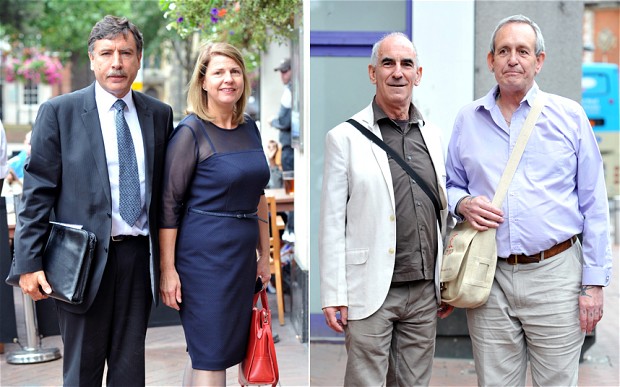
Bed and Breakfast owners forced to sell hotel after harassment by gay activists

Gay rights vs religious liberty

The Blaze reports.

Christian bed and breakfast owners who once famously refused service to a gay couple in the U.K. now claim that they’ve been forced to sell their hotel following a contentious legal battle andongoing harassment.

Hazelmary and Peter Bull insist that they have been the victims of vandalism, death threats and website attacks since the 2008 incident. As a result, in addition to the impending loss of the Chymorvah Hotel in Marazion, Cornwall, England, the couple has also grappled with intense anger from their ideological opponents.

Since denying a room to Martyn Hall and Steven Preddy, a gay couple, they have been forced to pay for legal representation and to compensate Hall and Preddy, all-the-while attracting fewer guests as a result of their stance on homosexuality (the hotel only allows married adults to share a bed).

“We were optimistic in the spring. Why wouldn’t we be with the summer ahead of us?,” Hazelmarytold the Daily Mail. “We have had a better summer than we thought but nowhere near good enough to pay our way. We were not even half-full. We must have been the only place in west Cornwall that had rooms left.”

[…]In an interview with the outlet, the Bulls said that they also had a dead rabbit nailed to their fence and that someone even removed the bolts from the tires on their car. They have also reportedly encountered death threats.

The Blaze also had an article about the Oregon couple who had to sell their bakery because of harassment by gay activists.

Excerpt:

But the harassment has also come in some very eerie forms, Melissa claims. In the early morning hours on Monday, the baker claims that someone broke into the Sweet Cakes truck, a vehicle the family uses to advance its business. The truck was parked in the Kleins’ driveway. This was particularly nerve-wrecking for Melissa and Aaron, astheir home, where the truck was located, is in a highly secluded area — one that is nowhere near where their former shop.

“Somebody came up into our driveway and rummaged through our truck and took stuff out,” she said. “The really strange thing is, they didn’t steal anything, they just made a mess. It kind of was a little creepy.”

The culprit didn’t take any money, she said, which was also odd, as the truck contained cash. While she’s definitely shaken by the incident, Melissa said that she feels safe, as her husband is a hunter who is trained to use a firearm. When he’s home, she’s fine, but when Aaron is out of the house, Melissa admitted that she does get a little scared.

In addition to losing their business, the Klein family has been impacted in other ways. Their children are now homeschooled — a decision that Melissa said she made this year following the media firestorm that erupted. And in light of the bakery’s closure, Aaron has gone back to work to help provide for the family.

The harassing e-mails haven’t stopped either. Melisa shared just a few of the messages she has received of late:

  • One message with the subject line “racist maggots” read, “People like you will burn in HELL, you racist pigs.“
  • Another read, “Your homophobic rants will not be forgotten and you will go out of business. This is the 21st century, a**holes.”
  • And another: “Do everyone a favor and fall off a cliff.”
  • One individual made it very personal: “Honey it would take a lot to make your ugly a** look good! You are ugly inside and out!”
  • And finally: “Maybe your god will send you some cat food to eat when you are living on the street?”

And those are just a few of the messages received over the past few days. Negative social media comments, too, have abounded.

This is what happens when cultural elites push the idea that their is only one side to the gay marriage debate. It probably doesn’t help that most Christians have not bothered to prepare a secular case against policies that we disagree with.  It’s very easy for the secular left to dehumanize their opponents when they think that our position is based on religion only. We have to find arguments that appeal to moral non-Christians in order to build a coalition that will defend basic human rights from gay activists.

Pro-gay web site “The Advocate” tells real story of the Matthew Shepard murder

A fascinating article the radically pro-gay The Advocate.

Excerpt:

What if nearly everything you thought you knew about Matthew Shepard’s murder was wrong? What if our most fiercely held convictions about the circumstances of that fatal night of October 6, 1998, have obscured other, more critical, aspects of the case? How do people sold on one version of history react to being told that facts are slippery — that thinking of Shepard’s murder as a hate crime does not mean it was a hate crime? And how does it color our understanding of such a crime if the perpetrator and victim not only knew each other but also had sex together, bought drugs from one another, and partied together?

None of this is idle speculation; it’s the fruit of years of dogged investigation by journalist Stephen Jimenez, himself gay. In the course of his reporting, Jimenez interviewed over 100 subjects, including friends of Shepard and of his convicted killers, Aaron McKinney and Russell Henderson, as well as the killers themselves (though by the book’s end you may have more questions than answers about the extent of Henderson’s complicity).  In the process, he amassed enough anecdotal evidence to build a persuasive case that Shepard’s sexuality was, if not incidental, certainly less central than popular consensus has lead us to believe.

And here are the details:

But in what circumstances does someone slam a seven-inch gun barrel into their victim’s head so violently as to crush his brain stem? That’s not just flipping out, that’s psychotic — literally psychotic, to anyone familiar with the long-term effects of methamphetamine. In court, both the prosecutor and the plaintiffs had compelling reasons to ignore this thread, but for Jimenez it is the central context for understanding not only the brutality of the crime but the milieu in which both Shepard and McKinney lived and operated.

By several accounts, McKinney had been on a meth bender for five days prior to the murder, and spent much of October 6 trying to find more drugs. By the evening he was so wound up that he attacked three other men in addition to Shepard. Even Cal Rerucha, the prosecutor who had pushed for the death sentence for McKinney and Henderson, would later concede on ABC’s 20/20 that “it was a murder that was driven by drugs.”
No one was talking much about meth abuse in 1998, though it was rapidly establishing itself in small-town America, as well as in metropolitan gay clubs, where it would leave a catastrophic legacy. In Wyoming in the late 1990s, eighth graders were using meth at a higher rate than 12th graders nationwide. It’s hardly surprising to learn from Jimenez that Shepard was also a routine drug user, and — according to some of his friends — an experienced dealer. (Although there is no real evidence for supposing that Shepard was using drugs himself on the night of his murder).

Despite the many interviews, Jimenez does not entirely resolve the true nature of McKinney’s relationship to Shepard, partly because of his unreliable chief witness. McKinney presents himself as a “straight hustler” turning tricks for money or drugs, but others characterize him as bisexual. A former lover of Shepard’s confirms that Shepard and McKinney had sex while doing drugs in the back of a limo owned by a shady Laramie figure, Doc O’Connor. Another subject, Elaine Baker, tells Jimenez that Shepard and McKinney were friends who had been in sexual threesome with O’Connor. A manager of a gay bar in Denver recalls seeing photos of McKinney and Henderson in the papers and recognizing them as patrons of his bar. He recounts his shock at realizing “these guys who killed that kid came from inside our own community.”

Not everyone is interested in hearing these alternative theories. When 20/20 engaged Jimenez to work on a segment revisiting the case in 2004, GLAAD bridled at what the organization saw as an attempt to undermine the notion that anti-gay bias was a factor; Moises Kaufman, the director and co-writer of The Laramie Project, denounced it as “terrible journalism,” though the segment went on to win an award from the Writers Guild of America for best news analysis of the year.

There are valuable reasons for telling certain stories in a certain way at pivotal times, but that doesn’t mean we have to hold on to them once they’ve outlived their usefulness. In his book, Flagrant Conduct, Dale Carpenter, a professor at the University of Minnesota Law School, similarly unpicks the notorious case of Lawrence v. Texas, in which the arrest of two men for having sex in their own bedroom became a vehicle for affirming the right of gay couples to have consensual sex in private. Except that the two men were not having sex, and were not even a couple. Yet this non-story, carefully edited and taken all the way to the Supreme Court, changed America.

In different ways, the Shepard story we’ve come to embrace was just as necessary for shaping the history of gay rights as Lawrence v. Texas; it galvanized a generation of LGBT youth and stung lawmakers into action. President Obama, who signed the Hate Crimes Prevention Act, named for Shepard and James Byrd Jr., into law on October 28, 2009, credited Judy Shepard for making him “passionate” about LGBT equality.

I think that it’s good that The Advocate posted this correction to the story. I admire them for being willing to tell the truth about the story. However, note that the author is not sorry that a fake version of the case was used to push the gay agenda forward. Now what if the same willingness to twist the truth was shared by the gay activists who are redefining the issues in the culture as a whole? What if the people who are pushing the gay agenda in schools, in the media, in the workplace, and elsewhere, had the same willingness to twist the truth in order to advance their cause?

It’s also helpful to understand the media bias angle of this story. Are they really interested in telling the truth? Or is there something else going on there? How much of a story was the attack on the Family Research Council building by a gun-wielding gay activist compared to the Matthew Shepard story? How much of a story is the persecution of Christians in the Middle East compared to the Matthew Shepard story? How much of a story is the loss of basic human rights like free speech and religious liberty here at home when compared to the Matthew Shepard story?

UPDATE: Mysterious Jack sends me this link from Breitbart News that has more about what really happened to Matthew Shepard.